Artificial intelligence (AI) is transforming core enterprise operations, but many organizations struggle to prioritize investments for measurable returns. The real value of AI lies in moving beyond basic automation to drive complex outcomes, from instant document summarization to accelerated compliance review.
This guide will help you choose the best AI use cases for your business.
Whether you’re a social media professional or a member of a data analytics team or any other role, you can benefit from AI business use cases. Here are 17 options to get started.
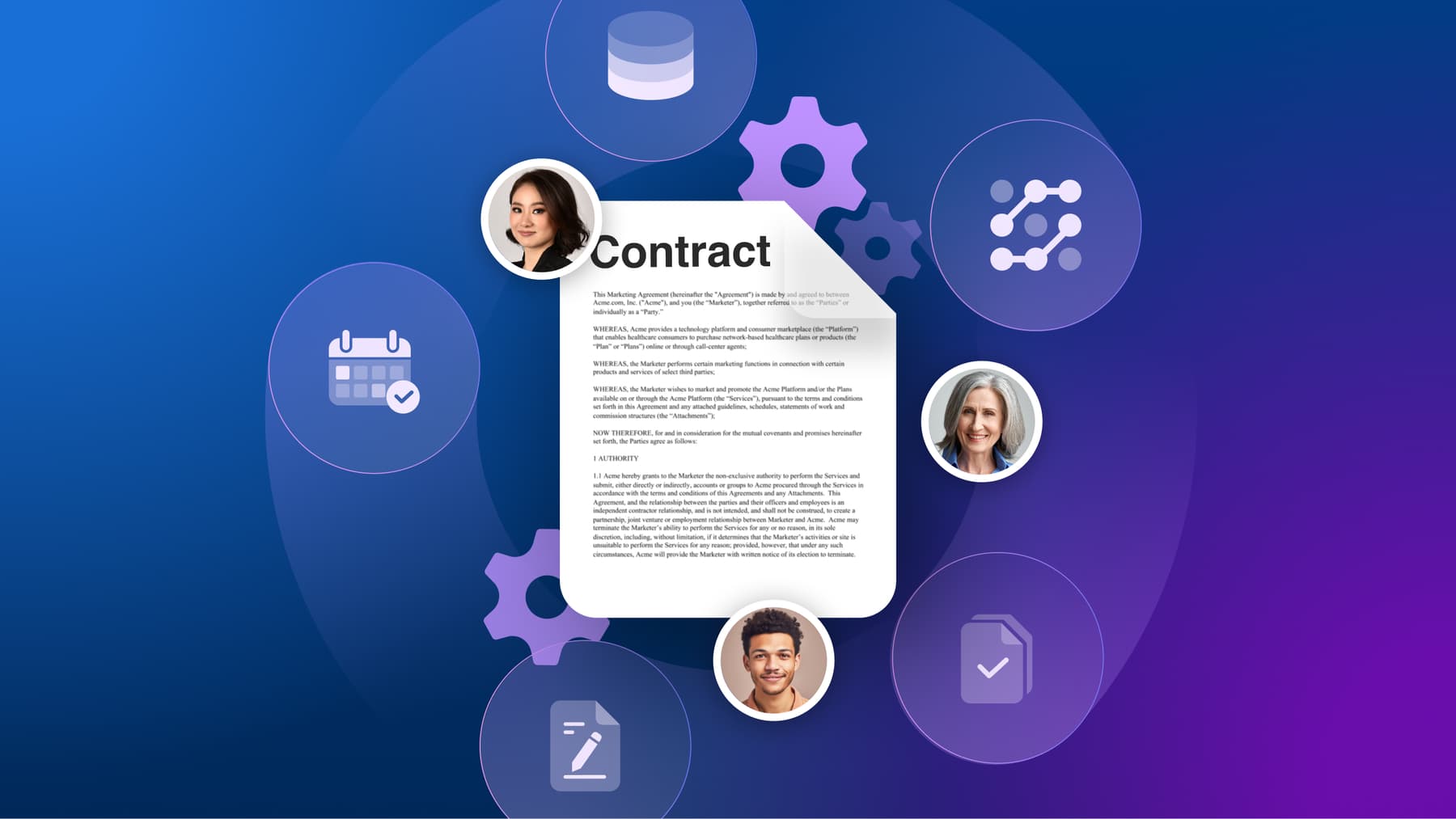
Automated data extraction from contracts, forms, and reports
Data extraction is a time-consuming process, especially for enterprises that handle a high volume of files. To save time with manual processes, large companies use advanced AI technology. In fact, the Box State of AI Report 2025 indicates that high-ROI businesses adopt advanced AI capabilities like metadata extraction more frequently than lower-ROI organizations.

The benefits of data extraction as an AI business application include:
- Quick processing of documents, since the technology scans files way faster than a human ever could
- Better compliance and risk management, since AI keeps track of any red flags that might appear on the scanned files — and lets you know about them
- Improved data accuracy and quality, as AI reduces the potential for manual entry errors by automating the data capture process
AI data extraction offers insights at a speed and scale that traditional methods can’t match, delivering key advantages in efficiency across many industries.
Instant summaries from long, complex documents
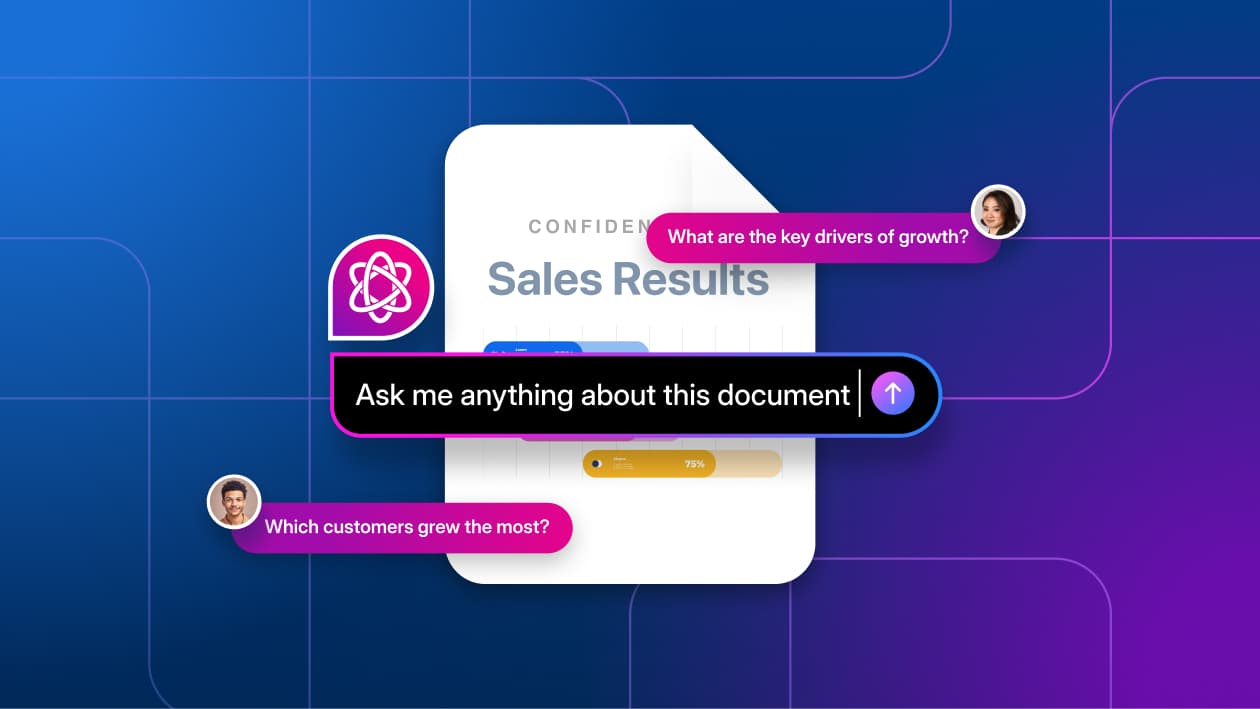
AI summarization tools analyze data and provide a condensed version of documents in seconds — while humans take hours to complete the same task. In this case, the technology functions as an assistant, highlighting the main information in the content.
Explore the advantages that AI agents provide for you:
- Time-saving efficiency: Agents produce brief summaries of extensive documents, allowing you to spend less time scanning through data to find what you need
- Focused inquiries: You set specific questions like “What are the technical specifications for the new feature?” or “Are there any invalid clauses in this document?,” and the AI agent goes straight to the point to bring you answers in seconds
- Crafted summaries: AI crafts customized summaries for various audiences, integrating specific terminology pertinent to areas like finance, law, or operations
End-to-end automation for document-heavy processes
Most organizations start with a single AI use case, then realize the real value comes from linking multiple steps together. Bringing AI to your document-heavy processes enables you to automatically:
- Classify incoming documents like vendor contracts, non-disclosure agreements (NDAs), statements, etc.
- Extract data from files to fill in fields of information
- Route documents for approvals
- Archive signed documents with the right retention and access policies defined in your system
Read our complete guide to AI workflow automation.
AI-assisted content creation
This generative AI business use case allows you to create new versions of documents, like proposals, playbooks, FAQs, job descriptions, and policy updates, just by following existing templates of these files in your system. Thanks to the use of GenAI, teams save 11.4 hours a week on content creation, according to Deloitte Digital.

With AI for content creation, you:
- Generate first drafts of recurring content from prompts or templates attached to your Content + AI platform
- Rewrite existing content for a new audience, channel, or length
- Standardize tone and terminology based on your brand and compliance rules
Intent-driven search across large content repositories
Intent-driven search uses AI to interpret natural language queries and context, not just keywords. This resource is useful when you know information exists somewhere, but you don’t remember the file name, owner, or folder. Instead of typing “Q2_pricing_final_v10,” you use prompts like::
- “What are our approved Q2 prices in EMEA?”
- “Show the latest security overview we sent to customers”
Real-time insights that track content performance
Real-time content insights tools look at activity, sharing patterns, lifecycle stage, and file type to surface what matters most right now, without forcing you into yet another dashboard.
With real-time AI insights, you:
- See which documents drive the most engagement, in and outside workspaces
- Spot stale, duplicate, or conflicting content before it confuses customers or employees
- Identify sensitive files with unusual access or sharing patterns so security teams step in
- Track progress and risks at the content level — for example, key artifacts missing from an onboarding, deal, or project workspace
Instead of guessing where to focus, you use instant signals from documents themselves to prioritize updates, reduce risk, and keep shared workspaces aligned with how your business operates.
Automated compliance checks and risk detection
Automated compliance goes through every selected document and searches for required terms, disclosures, or data retention policies by:
- Classifying sensitive or regulated content — like personal data, financial records, or confidential IP
- Checking contracts and policies for mandatory clauses and wording predefined by you
- Flagging missing language, anomalies, or out-of-policy documents for human review
Explore more about cloud compliance for enterprises.
Multilingual content translation and tone adaptation
Built-in multilingual content translation tools allow you to share policies, product information, and knowledge content across many languages by:
- Translating documents, FAQs, and knowledge articles into multiple languages without leaving your content repository
- Adjusting tone while preserving meaning, so content matches local expectations
- Ensuring key terms and legal language remain consistent across idioms
Custom, no-code AI apps that automate recurring content processes
A no-code app builder lets you implement features for different teams in your system without programming. With a drag-and-drop interface, pre-built templates, and visual workflow tools, no-code platforms:
- Implement specific services applications like client onboarding portals, automated purchase-order approval systems, HR request management tools, etc.
- Reduce time to market for new features and applications
- Embed AI skills like extraction, summarization, or classification where they are needed

Sales enablement and role-play simulation
Traditional sales training and role-plays do not scale well and are hard to personalize. Artificial intelligence use cases for sales productivity help teams keep up with new pricing, products, competitors, and messaging, by:
- Providing role-play simulations in a virtual environment, where AI acts like a specific buyer persona
- Personalizing client onboarding to accommodate the lead’s needs
- Researching in advance what a potential client could ask during a sales pitch
- Coaching pitches and suggesting better ways to handle client objections
- Drafting follow-up emails and proposals based on real customer-salesperson conversations
Customer service virtual agents that resolve issues faster
Customer service virtual agents use conversational AI to handle routine questions, capture context, and assist human teams. Instead of waiting in queues, customers get instant, accurate answers that stay aligned with your latest documentation and policies.
Agentic AI for customer service often:
- Answer common “how do I…” and troubleshooting questions in self-service channels
- Suggest relevant articles and forms for problem-solving matters while customers are still in chat
- Summarize long tickets so agents get updated on issues in seconds
- Hand off complex cases to humans with full conversation and content history attached
See how agentic workflows impact business operations.
Personalized marketing recommendations from your content library
Personalized marketing recommendation engines analyze behavior, preferences, and past engagement to match each audience segment with the right content and offers.
An enterprise AI agent for marketing recommendations allows you to:
- Segment audiences based on interaction patterns and intent
- Recommend the next best content asset or offer within your portals and campaigns according to real-time data
- Reuse existing assets more effectively by matching them to the right customer’s journey stage
- Feed performance data back into your large language models (LLMs), so targeting gets smarter over time
Cybersecurity agents that prevent threats in real -time
AI-driven cybersecurity solutions leverage artificial intelligence to detect and prevent threats in real -time. These tools analyze network traffic, user behavior, and system logs to identify unusual patterns indicative of cyberattacks.
By scoring risks associated with users’ activities, AI-powered cybersecurity:
- Prioritizes IT responses and better allocates security resources
- Provides continuous feedback loops to improve threat detection accuracy and reduce false positives
- Prevents data loss with classification-based security measures
- Detects potential data theft and malicious content with intelligent, context-aware alerts
Implementing AI for cybersecurity enhances an organization’s ability to protect sensitive data, maintain operational integrity, and respond to evolving cyber threats.
Supply chain and inventory optimization for retailers
Supply chain and inventory optimization tools leverage AI to analyze purchase orders, shipping documents, vendor contracts, and performance reports, giving you clearer insights into demand, lead times, and bottlenecks.
With AI for supply chain and inventory, you:
- Forecast demand using both historical orders and information present in invoices
- Optimize reorder points and safety stock based on real-world variability
- Align procurement, logistics, and finance with a single, content-rich view of supply
IT operations copilots (AIOps) for faster incident resolution
IT operations copilots combine artificial intelligence operations (AIOps) with your runbooks, incident docs, and architectural diagrams to speed up detection, diagnosis, and remediation. Rather than sorting alerts by hand, your IT team receives AI support that comprehends both logs and their context.
See what AIOps provides you:
- Correlated signals across logs, tickets, and monitoring tools to spot incidents
- Fast, AI-generated suggested remediation steps from past fixes and documentation
- Summaries on incident timelines and impact for team updates
- An updated knowledge base by turning resolved incidents into reusable patterns
HR and talent lifecycle agents that streamline employee journeys
Human resources and talent lifecycle agents sit on top of your HR content — job descriptions, policies, handbooks, performance frameworks — to assist both candidates and employees. They reduce repetitive work while giving people faster, clearer answers.
HR content agents:
- Draft and refine job descriptions and internal postings based on templates and past roles
- Summarize CVs, interview notes, and feedback into concise candidate snapshots
- Answer policy questions about benefits, leave, and internal processes in natural language
- Surface learning resources and internal knowledge tailored to each role and stage

Executive decision support with AI-generated briefs and scenarios
Executive decision support tools use AI to synthesize reports, dashboards, market research, and internal documents into decision-ready briefs. They provide you with immediate clarity on options, tradeoffs, and risks, eliminating the need to sift through disorganized decks and PDFs.
Executive decision support AIs are the best option when it comes to:
- Consolidating financials, operational metrics, and narrative updates into concise summaries
- Generating scenario comparisons — for example, “what if” views of different investment or resource allocations
- Tracking how key initiatives are progressing based on project docs and status reports
- Producing board- and exec-ready materials faster, grounded in the latest content and data
According to Congruity, unstructured data accounts for 90% of the information organizations generate, which represents a missed opportunity for extracting valuable insights. Using AI in business is great for handling large and varied datasets, as it finds patterns, pulls out important information, and makes quick predictions to support your decisions.
Power your AI business use cases with Box
Box is the leading Intelligent Content Management platform. By bringing content and AI together, it allows you to manage your data n with consistent security, governance, and 1,500+ integrations.
With Box AI, it’s possible to:
- Generate instant summaries of long, complex files for different teams
- Extract datafrom contracts and forms to feed core systems
- Drive agentic workflow automation for document-heavy processes
- Build no-codeintelligent content applications
Talk to us and see how Box handles demanding enterprise AI use cases, from intelligent content classification and automated workflows to secure collaboration and compliance.