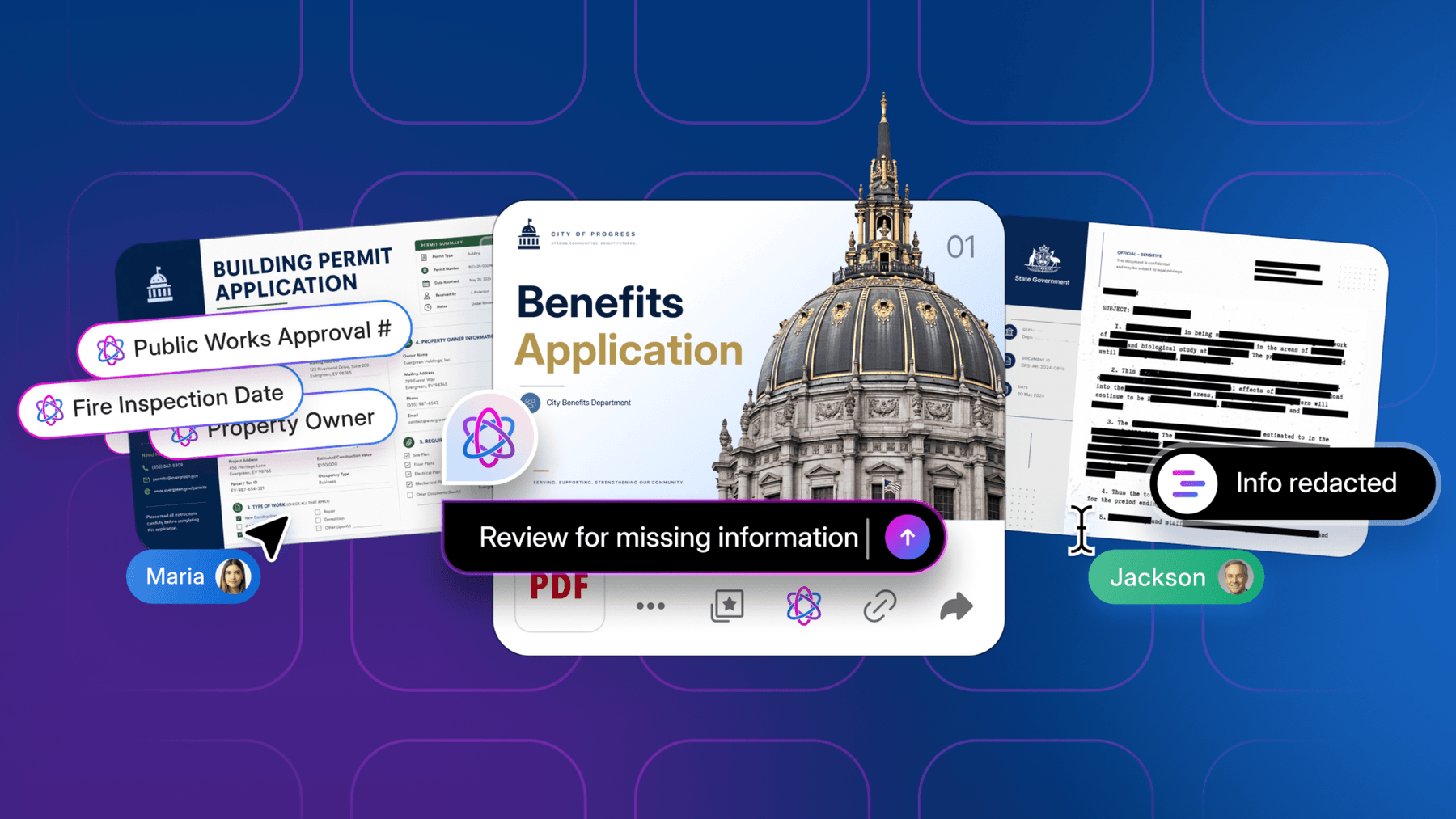
Pulling information from business documents takes time, especially when you do it manually or using rule-based tools. Scanned forms, handwritten notes, and other layout-free formats are especially difficult for traditional data extraction programs to interpret without a heavy setup.
AI data extraction is how you modernize content workflows in your organization. By powering a more accurate and affordable way to process data, artificial intelligence (AI) opens up a scalable path to gain not just simple answers but deep insights from your documents. Let’s see what makes this technology stand out and explore all the ways you can apply AI in your processes.
Key highlights:
- AI data extraction is how you turn unstructured documents into useful information using tools that understand meaning and context, not just format
- The critical difference between AI-based data extraction and rule-based methods is that AI learns from data and adapts to varied layouts, while rule-based tools follow templates and lack contextual understanding
- To extract data from your business documents using AI, you need to connect your content management system to an AI model that interprets and structures the information for direct use in your workflows
- With Box, the leading Intelligent Content Management Platform, you surface insights from documents in seconds, automate tasks with custom AI agents, and keep your data secure under strict governance controls
What is AI data extraction?
AI data extraction is the use of AI-powered technologies like natural language processing (NLP) and machine learning (ML) to collect and process information from documents, especially unstructured formats such as PDFs and images.
Through AI data extraction tools, you:
- Capture order details from a purchase form and send them straight to your procurement tools
- Interpret the content of a supplier contract to flag compliance risks before approval
- Organize resumes by role to help HR teams identify top candidates for urgent positions

Take a loan application as an example. This process involves dozens of documents — income statements, credit reports, proof of identity, and more — all tied to one transaction. Rather than assigning team members to manually gather details from each file, AI-based data extraction collects the necessary information across all documents, speeding up review and reducing mistakes that can hurt your credibility.
Traditional vs. AI-based data extraction: Key differences
Document data extraction isn’t a new concept. Before the creation of intelligent document processing (IDP) solutions powered by AI models, businesses often used optical character recognition (OCR) technologies to capture information.
OCR converts images of text into machine-readable characters, so you can extract the total from an invoice by enforcing a rule that looks for “Total” and pulls the number next to it. But these traditional methods have limitations, especially when it comes to processing unstructured data.

Below are the key differences between AI-based data extraction and conventional technologies.
| Aspect | Traditional data extraction | AI-powered data extraction |
| Technologies used | Conventional data extractors depend on OCR and fixed rules | Data extraction AI tools use NLP and ML to understand context and learn from data |
| Accuracy | When documents have different layouts or poor quality, errors are more likely, so you need to manually catch them | AI improves accuracy over time and highlights questionable data for review, helping cut down errors |
| Scalability | Legacy data extraction solutions can slow down as processing demands grow | Artificial intelligence data extraction supports increasing workloads with minimal human input |
| Data types | OCR-based data extraction software works better by processing documents with a structured format, such as forms and spreadsheets | AI processes structured and unstructured data, which includes handwritten notes and documents of varied layouts and formats |
Free 14-day trial. No risk.
Box free trial includes native e-signatures, lets you securely manage, share and access your content from anywhere.

Most common AI data extraction types
We can sort AI data extraction types into two main categories:
- Template-based extraction: This method covers OCR and rule-based data extraction systems that integrate AI to improve accuracy and efficiency. The initial setup can be costly — for example, if you change the layout of a new vendor’s form, you’ll have to rebuild the extraction rules from scratch.
- Context-aware extraction: This AI-first approach uses models that grasp context, meaning, and different document styles. It includes general-purpose large language models (LLMs) and AI trained on industry-specific data. These platforms can extract information from financial statements, digital documents, and other unstructured sources.
Why do businesses need AI tools for data extraction?
Businesses often need AI tools for data extraction to process a massive amount of unstructured files, including shipping receipts, insurance claims, employee records, and more. According to Congruity, 90% of digital data is unstructured. That means most of the data your company creates doesn’t stick to a format that’s easy to use.
As your workload grows, errors become harder to catch, which is concerning for industries like financial services, where a missed field in a contract can affect compliance and customer trust. With AI tools for data extraction, you can pull the details from a file instantly, eliminating the hassle of configuring document layouts or typing in information.
Benefits of using AI in automated data extraction
More than just saving you time spent collecting data by hand and helping manage a flood of unstructured information, using AI for automated data extraction can benefit your organization in many ways.

Take a look at the most common benefits of AI-based data extraction for businesses.
- Enhanced data quality: For 92% of analytics and IT decision makers in a Salesforce survey, trustworthy data matters more than ever before. With AI, automated data extraction adapts to different document layouts and interprets content at a semantic level, delivering high-quality information.
- Optimized workflows: Think about how much easier HR onboarding could be with document data extraction software that collects information from offer letters and fills it into HR and payroll systems. These solutions allow you to make entire processes more efficient and agile.
- Scalability: By cutting out manual tasks like sorting and categorizing documents, you can handle larger volumes of files without extra staff. Intelligent data extraction platforms use AI to understand the content faster and more precisely, handling different formats with fewer mistakes than old-school rule-based systems.
- Better decision-making: When you collect information from your files in real time, you get clearer insights to drive your strategies. For example, your sales department can analyze performance instantly and adjust tactics for better conversion rates.
- Reduced operational costs: With new AI models coming out, modern technologies are getting more affordable for organizations of all sizes. Plus, conventional data extractors require costly configuration of rules for each document layout or data field.
Artificial intelligence data extraction: Best business applications
Per Verified Market Research, the data extraction software market reached $1.38B in 2024 and will reach $3.99B by 2031, with a compound annual growth rate (CAGR) of 9.8% over the forecasting period. The reason behind this expansion is the demand for business intelligence tools and AI technologies to make data a source of value.
To help your organization get the most from its data, check out these common ways businesses use artificial intelligence data extraction.
| AI data extraction use case | Who can benefit from this application |
| Financial report analysis | Financial teams and analysts use AI to quickly identify revenue fluctuations or margin changes from complex reports |
| Patient admission | Healthcare staff and administrators instantly pull insurance coverage details and prior visits from admission forms, speeding up patient intake |
| Customer service portals | Support teams have their own centralized portals to retrieve customer information (like purchase history and past issues) and analyze the tone of queries to deliver more personalized answers |
| Contract summarization | Legal teams and contract managers use AI summarization to surface key terms and renewal dates from contracts, saving hours of review time |
| AI agentic workflows | Businesses of any size can integrate data extraction into their workflows using AI agents, intelligent assistants that capture and analyze the content of documents within a cloud-based storage platform |
When to use AI-powered data extraction
Let’s say your business manages contracts from multiple partners, each with a different language, layout, and clause structure. Rule-based data extraction tools rely on fixed templates, so when you phrase a clause differently, the system either breaks or pulls incorrect data.
Go with AI data extraction solutions when:
- You manage a high volume of lengthy documents: Handling technical documentation or complex policies? AI-powered data extraction lets you generate summaries with a click and pull specific details, like dosage instructions in pharmaceutical protocols or retention policies from governance guidelines.
- You process sensitive data at scale: In finance or healthcare workflows, where privacy matters most, intelligent content extraction can classify files based on metadata, reducing error and exposure. An Intelligent Content Management platform protects data with encryption and granular access controls, helping these highly regulated industries meet strict standards.
- You’re looking for a cost-effective solution: As AI becomes more accessible, conventional options might not fit your budget, as their setup often requires significant investment. Look for automated content extraction solutions that let you easily adjust cloud storage capacity to match seasonal demands.
- Manual data entry drains time and resources: If your team spends hours inputting data by hand, AI workflow automation solutions with data extraction can speed up document processing and retrieval.

What is the best way to extract data using AI?
The best way to extract data using AI is through solutions with responsible AI implementation. These platforms use reliable AI models that prioritize data security, respect user permissions, stay transparent about how they work, and adapt to your specific industry regulations.
This way, you can rest assured that your most sensitive data stays protected while you save time and improve your customer experiences. For example, you can integrate your AI-powered content management platform with the customer relationship management (CRM) system you use — AI automatically collects and organizes customer information from reports to keep your sales and marketing teams updated on performance.
Review the benefits of cloud app integration for your enterprise.
How to extract information from documents using AI
Here’s how AI extracts information from your documents:
- Document collection: First, your chosen AI data extraction program will access the data source, such as your cloud storage platform
- Preprocessing and text cleaning: Raw documents often come with inconsistent formatting or redundant information, so AI cleans this up to read the text clearly
- Data structuring: Next, the system identifies fields like dates, amounts, and names, and categorizes documents in a way your business applications can process — for example, comma-separated values (CSV), a format that works well for spreadsheets
- AI model training: AI learns from thousands of documents and data points to understand patterns, which helps models improve accuracy over time
- Information extraction: AI scans documents for critical details much faster than manual methods (even when buried deep inside irregular file formats)
- Contextual understanding: Unlike OCR, AI interprets context — for instance, a model knows that a number next to “Total” means something different than one under “Tax,” which reduces errors caused by misinterpretation
- Post-processing and validation: The intelligent data extraction system double-checks the data to catch missing fields or conflicting information, notifying you if human review is needed
- Integration with systems: As the final step, data feeds directly into your apps, making real-time insights accessible with no manual input
Harness the power of intelligent data extraction with Box AI
There’s a lot of value hiding in your unstructured data, and you need the right platform to surface insights your team can act on. As the leader in Intelligent Content Management, Box puts AI to work to help you manage files, collaborate on documents, and automate business workflows from any location or device.
With Box AI, you extract not just data, but also real value from your content:
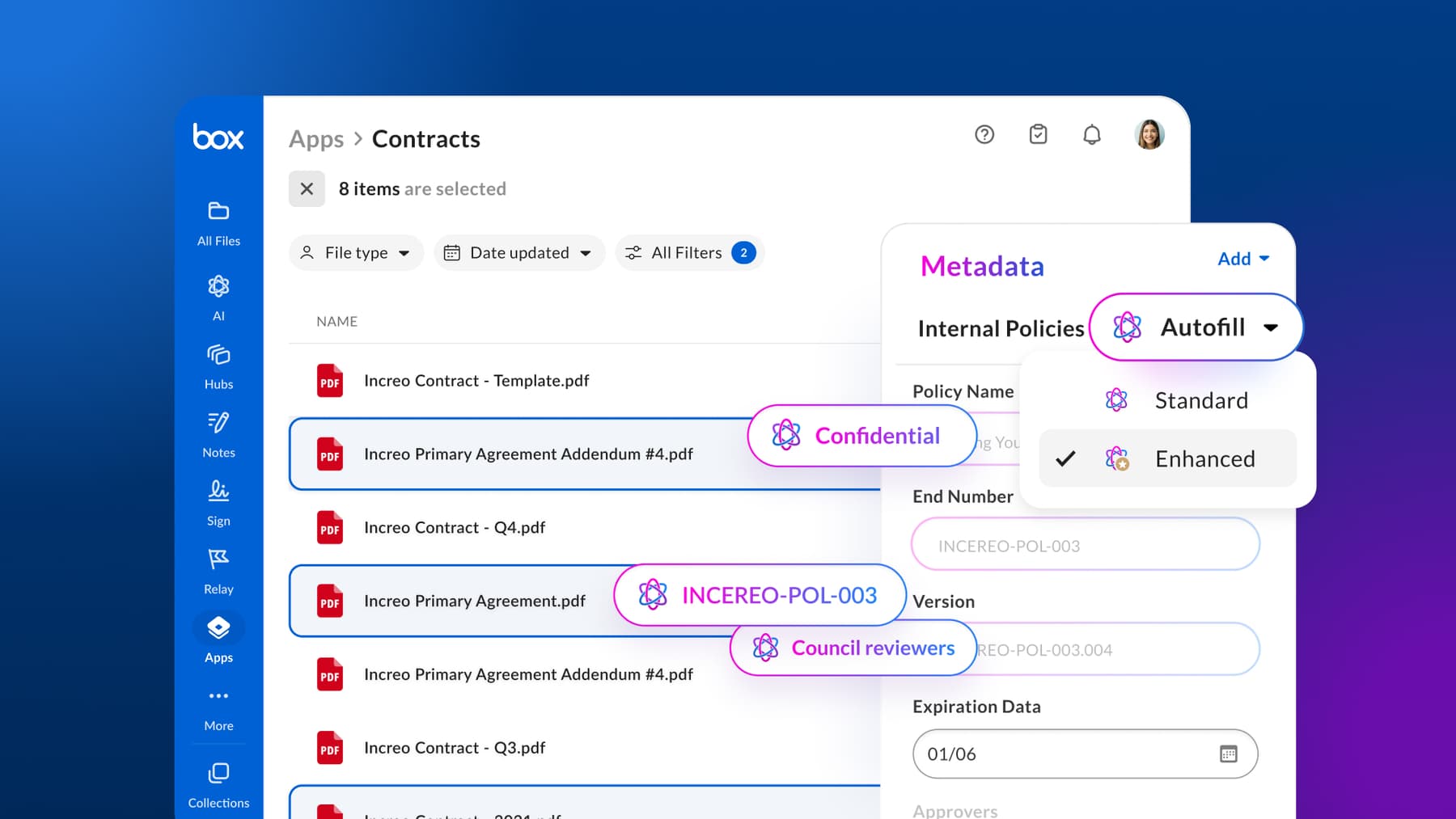
- Uncover critical details from your business documents and convert them into structured metadata for easy access
- Collect intelligent insights from high volumes of content to support informed decisions and faster actions
- Receive instant summaries and contextual responses across multiple documents via Box Hubs
- Use trusted models to build customized AI agents with Box AI Studio
- Safeguard sensitive data with enterprise-grade security and compliance controls and responsible AI principles
Contact us to explore how AI data extraction can drive results for your business.

*While we maintain our steadfast commitment to offering products and services with best-in-class privacy, security, and compliance, the information provided in this blog post is not intended to constitute legal advice. We strongly encourage prospective and current customers to perform their own due diligence when assessing compliance with applicable laws.