In enterprise settings, manual, error-prone tasks slow your strategic work, making you waste hours on data entry, reporting, and coordination. AI teamwork solves this challenge by combining human insight with AI to streamline workflows and cut down on administrative burdens.
In this guide, you’ll learn what teamwork AI looks like, the everyday benefits of integrating AI into your workspace, and five ways to foster this technology in your business.
Key highlights:
- AI teamwork is when AI and humans work together in high-performing, collaborative teams where the technology is seen not as a replacement for individuals, but as their partner
- Benefits of AI teamwork include increased efficiency, faster time-to-market, reduced administrative and labor costs, stronger compliance, and accelerated market intelligence
- For effective human and AI collaboration, centralize data, use a multi-model approach, implement AI agents to automate processes, prioritize strong governance, and invest in training programs
- The Box Intelligent Content Management platform powers advanced AI solutions for agent teamwork across all departments
What is AI teamwork?
AI teamwork is the strategic integration of artificial intelligence technologies into business processes to enhance how teams operate, collaborate, and achieve their goals.

AI helps you improve teamwork by:
- Flagging content discrepancies in files for you to review
- Automating routine tasks and workflows
- Creating first drafts of content for you based on templates or prompts
- Improving project management and organizing tasks in a single platform
What are the benefits of AI and humans working together?
With AI and humans working together, your business benefits from increased efficiency. According to The Box State of AI in the Enterprise report, early AI adopters see 37% productivity continuous improvements in their businesses.

Key benefits of AI teamwork for your organization include:
- Faster time-to-market: AI reduces product development cycles from months to weeks, enabling brands to respond quickly to market opportunities
- Increased operational efficiency and scalability: By offloading repetitive, data-intensive, or complex analysis tasks to a centralized AI, you can dedicate more human bandwidth to creative problem-solving and strategic thinking — once limited in siloed teams
- Reduced administrative and labor costs: Automation of tasks like content reviews, compliance checks, and report generation decreases the need for manual effort, with Harvard Business School reporting that individuals using AI spent 16.4% less time on their tasks
- Strong compliance and risk management: AI agents provide comprehensive compliance monitoring, which lowers the likelihood of missed regulatory issues, directly helping firms avoid penalties
- Accelerated market intelligence: AI expedites market research by reading and summarizing vast amounts of material, providing insights for effective decision-making in new markets
5 ways to foster AI teamwork across your organization
Turning AI into a real team member demands structure. This process involves adopting a unified tool that supports apps and platforms you already use, bringing agents to automate the complex workflows, defining access controls at the content level, and training your team to collaborate with AI instead of working around it.

Unify knowledge bases to power decision-making
To make your AI systems engage in complex tasks, first establish a unified content strategy through a secure cloud platform. AI models, particularly those engaged in collaborative workflows, depend on the quality, consistency, and accessibility of the data they process.
Unifying your databases helps eliminate silos as you train large language models (LLMs) and AI agents on the most accurate, up-to-date information available to the team.
Adopt a multi-model strategy for optimal performance
No single AI model is perfect for every task. A flexible platform allows you to choose the LLMs best suited for specific jobs, enabling a multi-agent systems approach.
For example, one large language model may excel at AI summarization, while another is optimized for code review or sentiment analysis. This “best-of-breed” approach helps you get optimal performance and flexibility from agents.
Automate complex processes with AI agents
AI agents act as digital assistants that execute multi-step processes, like collecting information, generating reports, and triggering next steps through AI workflow automation.
Agent teamwork drives true collaborative project planning and allows enterprises to automate complex business processes, like client onboarding, compliance routing, and invoice processing. In these AI-driven workflows, humans shift from performing repetitive tasks to overseeing the technology, handling exceptions, and focusing on high-value strategic work.
Learn how to choose the right enterprise AI agent.
Embed governance and access controls at the content layer
As AI interacts with your company’s sensitive information, strong data governance and security controls are obligatory. You must apply the same detailed permission rules to both human and AI access to prevent unintended leakage of proprietary content.
Learn how AI data governance works.
Train your team to collaborate with AI
Human adoption determines successful AI teamwork. You need to invest in training programs to build collaboration skills with the adopted tools. This way, you show your team how the technology functions as an AI assistant, rather than a replacement.
What are the latest developments in AI teamwork?
The latest developments in AI teamwork are centered on making the technology accessible, contextual, and customizable to specific enterprise needs. Large companies are shifting the focus from standalone generative tools to embedding powerful AI capabilities directly within the content platforms where teams already work.
Take a look at some of the developments built into the best platforms for AI teamwork:
- Flexible choice of AI models (LLM agnostic): Vendor-neutral platforms connect to different LLMs as needed, balancing cost, latency, and accuracy by use case
- Content summarization and insight extraction: Long reports, transcripts, and tickets turn into short briefs with clear action items, themes, and risks your team can act on
- Enterprise AI-powered search: You ask AI natural-language questions and get direct answers and relevant documents without digging through folders
- Real-time governance and access controls: Enforce real-time security at the content level, with policies that support security and compliance standards like GDPR and HIPAA
- No-code AI tools for custom app creation: Business users drag, drop, and configure components to ship AI workflows without waiting in line for engineering
- Customer support agents: Your team can improve customer experience through AI agents that summarize tickets and generate high-quality draft responses to the clients
- Analysis of multimodal content: The AI system processes text, images, spreadsheets, audio, and video together, so patterns and insights emerge across every format your business uses

Teamwork: AI use cases by industry
Teamwork AI impacts everything from R&D in life sciences to resident services in government. AI-powered document management systems automate the organization of prior unstructured content — contracts, assets, forms, and patient records — to simplify routine workflows, speed up approvals, and improve both external and internal service delivery so everyone in your company works collaboratively.
Here are common AI teamwork use cases by industry:
Leverage leading AI solutions for agent teamwork with Box
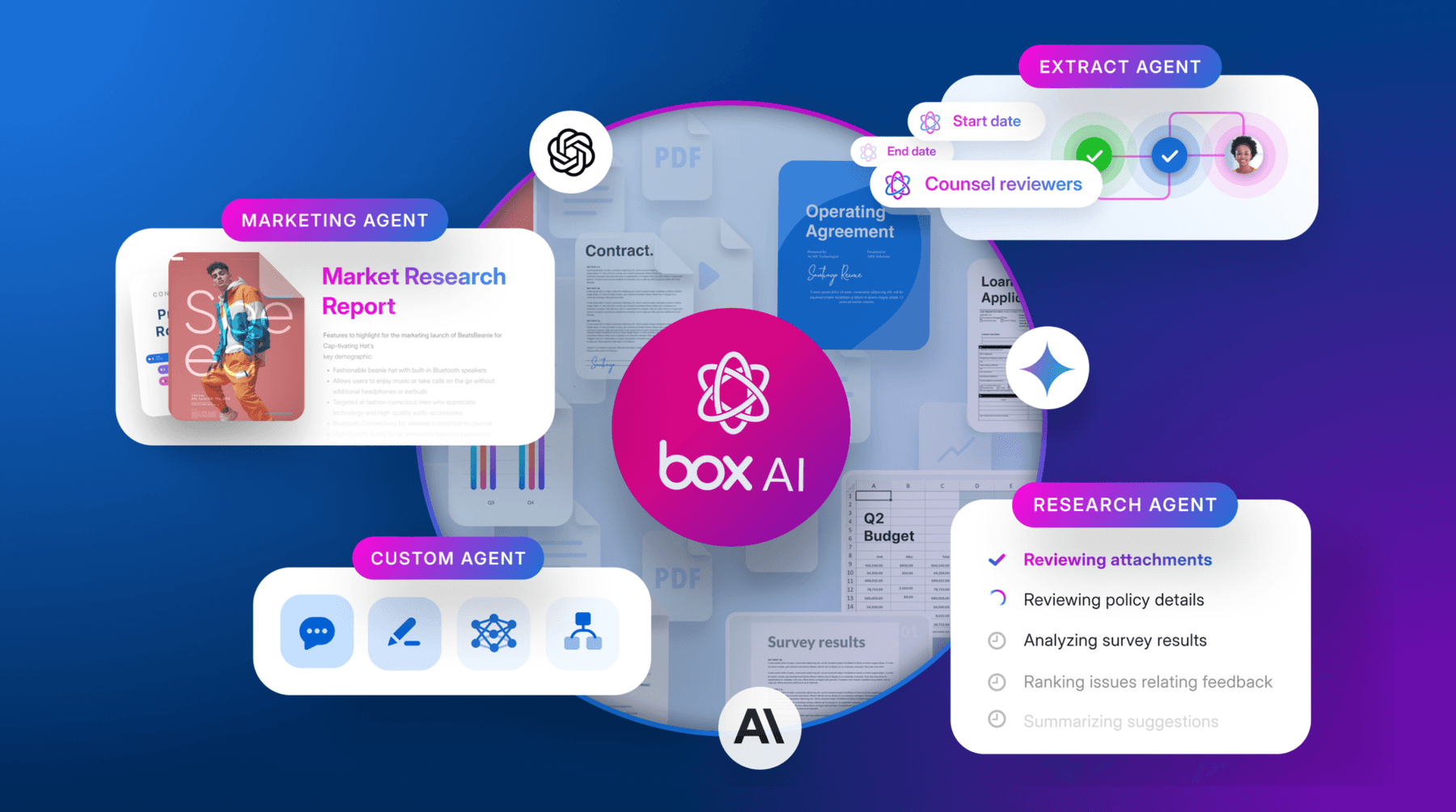
Box Intelligent Content Management is the leading AI solution for agent teamwork. Our platform unifies your content, automates mission-critical workflows with agentic AI, and secures your most valuable assets at scale.
With Box AI, you:
- Turn complex prompts and relevant context into polished drafts for marketing copy, board briefings, and general statements
- Summarize leases, statements, and financial reports to deliver precise answers and insights
- Enable AI while maintaining enterprise-grade security and compliance, access controls, and data governance across all content
- Connect your content + AI with every app in your technology stack to eliminate silos and enable cross-departmental collaboration through 1,500+ integrations
From workflow automation to data structuring, Box makes AI teamwork easier. Contact us to see what we can do for you.