As enterprise workloads grow, your team needs smarter ways to manage repetitive operations and complex content-driven projects. Agentic process automation enables AI systems to understand context and take the next best action automatically, minimizing routine task handling and improving consistency across workflows.
Learn what agentic AI process automation is, how it works, and how to choose the best tools for your business.
Key highlights:
- Agentic process automation is a modern approach where AI coordinates multistep work, evaluates context, and advances processes without relying on fixed rules or manual handoffs
- Agentic systems improve business efficiency by interpreting content, reasoning over prior steps, planning actions, and executing tasks across multiple tools
- To select the right agentic process automation tools,consider capabilities like permission-aware content access, native document understanding, multi-document processing, activity logs, and strong governance guardrails
- Box enables secure, end-to-end agentic automation with governed content access, permission-respecting AI actions, and customizable AI agents built in Box AI Studio
What is agentic process automation?
Agentic process automation is the use of AI agents to independently complete business tasks and workflows from start to finish. Instead of waiting for a rule, a trigger, or a human handoff, these systems evaluate context, identify what needs to happen next, and move the work forward automatically.

Agentic automation should:
- Understand where a process currently stands
- Choose the correct action instead of relying on a fixed sequence
- Pull or update information across tools
- Escalate exceptions when human input is needed
In practice, artificial intelligence shifts automation from “if-this-then-that” flows to context-aware execution. The focus isn’t just on completing tasks, but on ensuring the entire process progresses toward an outcome with minimal manual intervention.
Learn more about agentic workflows with our guide.
Benefits of agentic AI process automation
Agentic AI process automation gives teams a way to move work forward without constant oversight. Gartner expects that by 2028, at least 15% of daily work decisions will happen autonomously through agentic AI, indicating a shift toward technologies that carry out entire sequences of work without needing human guidance.
Key benefits of automated agentic processes include:
- Faster, more confident decisions powered by an AI-driven understanding of documents, metadata, and business context
- Repetitive task reduction, freeing teams to focus on judgment-based and strategic work
- Higher accuracy and consistency by standardizing how information is interpreted, routed, and validated
- Better exception handling through AI that identifies when a situation needs human input and escalates appropriately
- Increased scalability as automated processes expand without adding headcount or building new rule-based flows
Master how to use AI for business success.
How does agentic automation work?
Agentic automation works by breaking down processes into smaller decisions and actions that an AI agent evaluates in sequence. The agent starts by collecting the content and data it needs, interprets that information, and uses memory and reasoning to determine the next best step. This loop continues until the process is complete.

Data ingestion and interpretation
The first step in agentic process automation is giving the agent access to the right information. At this stage, the system ingests documents, messages, metadata, and system records, then interprets their meaning using advanced AI technologies such as natural language understanding and entity recognition.
By turning unstructured data into structured signals, the agent determines what information is relevant and what details should drive the next step in the process.
Understand the difference between structured and unstructured data.
Context and memory reasoning
Once agentic AI systems understand the content, they evaluate context: what has already happened in the process, what state it is in, and what data points matter for the next action. The platform maintains short-term memory of the current run and long-term memory of prior decisions or outcomes. This reasoning layer provides continuity for complex tasks, reducing the need for humans to restate information or manually guide the automation forward.
Autonomous task planning
In this stage, the agentic system maps out the actions required to reach the intended outcome. Unlike workflow automation limited by predefined rules, agent automation adjusts its plan based on what it discovers in the content or systems it interacts with.
The agent then determines what should happen next, which tools or APIs it needs to call, and whether steps should run in parallel. This planning capability enables more adaptive and efficient execution paths.
Learn the importance of digital workflow automation.
Multi-system execution
After planning, the agent carries out tasks across the connected apps and content repositories that support the process. Agentic AI automation executes actions such as updating records, generating outputs, sending notifications, or retrieving additional information. Because the system works across multiple tools, it prevents the manual switching and information gaps that slow enterprise processes.
Discover what multi-agent systems are.
Quality review and learning
Before closing a process, the agent checks whether the results meet defined thresholds or business requirements by validating extracted data, confirming task completion, or flagging issues for human input when needed.
Over time, the agent incorporates feedback from these checks to improve performance, allowing agentic automation systems to refine decisions and produce increasingly reliable outcomes.
Types of automated agentic processes

As companies move beyond task-level automation, different types of agentic processes emerge to manage full business workflows. According to the Box State of AI Report, 84% of organizations are already adopting agentic process automation, with 41% using agents for fully autonomous operations.
How to choose agentic process automation tools for your business
When evaluating agentic process automation tools, focus on how well they support the actual work your teams manage every day.
For example, a legal team might need a system that gathers contract versions from different folders, compares key terms, analyzes data from related records, and routes the file to the right reviewer. If the tool cannot handle these steps, the process stalls, errors slip through, and people end up doing the same manual work you were trying to automate in the first place.
To minimize these process automation gaps, prioritize agentic tools that offer these key capabilities:
- Agent configuration controls to define instructions, constraints, and behavior for every agent
- Model flexibility to choose the best AI provider or model for each process
- Permission-aware content access that enforces user, file, and folder permissions
- Native content understanding with AI that reads, extracts, and classifies unstructured files
- Intelligent document processing for analyzing, comparing, or summarizing several files at once
- AI data extraction and generation to structure information for downstream steps
- Real-time activity logs and monitoring for audit readiness and transparency
- Secure integrations and APIs for updating records, triggering actions, or exchanging data across systems
- Compliance and AI data governance guardrails that prevent unauthorized access or unsafe model behavior
- Centralized management to oversee all agents, models, actions, and usage from one place

Deploy next-gen agentic AI automation with Box
With Box, you bring agentic AI automation into the flow of work. Our Intelligent Content Management platform lets AI operate securely on your business content by reading files, understanding context, and taking action based on the information stored across your repositories.
That’s how Box AI helps teams complete work faster: by giving them a unified way to automate processes without switching tools or rebuilding workflows from scratch. Our models use advanced AI capabilities to:
- Read and interpret full documents to inform next-step decisions
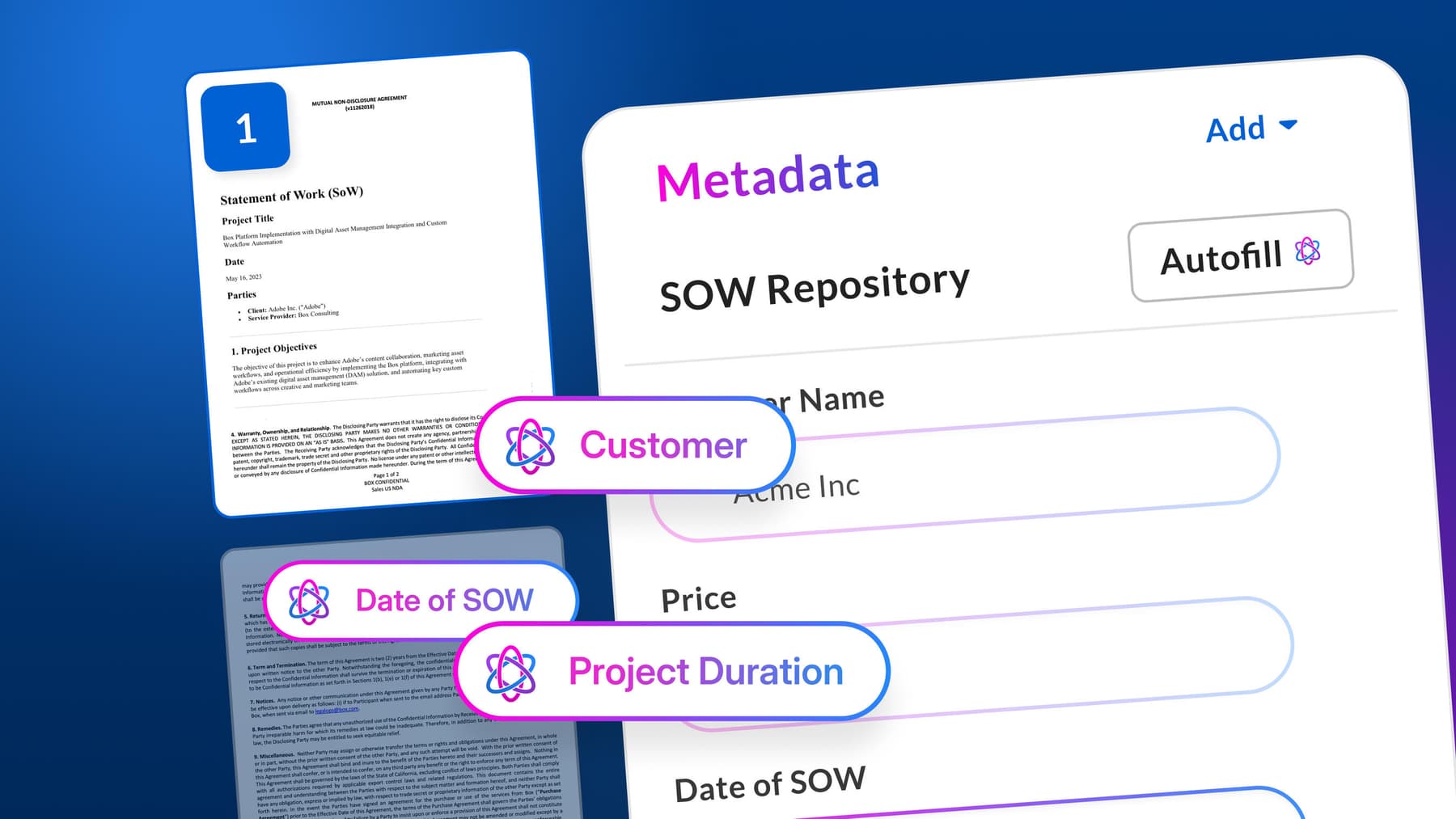
- Extract structured fields and metadata to trigger downstream actions
- Compare versions, clauses, or records to accelerate reviews
- Identify gaps or inconsistencies that block process completion
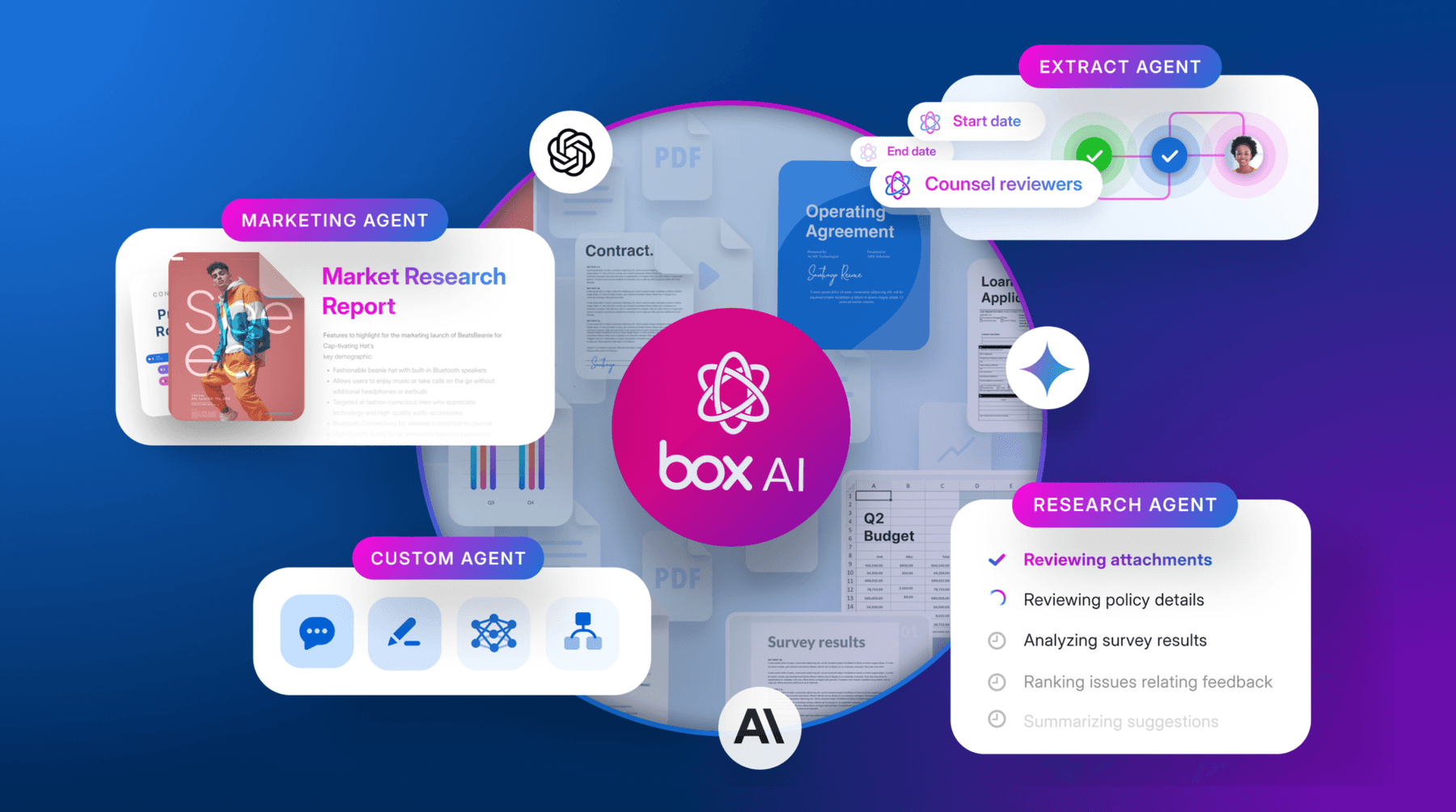
With Box AI Studio, you can also create custom logic, define instructions, and control how each workflow behaves.
Contact us to deploy agentic process automation and accelerate work across your organization.
Frequently asked questions
What is agentic automation?
Agentic automation is a form of AI where systems take independent actions to achieve a goal, using context, reasoning, and real-time information to decide what to do next. Instead of waiting for a rule, trigger, or manual instruction, AI evaluates the situation, selects an appropriate action, and executes it, whether that involves answering a question, retrieving information, completing a task, or progressing part of a workflow.
See our guide to AI workflow automation.
How do AI agents differ from traditional automation tools?
Traditional automation tools follow predefined rules, meaning they only act when a specific condition is met. AI agents interpret content, understand intent, and decide what should happen next. That’s why many organizations are now exploring agentic AI for business process automation to handle more dynamic and decision-heavy workflows.
Where traditional automation answers “what do I do when X happens?”, agentic process automation answers “what should happen next to complete this process correctly?”
See how to strengthen your business process automation strategy.
Agentic AI vs robotic process automation: What’s the difference?
Robotic process automation (RPA) mimics user actions, such as clicking buttons or copying fields, and works best with structured, repetitive tasks.
Agentic AI, however, reads documents, reasons over information, and adapts to changing conditions using large language models (LLMs) and natural language processing (NLP). These capabilities make agentic systems better suited for processes that involve variable inputs or real-time decisions.
What are the best AI agents for automating business processes?
The best AI agents for automating business processes are those that understand content, make decisions, and take action across systems while respecting permissions and process requirements. Box AI Agents combine content understanding with secure execution, allowing teams to automate end-to-end workflows with confidence.