The promise of enterprise AI is often framed in terms of efficiency: hours gained, errors reduced, decisions made, and money saved.
Those outcomes matter. But they don’t fully capture the impact of AI in the world of business, because AI doesn’t just help people do the same work more quickly. It enables organizations to redesign work altogether.
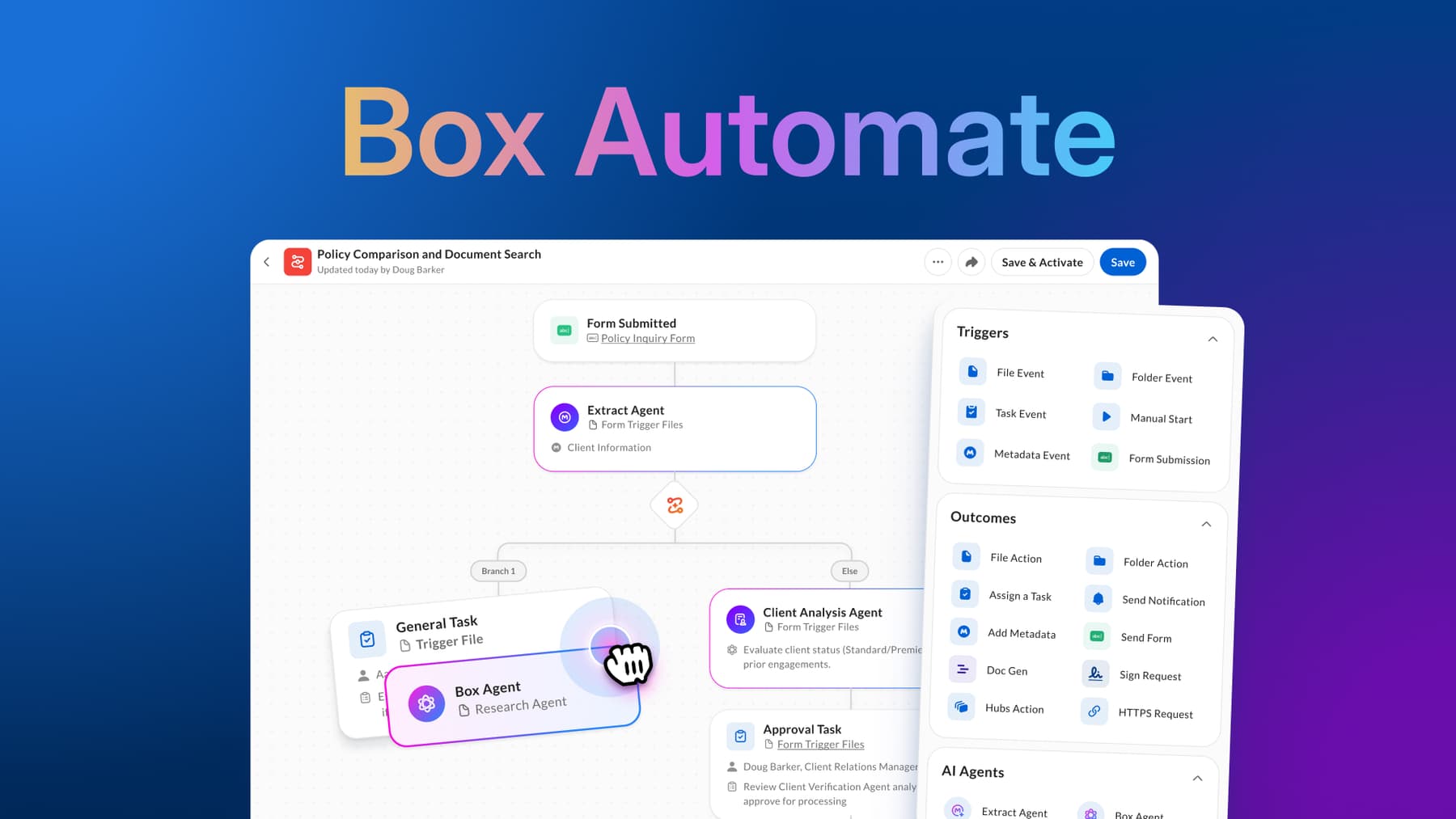
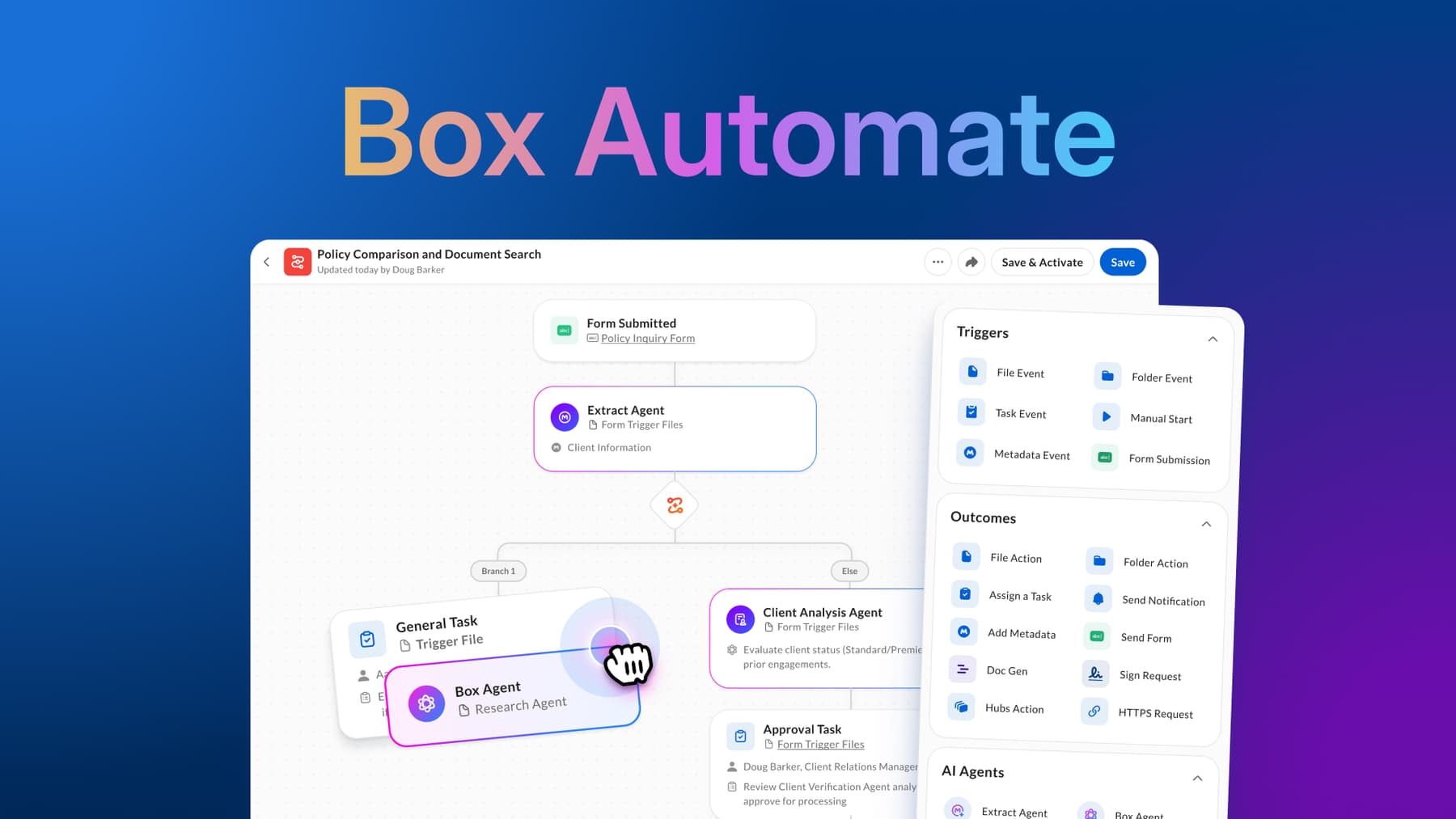
Box Automate uses AI agents and metadata extracted from content in Box to automatically route files, trigger downstream actions, and orchestrate end-to-end workflows using the right context. But beyond that, Box Automate empowers teams to envision what work might look like with AI agents employed at scale across every workflow — specifically, workflows based on content, which is where all the context of an enterprise lives.
We spent hundreds of hours with enterprise teams across industries and lines of business to understand where content bottlenecks create the most drag. The pattern is remarkably consistent. The bottleneck is almost never a single slow task. It’s the accumulated burden of manual hand-offs, context reconstruction, and routing across workflows that are individually manageable but collectively exhausting.
Keep reading to find out what’s possible with Box Automate and how Box customers are already putting this solution to work.
Key takeaways:
- Box Automate’s main value isn’t limited to speeding up isolated tasks, but redesigning end-to-end workflows so content enrichment, routing, validation, and downstream actions are based off real business context, reducing repetitive handoffs and rework
- Early customer examples show practical impact: Samsung uses extracted metadata to scale onboarding and task assignment and Argonne National Laboratory is seeing promising results that could cut publication entry times tenfold
- The strongest AI workflows combine Box Extract, Box Automate, and the Box content platform so agents handle metadata extraction, policy comparison, risk analysis, and routing, while people focus on judgment, exceptions, and decisions

Box customers who’ve reinvented work
More than a hundred customers and partners have been participating in the initial pilot launch of Box Automate, and they’re already starting to share their outcomes.
Samsung
Samsung is experimenting with Box Automate to transform onboarding. Evelyn Ngai, Head of GRC, says, “Box Automate has the potential to make our onboarding workflow far more scalable by processing documents from Greenhouse, Workday, and new hire documents; extracting the metadata we choose; and sending it to Box Doc Gen to generate personalized documents for new employees at scale.”
By leveraging Box Automate's capabilities, we can programmatically trigger workflows based on the extracted metadata.
Specifically, she says, “By leveraging Box Automate's capabilities, we can programmatically trigger workflows based on the extracted metadata, automating task assignments to different teams and streamlining our overall onboarding process.”
For Samsung, this could make onboarding far more scalable while streamlining task assignment across teams. The larger shift: not just automating steps in onboarding, but using content-aware AI to coordinate decisions, context, and cross-team execution at scale.
Argonne National Laboratory
The US Department of Energy multidisciplinary science and engineering research center Argonne National Laboratory is testing Box Automate to streamline its enterprise publications and scientific and technical information workflows, which span publication records, technical reports, datasets, and related documents. Early results prove this could reduce manual effort for researchers and support staff while helping route content for the right approvals and folder locations.
Box Automate could cut publication entry times down tenfold.
Bulletproof
The global brand agency Bulletproof is experimenting with using Automate for managing complex onboarding tasks in HR, which currently involves 5+ applications. Bulletproof is also looking into using Automate to streamline legal contract processes and consolidate tools in that area as well.
Box Automate stands out for bringing scattered tools under one roof while streamlining the behind-the-scenes work.
IT Manager Peter Walkers says, “From an IT perspective in a creative environment, Box Automate stands out for bringing scattered tools under one roof while streamlining the behind-the-scenes work — like job requests, approvals, and file organization — so designers can stay focused on creating.”


More from early adopters of Box Automate
Other early adopters of Box Automate are applying it to transform:
- Employee onboarding: A custom Box AI Agent validates I-9 uploads, flags exceptions for human review, and fast-tracks high-confidence files
- Invoicing: Box Automate renames incoming invoices with default names and routes them directly to approval
- Insurance claims: Route claim documents, notes, and correspondence — regardless of format — and auto-generate response letters
- Vendor assessment: Review vendor documents against required risk assessment criteria before onboarding
- Contract approvals: Combine conditional routing, dynamic fields, and scalable cross-tool workflows (like ServiceNow)
- Report generation: Plan and cost report (PCR) generated with parallel agents contributing structured outputs, merged and finalized into one report via Box Doc Gen
- Corporate records management: Standardize and consolidate the intake of 300-400 monthly files from counterparties that require renaming, relocating, and forking trade documents
- Marketing review approvals: Streamline approvals from multiple teams and departments, each with their own review cycles and workflows
This is a short list. Across energy, financial services, life sciences, media and events, professional services, and more, Box customers are also experimenting with Automate for loan application underwriting, vendor risk evaluation, regulatory compliance review, and other workflows.
These early customer successes indicated broader potential for Box Automate beyond speeding up isolated tasks. Box Automate gives organizations a way to redesign end-to-end workflows around AI automation — which opens up a world of possibility for what workflows can accomplish.
Content security stitched into the workflow
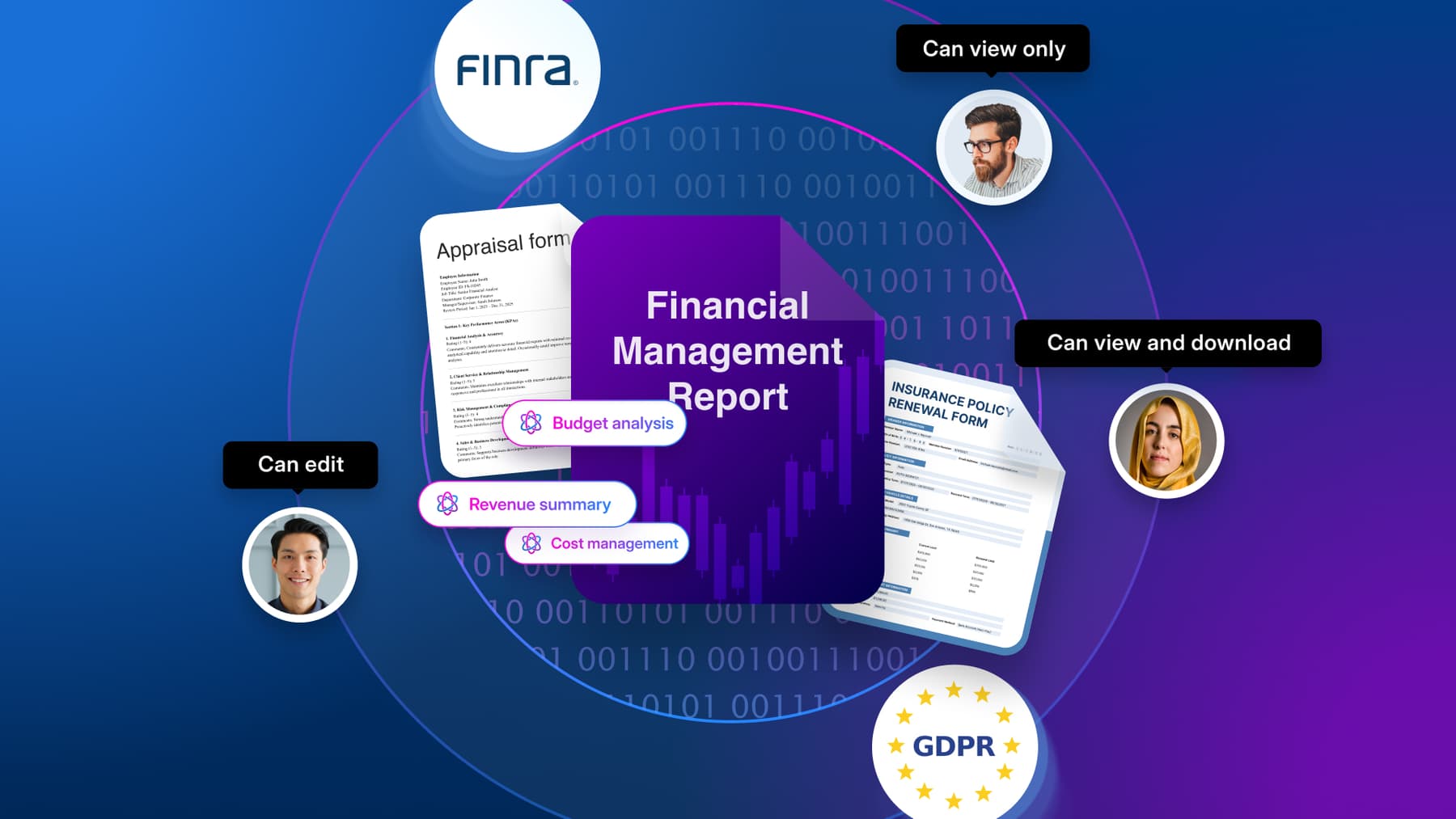
Content security is a big part of how Automate creates value in the real world. Within all kinds of workflows, customers must ensure sensitive content stays governed as it moves through each step.
Because Box Automate runs on content already managed in Box, customers can focus on automating their critical workflows — extraction, routing, approvals, etc. — while leaving the content permissions, security, and governance to Box.
For customers using Automate today, they can redesign processes around AI agents with more confidence, knowing automation can happen with both richer context and stronger control.
That gives customers a more practical path to AI-powered workflows. Instead of moving sensitive documents into disconnected tools or rebuilding context at every handoff, they can keep work anchored in the content layer where governance already exists.
For customers using Automate today — and for those planning future workflows — that means they can redesign processes around AI agents with more confidence, knowing automation can happen with both richer context and stronger control.
Redesigning workflows at the core of business
What we heard early and often from beta customers was that the real problem wasn’t one broken task. It was the friction created when information had to be reassembled at every step of a workflow.
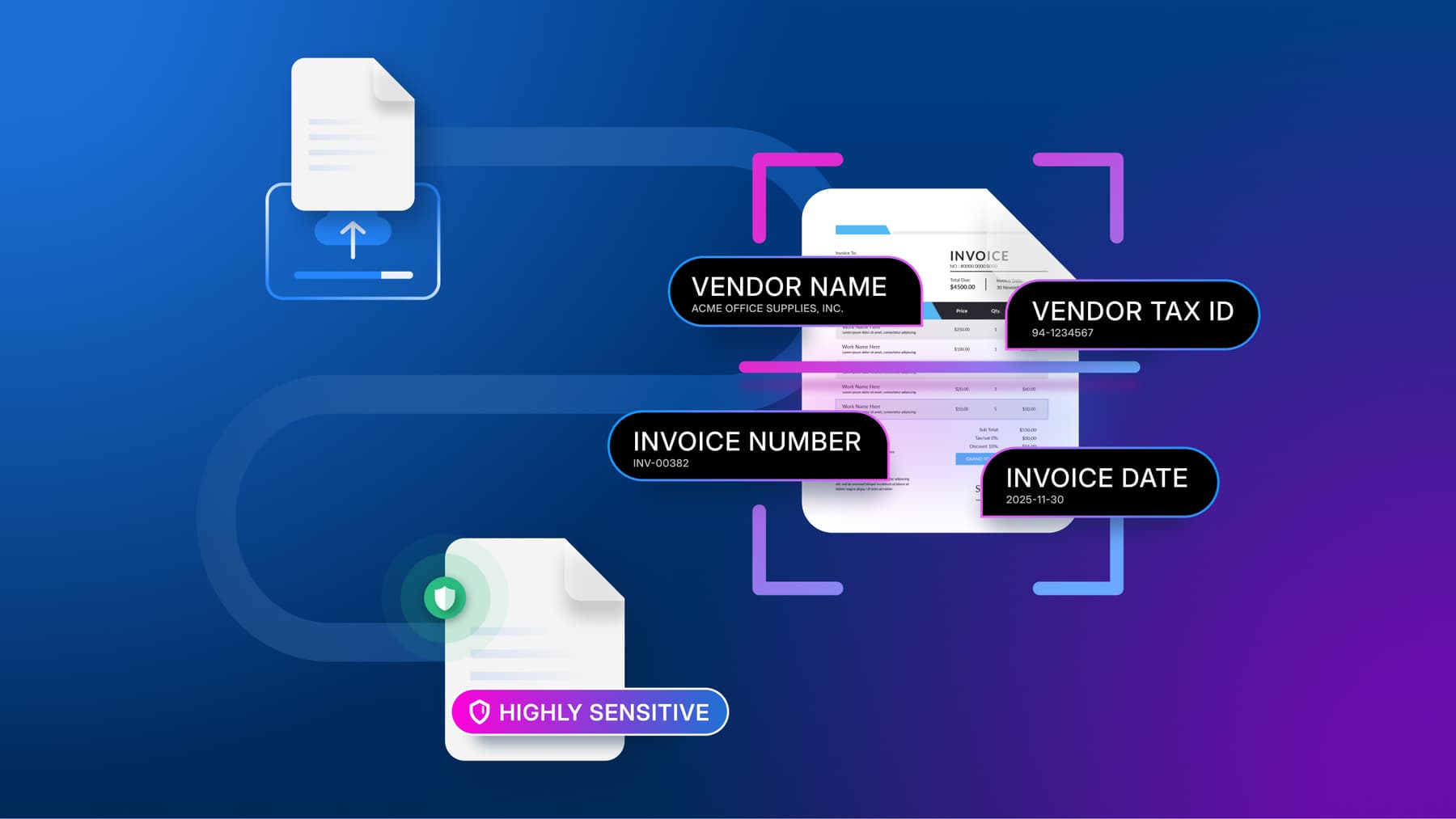
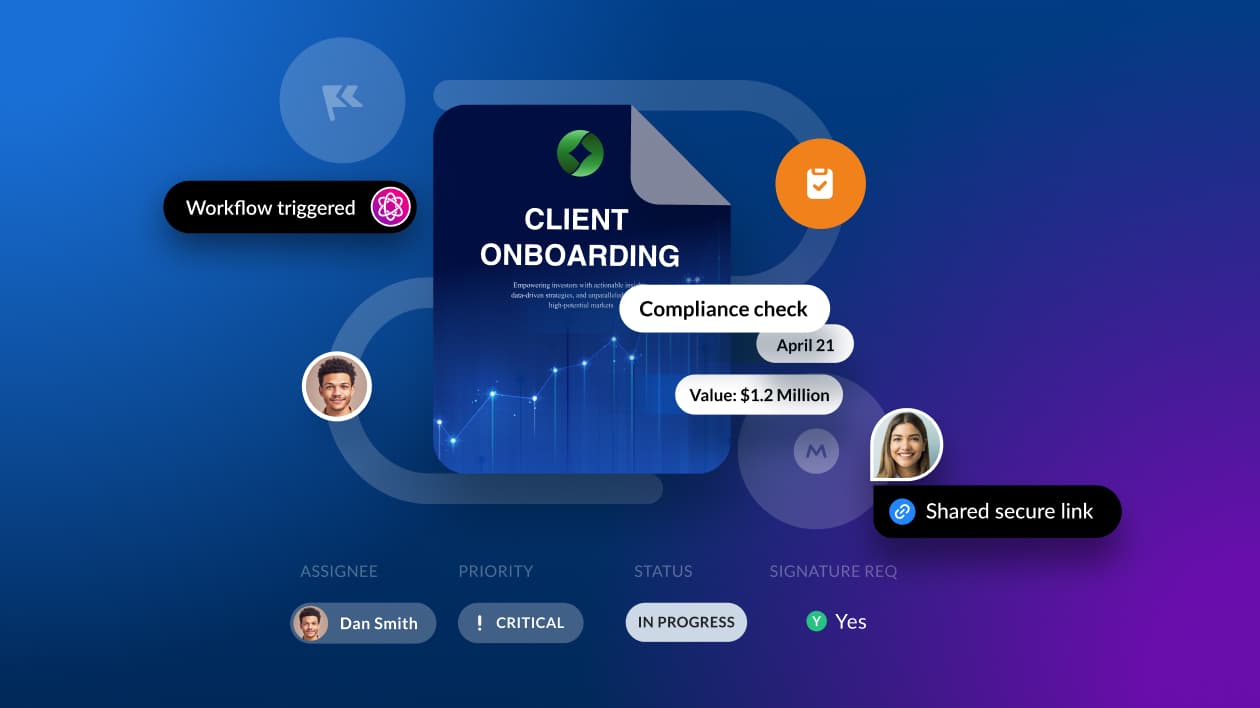
In many workflows reliant on content, the first step is understanding what’s in the file in the first place, which is where Box Extract plays an important role. Box Extract pulls structured metadata and key details from unstructured data. Then, Box Automate uses that output to trigger the next step: routing a file, applying business rules, assigning a task for human review and approval, generating documents, or moving content into the right folder.
Box Extract identifies the relevant information, and Box Automate leverages that valuable insight to accomplish outcomes with intelligent decisioning.
In other words, Box Extract identifies the relevant information, and Box Automate leverages that valuable insight to accomplish outcomes with intelligent decisioning.
It’s early days for Automate, and we’ll share more stories soon, but in the meantime, here are three more examples — hypothetical, but realistic and achievable today — of how Automate could redefine workflows in three different industries.
How a healthcare organization can rethink claims intake
A regional health system receives hundreds of thousands of claims a year through fax, email, and mail — literal and metaphorical stacks of paperwork. Staff manually open letters and files to extract key details, verify eligibility, cross-reference policy terms, and route claims for review. That intake process can consume far more time than actual decision-making. Even when organizations add OCR to speed up one step, the larger bottleneck often remains: routing, verification, decisioning, and context-building are still manual.
Here’s what the workflow for claims intake could look like with Box Automate:
- AI extraction agents process incoming claim packages and identify relationships across provider notes, procedure codes, and member records
- A verification agent compares extracted information against policy documents and eligibility records already managed as enterprise knowledge in Box
- A routing agent then assesses complexity and sends the claim to the right queue with context attached
Human reviewers step in to apply oversight, but they do so with the relevant documents, discrepancies, and analysis already assembled. The result is an overhauled operating model with less time spent assembling context and making good decisions — and a workflow that can scale without depending entirely on headcount.

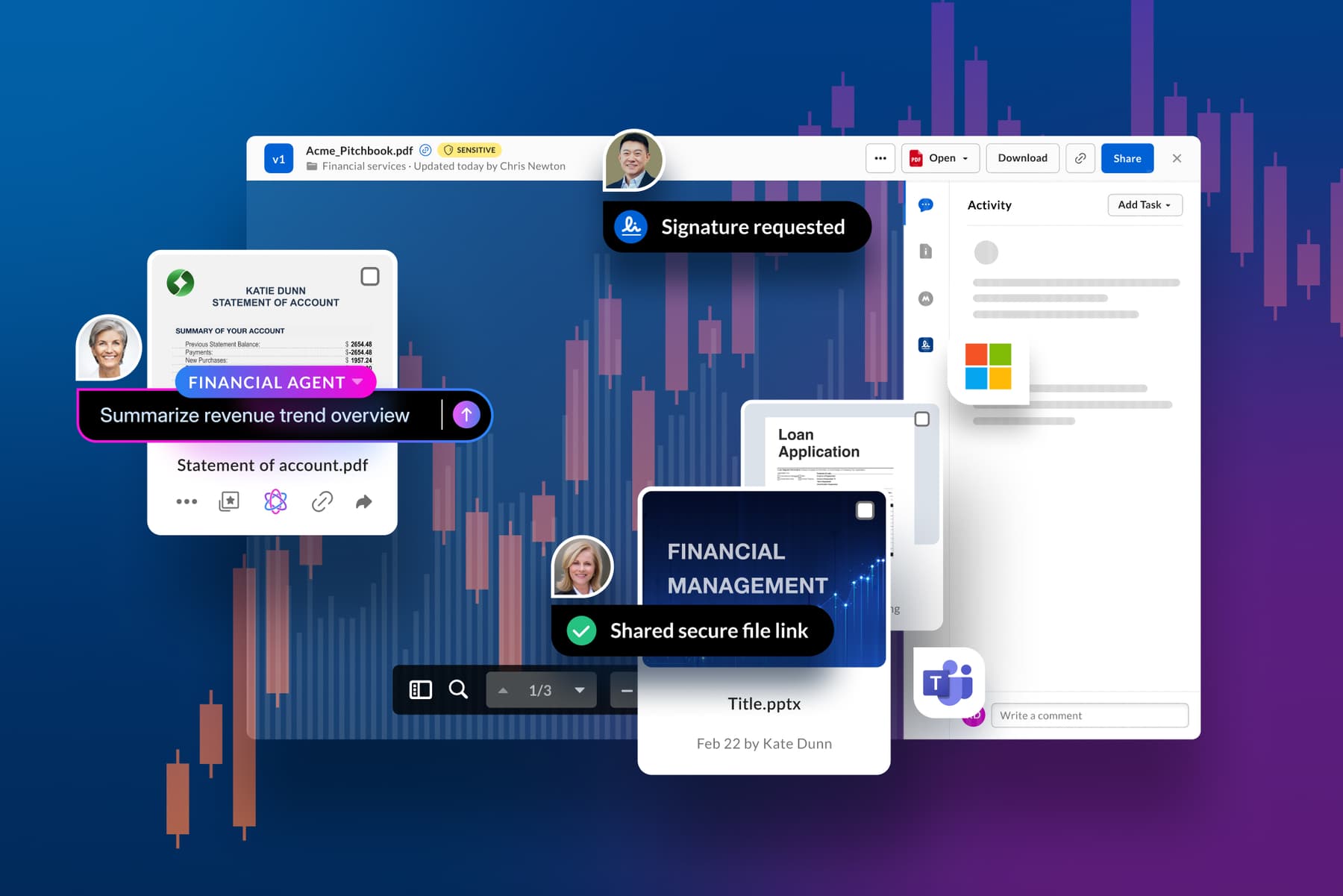
How a financial services company could modernize contract review
Now consider a global financial services firm managing thousands of vendor contracts and processing renewals, amendments, and new agreements every year. Contract reviews are slowed by serial hand-offs: Legal reviews the agreement and summarizes it. Procurement receives the summary, reopens the original contract, and re-reads the relevant sections. Compliance then does the same. In addition to prolonged review time, this scenario causes repeated context reconstruction from team to team.
With Box Automate, the workflow begins the moment a contract is uploaded to Box.
- An extraction agent maps key terms like renewal dates, liability caps, indemnification clauses, data-handling provisions, and service-level commitments against a standard playbook stored in Box
- A risk assessment agent evaluates deviations, cross-references vendor history, and produces a risk score with rationale
- Reviewers open a flagged contract and immediately see the extracted terms, the comparison to policy, the risk analysis, and links to the relevant source clauses
Teams no longer need to start from scratch at every hand-off. They can instead focus on the flagged issues and the decisions that matter.
How an event company would streamline contractor onboarding
Last scenario: Imagine a global event management company onboarding a few hundred contractors for each production cycle. Each contractor needs a service agreement, NDA, tax forms, insurance documentation, and production-specific addenda. Even if each package takes only 20 minutes to prepare manually, the total time adds up quickly under tight deadlines.
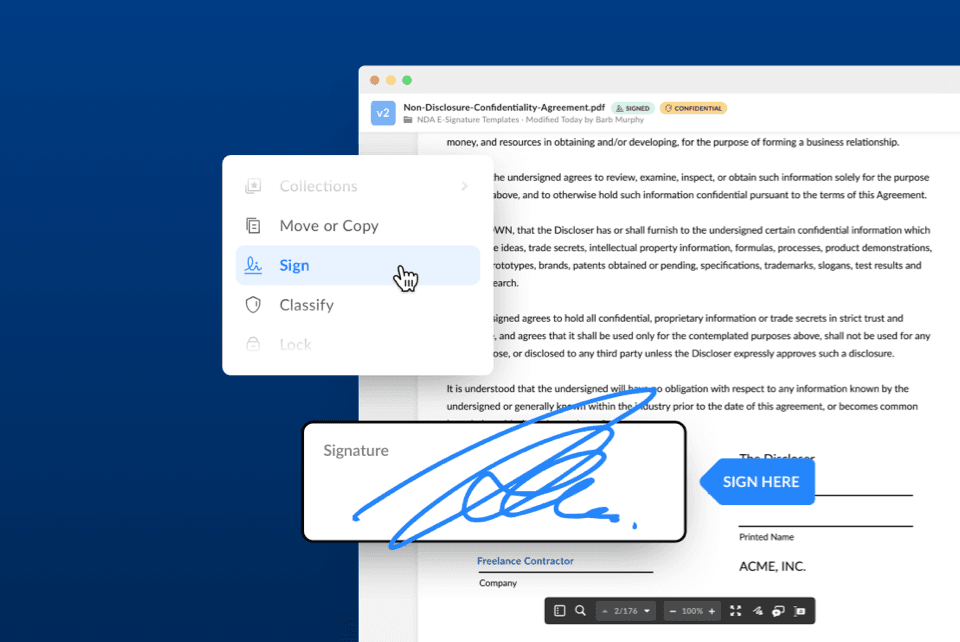
With Box Automate, the company can connect Box Forms, Box Doc Gen, and Box Sign into a coordinated workflow. A contractor submits their information through a form, and we’re off:
- An AI agent identifies the correct document package based on role, location, and entity type
- Another agent checks the package against compliance requirements, such as jurisdiction-specific NDA versions, insurance thresholds, and tax form rules
- Once reviewed by a human, the package is then routed for e-signature with Box Sign
- While another agent tracks completion, sending reminders and escalating exceptions when needed
In that model, the coordinator is no longer buried in repetitive document assembly and follow-up. Instead, they monitor progress and intervene only when a case needs human attention.
Division of labor between people and AI
These examples are hypothetical, but the pattern is real, and we’re seeing a lot of similar successes in customer beta use of Box Automate.
When workflows run on content already managed in Box, agents can work with native access to files, metadata, permissions, and version history.
The biggest workflow gains don’t come from attaching AI to one isolated task but from redesigning workflows so that context carries forward from step to step. That’s what makes automation useful in practice. Agents can process unstructured data, extract meaningful metadata, compare documents against policies and templates, assess confidence, and route work based on context. People remain essential, but their role shifts toward judgment, exception handling, and decision-making.
This is also where the content platform matters. When workflows run on content already managed in Box, agents can work with native access to files, metadata, permissions, and version history. That richer context makes automation more reliable and more actionable.
With Box Automate, organizations can now orchestrate agent-powered workflows directly where their content already lives in Box. That means teams can extract metadata, route files, trigger downstream actions, generate documents, collect information, and move work forward with richer context and less manual effort.