There’s a quiet crisis sitting inside banking onboarding workflows. It shows up in abandoned applications, unanswered follow-up emails, and revenue that simply disappears.
Half of the people who want to open a relationship with a bank walk away before the process is done according to Cornerstone Advisors. And 68% of consumers habitually abandon online applications for financial services.
There’s too much friction in traditional application processes. It takes too long, asks applicants for too much, and offers very little in the way of visibility. For consumers, it’s often a stressful, daunting project to apply for a loan or a new account.
Banks have invested heavily in digitizing pieces of the onboarding journey. But the building blocks — document collection, KYC review, approvals, e-signature, audit trail — are still scattered across six or seven disconnected systems, held together with manual effort and a lot of email threads. The result is a workflow that’s slow for the bank and opaque for the client.
The solution is to bring these building blocks together into a single governed, end-to-end onboarding workflow instead of leaving them scattered across disconnected systems. Here’s what that looks like.
Three things you’ll take away from this article:
- The specific friction points that cause onboarding to break down and why they get worse as you move from retail to wealth management to commercial banking
- How one wealth management firm cut quote turnaround from two weeks to five minutes and saw 30–50% productivity gains for its financial planners
- What a governed, end-to-end onboarding workflow actually looks like in practice and what capabilities to evaluate when you’re considering how to close the gap

The gap between what clients expect and what banks deliver
Four out of five consumers value a complete digital experience when choosing a financial institution. But most bank onboarding workflows don’t deliver.
The mismatch is sharpest in wealth management and commercial banking, where the complexity of the onboarding package grows significantly. In retail banking, onboarding a single account holder requires a relatively short document list. In wealth management, it gets slightly more complex: trust structures, beneficial ownership verification, source-of-wealth documentation. But by the time you get to commercial and corporate banking, onboarding typically requires multiple authorized signers, cross-jurisdictional requirements, entity hierarchies, and multi-party KYC review.
At that level of complexity, you’re onboarding the client, the entities behind the relationship, the people authorized to act on it, and the documents needed to clear KYC. This is a process that can take weeks, and that timeline is both an operational inconvenience and a competitive liability.
Where the workflow actually breaks down
The friction points in onboarding are well known to anyone who works in banking operations.
Document collection becomes a bottleneck before review even begins. Documents arrive in person, over email, and via shared links from different submitters. Without automated central tracking, it’s challenging to keep track of what’s been received and what’s still outstanding without checking manually. Missing documents lead to delays and back-and-forth with the client — who, meanwhile, has zero visibility into where things stand. They’re sending follow-up emails asking whether their documents were received, because there’s no central place to check.
Manual data entry multiplies errors and time. Once documents arrive, someone on the ops team is organizing files by hand, rekeying data from scanned documents into a spreadsheet tracker or CRM, and manually uploading everything into a shared drive. Every handoff adds time. Every manual entry is an opportunity for error.
Review and approval live in separate systems. Compliance reviews the package in one system. Approvals happen over email. E-signatures occur in yet another tool. The custodian portal is separate from all of it. Handoff between systems creates information siloes and compliance risks.
The client experience reflects all of this. From the client’s perspective, onboarding feels like submitting documents into a black box. They don’t know what’s been received, what’s still needed, or when they’ll hear back. That opacity erodes trust at exactly the moment a bank is trying to build it.
What Mercer Advisors found when they looked at the problem
Mercer Advisors is a full-service wealth management firm focused on financial planning and investment strategies. The company was dealing with slow manual data extraction, time-consuming client onboarding, and difficulty applying technology to complex workflows.
By partnering with Box, Mercer Advisors transformed their client onboarding experience and eliminated the bottlenecks of manual document processing:
- Quote turnaround is estimated to drop from two weeks to five minutes
- Data extraction for onboarding became five times faster
- Financial planners saw 30–50% productivity gains
That last number matters most. Time recovered from processing paperwork is time reinvested into serving clients. For a wealth management firm, that’s the core value proposition — and it was being consumed by manual work.
What a governed, end-to-end workflow looks like
The capabilities that close the gap in onboarding aren’t exotic. They’re the same building blocks banks already have, brought together in a single governed workflow instead of scattered across disconnected systems.
Here’s what that looks like in practice, following a wealth management onboarding package from intake to signed agreement:
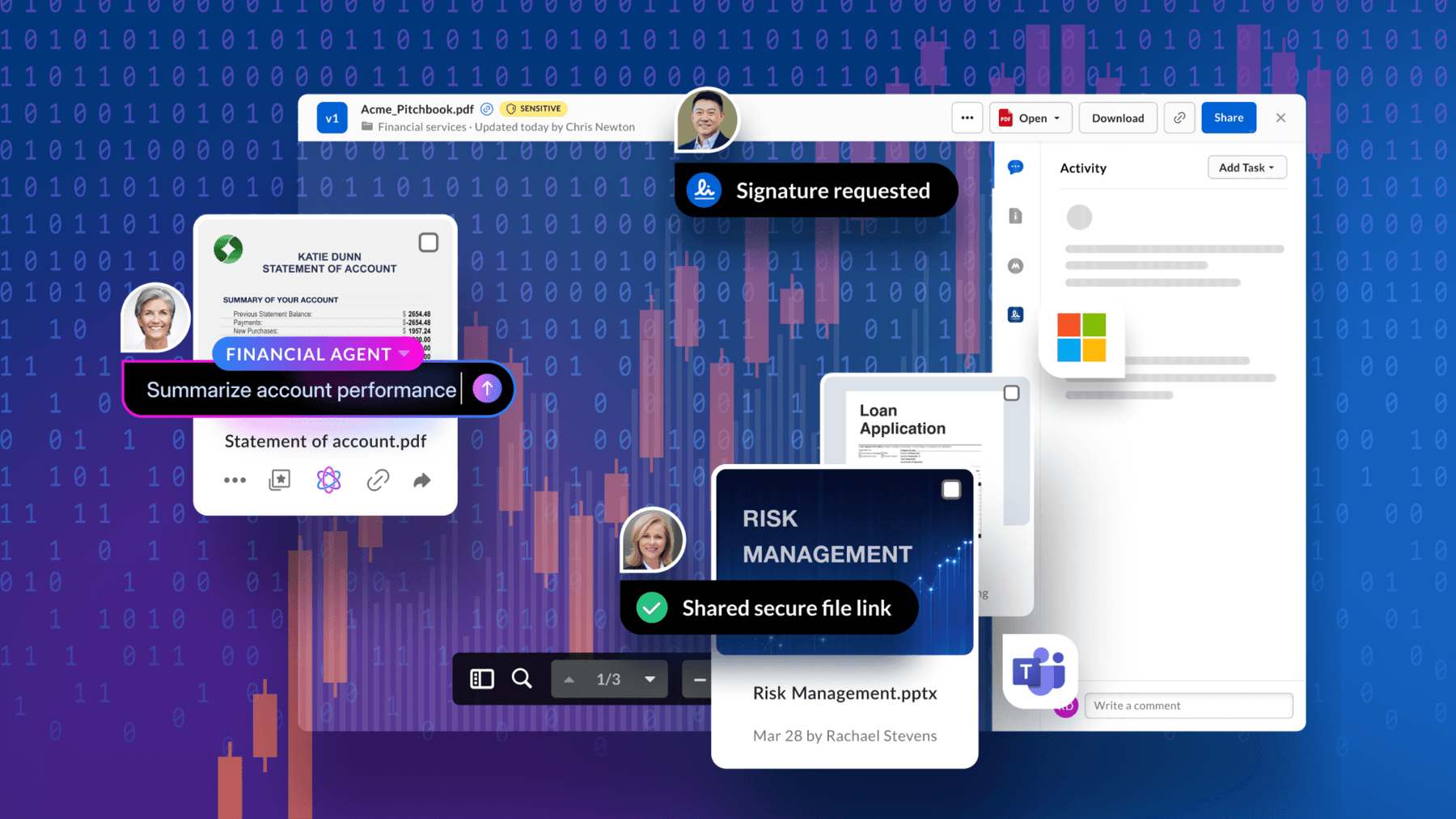
Intake and extraction. The client submits a structured form and supporting documents (including things like trust agreements, government IDs, proof of address, W-9, financial statements) in one step. The package arrives already organized and tagged. AI extracts key fields from uploaded documents automatically, getting the package ready for review without manual rekeying.
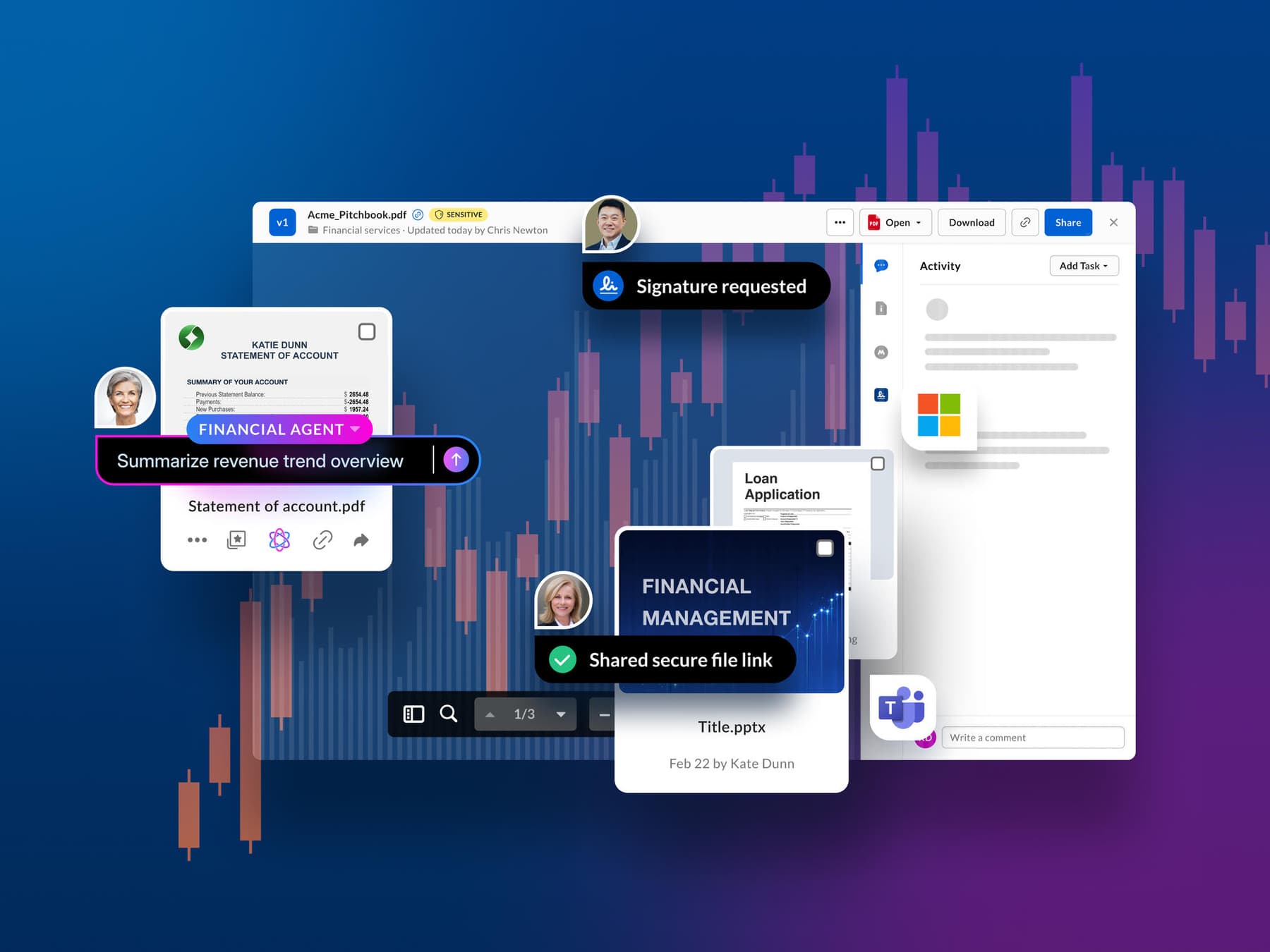
AI-assisted review. A compliance analyst can ask questions across the full onboarding package and get answers with citations back to the source documents in seconds rather than hours. Because the AI is permissions-aware, the analyst only sees content they’re authorized to access. Discrepancies in address consistency or income alignment surface automatically, rather than being caught (or missed) during manual review.
Agreement generation, approvals, and signature. The onboarding contract is generated automatically from a template using data already captured in intake — no manual re-entry. It routes through the review chain and goes out for signature. The executed document is stored with the rest of the onboarding record. The ops team can monitor every client’s onboarding status in a single dashboard: what’s outstanding, what’s complete, where each workflow stands.
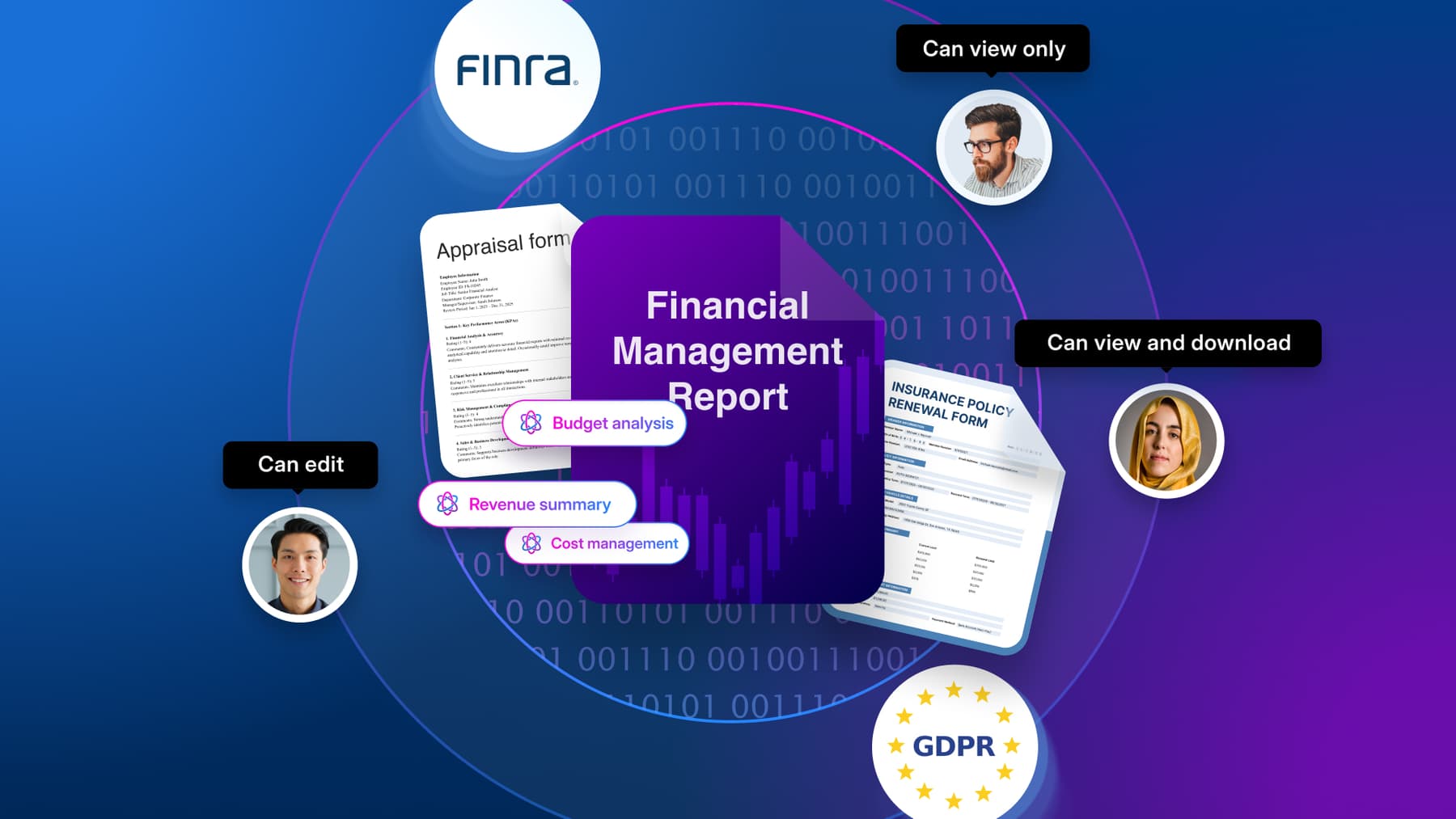
Governance throughout. For banks, AI only works if there are clear controls: who can use it, which content it can access, whether customer content is used to train models, and whether the bank can explain where an answer came from. A governed workflow means a KYC analyst can move faster while compliance can still see what was reviewed, what was cited, who approved it, and where the final agreement was stored.
What to look for when evaluating your approach
The question for most banks isn’t whether to modernize onboarding but how to do it without ripping out the systems already in place. The same workflow that handles wealth management onboarding applies to KYC refresh, commercial lending, and other banking processes. The evaluation criteria worth focusing on:
Does it consolidate the document workflow without replacing your core systems?
Salesforce remains the client record. Microsoft 365 can stay where teams draft and edit. The onboarding workflow needs one governed place for the trust agreements, KYC files, financial statements, and client correspondence that live across email and shared drives today.
Does AI have the controls compliance requires?
Admins should decide who can use AI, which content it can access, and whether responses cite source documents. Without that, AI in KYC review isn’t viable.
Does it give clients visibility?
The client experience is part of the workflow. A structured intake form and real-time status visibility reduce follow-up emails and build trust during onboarding — which is when the relationship is being formed.
Does it scale across onboarding types?
The building blocks of wealth management onboarding — document collection, extraction, review, approval, signature, audit — are the same building blocks needed for commercial lending and KYC refresh. A workflow that handles one should handle all of them.
Ultimately, onboarding is more than just a compliance checklist. It’s the very first impression a client has of your institution. When you replace disconnected systems and manual data entry with a single, unified workflow, you’re saving operational hours and building trust from day one. By giving clients the speed and transparency they expect, you lay the foundation for a stronger, longer-lasting relationship.
Watch the Box Virtual Summit keynote Transform client onboarding from end to end or learn more about Box for financial services.