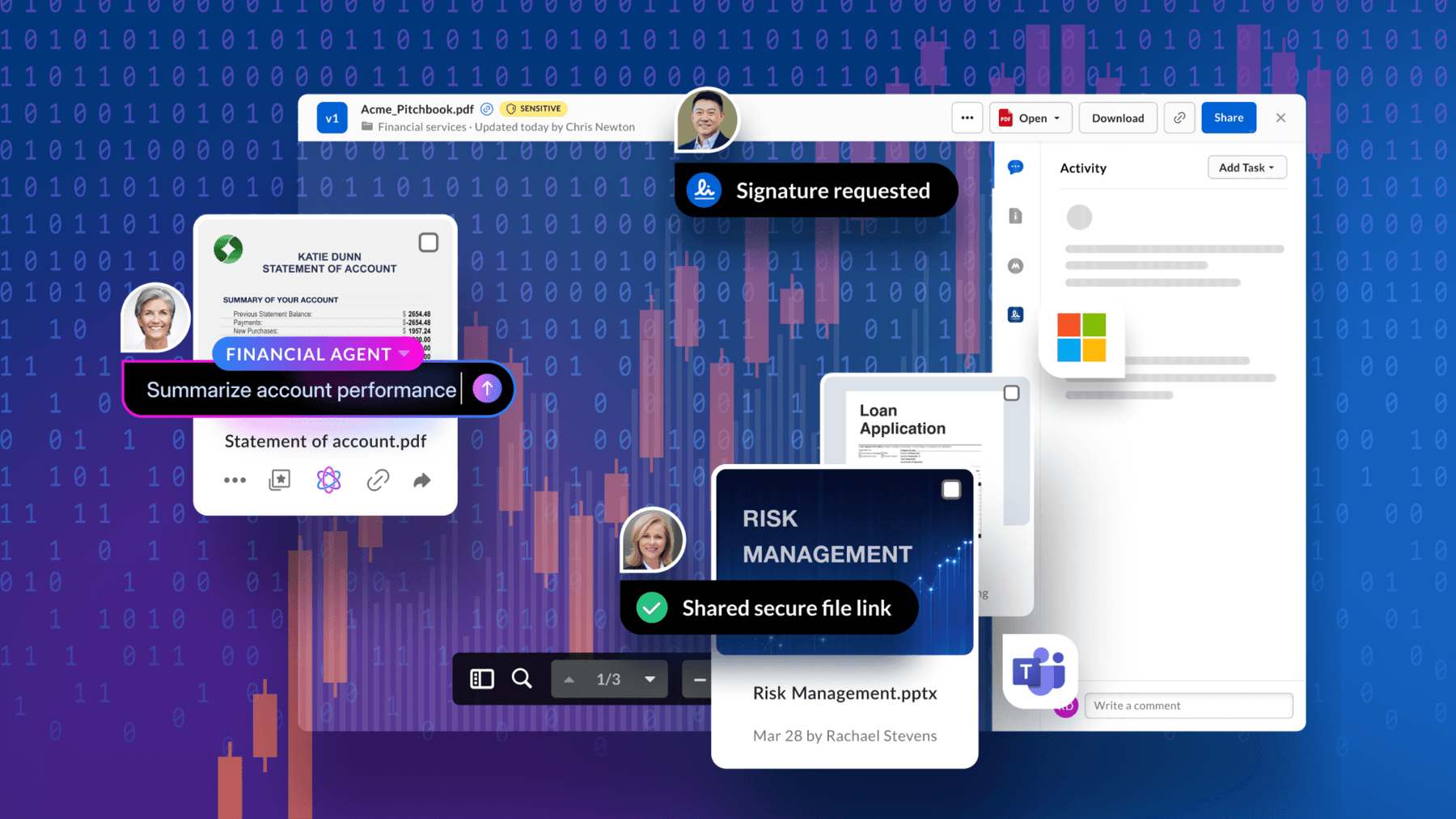
Missing information, manual review, rekeying, and endless follow-ups: Slow onboarding sabotages client experiences and keeps you from building loyalty with your customers.
Thankfully, AI is rewriting that story. Today, firms across banking, wealth management, and insurance are putting documents to work to move high-friction processes forward faster — while keeping people in control of the decisions that require judgment. From the policyholder waiting on a claim, to the retiree submitting a lengthy onboarding packet, you can make document-heavy interactions faster, clearer, and easier to manage.
Read on as we dive deeper into today’s most powerful use cases.
Key takeaways:
- Client-first outcomes start with improved clarity, fewer handoffs, and human-in-the-loop controls that build trust
- Data extracted from content provides the context behind service, audit readiness, safer operations, and automation at scale
- Start with high-friction business processes like policy issuance, onboarding, claims, and loan origination, then use agents to drive operational efficiency
- Box Shield Pro applies classification and granular access controls, accelerates threat analysis, and safeguards against ransomware attacks
- Firms pilot and scale workflows with a focus on iteration and improving over time

AI is poised to transform every corner of financial services. It’s the ultimate accelerator, giving businesses the edge they need to automate workflows and enhance risk management. Ascensus’ Director of Client Services Victor Leznik captured the north star, “It’s about serving our customer base, which spans from when you first go into the workforce until you retire. So how do you digitize all that content?”
For Ascensus, it starts with centralizing scattered history locked away in network files — so teams can find what they need and eliminate friction in moments that matter. “You’d spend a lot of time trying to sift through the data, understand it. AI saves a lot of time and money,” Leznik explained.
In Box Hubs, AI can organize content by categories like plan documents, KYC reviews, and claims. With policy-driven structures, teams see only what they need (and nothing they shouldn’t). Meanwhile, Box Extract can pull key metadata (effective dates, client IDs, addresses, terms), and Box Apps leverages that data to power metadata-based dashboards and views that surface the right content at the right time and speed up financial workflows.
Faster onboarding and stronger assurance
In a KYC onboarding flow, a financial institution’s portal or app can collect client documents while Box sits behind the experience as the governed document layer. The institution still determines what evidence is required, and its existing systems continue to handle identity verification, fraud, screening, and compliance decisions.
AI helps teams work through the document-intensive part of the process by:
- Auto-classifying sensitive documents using contextual analysis with Box Shield Pro
- Summarizing long documents for review, pulling key fields with Box Extract
- Checking documents for completeness and consistency, including missing fields, expired information, or mismatched names and addresses
- Routing flagged items to people for review while preserving actions for the audit trail
That shifts time away from reading, rekeying, and comparing documents by hand. People still make compliance decisions, while AI helps surface the information and exceptions they need to review.
By storing extracted details as metadata, teams can build KYC dashboards, track review queues, and trigger next steps via API (e.g., send to a third-party KYC service, request additional supporting docs, or escalate to enhanced due diligence). Information can then move into the onboarding, verification, or other systems already supporting the process.
The outcome is a clearer, quicker client experience with stronger guardrails — or what Box Staff Solutions Engineer Cian Mulderrig called “the power of Box agentic workflows.”

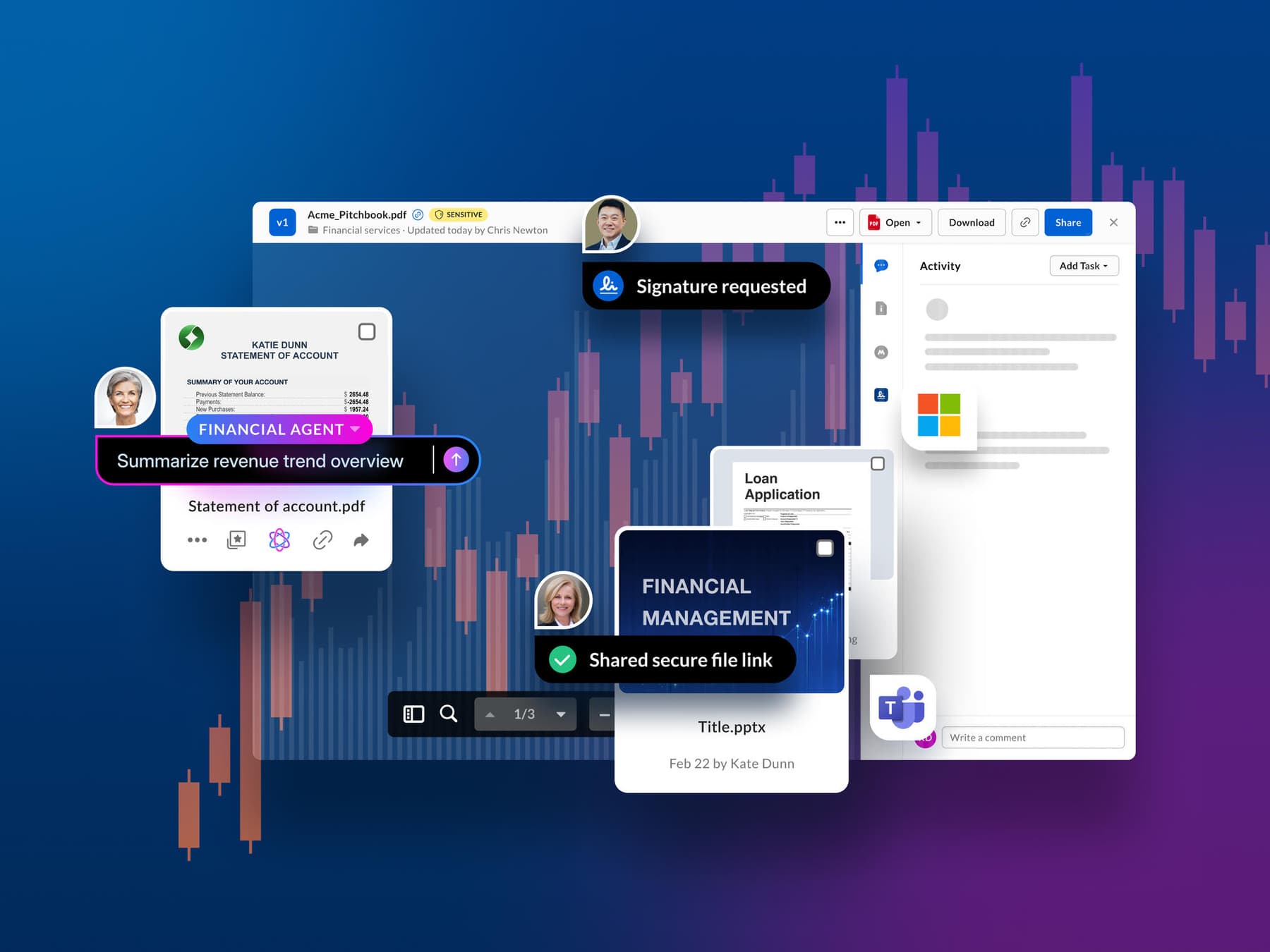
Financial applications of AI span workflows, from KYC onboarding to claims processing.
Claims and underwriting: Compressing cycle time without cutting corners
USAA’s Shane Enstad, AVP of Product Engineering, described a workflow for small auto losses where members upload vehicle photos, content lands in Box, a workflow routes to an adjuster, and payments go out in “a day or two” versus weeks.
In underwriting, agentic AI shines at evidence assembly and risk clarity. Brokers and carriers exchange loss runs, third party reports, and policy terms. With Box Extract, teams pull critical information from unstructured data, while Box AI summarizes long attachments into readable briefs.
Knowledge management: Make answers readable, findable, and current
LPL Financial’s Stephen Chien, Head of AI Advisor Solutions, said Box Hubs helps tens of thousands of advisors manage variations across affiliations; and Box AI drafts articles from anonymized call transcripts.
“We keep a human in the loop, but the first draft gets us 30% of the way and speeds everything up,” Chien said.
This is where retrieval-augmented generation (RAG) adds discipline. Instead of freeform answers, Box AI grounds responses in specific documents, cites them, and keeps sensitive data governed. The result: answers that are both fast and auditable.
Records, reporting, and audits: Be prepared before regulators request
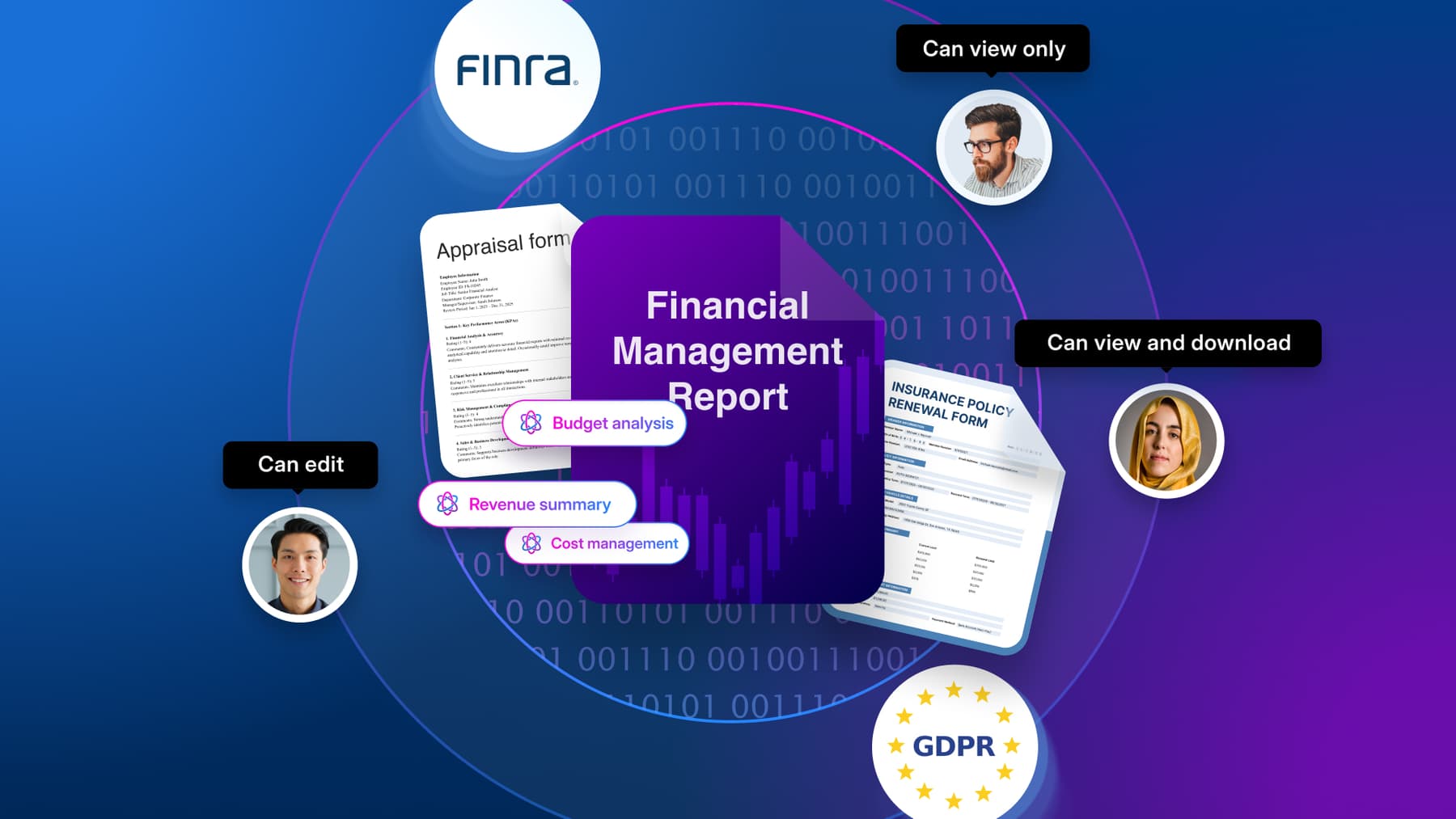
Regulatory scrutiny isn’t slowing down. The best time to prepare is before the request arrives. With extracted metadata living alongside content, teams can:
- See which investor contracts renew in the next six months and flag risky terms
- Assemble regulatory reports from verified fields instead of manual copy‑paste
- Validate controls with AI classification, strict permissioning, and thorough access logging
One example: A firm used Box Extract to identify compliance‑relevant fields across 750,000+ documents in a single weekend to get audit‑ready. That’s not a trophy metric, it’s time back to serve clients and reduce disruption when auditors come knocking.
The same principle applies to the client lifecycle: Documents collected during onboarding can become part of a governed evidence record instead of being scattered across inboxes and shared drives when operations or examiners need them later.
Along with newfound speed in governance, teams can accelerate threat responses with agentic insights, and proactively strengthen their security posture against evolving threats like ransomware. Manoj Asnani, VP of Product Management, Security, Privacy, Compliance & Governance Products at Box, addressed the magnitude of these advancements:
“SecOps teams are dealing with a number of alerts on an ongoing basis,” he said. “They have to deal with 1.3 million alerts on average per year. That’s a massive number, and these alerts require filtering, prioritization, analysis, and investigation to be able to respond, and because of time constraints, these teams now have to make really hard trade-offs. That’s the problem we’re going to solve.”
Flexibility as a key to future success
Financial leaders emphasized two realities: keep humans in control, and don’t lock into brittle architectures. For onboarding teams in particular, modernization doesn’t require replacing the policy, verification, case-management, or core systems already doing their jobs. The opportunity is to make the document work moving between those systems easier to manage. Here’s how Box supports both:
- Box Platform and search: Unify content from legacy stores; make it discoverable with permissions intact
- Box Shield Pro: Delivers more flexible, context-driven classification securing more types of content, while empowering security teams to remediate sophisticated threats faster and more efficiently
- Box Extract: Use agentic extraction to apply structured metadata to documents and automate downstream processing
- Box Apps: Build intelligent, no-code apps for reviewers, advisors, and operations teams to manage metadata and workflows in one place
- Box AI with RAG: Answer questions by grounding in approved content; summarize, compare, and draft with citations
- APIs and Box Automate: Orchestrate end‑to‑end workflows with your preferred systems of record; stitch tasks across agents, then adapt as models and methods evolve
Box customers suggest aiming for an agent catalog, an interoperability layer to stitch agents together, and the flexibility to plug and unplug as tech changes. That’s how you stay pragmatic and current without painting yourself into a corner.

Box AI offers flexibility with leading models, while protecting content in a secure platform.
Fail fast to succeed faster
Customers shared how financial institutions can confidently navigate complexity and drive meaningful transformation from the inside out. Northern Trust’s Siddhesh Sawant, Sr. Principal Enterprise Architect, SVP, described “islands of innovation,” where employees first witness the power of AI on a smaller scale — and become change agents.
These smaller deployments give teams a place to learn what works before applying the approach to more regulated or client-facing processes.
The phrase “Islands of innovation", is used to describe the instance where employees first witness the power of AI on a smaller scale — and then become change agents.
“Learn lessons, improve, and then apply them to more regulated, more external facing, customer facing processes,” another Box customer added.
And finally, the value of practical, hands-on application can’t be overstated. “The immediate proof of concept and demo goes way further than the PowerPoint slide that you create,” Sawant said.
Financial services leaders have the opportunity to create value where document friction once slowed client journeys. In onboarding, that means making content easier to collect, review, route, and preserve, while keeping people in control of the decisions that matter. From KYC to claims and audits, that’s where Content + AI can turn faster document work into better service.