Agentic AI governance is the disciplined management of delegated authority granted to autonomous AI systems that plan and execute actions on behalf of an organization. It defines what an agent can access, which tools it can invoke, and which actions it can take without human confirmation — and it continuously verifies that those boundaries hold during live operation. Unlike traditional AI governance, which focuses on the quality of model outputs, agentic AI governance is fundamentally an authority control problem: the governance question is not "is the answer correct?" but "is the action authorized?"
This guide is written for chief AI officers, CISOs, heads of risk and compliance, and enterprise architects deploying autonomous agents into operational workflows — particularly content- and data-intensive workflows where agents read, write, and route enterprise information. It covers the risks unique to agentic systems, an eight-step implementation framework, where governance applies across the agent lifecycle, how Box approaches agentic governance at the content layer, and the standards and regulations that shape program design.
Why agentic AI governance matters now
Earlier AI tools produced outputs — summaries, predictions, classifications — that humans then acted upon. Agentic systems invert that relationship. They receive a goal, construct a plan, select tools, and execute across business systems, often without pausing for human confirmation. The shift from "AI advises" to "AI acts" fundamentally changes the nature of organizational risk.
Most existing AI governance programs were designed for the prior era. They focus on training-time controls — bias testing, data quality review, explainability requirements — that address model quality, not operational authority. When an agent can initiate a vendor payment, modify a database record, or trigger a downstream workflow, training-time assurances are not enough.
How agentic AI governance differs from traditional AI governance
Traditional AI governance is designed for systems that generate outputs for people to review. Its main concerns are output quality: accuracy, fairness, interpretability, and the integrity of the data and processes behind the result.
Agentic AI systems do more than generate answers. They can plan multi-step workflows, use tools, call APIs, read from and write to live systems, and even coordinate other agents to complete a delegated objective. Instead of producing a single response, they can take a sequence of actions over time.
This creates two distinct risk profiles:
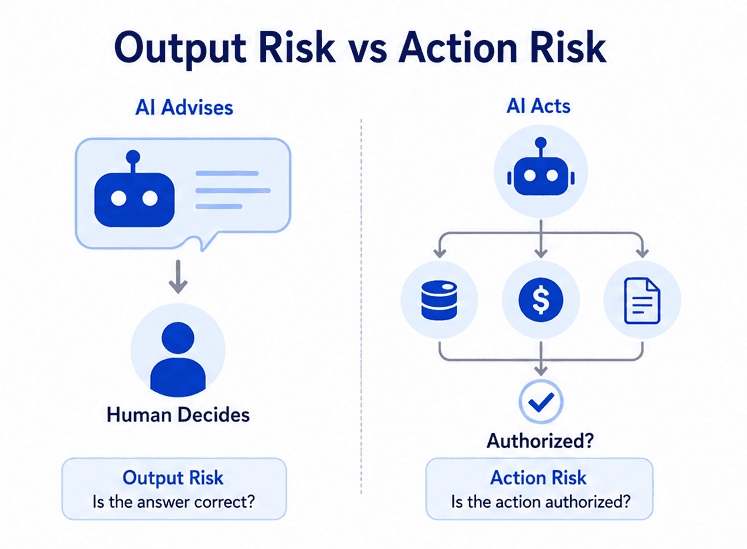
- Output risk (traditional): Is the response accurate, fair, and compliant? The concern is the quality of what the system says.
- Action risk (agentic): Is the action taken within authorized bounds? The concern is the legitimacy and scope of what the system does.
Traditional AI governance is a quality assurance discipline. Agentic AI governance is an authority control discipline. The two require different frameworks, controls, and oversight structures.
What are the main risks of AI agents?
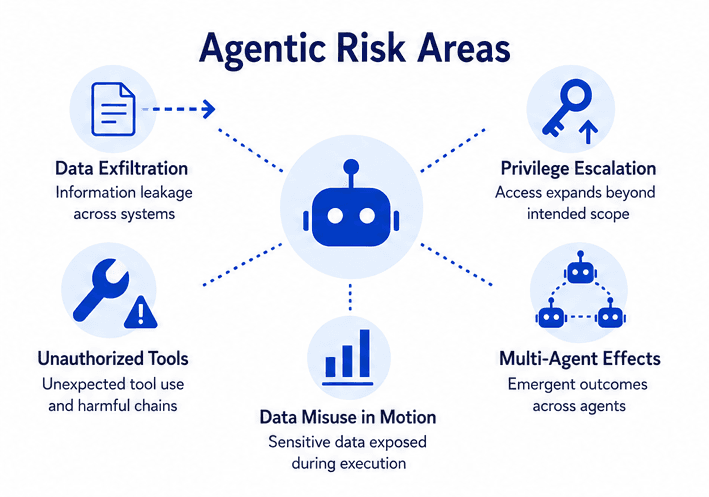
Agentic risk spans execution, identity, data, coordination, and accountability. A governance program designed for one of these dimensions will leave the others exposed.
AI data exfiltration and intellectual property leakage: Agents can access sensitive information across multiple systems and expose it through normal workflows in ways traditional security controls may miss. Unlike conventional insider threats, data leakage can occur during routine tasks — summarizing documents, generating code, or creating reports — making continuous monitoring and strict data boundaries essential.
Loss of execution control: When permitted actions are not precisely defined, multi-step task chains can carry an agent beyond its intended operating area. A routine process can extend into systems, records, or actions that were never explicitly authorized.
Unauthorized tool invocation: Agents dynamically select which tools to call at runtime. Static configuration reviews can confirm that individual tools are properly permissioned, but they cannot anticipate which combinations of tool calls will be chained together. A sequence of individually authorized calls can create an effective access pathway no single call was meant to open.
Privilege escalation: Agents act through service identities — accounts, credentials, and tokens. In multi-agent environments, when one agent orchestrates another, it can pass along access that exceeds the receiving agent's intended scope. This cross-agent escalation vector does not appear in any single agent's permission review.
Data misuse in motion: Most data governance frameworks focus on training data and data at rest. Agents process and relay sensitive data continuously during execution — between APIs, into other agents' context windows, into temporary memory. Agentic governance must extend to data-in-motion at runtime. This is where content-layer controls — classification, access policy, and audit logging applied at the file and metadata level — become critical.
Emergent multi-agent effects: When multiple agents share an environment, each behaving correctly in isolation, their combined actions can produce system-level outcomes no individual audit would predict.
Accountability diffusion: Authority is distributed across model providers, platform operators, integrators, and the deploying organization. Without explicit pre-deployment ownership assignments, the question "who is responsible?" becomes unanswerable after an incident.
Drift over time: Environments change: new data sources, updated APIs, evolving processes. In agentic systems, drift is best understood as authority expansion, not performance decay. The agent's operating context grows incrementally, and its effective scope grows with it — not because anyone intended it, but because no one was watching for it.
Who is responsible when AI agents act autonomously?
Delegating authority to an autonomous agent does not transfer the responsibility that comes with it. Responsibility spans:
- Model providers — shape system capabilities and behavioral tendencies.
- Platform operators — establish technical environment and constraints.
- Integrators — configure tool connections and workflow logic.
- Deploying organizations — authorize scope, define use cases, and set autonomy levels.
The deploying organization bears primary accountability for operational outcomes. It sets the authority envelope, approves the risk trade-offs, and decides which actions the agent may take independently.
That accountability requires named ownership before deployment, including individuals responsible for: monitoring agent behavior against objectives; approving actions that exceed autonomy thresholds; investigating anomalous outcomes; and authorizing suspension or shutdown.
How to implement agentic AI governance: 8 steps
1. Define the agent's scope and authority. Document purpose, permitted actions, authorized resources — and explicitly document what the agent is not permitted to do. Treat the prohibited actions list as a primary governance artifact.
2. Map identity and access boundaries. Provision service identities under strict least-privilege. In multi-agent architectures, ensure a receiving agent's authority does not expand simply because the orchestrating agent holds broader access.
3. Conduct a pre-deployment impact assessment. Evaluate financial, operational, legal, and reputational exposure. Scale assessment depth to autonomy level — autonomy is the most practical indicator of review depth required.
4. Establish runtime controls. Implement tool invocation limits, execution path constraints, and escalation triggers as infrastructure separated from the model's reasoning. Controls that depend on the agent cooperating with its own constraints are not reliably enforceable.
5. Implement logging and traceability. Capture tool calls and parameters, data access events, intermediate reasoning steps, escalation triggers, and the service identity behind each action. These records support audit compliance, incident investigation, and continuous improvement.
6. Define human oversight thresholds. Map the oversight model to each action type:
- Human-in-the-loop: Approval required before action. Used where stakes are high, irreversible, or externally visible.
- Human-on-the-loop: Agent proceeds, human monitors and can intervene. Used where speed matters and actions are recoverable.
- Human-out-of-the-loop: Agent operates autonomously within audited bounds. Used for low-stakes, high-volume actions where post-hoc review is sufficient.
7. Plan incident response and shutdown mechanisms. Validate isolation and shutdown capabilities before deployment. Define in advance who has authority to halt execution and under what conditions.
8. Establish ongoing evaluation and drift monitoring. Track scope-boundary integrity as a primary monitoring metric — drift that shows up as permission expansion often precedes drift that shows up as harmful outcomes.
How Box approaches agentic AI governance
Box governs agentic AI at the data and content layer where agents often work: reading, writing, routing, and acting on enterprise information. With Box, agents can operate with the same security and compliance boundaries that apply to human users.
Box's approach covers two scenarios: agents built natively on Box, and external agents that connect to Box-managed content from outside.
For native Box agents:
- Customer data is never used to train AI models. What an agent reads to complete a task stays within your environment — it is not fed back into model training or improvement.
- Agents can only retrieve what they're authorized to see. Access policies are enforced at the moment of retrieval, not checked afterward. An agent cannot surface content the acting identity isn't permitted to access.
- Compliance coverage extends to agent activity. Data residency, retention policies, legal hold, and audit logging apply to what agents do — not just what people do.
For external agents (Microsoft Copilot, Claude, Gemini, and others) that need access to Box content, Box provides a governed integration layer built on the Model Context Protocol (MCP):
- One auditable access point, not a tangle of ad hoc connections. All external agent traffic flows through a single, controllable pathway — making it practical to monitor, restrict, or revoke access.
- The same permission model applies. External agents can't access content the user or service account they act on behalf of isn't authorized to see — regardless of what their own platform would otherwise allow.
- Compliance requirements don't get bypassed. Data residency, retention, and audit obligations hold even when an external agent is in the execution path.
Box treats content governance as infrastructure. Controls are enforced at the content layer rather than bolted on.
Agentic AI governance FAQs
Who bears liability when an AI agent causes harm? Generally, liability rests with the deploying organization. Model providers and platform operators may contribute to conditions that enabled harm, but they do not absorb the deploying organization's accountability for how authority was granted and overseen.
What documentation should an AI agent deployment include? Defined purpose and authority scope, explicit permitted and prohibited actions, service identity specifications, pre-deployment impact assessment findings, assigned oversight roles and escalation procedures, incident response protocols, and operational logs maintained throughout the agent's lifecycle.
What makes an AI system "agentic" from a governance perspective? It crosses into agentic territory when it moves from generating outputs for human review to initiating actions in live systems — planning multi-step workflows, invoking tools at runtime, and executing under delegated authority with limited human confirmation per step.