As Box CEO Aaron Levie said onstage at Box's Virtual Summit, "the real impact of AI agents isn’t just what we do with them as individuals, but when you think about deploying them in a workflow or a business process across the enterprise."
Over the past year, agents that can answer questions and chat back and forth have evolved into agents that can execute on nearly any type of task that humans give them. And even as those tasks increase in scale and volume, we’re also seeing a steady increase in the complexity of the work our agents can deliver on.

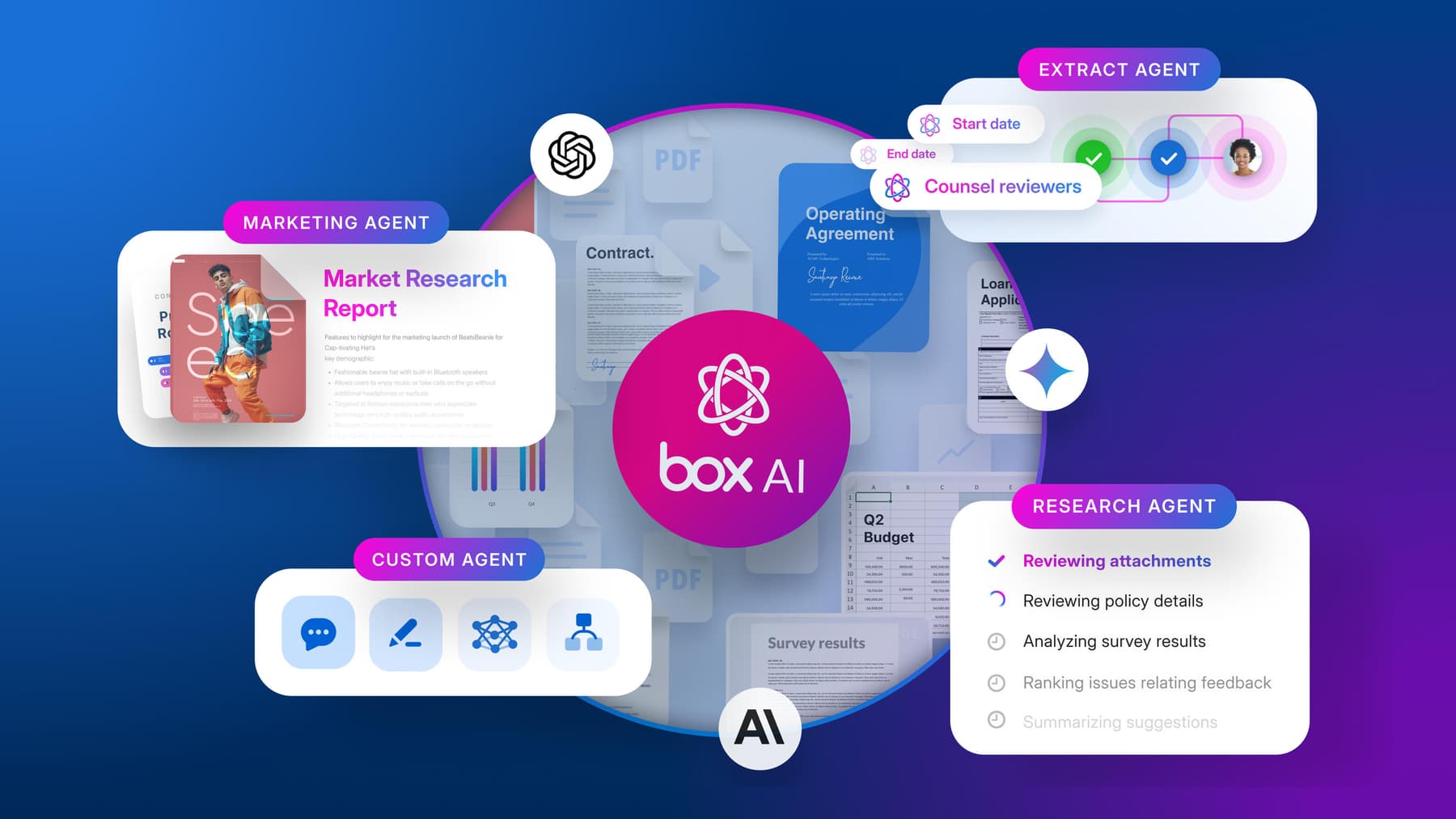
What happens when we can deploy fleets of agents to automate multiple workflows within business processes? Imagine if every employee in your company had access to expert analysts, researchers, and domain experts in engineering, legal, marketing, and sales — all of whom could work a thousand times faster than humans.
At the Virtual Summit, a series of Box speakers described the agentic opportunity that’s now available to every organization — and the necessity of understanding and embracing the operational elements that will enable them to make the most of it.
Why enterprise AI breaks without business context
The first wave of AI has been about accelerating knowledge work: answering questions faster, bringing expertise to more problems, helping review contracts, analyze financials, and surface insights from product materials.
AI agents’ greatest impact will be felt as we begin to deploy them inside our most complex business processes.
AI agents’ greatest impact, though, will be felt as we begin to deploy them inside our most complex business processes: accelerating client onboarding, automating approvals, personalizing marketing for specific segments and regions, reducing business risk by studying the data landscape to discover issues and improve compliance and security.
But there are real challenges on the road to making this vision a reality.
Unstructured content is the missing layer
Large language models are incredibly powerful, but their training on vast amounts of information from the public internet doesn’t ground them in the specific context of your business: your product specifications, research, marketing assets, HR policies — all the knowledge that makes your company unique.
We can only unlock the true power of artificial intelligence when we can successfully and securely connect AI agents to those oceans of unstructured enterprise content.
And the vast majority of that knowledge — your organization’s essential context — lives in unstructured content: the materials that help launch products, the financial records that close the books, the brand guidelines that define marketing materials, the resources that let sales reps answer customer questions, and the contracts that close deals.
“All that information is living right now in our unstructured data,” Levie observed, “but we've never been able to automate any of the work on it.” We can only unlock the true power of artificial intelligence when we can successfully and securely connect AI agents to those oceans of unstructured enterprise content.
Fragmented content creates risk at scale
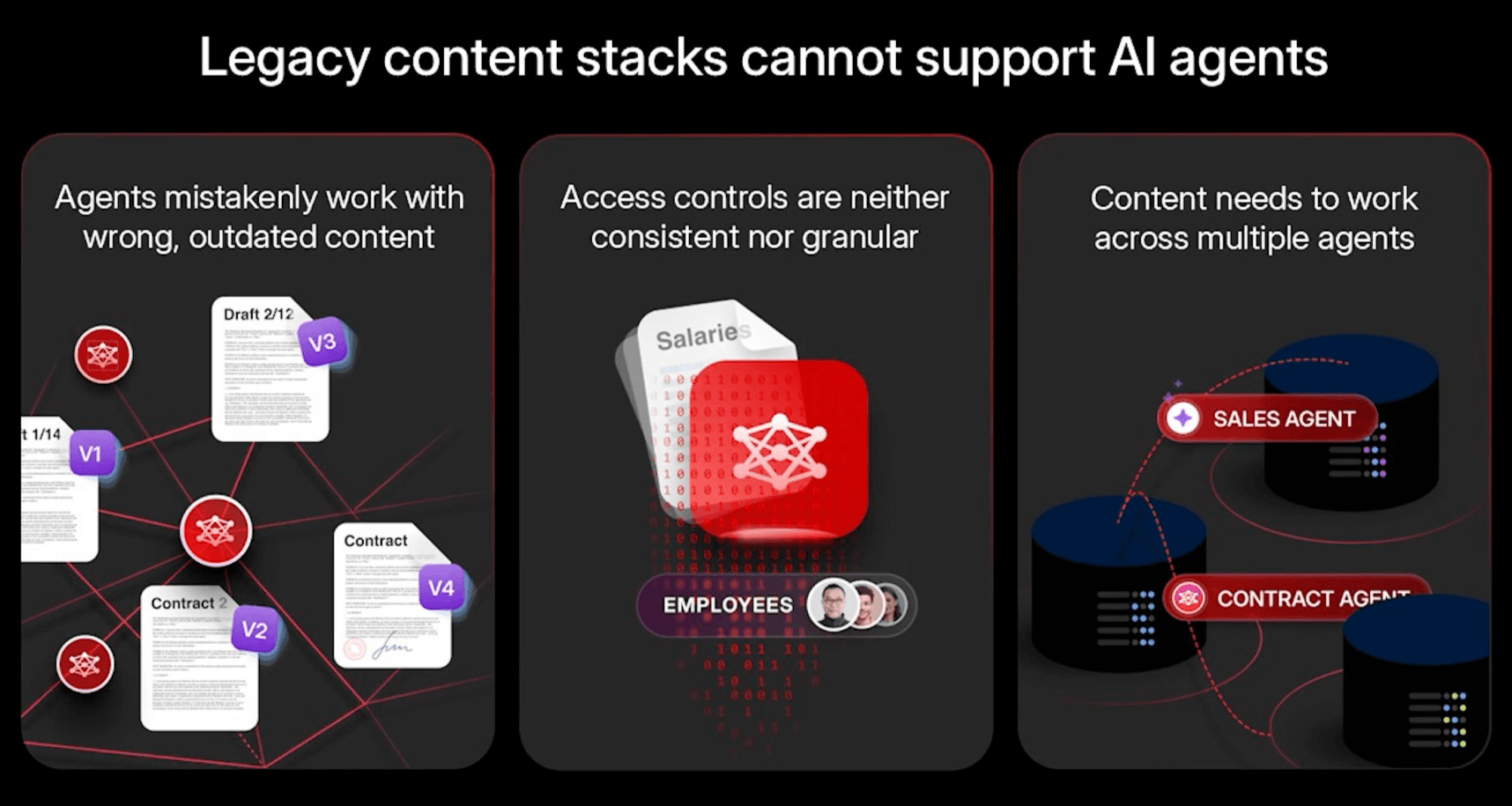
“The way most organizations manage unstructured data,” Levie said, “is fundamentally broken. Content tends to be fragmented across a wide variety of systems: network file sharers, document management systems, collaboration tools. Even content in the cloud might be in fragmented environments, or environments that don't work well for getting information to agents.”
That fragmentation, which makes data harder to access, less secure, and more expensive to manage, has long been an industry problem. In the AI era it has become a truly existential challenge.
The way most organizations manage unstructured data simply won’t work in a future where AI agents outnumber their human counterparts by 100 or even 1,000 to one.
Every silo creates risk. AI agents are vulnerable to pulling the wrong data or drawing from outdated sources. As access controls become harder to manage across systems, agents may lack the information they need in some cases and have too much access in others.
And as enterprises work with multiple agent systems at once, the complexity only grows. “The way we manage content today,” said Levie, “simply won’t work in a future where AI agents outnumber their human counterparts by 100 or even 1,000 to one.”
A file system for the AI era
That’s why every enterprise — no matter what products and services it offers, what workflows it devises, what customers it serves — needs a platform that can securely manage, organize, store, and govern its most important enterprise information and connect it to the full stack of agents you want to work with.
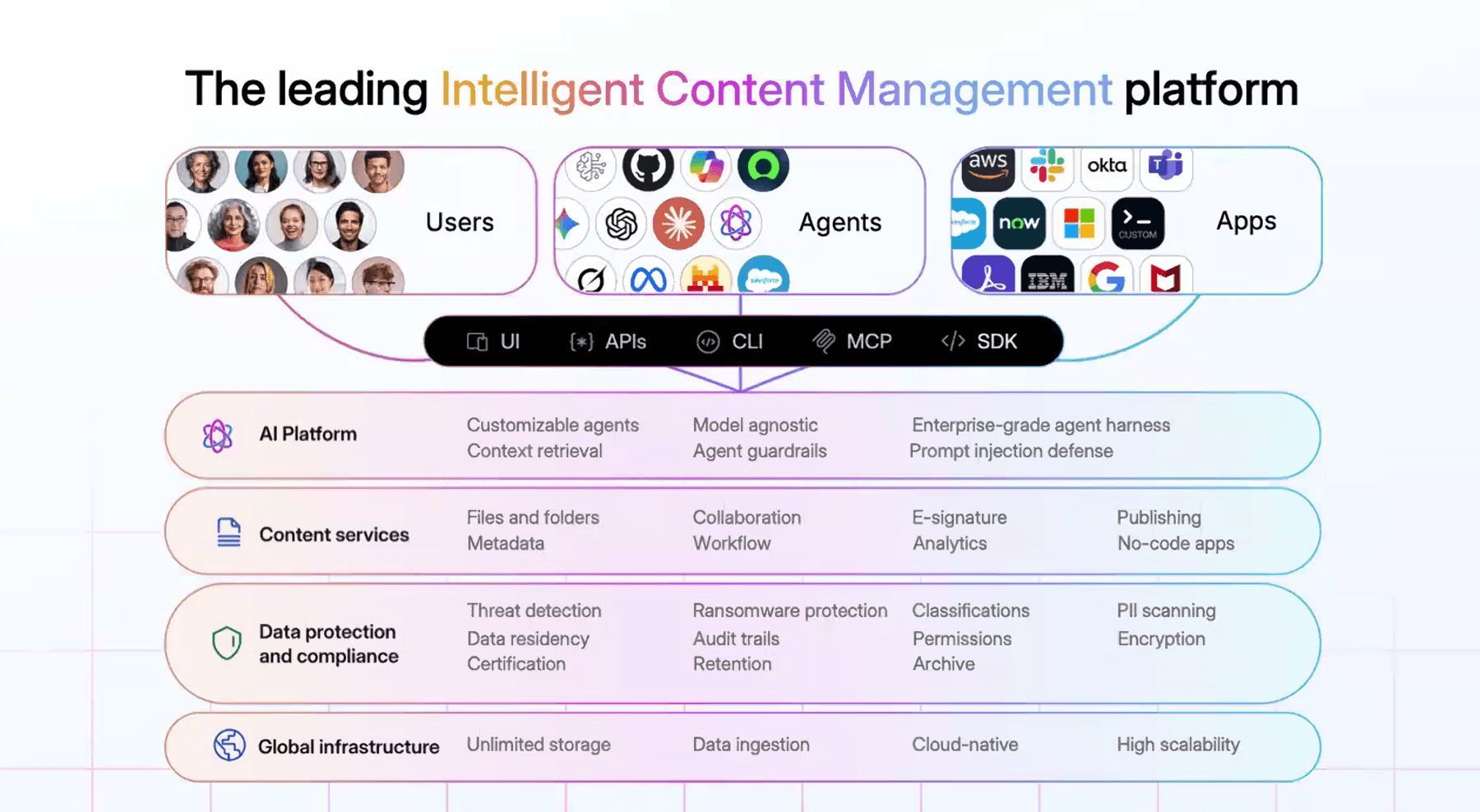
You need infrastructure that can handle content at massive scale, security and compliance layers that let you use AI in critical workflows, content services that can manage billions of files and automate processes around them, and an AI layer that lets you connect that content to the best models and agentic systems.
Every enterprise needs a platform that can securely manage, organize, store, and govern its most important enterprise information and connect it to the full stack of agents you want to work with.
The Box Intelligent Content Management platform can securely manage, organize, store and govern your most important and sensitive enterprise information, and then connect it up with the full stack of agents you want to wield. We work with more than 120,000 organizations globally, from some of the fastest-growing companies to industrial giants transforming how the world operates every day. And what we see across these organizations is AI moving from isolated productivity gains to workflow transformation.
Box offers you a single platform that connects your people, agents, and applications to your enterprise content via one security layer, architected specifically for the age of AI agents.
Box is designed from the ground up to enable that shift. We provide a single, secure platform that connects people, agents, and applications to enterprise content. Instead of fragmenting data across systems, Box gives organizations one place to manage their most important information and make it available wherever users are working and wherever agents are being deployed.
And we do so securely. That’s crucial. Security and governance must be foundational to the content layer, rather than bolted on as an afterthought. Box offers you a single platform that connects your people, agents, and applications to your enterprise content via one security layer, architected specifically for the age of AI agents.
The path from knowledge work to agentic workflow transformation
First, organizations use AI agents to accelerate knowledge work. Then they begin mining unstructured data at scale — extracting information from contracts, invoices, financial assets, and brand imagery. Finally, once that unstructured data is in sync with powerful, long-running agents, they can begin to transform their business processes with agentic workflows.
But these enterprise workflows only work when agents have the right context, the right guardrails, and the right platform underneath them.
That’s the road we’re all traveling down. Check out the full Virtual Summit to learn how we can help you on your AI transformation journey.