Bolt partnered with Box to automate its HR compliance workflows, turning a two-year manual audit backlog into a process that takes minutes.
Aire Vaigu’s team had been sitting on a goldmine of employee data they couldn’t actually use. The urban motility platform, which operates ride-hailing, car sharing, scooters, and e-bikes across more than 50 countries and 870 cities, had over 170,000 employee documents stored in Box. But they weren’t taking full advantage of the information within those documents.
As Senior Manager of Global People Operations at Bolt, Vaigu’s role is not just to finetune workflows but sometimes to rethink them entirely. Bolt was already using Box — but not to its full potential as an Intelligent Content Management platform with automated workflow capability. So to clear the document backlog and fix the underlying workflow issues, her team built out a new architecture with Box Automate to route documents, Box Extract to tag metadata automatically, and Box Apps to surface everything in a queryable dashboard.
By doing so, Bolt transformed weeks of manual contract and compliance checks into a seamless, automated process that empowers its people operations team to shift from manual executors to strategic reviewers.
Key takeaways:
- Bolt used Box to automate document organization and metadata tagging, turning a manual compliance audit that would have taken two years to complete into an instant, queryable process
- By integrating Box with Workday, Bolt established a unified content layer where Box Automate automatically renames, organizes, and routes incoming employee documents to their correct folders
- Automating repetitive document checks has transformed Bolt’s people operations team from manual data executors into strategic reviewers who can focus on tasks requiring human judgment
170K documents and a 2-year audit backlog
With over 4,000 employees, Bolt’s people operations team manages the full employee lifecycle, from the moment a candidate accepts an offer through every significant milestone to their last day. That means a constant flow of documents: contracts, remote work agreements, termination letters, and more, all coming in from multiple sources and platforms.
The People Operations team had already been using Box for content collaboration for a few years, but they weren’t taking advantage of the full capabilities of Intelligent Content Management. After migrating volumes of documents from previous content platforms, most of those files sat in Box, without ever being audited. At various times, various people had leaned into various file-naming conventions, leaving the folder structure inconsistent and hard to navigate. When a compliance question came in, for instance, the team had to open documents one by one to find the answer.
Vaigu did the math on manually auditing all of this content. “I actually did this little calculation on how long it would take us to audit those files,” she says. “On top of our day-to-day workload, it would take us two years.”
But without a full content audit, the team was stuck in reactive mode, spending their time on manual document checks instead of the work that requires real human judgment.
Automating contract renewal workflow
There was another way of doing things, and it came up in conversations around contract renewal. When Vaigu raised the issue of manual processes, the Box team came back with a demo that showed her what was possible with Intelligent Content Management. “They opened my eyes in terms of what Box can offer us,” she says.
Bolt built a new, automated workflow on top of Box. It connects two document sources: files generated in Box and files coming from Workday, the HR information system. With the Box + Workday integration, it became possible to create a unified content layer in order to automate workflows that rely upon information from both sources.


Here’s how it works:
- Box Automate handles the routing: When a document arrives, Box automatically renames the file according to a consistent naming convention, checks whether the correct folder exists, creates a folder (and all subfolders) if it doesn’t, and routes the document to the right place
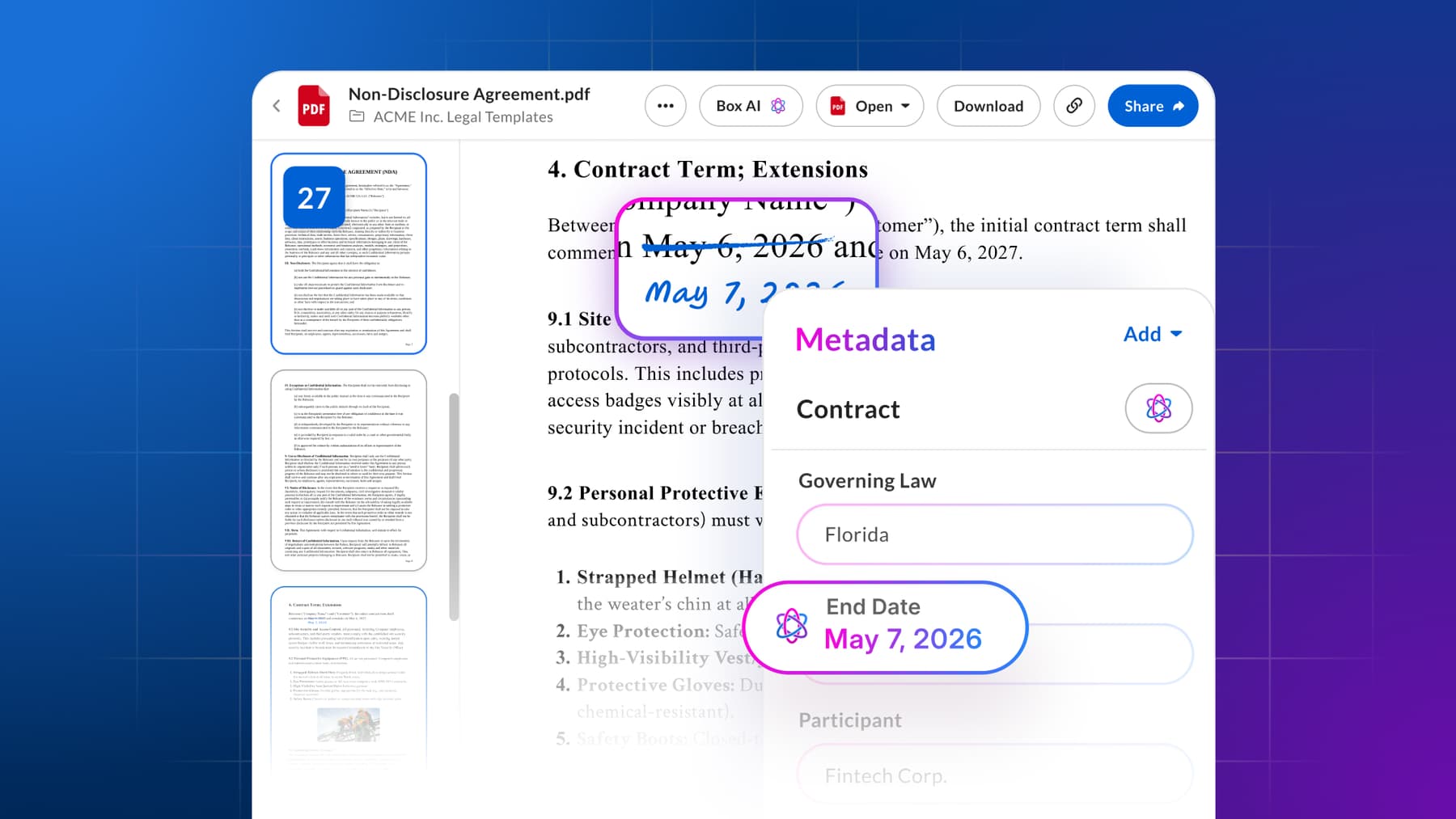
- Box Extract then reads the document and fills in metadata fields automatically in order to tag specific kinds of information
- Box Apps surfaces all of that structured data in a dashboard that the team can query instantly
The practical impact of this new structure is significant. When a compliance question comes in, such as how many remote workers Bolt has in Belgium, the answer is no longer buried in a stack of individual documents. “I’ll open my Box Apps dashboard, and I can say that out of 55 employees, 20 of them have a remote work clause,” Vaigu explains.
What used to take weeks or months to answer can now take minutes.
Getting rid of the backlog with AI
Next, Bolt is planning to use Box AI to tackle the existing backlog of 170,000 documents. Box AI will take a first pass at file naming, flag issues, and extract metadata. The people operations team will then serve as the quality check — not doing the manual work themselves, but owning the standard.
“Instead of checking documents one by one, the answers will be immediate,” Vaigu says. “And that frees my team’s time up to do things that need human judgment.”
Instead of checking documents one by one, the answers will be immediate, and that frees my team’s time up to do things that need human judgment.
The human shift from executor to reviewer is one of the most meaningful changes the team is making. The work isn’t disappearing, but it’s changing, and Vaigu is clear-eyed about what that means for her team.
“It’s important to be honest with them that the work that they’re doing is fundamentally changing,” she said. “You’re going from doing the manual checks, manual upload, and manual filling in of data — AI will do this for you. Now, you’re doing the tasks that need human judgment.”
Don’t automate a hot mess
As companies grow, documents pile up, naming conventions drift, platforms multiply, and teams that are supposed to be supporting employees spend most of their time hunting down information on computers.
Bolt rejected this status quo by building content-based workflow automation on a thoughtful architecture of Box Automate for workflow routing, Box Extract for metadata extraction, and Box Apps for dashboard visibility, all working together in one system. By doing so, Bolt embedded intelligence into the structure of their HR machine.
Vaigu’s advice to other teams going through a similar transformation is worth taking seriously: “Start with understanding what you need to do before you touch any of the technology. Write down the rules. What do you want to achieve? What are you aiming to do?”
In other words, don’t just tack on automation to your current workflow for the sake of saying you’re using AI. As Vaigu says, “If you’re automating a mess, then you’re creating even more mess for yourself.”