In the building industry, before a shovel ever hits the ground, there’s enough paperwork produced to wallpaper a skyscraper.
AI is reshaping architecture, engineering, and construction (AEC) in a lot of ways. It’s optimizing resource allocation, enabling predictive maintenance on expensive equipment, and monitoring job-site safety with the use of drones.
But AI is also changing the information-management side of AEC, one of the most document-intensive industries in the world. Firms handle contracts, permits, change orders, inspection logs, insurance certificates, worker certifications, and all kinds of records — often across multiple systems and stakeholders.
For many firms, critical information is still trapped in paper forms, PDFs, email threads, network drives, and disconnected systems. That creates friction everywhere: estimators chasing the latest files, project managers reviewing contracts by hand, field teams hunting for answers from the jobsite, and compliance leaders trying to prove that every record is complete and current.
As Deep Analysis notes in a new report, “The AEC sector shows an industry eager for new technology…Yet the core currency of AEC documents and drawings remains constrained by largely manual, expensive, and deeply inefficient systems.”
Instead of treating documents as static records, forward-looking construction organizations use them to create connected, searchable, governed workflows that support both pre-bid and post-win execution. And they do it with AI.
Key takeaways
- AI can speed up pre-bid work by helping teams validate bid packages, compare bids for missing pieces, and generate subcontractor scopes from plans and specs
- AI can reduce compliance bottlenecks by extracting data from documents like certificates of insurance, checking requirements, and routing files automatically with greater speed and accuracy
- Centralized, governed content makes project execution easier by giving teams a single source of truth, with AI improving search across project files and surfacing insights from long unstructured reports
How paper-based processes and disconnected tools fail the building industry
The operational burden of content management is real for construction companies, subcontractors, architecture firms, and others involved in the AEC industry.
The Bay Area general contractor Novo Construction once dealt paper certificates of insurance arriving in envelopes, manual check processing, lien-release workflows, and field documentation that had historically lived on pen and paper. As CIO Colin Stoner describes, “We would have stacks of open envelopes with COIs sitting on the reception desk waiting to get processed.”


National architecture and engineering consulting firm Marx Okubo had valuable information buried in thousands of long, unstructured reports. Teams had to review narrative-heavy documents, often 20 to 200 pages long, to identify materials, deficiencies, and risk signals. Manual review was prohibitively time consuming.
Cleveland Construction, too, faced documentation hurdles at enormous scale. Some projects generated hundreds of thousands of files, while field teams struggled to access information remotely through cumbersome Citrix access. Contract review was another bottleneck, with project managers spending four to eight hours reviewing each contract to extract around 50 critical data points before work could begin.
Different firms. Different workflows. Same core issue: too much critical information, not enough intelligent access.
AI-enabled bidding for faster project wins
Pre-bid work depends on speed and precision. Estimators need the latest plans and specs, teams must quickly distribute bid packages to subcontractors, and decision-makers need confidence that proposals are complete before moving forward.
Cleveland Construction uses Box to support estimating workflows and has built custom AI agents for bid checklist validation, bid leveling, and scope writing. These agents help teams verify proposal completeness faster, compare multiple bids for missing components, and generate subcontractor scopes from plans and specifications.
With Intelligent Content Management, estimating and pre-construction teams can access a more connected environment for reviewing requirements, identifying missing elements, and routing updates without relying on disconnected tools.


Streamlined compliance filing, secure workflows
For AEC firms, AI can significantly reduce the manual burden of compliance filing by extracting key information from incoming documents, checking it against required standards, and routing it to the right place automatically.
For companies managing high volumes of insurance, legal, or regulatory paperwork, this means faster processing, fewer errors, and better visibility into whether critical documents are complete and up to date. Automation based on the right compliance specifications can turn a slow, admin-heavy compliance process into a faster, more reliable workflow, and Box has the following guardrails built in:
- Data protection and privacy: GDPR, CCPA, local data residency laws (especially critical with client files)
- Information security: SOC 2, ISO 27001 certifications; encryption at rest/in transit
- Regulatory and code compliance: Building codes, environmental regulations, accessibility standards (ADA, WCAG)
- Contract and IP management: Clear ownership of designs, subconsultant agreements, licensing terms
- Audit trail and document control: Version history, change tracking, retention policies (legal/regulatory holds)
- Access controls: Role-based permissions, client segregation, external user management
- Export controls: ITAR/EAR restrictions for government/defense projects
At Marx Okubo, onboarding a new government agency client meant sticking to a set of strict data requirements. Matt Hoey, AVP of Technology, explains how the company was “able to stay within our familiar instance of Box and build out a whole new folder structure so we could take advantage of things we didn’t need before.”
Strict security features built into Box — geofencing to restrict access by location, watermarking to protect document integrity, and download prohibitions to prevent unauthorized distribution — meant the team didn’t have to worry about breaching the confidence of the client.
Novo Construction uses Box AI to automate the handling of certificates of insurance (COIs), a document-heavy compliance process that previously required teams to manually review, extract, validate, and file information from incoming COIs. Box AI now extracts key data, checks coverage requirements, and routes documents into the right project folders with 98% accuracy, cutting processing time from hours or even days to minutes.
Novo Construction also uses Box to automate extraction and routing in adjacent document workflows, including manual check processing and lien-release workflows. When financial and operational documents are centralized in a governed system, AI can be applied to nearly any high-friction content workflow to make operations faster, more scalable, and more reliable.

Expedited project organization and document insight
Post-bid, onboarding a new project often means collecting, validating, and organizing a large set of documents: contracts, certificates of insurance, safety records, training records, project files, and other business-critical content.
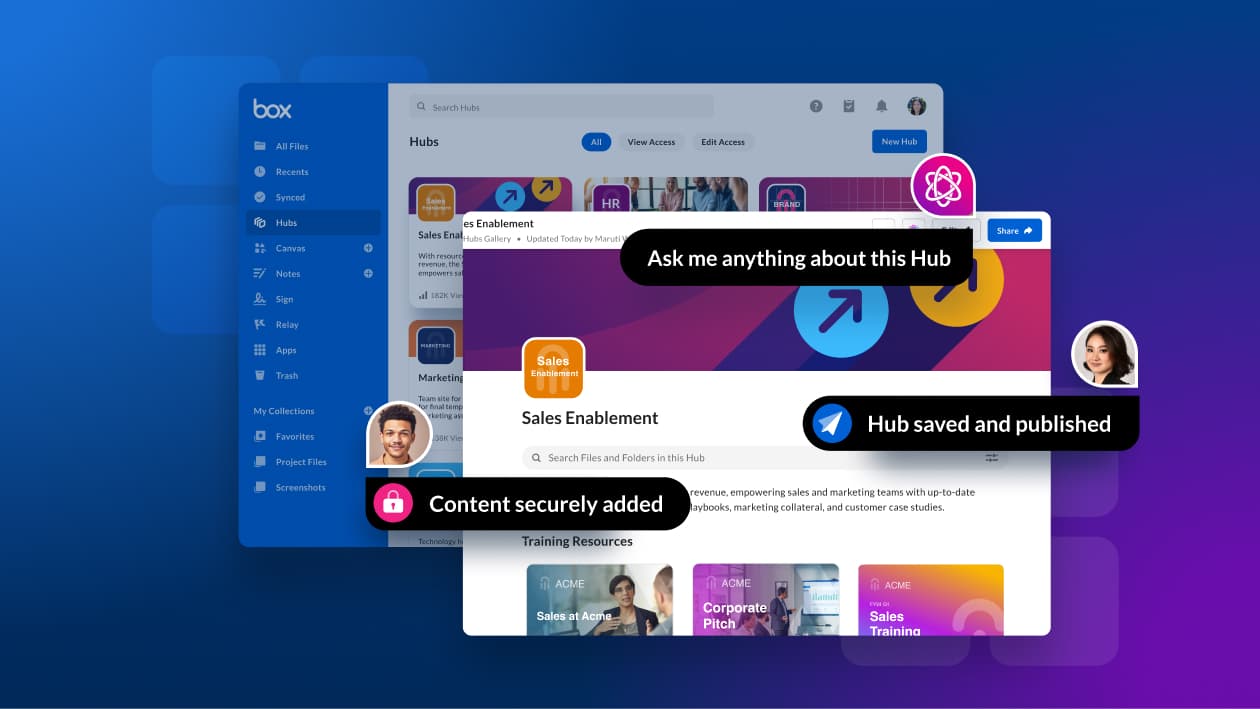
Marx Okubo uses Box Hubs to create centralized portals where teams can organize project-specific content. This content is accessible internally to other team members and externally to clients and partners — with granular permissions applied so no single piece of content gets into the wrong hands. With that level of content governance in place, Marx Okubo can apply Box AI to sort through large volumes of unstructured project information and extract key information.
The ability of a Box Hub to search everything at once makes it a lot more user friendly.
Cleveland Construction used Box to create a more consistent source of truth for project execution, with project-specific Box Hubs, contract review automation, and collaboration workflows that made it easier for teams to work from the same information. That kind of structure is critical when onboarding new projects and coordinating across stakeholders. Elliot Christiansen, Sr. Vice President of Operations, attests: “The ability of a Box Hub to search everything at once makes it a lot more user friendly.”
At Novo Construction, Box has become an extension of the internal project system, helping teams manage project files, automate COI handling, route lien-release workflows through Box Sign, and improve access to safety and project documentation.
In all of these cases, AI helps grab organized context from previously unwieldy content and make AEC project management far easier.
Rich document insight that never existed before
Part of its consulting business requires Marx Okubo’s teams to sort through thousands of detailed reports in an unstructured narrative format. Manually extracting comprehensive information from these documents was "prohibitively cost or time consuming,” according to technical team member Adams Wong-Brooks.
With the Box API, his team custom-built a solution for automatic metadata extraction that could programmatically query relevant files, extract structured data from unstructured content, and apply those metadata values back to the reports. Now, previously inaccessible information is available virtually at the touch of a button.
With project materials easier to organize, access, and search on, teams can turn complex content into project enablement, with faster insight-to-response time on tasks that require information buried within documents.
The new era of construction
Deep Analysis says, “The next five years will see more change in AEC document automation than the last twenty,” driven by labor shortages, tighter regulatory handover requirements, and other factors.
Construction firms don’t need more disconnected tools. They need a better way to bring content, workflows, governance, and advanced AI together on one platform.
Intelligent Content Management is about much more than storage. It’s about helping estimators move faster, reducing friction in finance-related operations, giving project teams a consistent source of truth, and making critical documentation easier to manage at scale.
The opportunity for the building industry is bigger than efficiency alone. It’s about reducing risk, improving access, and helping teams make faster decisions with confidence.
Read more stories of Box architecture, engineering, and construction customers.