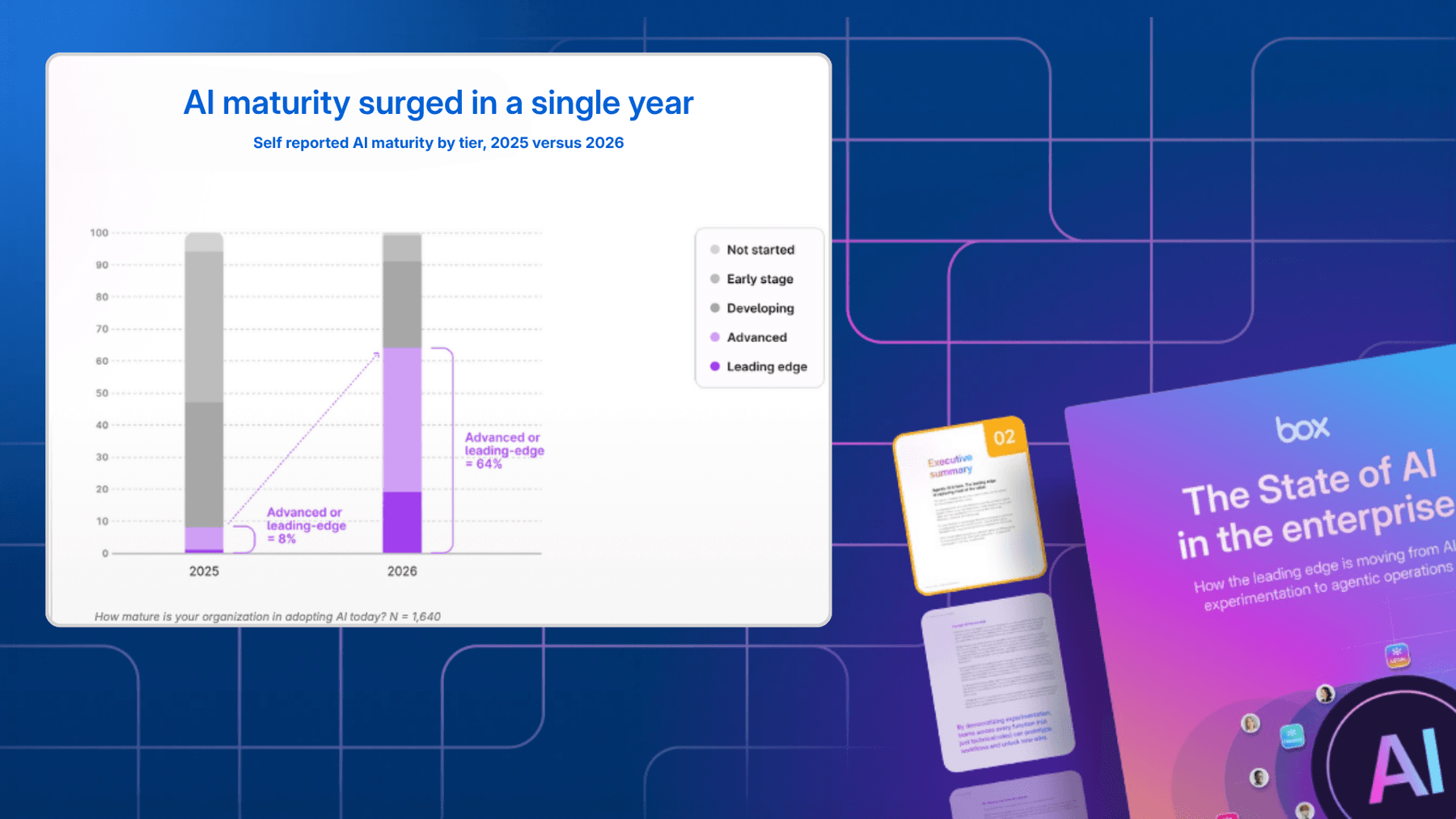
For years, the dominant workforce narrative around AI has been one of subtraction: jobs lost, roles automated away, humans replaced. The fear around how AI will impact work sometimes overshadows the reality happening inside enterprises that have moved beyond AI pilots into real, scaled deployment.
The 1,640 IT decision-makers Box surveyed for our 2026 State of AI in the Enterprise report reveal what’s actually happening: 58% expect their organization’s total headcount to rise over the next three years. Of the most mature companies in terms of AI adoption, that number rises to 79%. Only 9% say AI agents are primarily eliminating roles within their organizations.
A lot of the roles being added fastest barely existed two years ago: agent operators, governance professionals, workflow specialists. Because when AI gets applied not just to isolated tasks but to enterprise content and workflows, entirely new categories of work become possible.
While job elimination because of AI is a valid headline, it’s far from the whole story.
Taking out the busywork, elevating the human work
There are jobs being added in nearly every industry as a direct or indirect result of AI, but they’re not necessarily the same jobs we’ve always seen.
Manufacturing, for instance, created around 620,000 AI-adjacent positions in 2025, largely driven by quality control automation and predictive maintenance. Financial services added 470,000 AI roles in areas including fraud detection, algorithmic trading, and risk assessment. In the skilled trades, AI infrastructure buildout is increasing demand for solar installers (up 42% according to the BLS) and wind turbine technicians (up 50%).
Scrutiny of the job market tells a story of AI increasingly interwoven with human work, elevating all kinds of jobs in surprising ways. Last year, healthcare was the single largest industry creator of AI-related jobs, with 640,000 positions added in areas like automated diagnostics, predictive analytics, and virtual patient support. AI is revolutionizing major aspects of healthcare: auto-documentation of patient interactions, medication flagging, image analysis, risk-flagging, and more. But AI can't replace personal, hands-on care.
Long-overworked nurses stand to benefit tremendously from AI, making them more productive and effective instead of redundant. AI can handle the time-consuming, non-hands-on parts of nursing work like documentation, charting, triage flagging, monitoring alerts, and scheduling so nurses spend more of their hours on actual patient care rather than paperwork and administrative overhead.
AI doesn’t replace the human touch in nursing, but clears away tasks that cut into the time available for it. The ideal scenario is that AI makes nursing a more desirable, effective, and satisfying job — just in time, since the US Bureau of Labor Statistics projects roughly 1.9 million healthcare job openings a year through at least 2033.
Human-AI collaboration transforming the job market
We know that AI is excellent at taking over repetitive knowledge work. After the public launch of ChatGPT in November 2022, Harvard Business School research found that job postings for occupations involving structured and repetitive tasks decreased by 13%. But employer demand for jobs requiring more analytical, technical, or creative work grew 20%. As Harvard Business School Professor Suraj Srinivasan notes of his research, “Human-AI collaboration is a key driver of labor market transformation.”
Human-AI collaboration is a key driver of labor market transformation.
While job elimination is certainly part of the story, within the larger context of technology evolution, we’ve seen the same pattern with virtually every previous technology wave: The new tech lowers the cost of the work an organization already does, demand for that work expands, and the workforce reshapes around this new capacity. It’s an important mechanism to note, because it means that even entry-level work holds the potential to increase under AI.
As Box CEO Aaron Levie puts it: “There were a few hundred thousand people employed across marketing-related job categories in the 1970s in the US. Today, it’s in the low millions. How did we experience a 5X+ increase in these jobs in 50 years at the exact same time that technology made this work far more efficient? Actually, precisely because of those efficiencies."
This paradox is true across industries. Make work easier and more efficient, and the market for that work eventually grows.
The content layer is where new roles are born
The Box 2026 State of AI Report found that 44% of organizations are actively hiring AI agent operators within IT. These are the people who configure, monitor, and maintain agents in production. Emerging roles also include:
- 37% AI-adjacent security, risk, and compliance professionals
- 31% agent operators inside other business functions
- 30% workflow automation and process-redesign specialists
- 30% AI ethics and governance roles
In fact, only 4% of all organizations report not hiring for any AI-related role. If you narrow the focus to companies self-described as on “the leading edge” of AI use, that figure drops to 0%. In other words, every company on the leading edge of AI is hiring for AI-related roles.
One key value of AI for most companies lies in capitalizing on a resource they already have: unstructured data — all of the files and content that go into valuable workflows like contract creation, customer relationships, and marketing campaigns. When that content is well-organized, governed, and seamlessly connected to AI agents, work that couldn't be done before becomes possible.
This explains why new roles already emerging inside enterprises aren't all in engineering or data science. They’re often within legal, sales, marketing, HR, finance, and operations, and they exist specifically because AI can now act on enterprise content at scale.
The emerging taxonomy of AI jobs
The mainstreaming of AI has created a lot of roles that are within reach for existing professionals outside of the technology field. We see these roles emerging in Box customers implementing Intelligent Content Management in more and more sophisticated ways, and even within Box as an organization. In general terms:
- Prompt engineer: Copywriters, software engineers, and UX researchers are making the transition to this role, responsible for designing systematic prompts for reliable, production-grade output from AI systems
- AI content creator: Content writers, social media managers, and other marketing roles are capitalizing on their skills to produce content at scale using generative AI tools
- AI solutions architect: Cloud architects and software architects are well-positioned to design end-to-end AI systems aligned with business requirements
- AI governance and ethics specialist: A natural transition from privacy officers, compliance managers, and policy analysts to a role that ensures compliance around AI efforts, oversees audits, and navigates regulations
- Workflow automation specialist: Business analysts and operations managers have practical applications in the realm of process improvement and AI operations
- Data labeler: QA analysts and subject matter experts can easily make the transition to data annotator
These roles exist because companies must now organize, secure, and operationalize their content for AI — and because someone needs to own how agents perform, improve, and scale over time. For the most part, they’re jobs that don’t require data science training or engineering expertise. Instead, they require a shift in thinking.
AI is an extension of human activity — a capability expander that gives you freedom to do things you otherwise couldn’t do.
As Box COO Olivia Nottebohm explains: “This is the most significant new technology most people will have experienced in 15 to 20 years. Ultimately, AI is an extension of human activity — a capability expander that gives you freedom to do things you otherwise couldn’t do.”
The now-critical role of AI oversight
One of the most underappreciated dimensions of AI-driven job creation involves governance. As AI agents take on more autonomous action (drafting customer communications, processing contracts, routing decisions), the need for humans who can audit, oversee, and continuously improve those systems grows in parallel.
Box's own AI transformation, spanning more than 2,800 employees across sales, support, engineering, and customer success, runs on a governance model that deliberately avoids creating new bureaucratic layers. Instead, functional leaders own AI transformation within clear guardrails, supported by a central design and build team.
In some organizations, we’re seeing a whole new class of dedicated AI leadership roles that sit at the intersection of business knowledge and agent oversight. Our survey data reflects this broad-based shift. 95% of organizations now have a dedicated AI leadership role. This person’s responsibilities span governance, P&L accountability for AI ROI, and communication and cultural change — not a technologist, but not a traditional business analyst either.
Only 12% of respondents expect AI to have limited impact on roles or team structures. The rest are actively redesigning how work gets done within their organizations.
Supplementing human work when people are hard to find
AI is also becoming a practical way for companies to extend human capacity when skilled workers are in short supply. This is certainly true for nursing, but it’s also true in other fields.
At top 25 US accounting firm Withum Smith+Brown, AI augments a declining pool of job candidates with CPAs, which is shrinking as fewer and fewer people graduate with accounting degrees. CIO Amel Edmond explains the dynamic directly: “There are fewer people graduating out of college with CPAs or with accounting degrees in general than there have been historically. That creates a resource shortage.”
At his company, Edmond is using AI to redesign certain processes — things like auditing and advisory — to rescue team members from tedious box-checking and make them more effective at their jobs. “Ultimately,” he says, “the goal is to free up our team to actually own the process and not the task itself.”
The goal is to free up our team to actually own the process and not the task itself.
The result is a deliberate elevation of roles. With work that can be automated by AI removed from their plates, entry-level staff can take on more responsibilities, and partners can spend more time as business advisors versus managers of tasks.
As Edmond describes it, “This concept is important — elevating the roles that people have and taking out the work they really don’t enjoy doing. We can redeploy them on level-two or level-three tasks, and everyone shifts up.” The goal, as he puts it, is “not to replace but to re-skill,” making AI a tool for expanding human capacity when skilled talent is scarce.
Over the last three and a half years, Withum’s innovation team has saved the firm over $15 million through automation and AI, while growing headcount from 750 to over 3,000 employees. (Hear more from Amel Edmond of Withum Smith+Brown on the AI-First Podcast.)
The bottleneck is the content, not the model
To get to the point of using AI to elevate human jobs and expand (and introduce) roles is contingent on an organization’s ability to transform workflows with AI. The challenge is making enterprise knowledge accessible, usable, and trustworthy for the agents that depend on it.
According to our State of AI Report, 96% of organizations say agents need access to company-specific content, but only 36% have connected agents to trusted content across many use cases.
Organizations that have spent years consolidating content, standardizing metadata, and building trusted knowledge infrastructure are the ones moving fastest with AI today — not because they started AI initiatives earlier, but because they built the foundation that makes AI useful. Among leading-edge organizations, 63% describe their unstructured data (documents, contracts, reports, etc.) as an active competitive AI advantage, compared with just 26% at the early stage.
The content foundation also makes new roles sustainable. An AI contract intelligence analyst, a knowledge lifecycle manager, or a workflow orchestration lead can only do their jobs when the content layer beneath them is trustworthy, accessible, and well-governed. The same goes for AI agents. AI-driven workflow has to be grounded in the right enterprise content, with robust permissions, compliance controls, and audit trails built in.
The jobs AI creates aren’t a consolation prize for automation. They’re the frontier of what work looks like when intelligence finally gets applied to the content that runs every business.
Box's 2026 State of AI in the Enterprise report surveyed 1,640 IT decision-makers across the US, UK, France, and Japan. The survey was conducted April 30–May 8, 2026, by The Harris Poll on behalf of Box.