Organizations under pressure to boost operational efficiency often face a tough reality: fragmented workflows, where information spreads across disconnected systems, typically requiring manual updates and handoffs.
According to a report from Congruity360, 90% of company data is unstructured, creating bottlenecks that slow decision-making and hinder innovation. To help close this gap, we’ll break down how AI productivity tools can automatically extract, organize, and surface critical insights from your content, bringing scattered information into a centralized workspace.
Key highlights:
- AI productivity tools are intelligent solutions that automate tasks, process information, and help teams make faster, more informed decisions
- The best AI tools for business productivity include systems for workflow management, data extraction, autonomous agents, document generation, and AI-powered search
- AI-driven productivity speeds decision-making, reduces manual work, and increases operational efficiency
- Box, the leading Intelligent Content Management platform, helps organizations analyze unstructured data, automate workflows, generate content, and get insights through productivity AI tools
What are AI productivity tools?
AI productivity tools are software solutions that rely on automation, machine learning algorithms, and natural language processing to speed up decision-making across organizational workflows.

These intelligent systems reduce manual work by automating repetitive tasks like:
- Drafting and editing content
- Generating reports and AI summaries
- Extracting key data from documents
- Surfacing insights hidden in unstructured data
- Categorizing documents and tagging information
What are the best AI tools for business productivity?
The best AI tools for business productivity depend on your business’s size, industry, workflows, and data landscape. There’s no one-size-fits-all solution. The categories below address the core areas where AI can make the most impact.

1. Workflow management tools
Workflow management tools are productivity AI systems that help you organize, track, and automate the flow of tasks and processes. They reduce the friction of manual handoffs by keeping responsibilities and progress visible in real time.
Slow approvals and inconsistent processes sound familiar? It’s time to consider a workflow management system. These AI productivity tools let you:
- Create custom workflows for specific scenarios, like sending notifications to all stakeholders when a task changes status to reduce the risk of missed deadlines
- Trigger actions based on metadata (information about data), such as routing a document to legal review if it’s tagged as a contract or automatically escalating tasks marked “high priority”
- Automate workflows from end to end to move information between enterprise apps and close out completed items without manual intervention
2. AI data extraction tools
Think back to how long it once took teams to prepare a report compared to the speed they can now achieve. With AI data extraction, marketing, finance, operations, and other departments can now pull accurate figures and deliver polished reports in minutes, without digging through systems or re-entering data by hand.
Put this category on your best AI tools for productivity shortlist if you're looking for more insights from unstructured data, including emails, documents, and other assets that don’t fit neatly into a standard database.
To get the most from this solution, centralize your data into one content repository, organize it, and make it searchable. This approach gives you a single source of truth, cuts the time people spend hunting for files, and enables faster, more confident decisions.
Understand structured data vs. unstructured data in the age of AI.
3. AI agents and multi-agent systems
Agents and multi-agent systems are the best AI productivity tools to carry out tasks autonomously or collaboratively across multiple systems. They can exchange data between applications and perform tasks like analyzing customer interactions and generating contextual responses to improve satisfaction rates.
In fact, Gartner predicts that agentic AI will autonomously resolve 80% of common customer service issues without human intervention by 2029. But even if support is not your primary focus, AI agents can add value across many areas, coordinating workflows, summarizing information, and routing documents for review.
Simplify your content review process with the best automated workflows.
4. Document generation tools
AI-powered productivity tools for document generation automate the creation of reports, contracts, proposals, and other standard documents. They help avoid drafts with typos and missing information, freeing up time that you would spend fixing errors.
For best results, use templates that reflect your organization’s style and compliance requirements. Integrate your AI productivity tool with your data sources so content updates automatically and remains accurate.
Review other examples of document workflow automation for businesses.
5. AI-powered search tools
Without AI tools for productivity, searching through massive amounts of information can quickly become overwhelming. AI-powered search tools use retrieval-augmented generation (RAG) technology to pull together relevant information from your content management system.
Instead of depending on keywords to find specific data points, you can simply ask questions and get contextual answers. These AI productivity tools understand the meaning behind your query and deliver the most relevant insights, so you can make faster, data-backed decisions.
See how to access all these tools with a single Intelligent Content Management platform.
Why invest in AI tools for productivity?
Investing in AI tools for productivity delivers measurable results. According to the State of AI in the Enterprise report by Box, early adopters see significant gains, with leading-edge companies achieving an average of 37% improvement in productivity. These gains are helping organizations plan for higher returns.
On average, companies expect to boost productivity by about 30% over the next three years, as AI implementations become more effective and expand to higher-value AI use cases.

Measure the AI business impact on your business with these best practices.
What are the benefits of using AI for productivity?
The benefits of using AI for productivity include:
- Smarter, data-driven decisions: By analyzing terabytes of information, AI uncovers trends that guide better decisions, helping respond to opportunities and challenges more effectively
- Reduced time spent on repetitive tasks: With AI for productivity, you automate routine activities such as data entry and customer inquiries, lowering response times
- Improved data accuracy: The best AI productivity appsreduce human errors in data analysis, content creation, and code generation, delivering more reliable results
- Innovation and market responsiveness: By revealing emerging trends and customer needs, AI enables faster development of products and services, shortening time to market
- Greater operational efficiency: Creating and automating workflows reduces costs, shortens timelines, and improves overall performance

How do you choose the best AI tools for productivity?
Choosing the best AI tools for productivity starts by identifying the specific gaps slowing your organization. For example, if your marketing team struggles to manage campaign approvals, AI for collaboration can send notifications and reminders when reviews are pending.
But if your finance team is spending hours generating reports, financial AI agents can automatically pull key data, categorize transactions, and produce summary reports. Once you map out these gaps, prioritize AI productivity apps that address them. Look for solutions with:
- Digital workflow automation to streamline processes from start to finish
- Scalable cloud-based data storage that adapts to your team’s needs and handles growing volumes of content as operations expand
The top AI productivity tools keep everything in one place, so employees aren’t switching between apps, allowing work to flow without friction.
Enhance your business strategy with Content + AI.
Make the most of artificial intelligence for productivity with Box AI
Looking for artificial intelligence for productivity that’s easy to set up and scale? Box, the leader in Intelligent Content Management, empowers organizations to unlock the hidden value of unstructured data with secure, enterprise-grade AI. With our platform, you automate workflows, gain strategic insights, and stay ahead in the AI-first era without sacrificing security or productivity.
Leverage Box AI to:
- Find answers fast with AI agents that deliver summaries, responses, and contextual insights from complex files
- Uncover patterns with content portals via Box Hubs, using AI to analyze thousands of documents at once to compare terms and surface trends
- Speed up content creation with context-aware drafts and polished outputs tailored to your audience
- Automate workflows with Box Relay, extracting key details from contracts, forms, and images
- Customize AI agents with Box AI Studio to fit your workflows, using the large language model of your choice
- Integrate AI across apps through Box APIs that simplify adoption without adding complexity for developers
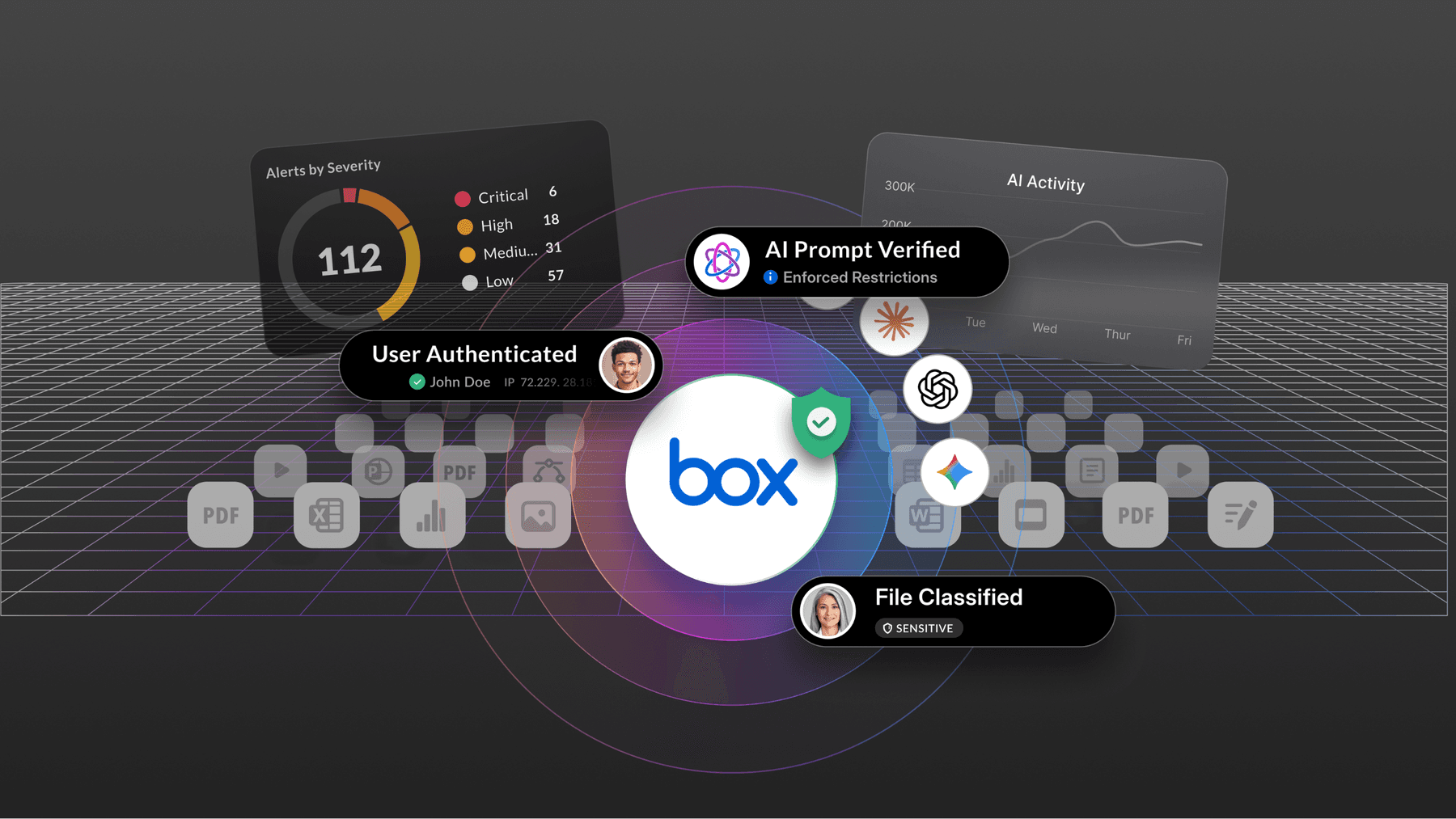
- Maintain security and compliance with strong user authentication, encryption, permissions, and built in information governance
Simplify the way you work with Box. Contact us to explore the best AI productivity tools.
Simplify the way you work with Box. Contact us to explore the best AI productivity tools.
Frequently asked questions
Can AI increase productivity?
Yes, AI can increase productivity. In the State of AI in the Enterprise report by Box, organizations at the forefront of AI adoption have seen an average 37% boost in productivity. These results encourage companies to plan for even greater returns. Looking ahead, businesses expect productivity to rise by 30% over the next three years as AI adoption matures.
The real gains of using artificial intelligence for productivity come from applying it strategically:
- Integrating it into your core processes
- Aligning it with business goals
- Focusing on use cases that remove bottlenecks
See why becoming an AI-first company is more than just automation.
What types of business workflows can AI productivity apps automate?
AI productivity apps automate various business workflows, including:
- HR onboarding: Automating document collection, sending forms for e-signature, and and managing policy acknowledgments
- Report generation and distribution: Compiling data, creating summaries, and sharing insights
- Contract management: Drafting, routing documents, and storing contracts efficiently
How to use AI for productivity?
To use AI for productivity, embed it into the tasks that matter most. Choose applications with AI features that directly address inefficiencies and continuously refine them as adoption grows.
Below are examples of how to use AI for productivity:
- Analyze unstructured data to uncover trends
- Personalize customer interactions to improve service quality
- Retrieve files and data efficiently withAI content discovery
- Generate first drafts of documents and presentations for faster creative work
Learn best practices for responsible AI implementation.
How secure is an AI tool for productivity?
Security depends heavily on your provider’s safeguards. Leading AI tools for productivity offer enterprise-grade security, including:
- File encryption within storage and during transmission
- File and folder permissions to control access
- Document audit trails to track changes and user activity
Still, your organization should carefully evaluate vendor policies on data privacy and retention to protect sensitive information.
Can AI-powered productivity tools integrate with my current business software?
Yes, AI-powered productivity tools with APIs and integrations connect with CRM systems, project management tools, communication suites, and cloud storage. With this interoperability, you can add automation and intelligence into existing workflows without having to replace the tools your teams already rely on.