From customer onboarding to fraud detection, finance runs on data. But critical records often live in isolated systems, requiring manual checks to reconcile data across platforms. Without a clear view, blind spots raise the chance of compliance breaches. These inefficiencies might cause errors — and leave customers waiting.
AI is reshaping how finance organizations tackles these challenges, and one of the most promising approaches is the rise of AI agents in finance. These intelligent systems offer a way to consolidate data silos, making information accessible and more secure across platforms. Let’s explore their benefits and the most practical applications of AI agents.
Key highlights:
- AI agents in finance are intelligent systems that gather financial data from multiple sources, analyze it, and perform tasks without constant human oversight
- Organizations implementing agentic AI in financial services gain faster access to accurate data, reduce manual effort, and improve decision-making
- Agentic AI use cases in financial services include automating KYC checks, ingesting and extracting documents, and preparing client briefs
- As the Intelligent Content Management leader, Box empowers financial institutions to unlock insights from unstructured data, connect content across silos, and automate workflows using AI-powered agents
What are AI agents in finance?
AI agents in finance are intelligent software systems that collect financial data, analyze it, make decisions, and complete tasks on their own. These programs usually combine three capabilities:
- Comprehension (understanding input)
- Planning (deciding what to do)
- Action (performing tasks)

More advanced than conversational AI assistants, finance AI agents fetch data from multiple sources, prepare memos, generate reports, and route them for review.
In finance organizations, financial AI agents often pair large language models with retrieval-augmented generation systems, domain rules, and connectors to platforms like CRMs and ERPs. Combined, these components give agents context, memory, and the ability to act on business data.
Discover how an AI content agent turns your unstructured data into actionable insights.
How agentic AI in financial services is changing organizations
According to ISG’s State of the Agentic AI Market Report, 30% of agentic AI use cases are in banking, financial services, and insurance (BFSI), the highest share among all industries. BFSI organizations operate in highly data-rich, decision-intensive environments where the speed and accuracy of agentic AI offer a competitive edge.

By deploying AI agents to independently execute tasks, these institutions reduce dependency on manual decision-making and enable faster workflows. Agentic AI in financial services also works across departments, creating more collaborative and agile operating models.
What are the benefits of financial AI agents for organizations?
Financial AI agents benefit organizations by running workflows that reduce manual work to prioritize human oversight and judgment. This leads to shorter cycle times and the ability to surface deeper, more timely insights hidden in unstructured data.
Explore the key benefits of deploying agentic AI for financial services.
AI-powered insights
AI in finance opens up many opportunities — Gartner reports that 58% of functions across the industry already use the technology. One of the valuable applications is the use of agents to uncover insights from structured data (such as account balances and payment histories) and unstructured data (like contracts and call transcripts).
In these systems, AI can instantly highlight correlations that humans might miss, such as early signs of churn in client communications. For example, a wealth management firm might notice certain phrases or requests in account forms that suggest a client is unhappy, allowing them to reach out before the client decides to leave.
Explore structured data vs. unstructured data in the age of AI.
Faster data processing
Many workflows in finance involve standardizing data formats and tracking down missing information. An example is bank reconciliation, where accountants compare a company’s internal ledger to its statement to make sure all transactions are accurate.
AI agents for finance, with their intelligent document processing capabilities, automatically capture files, structure formats, and validate data in real time across different systems. Agents flag inconsistencies and draft journal entries for reviewer approval, shortening close cycles and reducing human errors.
Enhanced data security and regulatory compliance
As AI adoption grows across all areas, data privacy and security remain top enterprise challenges. The State of AI in the Enterprise report 2025 by Box shows that 74% of organizations cite these factors as their main concerns when selecting an AI platform for content and unstructured data.
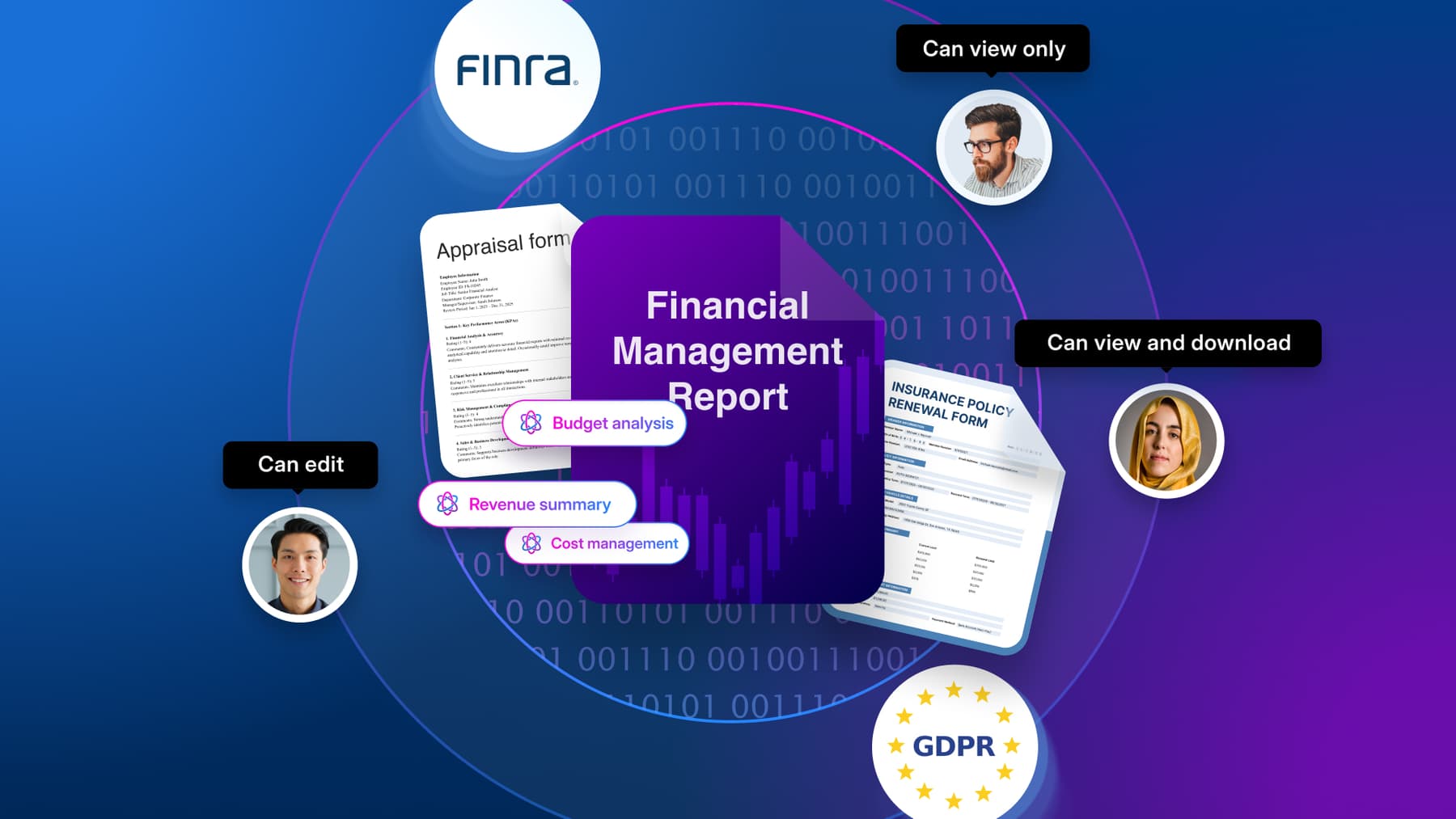
In highly regulated industries like finance, compliance will influence every decision you make about your tech stack. AI agents for financial services with built-in security and compliance controls cover specific regulatory standards, protecting files with encryption and role-based access controls.
Explore all the benefits of cloud compliance to build trust with customers and partners.
What are the top agentic AI use cases in financial services?
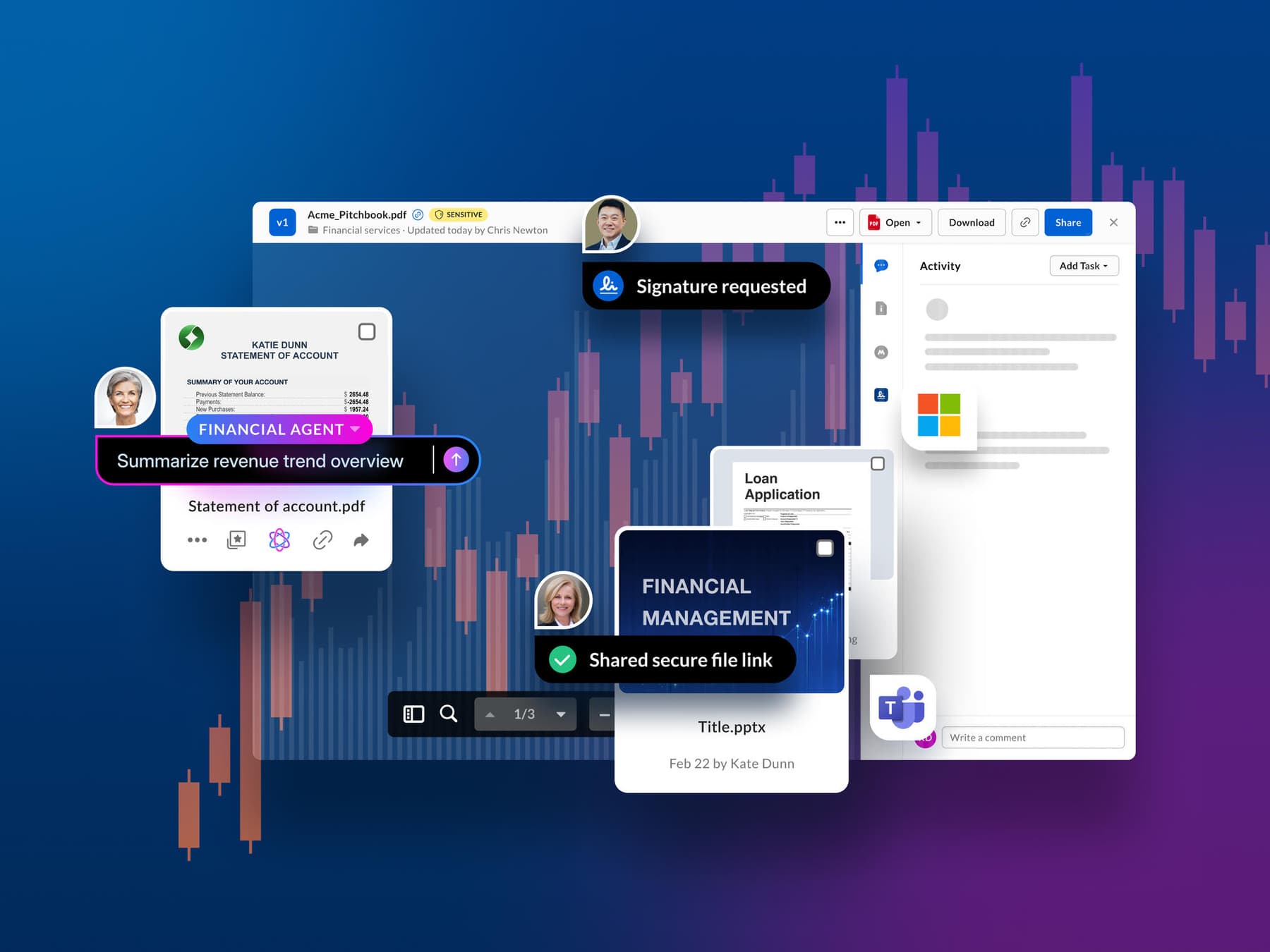
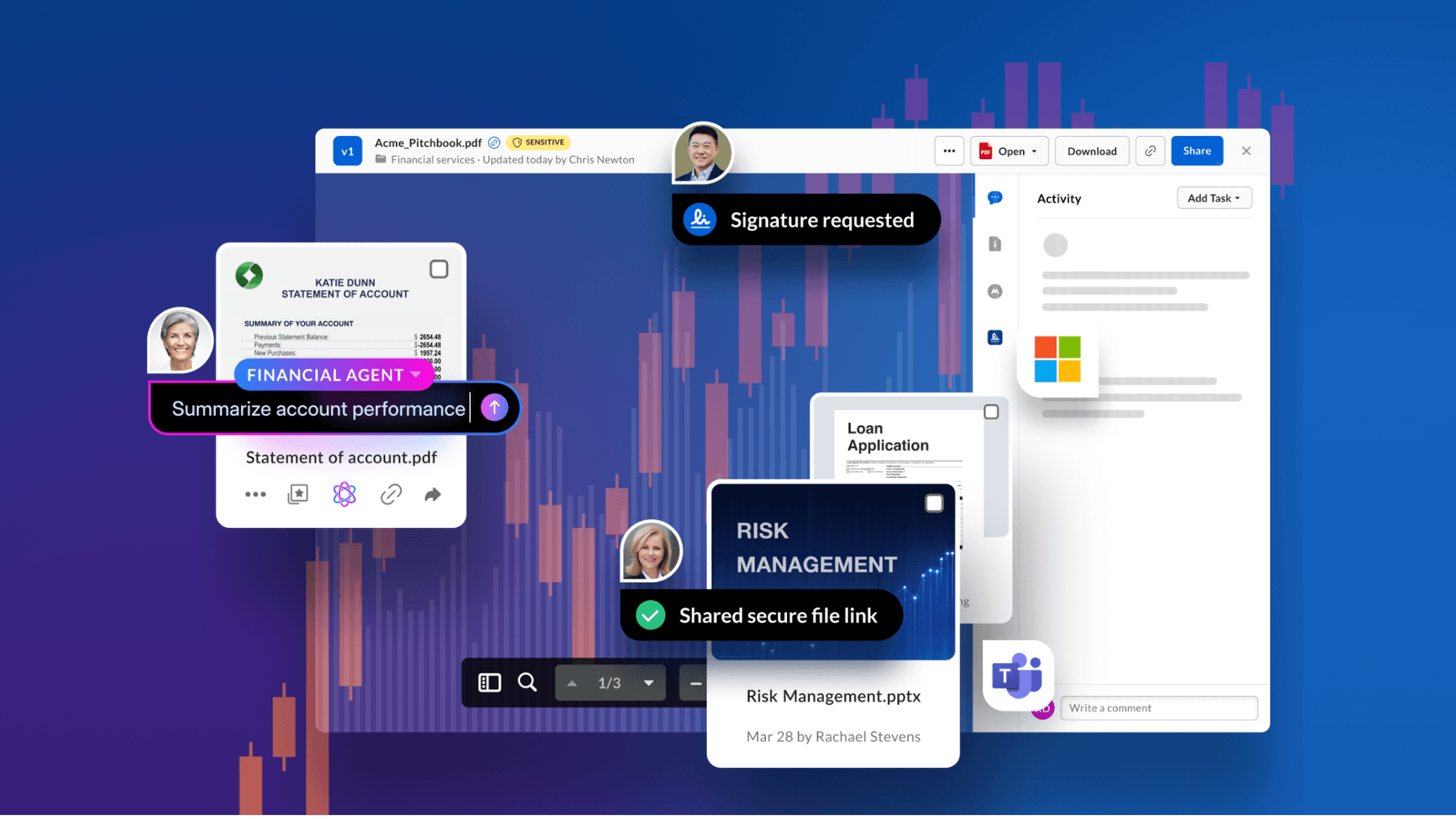
Top agentic AI use cases in financial services include automating know your customer (KYC) checks to reduce client onboarding time, generating summaries for meetings and briefings, processing vast volumes of financial documents, and leveraging AI data extraction to surface key contract clauses for compliance and risk management.

Below are high-impact, realistic agentic AI use cases in financial services.
1. KYC automation
KYC validation is critical for onboarding customers, but it often slows down processes due to the manual effort involved in collecting identity documents, verifying addresses, and cross-checking watchlists.
You can use a financial AI agent to extract data from IDs and validate it against trusted sources in real time. Automation reduces onboarding times and improves customer experience while you stay compliant. Agents also flag incomplete or inconsistent submissions, eliminating the back-and-forth for relationship managers.
Find out how financial services organizations improve customer experience in the cloud.
2. Meeting preparation
In the financial services industry, client meetings often require pulling together information from CRM systems, portfolio data, transaction histories, and recent market movements. This prep work can consume hours of analyst time. AI can assemble all relevant details into a concise briefing pack within seconds through targeted AI agent analysis.
For example, before a wealth advisor meets a high-net-worth client, a finance AI agent could compile recent portfolio performance, online notes from past interactions, and any personal milestones detected. The advisor then walks in ready to discuss tailored strategies, rather than spending time piecing together basic facts.
3. Client brief generation
When your team needs to quickly understand a client’s background and current challenges, they often need find information buried within emails and historical records. AI agents in finance can generate an easy-to-digest brief by quickly scanning available data sources.
You can also use an AI agent for finance to get quick answers when questions come up. For instance, during a client meeting, you can instantly pull up an AI summary of the client’s latest activities and relevant history to address questions without breaking the flow of the discussion.
4. Document ingestion
Financial organizations handle loan applications, claim forms, statements, and other records that come in different formats and from many systems. While manually indexing and categorizing documents can cause errors, financial AI agents automatically ingest these files, extract key data, and store them in the correct system, with minimal or no human intervention.
5. Contract extraction
Imagine a lending team with hundreds of loan agreements stored across shared drives and email threads. Critical details like renewal dates and interest rate changes hide in dense legal text, and missing them can lead to compliance violations. When your content review process is manual, it’s easy to overlook these obligations.
Agent-based AI systems read contracts, extract key terms, and feed them directly into automated agentic workflows that prompt timely actions.

What should I look for in an AI agent for finance?
When selecting an AI agent for finance, consider these factors:
- Flexible model selection:Look for options that let you select or test different AI models to find the best fit for your workflows and data
- Transparency and AI responsibility: Ask for document version control and audit trails, making sure the system supports accountability and meets regulatory and ethical AI implementation
- Regulatory compliance and governance: Check if the AI-powered platform aligns with your compliance framework and supports data governance, including retention schedules to meet regulatory requirements
- Financial data security: Expect encryption in transit and at rest, multi-factor authentication for secure logins, and role-based access control to limit user permissions
How to get the most value from AI agents for finance
Whether building individual AI agents for finance or multiple-agent systems, focus on deploying a platform that removes friction from high-impact workflows, retrieves reliable answers, and delivers quick summaries in a matter of seconds.
Use these systems to get insights from unstructured information within your content repository. Prioritize applications that back your decisions and strengthen governance, so you gain speed without sacrificing accuracy or trust.
Speed up finance workflows with Box AI
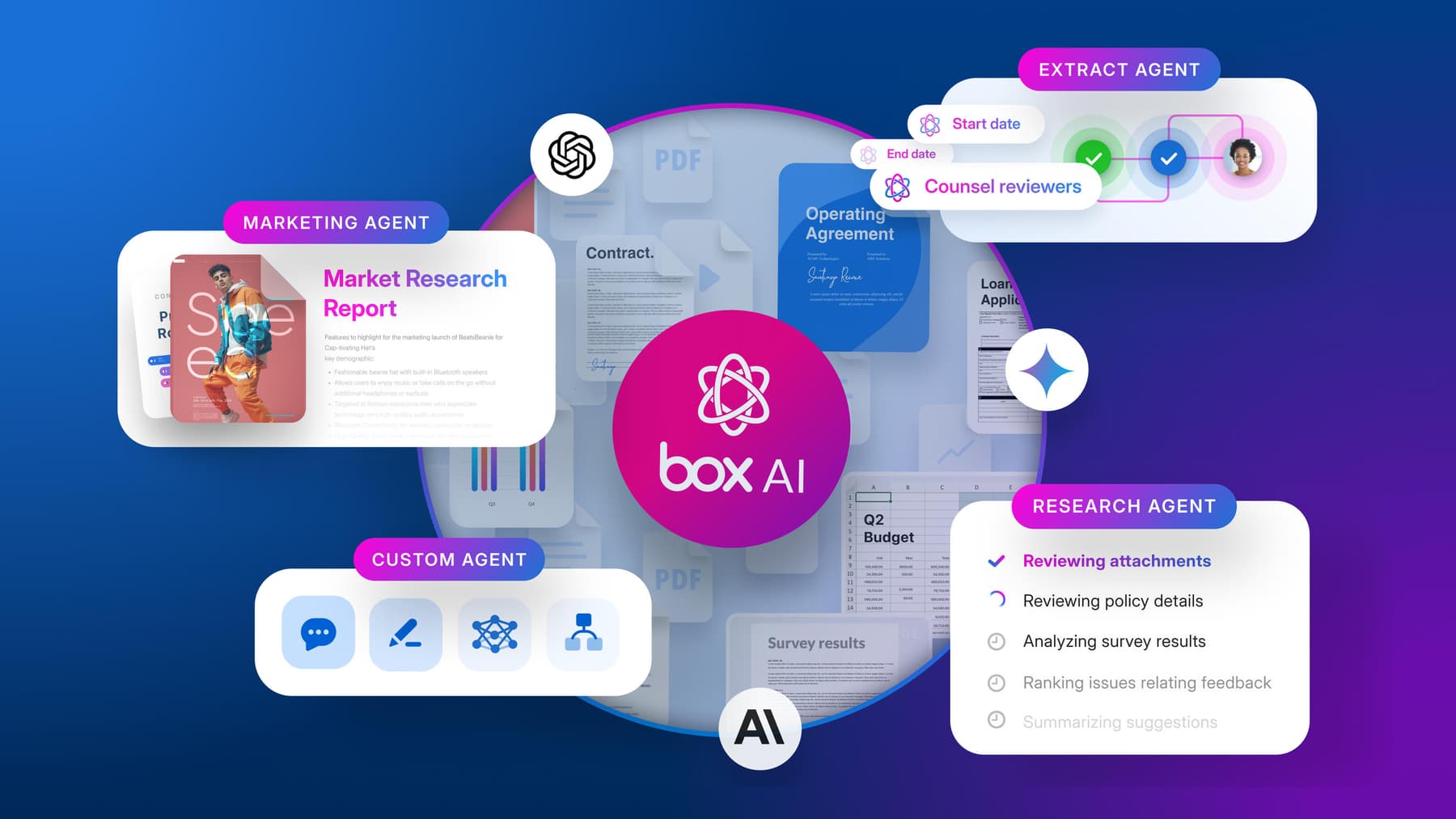
Becoming an AI-first company in the financial services industry is easier with Box. The leading Intelligent Content Management platform offers a suite of AI capabilities, so you can leverage the power of agents to automate workflows and get more value from unstructured data.
With Box, you get a suite of iIntelligent solutions for financial services, including:
- Box AI: Automate deep research, key data extraction, and content analysis from complex financial documents
- Box AI Studio: Customize and configure AI agents to fit specific finance processes using trusted large language models
- Box Hubs: Create intelligent portals for fast, accurate data access and collaboration
- Box Apps: Build AI-driven workflows and dashboards without coding
Contact us to build custom AI agents in finance with Box.
Frequently asked questions
What are AI agents in finance?
AI agents in finance are intelligent software systems that collect financial data, analyze it, make decisions, and complete tasks with minimal human oversight. They combine comprehension, planning, and action to automate complex, data-intensive workflows.
What are the top use cases for AI agents in financial services?
Key use cases include automating KYC onboarding checks, ingesting and categorizing financial documents, extracting critical contract terms, generating client briefing packs, and preparing meeting summaries. These applications reduce manual effort and shorten cycle times across finance teams.
Are AI agents secure enough to handle sensitive financial data?
Yes. When deployed on a platform with enterprise-grade controls, AI agents can enforce encryption, role-based access, and multi-factor authentication to protect sensitive data. Permissions-aware retrieval ensures agents only access files a user is authorized to see.
Why does unstructured data matter for AI agents in finance?
Financial organizations store critical information in unstructured formats like contracts, PDFs, and call transcripts that traditional systems cannot easily process. AI agents use intelligent document processing to extract and structure this data, turning it into actionable insights that trigger automated workflows.
What should I look for when selecting an AI agent for finance?
Prioritize flexible model selection, audit trails for accountability, regulatory compliance and data governance support, and strong financial data security controls including encryption and role-based access. These factors ensure your AI agent meets both operational and compliance requirements.
How should a financial firm get started with AI agents?
Start by identifying high-volume, repetitive workflows such as document ingestion or KYC validation, then pilot an agent on a narrow, well-defined task. Validate accuracy, security, and compliance before scaling to more complex processes.
What’s an example of agentic AI for financial services?
A practical example of agentic AI for financial services is an agent that runs end-to-end client onboarding.
The agent can:
- Collect identity documents
- Extract key fields from PDFs
- Draftsa KYC memo
- Route the memo to compliance for sign-off
This workflow saves manual hours and enables event-driven reviews.
Are financial AI agents secure?
Yes, financial AI agents are secure — but only if you enforce strict file and folder permissions, encryption, multi-factor authentication, and other critical data protection controls. Responsible AI platforms with enterprise-grade security frameworks help you safeguard sensitive financial data from unauthorized access or leaks.
What are the best AI agents for financial services?
The best AI agents for financial services depend on your needs.
Prioritize agents that prove they can do three things in a pilot:
- Respect content permissions
- Supply reliable, auditable outputs
- Integrate with your enterprise apps
Focus on cloud-based solutions with AI data extraction to speed up document-centric finance workflows.
How does Box support AI agents in financial services?
Box offers a suite of intelligent solutions built for finance, including Box AI for data extraction and content analysis, Box AI Studio for customizing agents to specific workflows, Box Hubs for intelligent data portals, and Box Apps for building AI-driven workflows without coding.
Understand the importance of transitioning financial services to the cloud.