Business process management (BPM) is a strategic approach that organizations use to model, improve, and optimize end-to-end processes. It defines how work moves through an organization by combining technology and methodologies to eliminate inefficiencies in activities that drive value to your company.
As you’ll see in this guide, BPM takes a holistic view of business processes, treating them as assets that you must refine and align with your organizational goals. We’ll cover how to implement each BPM stage so you can use this repeatable framework to streamline workflows, increase productivity, and eliminate any gray areas in how you get work done.
Key highlights:
- Business process management is an organizational approach to model, analyze, and improve processes for greater efficiency and value
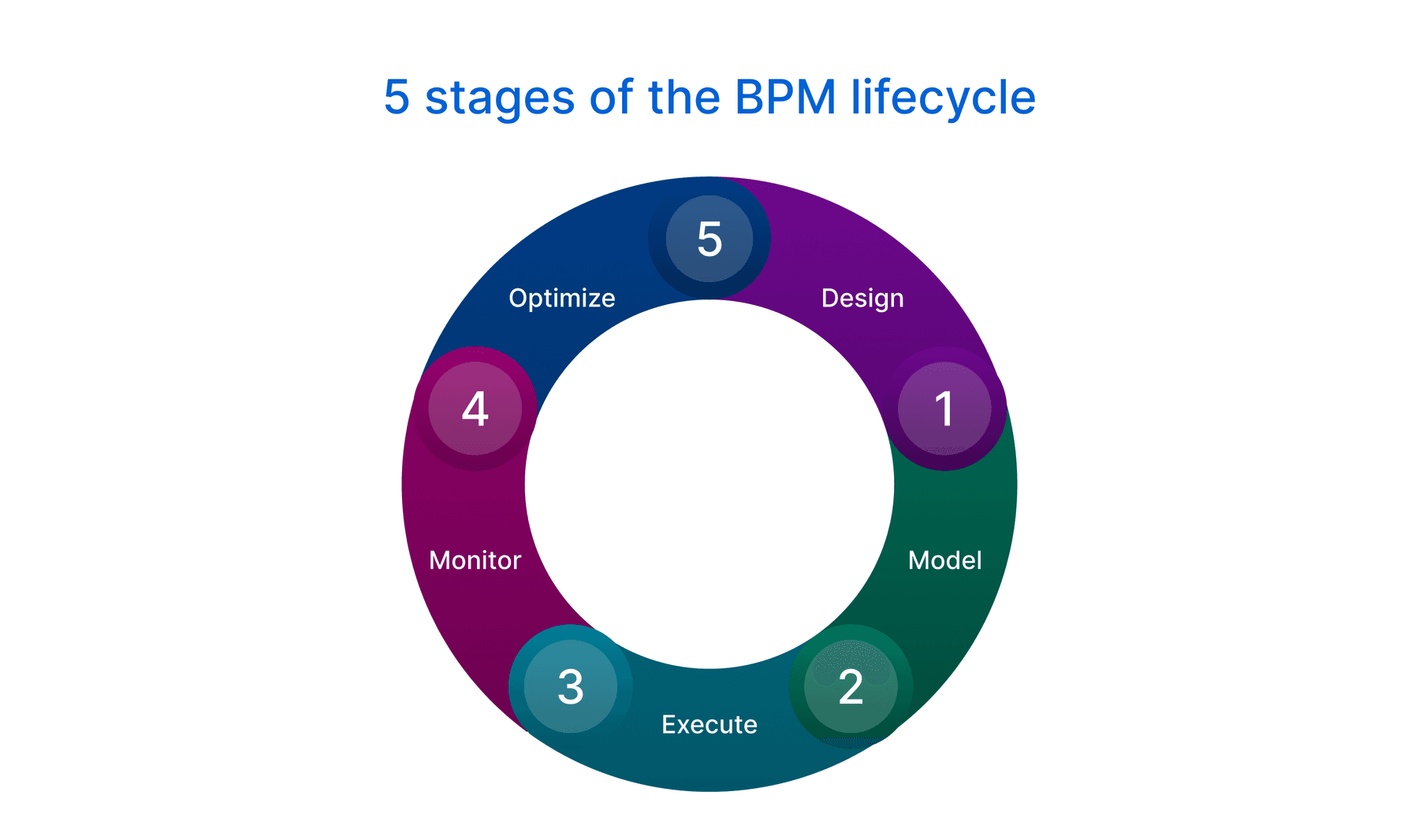
- The five business process management stages are design, model, execute, monitor, and optimize — they form a repeatable lifecycle that helps you map workflows and refine operations
- Managing business processes involves connecting people, information, and AI-driven automation to deliver scalable operational excellence and customer satisfaction
- Box, the leader in Intelligent Content Management, enables organizations to streamline document-centric workflows and enhance team collaboration across business operations
Understanding what managing business processes means

It’s a commonly accepted truth that businesses thrive when their workflows are well defined and repeatable. Effective business processes should make your team more efficient and collaborative, but many companies lack effective, organization-wide procedures. With business process management, you can build more effective processes and continuously optimize them.
BPM is an organizational methodology that allows you to assess, develop, and fine-tune processes. By analyzing each workflow individually, you can identify areas for improvement and operate more efficiently. BPM relies heavily on data to get insights into bottlenecks affecting standard processes.
Typical examples of processes you can enhance with BPM include:
- Issuing and filling product orders
- Onboarding new employees or customers
- Remitting and approving invoices
- Updating online project management software or databases
How business process management technology supports organizations
Many departments rely on business process management technology to turn organic tasks into predictable, defined processes. Often, BPM involves using software programs like:
- Enterprise content management (ECM) systems to organize and govern your company’s digital assets
- Billing platforms that automate payment processing and invoicing
- Document management systems to manage and store electronic files
By implementing these solutions, you can automate processes that are error prone and inconsistent. With the growing adoption of generative AI and low-code business process management, organizations adapt faster to market changes by automating workflows and reducing development costs.
Per Fortune Business Insights, these technologies are driving growth in the BPM market, which is expected to expand at a CAGR of 18.6%, increasing from $21.51 billion in 2025 to $70.93 billion by 2032.
What is the importance of business process management?
Business process management has become an important organizational best practice, bringing clarity around workflows, improving cross-departmental collaboration, and landing everyone on the same page. BPM is also a way to ensure job accountability by clearly defining responsibilities and deliverables.
The importance of business process management comes from how you can:
- Eliminate friction points or unnecessary steps that slow down task execution or lead to inconsistent results
- Spot inefficiencies in workflows by mapping out each step and revealing redundancies and delays
- Prevent misunderstandings among team members by defining roles and expectations clearly
- Boost morale among employees by reducing misunderstandings and streamlining work
Without BPM, there’s a constant battle against disorganization and miscommunication, making it challenging for team members to interpret job duties and expectations. With better clarity around business systems, each employee can thrive, creating more effective departments and healthier organizations as a whole.
Top benefits of business process management for your operations
When BPM becomes a reliable method for carrying out your day-to-day operations, you complete tasks faster and reduce errors across processes. By mapping each step and setting clear rules, you can create workflows for HR onboarding, invoice approvals, and other day-to-day activities with fewer delays and less confusion.
Benefits of business process management for your operations include:
- More control over your processes with clear workflows and visibility into task progress
- Increased team communication, collaboration, and engagement through shared and integrated tools
- Lower risk from mishandling sensitive information by setting permissions and maintaining document audit trails
- Clear documentation to simplify auditing and regulatory reporting
- Increased productivity by removing bottlenecks and speeding up approvals
- Better resource utilization through digital workflow automation
- Business agility to better respond to market changes and opportunities
- Increased customer satisfaction levels with faster response times and consistent service
One of the most significant advantages of incorporating BPM into your operations is that it helps create the vision for your organization. A report by Howspace shows that 81% of workers want to see how their role and participation contribute to a greater impact in order to feel their work is worth the effort. By prioritizing process development, your organization can unite your team toward a common goal of improved efficiencies.
What are the 5 business process management stages?
The five business process management stages are design, model, execute, monitor, and optimize. Each helps you simplify and enhance your processes.
Let’s take a closer look at the BPM lifecycle and how you can apply each stage to strengthen your organization’s operations.
1. Design
Start by identifying the existing activities or workflows you want to be more intentional with. The first stage in the BPM lifecycle focuses on designing repeatable, definable business processes. During this phase, process designers typically focus on performing in-depth analyses of existing workflows, procedures, tasks, and systems.
Your organizational processes deliver value to your customers and help you stand out from competitors. When undergoing the design phase, focus on creating processes that provide the most benefit to your stakeholders.
The design phase is also an ideal time to identify your primary and secondary processes:
- Primary processes are integral to the organization’s day-to-day operations — for example, product manufacturing and customer support
- Secondary processes are necessary for primary ones to succeed — examples include employee training, IT maintenance, and budget planning
Using a business process management checklist or form can help you conduct a uniform design analysis across every primary and secondary process you identify.
2. Model
During this business process management stage, you’ll focus on mapping out the workflow in question. By developing a model or flow, you’ll better understand the operational procedures involved.
Often, process modeling involves using visual collaboration tools to help understand what will happen at each stage of the process. By creating a flowchart or mind map, you identify the exact sequences of tasks they need to accomplish and when. The model also helps departments delegate responsibilities to specific people, making everyone’s role clear and well defined.
BPM modeling takes a logical and analytical approach to business process development. From start to finish, you can break down how a process gets initiated, how it concludes, and whether it requires approval and from whom.
3. Execute
Once you’ve identified your business workflows, mapped out their procedures, and assigned responsibility to team members, the next stage is to implement your process. This step is the only way to test your overall approach to BPM.
During the execution phase, focus on minimizing potential negative impacts. You can do so by conducting dry runs before going live.
There are two ways to execute a test run of your business processes.
- Systemic implementation using specific BPM software or tools
- Non-systemic implementation without software
If your new workflow requires collecting data and results, you’ll probably choose to use business process management tools. No matter which implementation path you take, the goal is to put into action the model you developed during stage two.
4. Monitor
Since BPM relies on continuous feedback for refinement, the lifecycle must include a monitoring stage. Business activity monitoring means observing your processes through data collection. Tracking results helps determine if you’re meeting all your objectives.
Ideally, this fourth stage happens in real time during the execution phase, but it depends on what you’re tracking. Set measurable KPIs and collect data to assess what’s working and what isn’t. Based on these metrics, you can continue improving or redefining processes to efficiently accomplish your organization’s goals.
5. Optimize
If you have been diligently monitoring your results, the data you collect through your BPM system should inform the next steps toward optimization. Then, you’ll see if the process works or if it’s time to go back to the drawing board.
If the results indicate your process implementation has been largely successful, you may only need to make a few minor tweaks. Often, these adjustments involve streamlining areas of friction, miscommunication, or other bottlenecks you noticed during implementation.
If the process didn’t yield the intended results, turn your attention back to stage one of the BPM lifecycle, where you’ll refine and redesign various elements to produce outcomes more efficiently. If your initial implementation wasn’t as successful as you’d hoped, remember that BPM is a continuous process that can evolve based on your organization’s changing needs.
What are the main types of business process management?
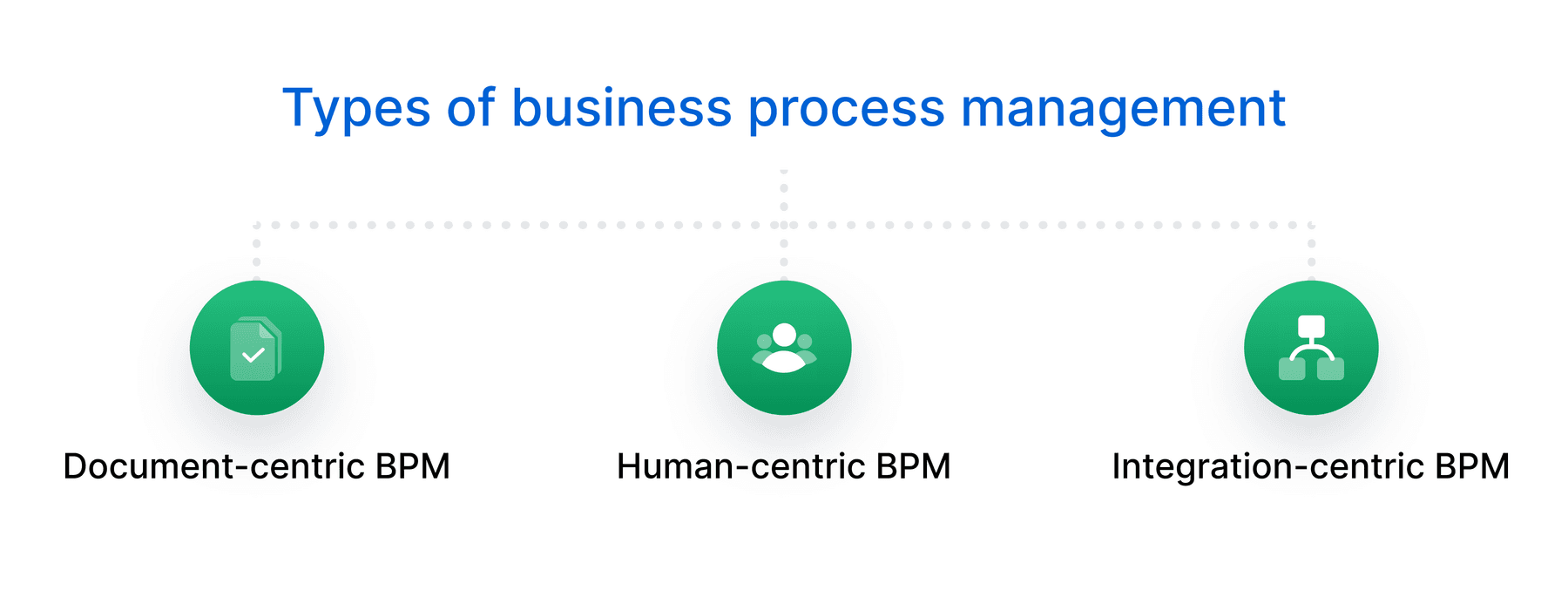
There are three types of business process management, each serving a unique purpose and centering on either documents, people, or data and systems (integration).
Document-centric BPM
In document-centric BPM, businesses rely heavily on printed information to accomplish their work. Often, numerous departments share these documents. To handle the flow, you need to develop procedures with document management as a central focus.
Examples of organizations that often use document-centric BPM include:
- Law firms managing contracts, case files, legal briefs, and compliance documentation
- Accounting and financial professionals handling invoices, tax forms, and financial reports
- Engineering and construction companies processing blueprints, permits, and safety documentation
- Hospitals and clinics that need organized patient records and regulatory paperwork
- Publishers and media agencies that coordinate the content review process of articles and digital media assets
- Sales organizations working on proposals, quotes, and customer onboarding documents
Regardless of whether a company’s documents are physical or digital, the goal of this type of BPM remains the same — to effectively manage the creation, co-editing, formatting, and approval processes.
While focusing heavily on the files themselves, document-centric BPM must also clearly define which people handle the information and how they collaborate to organize and access it.
Human-centric BPM
When work involves coordinating people, along with their duties, tasks, and roles, you can use human-centric BPM to shape operations. Generally, this approach is less reliant on automated workflows and may not involve as much software as document-oriented BPM.
In this category, companies focus on defining and streamlining workflows. Since these workflows center on human interaction, the priority is to make them as user-friendly as possible. Pay specific attention to any sticking points that delay people from taking action in their roles.
Examples of human-centric BPM include:
- Employee or customer onboarding workflows focused on personalized steps and interactions
- Performance reviews and evaluations that involve direct feedback
- Training and coaching initiatives to support individual growth
It’s impossible to fully automate certain human-oriented processes, such as hiring new team members. However, there are technological aspects to many human-oriented processes. For example, the HR team can incorporate e-signatures to speed up contract approvals and reduce paperwork.
Integration-centric BPM
With integration-centric BPM, organizations focus on streamlining workflows among networks, people, software, and other variable points. In this approach, teams typically use enterprise workflow automation software to assist in modeling, implementing, and monitoring the processes. These solutions provide data connectivity and APIs for easy access to the necessary workflows, documents, and other assets.
Processes developed through integration-centric BPM are typically more automated than human-oriented processes, resulting in highly efficient and repeatable workflows. This method reduces the need for continuous management and oversight, instead shifting to a more model-driven method.
Relying on a business process management system also saves teams from time consuming processes, helping reduce operational costs. Camunda’s survey reveals that 87% of organizations reported increased business growth thanks to process automation.

What are common business process management use cases?
BPM works best for processes that involve repetitive tasks or require coordination across multiple teams. Common business process management use cases include:
- Marketing campaign approvals: Automate document routing for creative reviews to speed up approvals and avoid bottlenecks in digital asset management
- Contract management: Use templates to reduce errors and automated reminders to enhance visibility over all active agreements
- Product development and release processes: Use collaboration software to track tasks in real time and keep projects on schedule
- Invoice and payment processing: Implement document workflow automation and validation checks to speed up approvals and reduce payment errors
Features of business process management software to look for
When selecting business process management software, make sure it integrates with other programs you use and offers an intuitive interface. You’ll also need robust automation capabilities to reduce errors and delays caused by human intervention.
Review these essential features of business process management services.
| BPM software feature | Why it matters | Benefits |
| Cloud collaboration tools | Choosing cloud-based BPM software that makes it easy for teams to access documents or tasks simultaneously improves collaboration on any given task | Collaborative software offers document version control, allowing teams to work together on the same document without confusion or mistakes |
| Cloud app integration | BPM tools should be compatible with other essential apps, offering APIs that enable data exchange without manual intervention | Integrating your existing tools into BPM procedures improves the monitoring stage by making it easier to track performance and identify issues quickly |
| Mobility | Mobile accessibility encourages collaboration and allows people to tackle work activities from anywhere with ease | Incorporating BPM tools with mobile capabilities lets you improve business productivity by enabling real-time updates and approvals from any device |
| Security and compliance | Protecting your team’s data is critical to preventing unintentional leaks or targeted cyberattacks | Implementing security and compliance measures like encryption and role-based access controls helps safeguard sensitive information while also building trust with clients and partners |
| AI workflow automation | AI speeds up processes and reduces errors, making BPM more efficient — Box State of AI report 2025 shows that process automation is one of the top five AI use cases | By integrating AI into BPM, you increase efficiency with intelligent document processing and extract insights from structured and unstructured data, enhancing decision-making |
Future-proof your BPM strategy with Box
When data is at the heart of your business processes, you need an effective way to manage it. As the leader in Intelligent Content Management, Box provides organizations with a secure platform for creating and managing unstructured data, from campaign videos to sales contracts.
By harnessing Box for your BPM strategy, you get:
- Unlimited online data storage to centralize all your files, making it easier to retrieve, govern, and collaborate on critical documents
- Box AI, a suite of AI capabilities to create intelligent workflows, so you can speed up content reviews, HR onboarding, and more
- AI-powered automation via Box Relay, where you build workflows in minutes with pre-built departmental templates — with no code or IT tickets
- Intelligent document generation via Box DocGen, allowing you to create contracts and agreements instantly by automatically pulling data from customized forms
- Seamless integrations with over 1,500 apps to connect your current tools in one platform and create a unified experience for teams and customers
Contact us to learn how Box helps you optimize your business process management.
Frequently asked questions
What is the purpose of business process management?
The purpose of business process management is to create, analyze, and continuously improve your organization’s processes. It’s about cutting out unnecessary and expensive steps in your workflow.
You understand the business process management purpose when you see departments struggling with long approval cycles for critical documents. The main goal of BPM in this case is to simplify communication and collaboration, enabling faster reviews and reducing errors.
Learn how to streamline a process in your organization using these proven strategies.
What are common business process management examples?
A good business process management example is budget approvals. Without BPM, this workflow often relies on manual forms that finance executives receive by email, leading to back-and-forth delays and increasing the risk of errors. With BPM, budget requests follow a predefined sequence of steps that automatically route approvals to the right managers — without the risk of emails getting lost or time-consuming status checks.
Another example of BPM is resolving customer complaints. Instead of interactions coming from multiple channels and being manually assigned, BPM centralizes all related messaging in a single content repository, making it easier to assign and resolve issues efficiently.
Where can I apply BPM within my organization?
You can use BPM for nearly any process within your organization, from human resources to IT to sales. When developing a BPM strategy, focus on coordinating people’s roles, tools, systems, and other components to create a clear, repeatable structure.
In any given organization, several departments may be responsible for developing separate BPMs, and a single team may have numerous processes requiring BPM. To succeed, you must clearly define, track, and manage each process while promoting ongoing improvements.
**While we maintain our steadfast commitment to offering products and services with best-in-class privacy, security, and compliance, the information provided in this blogpost is not intended to constitute legal advice. We strongly encourage prospective and current customers to perform their own due diligence when assessing compliance with applicable laws.