At Box, we’ve been talking for some time about what it means (and doesn’t mean) to become a truly AI-first company. It doesn’t mean layering AI onto disconnected workflows or simplifying isolated tasks. It means rethinking how work actually gets done inside the business: how documents move, how decisions get made, and how teams can act faster without losing control.
This focus on reimagining workflow involves several Box products, all of which are integral to the Box Intelligent Content Management platform. Box AI Agents use natural language to find files, synthesize information, and complete complex work across your enterprise content. Box Extract automatically pulls key information from Box content and saves it as structured metadata. Box Hubs is an AI-powered content curation product that lets organizations create organized, searchable portals from Box files. Box Apps is our no-code builder that lets business teams create configurable, metadata-driven views and workflows directly on top of their Box content.
And now there’s Box Automate for sophisticated workflow orchestration — so organizations can move work faster and with more consistency across the business. Instead of asking teams to jump between systems for things like intake, review, extraction, reporting, approvals, and signature, we’re designing processes that start with content in Box and stay in Box.
We’re piloting our internal use of automated metadata extraction, workflow orchestration, and custom agents across three specific areas of the business: legal, HR, and procurement.
The TL;DR of how Box will power new ways of working for these Box teams:
- Legal: Turn contracts into structured, searchable data that can trigger workflows, speed up search, and power an intelligent contract dashboard
- HR: Help analyze onboarding documents and generate standardized employee letters faster
- Procurement: Speed vendor risk assessments by analyzing source reports and generating review outputs more efficiently
The collective result will be faster, more consistent, and searchable work — and work that's easier to govern at scale.
An introduction to Box Automate
While not every use case outlined in this post has Box Automate at the center, as our newest product and the workflow orchestration tool that brings others together, it’s worth a brief explanation of how Box Automate operates.
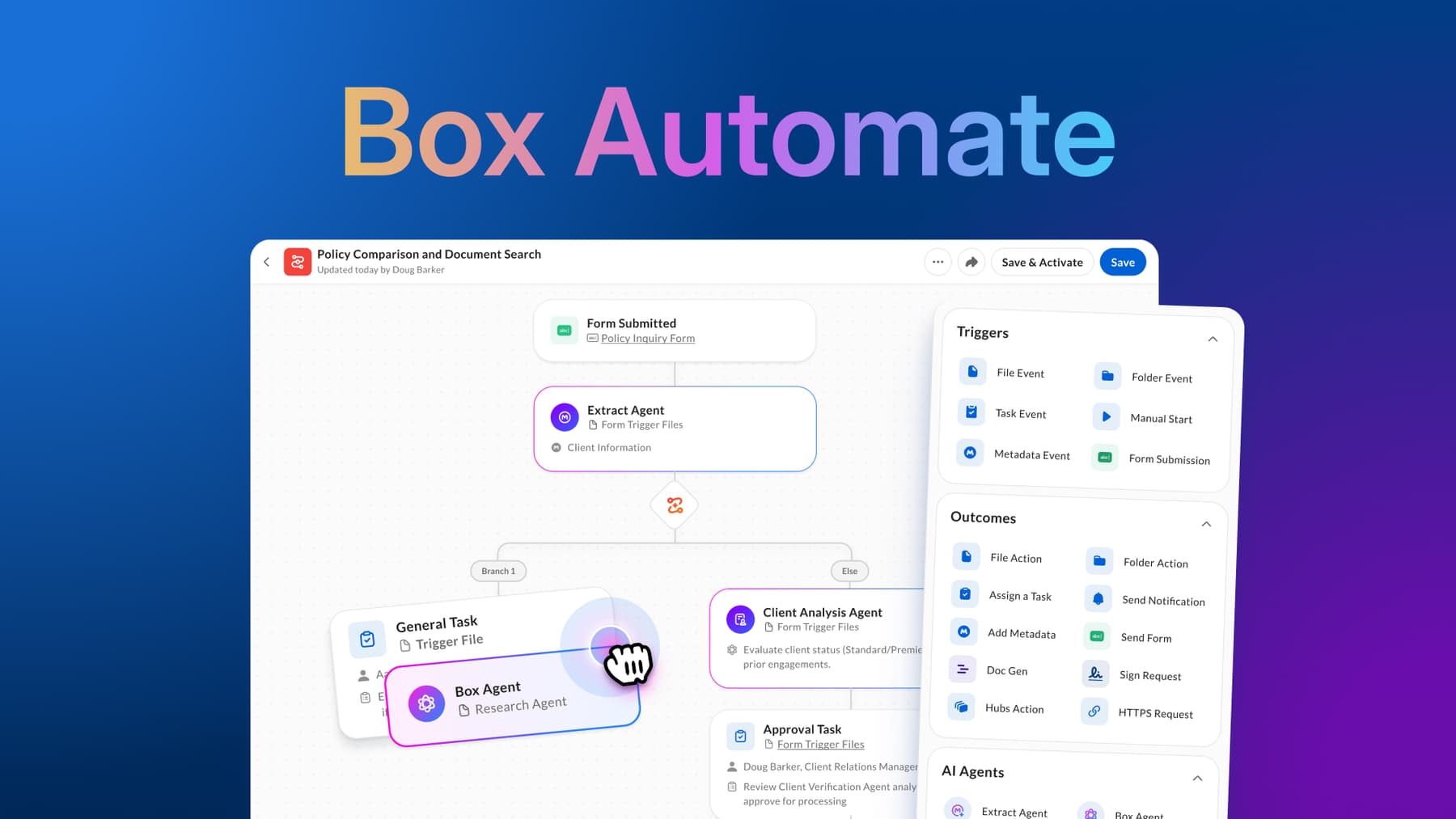
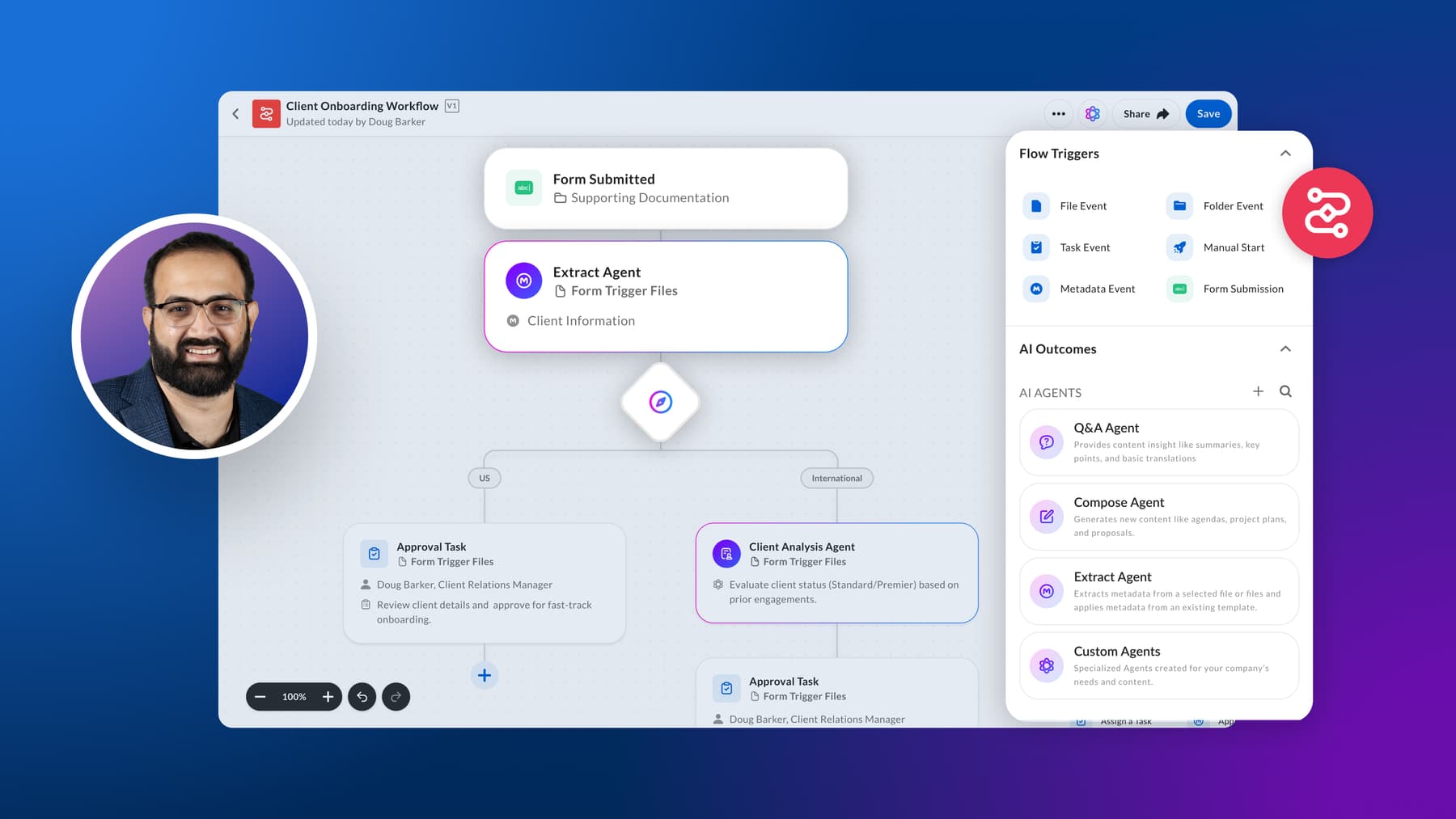
Box AI Agents are at the center of how Box Automate works. Various agents can conduct tasks like analyzing documents, identifying key information, and supporting decisions that previously required manual review. Agents turn unstructured data (documents, images, spreadsheets, and other kinds of content) into operational information (metadata).
This relationship between agents and metadata matters quite a bit at enterprise scale. Many of our highest-value workflows at Box are document-heavy, cross-functional, and full of repetitive review steps. Historically, these processes depended on a patchwork of tools, email threads, and manual handoffs. With Box Automate, we can weave all of the pieces together into a smooth workflow held entirely within Box.
Box Automate helps us orchestrate what happens after content lands in Box. This includes:
- Optical character recognition (OCR) to render PDFs and images into text
- Metadata extraction to make unstructured data structured
- AI-based analysis to find key information buried within long docs
- Document generation to create new files from existing information
- Document routing, approvals, and notifications
- E-signature to multiple stakeholders
- Countless other actions downstream
Inside Box as an organization, our goal for ourselves is the same as our goal for customers: to create a more Box-native operating model, where content is not just stored in Box but actively drives the business process around it.
With that in mind, here’s how three Box teams are putting these Box tools into action within their critical workflows.
Use case 1: Modernizing legal contract management
Our legal team manages a large corpus of contracts, including NDAs, MSAs, vendor agreements, and amendments, and it has long been a challenge to understand what was in those contracts, at scale. In the past, the team relied on a third party CLM tool to provide metadata extraction and intelligent dashboarding capabilities, at an annual cost of more than $300,000.
With Box Extract and Box Apps, we brought that work into Box and didn’t have to renew the contract with the software vendor.
When a signed contract hits a specific Box folder, the process begins:
- OCR is triggered on ingestion so scanned and image-based PDFs become searchable text
- Box Extract Agent populates a metadata template with key contract details such as party names, effective date, term, renewal date, governing law, auto-renewal terms, and termination clauses
- Once metadata is extracted, we can compute derived values like days-to-renewal, generated through Box AI prompting against the extracted values
The contract becomes structured business data that triggers action — not just a file to review manually.
We then use Box Apps as the intelligent contract dashboard, paired with Box AI search capabilities, which support full-text search, Boolean operators, exact phrase matching, and parenthetical grouping. That gives human reviewers a much richer way to interrogate the contract corpus and quickly narrow to the right set of documents. Search criteria can also automatically add filters, making review more efficient and repeatable.
From there, reporting and notifications become part of the same system. Saved views drive dashboards and notifications fire when new content matches a saved view.


Moving forward, the team will be using Box Automate to power even more of the contract lifecycle. The value here will come in both speed and consolidation. Instead of treating contract review, metadata extraction, search, and reporting as separate layers handled by separate tools, Box Automate will bring them together on one platform. That reduces cost, but just as importantly, it creates a more coherent experience for the team doing the work.
Use case 2: Supporting HR workflows with extracted data and AI analysis
“Box Automate is a major unlock for reimagining HR processes natively within Box that weren’t possible before, embedding agents into workflows directly to provide consistency, scalability, and significant uplift for our team.” — Natalie Saul, Sr. Director of People Operations & Technology.
Next, our HR team, aka our People Team. Two of the team's most frequently run and complex workflows are employee onboarding and offboarding. These bookends of the employee experience rely on tight coordination across multiple internal teams as well as external individuals — both future and former employees.
Many HR processes involve document review against clear criteria, and those are exactly the kinds of tasks where AI analysis can reduce repetitive work while improving consistency.
For instance, within onboarding, custom Box AI Agents assist human reviewers in evaluating whether documents appear to meet verification criteria. (Final I-9 determinations still must be made by a qualified human reviewer.)
The ability to share new hire credentials securely within Box based on training acknowledgement status can now be built into an automated flow, which in turn helps verity that training is complete and compliance with the control is documented before a new hire can access critical systems.
From the beginning of a Boxer’s journey to their departure from Box, we’re applying empathetically designed automation to concrete moments in the employee lifecycle.
When it comes to offboarding, the team will be using Box Automate to extract metadata from termination requests using Box Extract and generate departure documents using Box Doc Gen. Key information is captured from source documents, then used to generate a standardized output without requiring someone to manually re-enter the same details.
The Box Automate workflow will also create a Box Task to prompt a human audit before sending for signatures using Box Sign, seamlessly executing multiple sequential steps that were previously manually prompted by the People Operations team.
From the beginning of a Boxer’s journey to their departure from Box, we’re applying empathetically designed automation to concrete moments in the employee lifecycle where content, policy, and workflow intersect. Our internal teams reduce time spent on cyclical and repetitive actions, all while preserving the experience.
Use case 3: Rebuilding critical vendor assessment from end to end
“Box Automate handles the repetitive groundwork, allowing us to conduct an even more comprehensive review, so we can spend our time on the deeper, nuanced risks that require our expertise.” — Barbara Aryee, Compliance Manager, Supplier Trust
Evaluating critical vendor risk is a huge task for our Supplier Trust organization. This category of vendors, which includes AI vendors, professional services firms, and other SaaS providers, often have access to Box customer data, so it’s crucial they meet certain compliance guidelines. The assessments are high stakes, document-intensive, and often unique to the vendor being reviewed.
For Box Automate, inputs include vendor-provided artifacts such as SOC 2 reports, ISO certifications, penetration test results, policies, standards, and other evidence. (But this is not an exhaustive list, because the specific documentation may vary depending on the vendor under review.)
The outputs we want are a structured vendor risk-assessment workpaper and a finalized assessment report. Historically, this process required manually reviewing materials, drafting the workpaper first, then generating the report, and finally routing it for signature through Box Sign across multiple tools and inboxes.
Manual document-by-document review was slow and hard to scale. These reports can run 60–80 pages, and human reviewers had to painstakingly search through them to answer a 200+ question questionnaire spanning 12 control domains, with additional areas reviewed depending on the vendor type and associated risks.


The process was fragmented because teams had to generate a report and then manually move it into the e-signature process. And outputs could vary depending on human reviewer interpretation. In addition, teams were using different tools, including Box AI and Audit Board for summaries, which created a scattered experience.
Box Automate can evaluate for many controls simultaneously, and much more quickly. Box AI Agents help surface potential risks, gaps, and areas of concern for human review. The workflow spans intake, analysis, workpaper generation, approvals, and signature in an orchestrated flow. Four different Box AI Agents ultimately generate the final report.
Every vendor assessment is different. So the process needs to be rigorous, but it also needs to adapt to context. Box AI Agents help us do both.
The result? In our internal pilot, we saw 60% faster assessments and a reduction from more than an hour to about five minutes for generating a report (note that of course, results may vary). But what stands out most to us is not just the time savings. One important goal of AI at Box is to empower people to use their judgment where it matters most. Box Automate gives people time back to do a more detailed review of other factors that impact vendor assessment.
What we’re learning as an AI-first company
I called these use cases experiments, but they've become far more than exploratory pilots. They’ve become daily timesavers and have made work far easier and outputs more consistent. They've freed our people to do higher-value work — the work they never had time for before.
Across these use cases, a few themes have become clear for us.
First, AI works best when it’s grounded in content and metadata. A model on its own is not a workflow. But when AI can read the document, extract the right fields, classify what matters, and trigger the next step, it becomes operational.
Second, orchestration matters as much as analysis. Enterprise processes don’t break because people can’t read documents. They break because the work around those documents is fragmented. Bringing intake, extraction, review, reporting, approvals, and signature into one flow changes that.
Third, the real win is consistency at scale. Faster turnaround is valuable, but so is having a repeatable process, a searchable system of record, and outputs that are easier to audit.
Finally, becoming AI-first is not about one dramatic transformation. It’s about taking important workflows inside the business and redesigning them so Box AI Agents and automation are built into the foundation.
At Box, we're using Box Automate to reduce tool sprawl, turn content into structured action, and help teams focus on decisions that move the business forward — not manual process management.
Learn more about how Box Automate can help you automate work from start to finish.