In business, collaboration often stands out most when it’s missing — communication breaks down, and you feel like your departments are working in silos. While some team members may naturally work well with others, creating a collaborative environment is key to moving your company forward and preventing miscommunication and delays that will hurt your bottom line.
Fostering effective collaboration skills in the workplace boosts productivity and leads to a more engaged team. Let’s see how to get started.
Key highlights:
- Building collaboration skills in the workplace means empowering people to exchange ideas and work together toward shared goals
- By promoting teamwork and collaboration, you improve communication and achieve a more productive and positive work environment
- Critical team collaboration skills include communication, emotional intelligence, adaptability, and respect for diverse perspectives, all of which contribute to stronger teamwork and better problem-solving
- Box helps develop effective collaboration with real-time co-editing, virtual whiteboarding tools, secure cloud workspaces, and integrations with your favorite apps
What are collaboration skills?
Collaboration skills are traits that enable people to work effectively together toward common goals. These skills empower each team member to bring different perspectives and strengths to the table while working cohesively to solve problems and make decisions.
In most cases, collaboration goes beyond just finishing a project with coworkers. Effective collaboration skills allow team members to:
- Engage in collaborative project planning to align on goals and responsibilities
- Share real-time updates using online project management software to keep everyone on the same page
- Co-edit documents in real time, enhancing content accuracy and quality
- Actively listen to and incorporate feedback through virtual brainstorming tools
Review the best visual brainstorming techniques to address business challenges.
Examples of collaboration skills
Let’s look at examples of collaboration skills applied across different areas of an organization.
| Department | Examples of collaboration skills in the workplace |
| Marketing |
|
| Sales |
|
| Human resources |
|
| Legal |
|
| Finance |
|
| Engineering |
|
What does it mean to foster collaboration in the workplace?
To foster collaboration in the workplace means to encourage and support an environment where people work together effectively rather than expecting your teams to know how and when to cooperate. It involves making it easier for individuals or groups to:
- Express thoughts and feedback with confidence
- Access secure collaboration tools
- Feel heard and valued when sharing ideas
- Celebrate successful collaborative efforts
- Develop and strengthen collaborative skills

Building collaboration skills helps reduce confusion and unnecessary back-and-forth when managing tasks. According to Zoom’s Global Collaboration in the Workplace survey, 35% of leaders spend one hour or more a day resolving misunderstandings or miscommunications within their team. By strengthening the collaborative competencies of each employee, you give them the confidence and independence to tackle issues on their own.
Explore 10 strategies to build collaborative teams.
Benefits of fostering collaboration skills in the workplace
The ability to work together to find a collaborative solution is what drives innovation in many industries, from life sciences to software development. One of the greatest benefits of collaborative workspaces is that, together, your team combines strengths to accomplish more collectively.
Explore other advantages of promoting collaboration skills in the workplace.
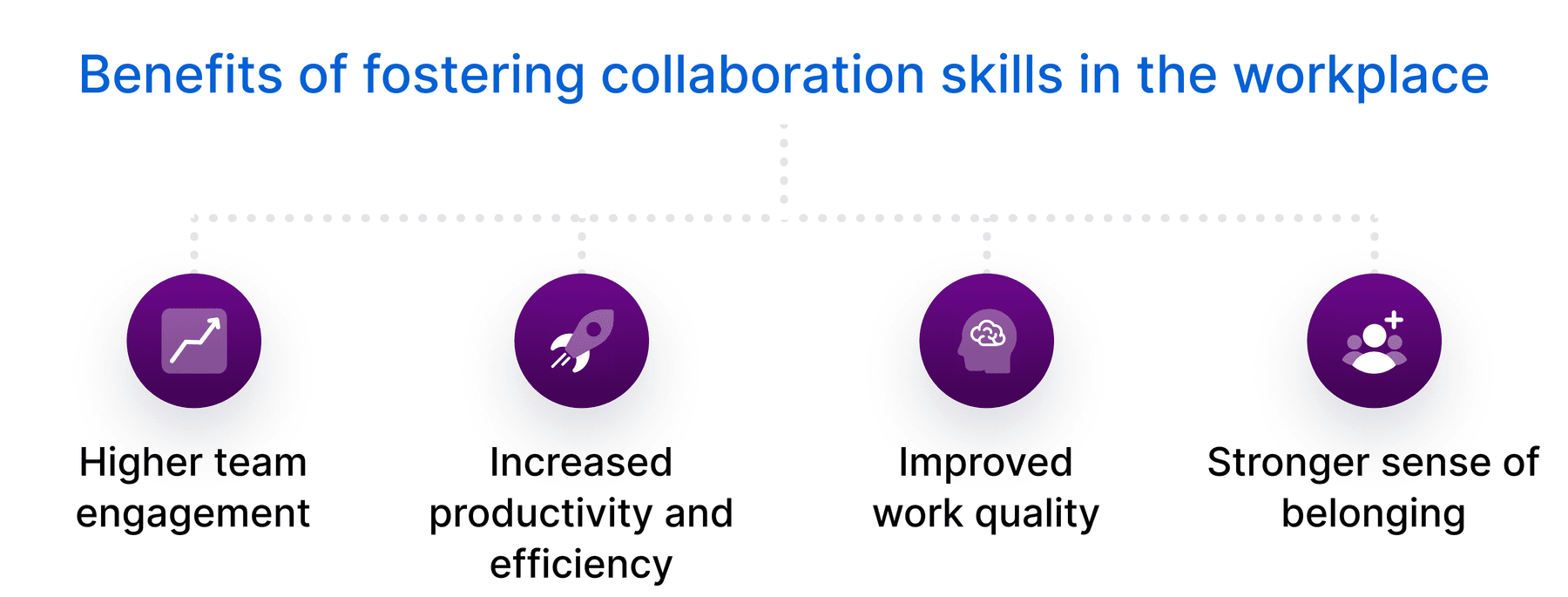
- Higher team engagement: As highlighted in a TalentLMS report, 77% of workers say that learning new skills gives them a sense of purpose — making upskilling in collaboration skills a great way to boost your team’s motivation. When workers see how their contributions directly impact the company’s success, they are more likely to stay engaged and keep contributing as team members.
- Increased productivity and efficiency: Teams achieve more in less time when they collaborate. For example, if you work in a fast-paced clinic and need to find a specific patient case, a teammate can quickly access and retrieve information from centralized storage, enhancing healthcare collaboration on medical records.
- Improved work quality: Better teamwork and collaboration skills improve the quality of your team’s work by allowing members to bounce ideas off each other and share different perspectives. For example, in a collaborative content review process, teams identify errors and inconsistencies with greater accuracy.
- Stronger sense of belonging: As employees work together and participate in collaboration skills training, they develop stronger relationships, creating a more positive work environment. When people feel supported in their work environment, they connect better and commit to the team’s goals.
Understand the importance of employee training and upskilling in digital transformation.
Free 14-day trial. No risk.
Box free trial includes native e-signatures, lets you securely manage, share and access your content from anywhere.

Top 8 effective collaboration skills to develop in your organization
Grammarly’s State of Business Communication reveals that knowledge workers spend 88% of their workweek interacting across multiple channels — with 55% dedicating excessive time crafting messages or deciphering others’ communications. Clearly, there’s room for improvement in how teams interact to get work done more efficiently.
To address areas that hinder productivity and make the most of your team’s potential, you need to cultivate the right skills. Here are eight valuable areas of development to focus on when fostering teamwork and collaboration in your company.
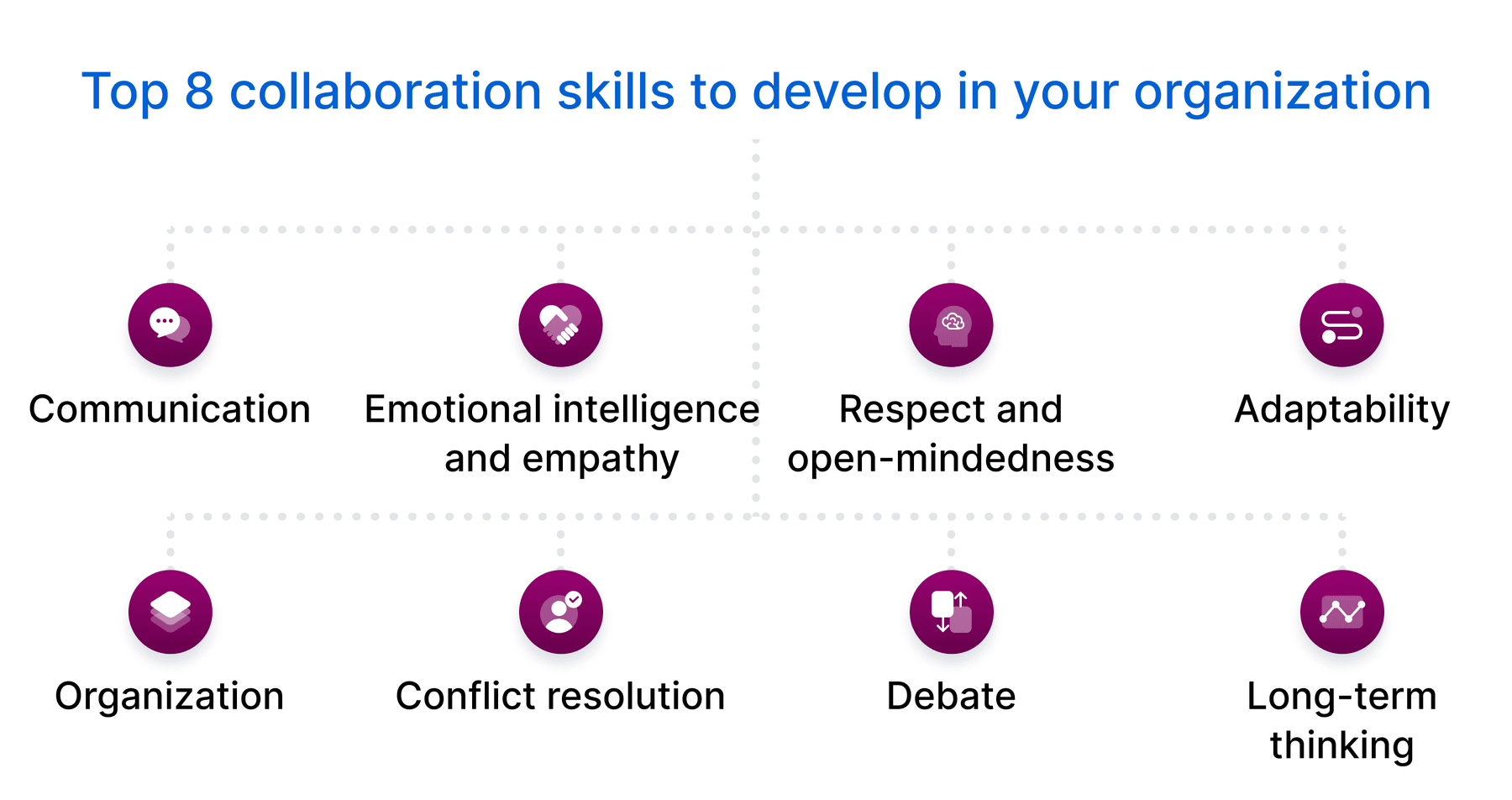
1. Communication
When fostering communication and collaboration skills in the workplace, consider varying styles and how you and your team can adapt to different types of communicators. Here are examples of skills to consider in your training program.
- Written: A significant amount of teamwork happens through written communication channels, especially when collaboration takes place within virtual workspaces. When communicating through writing, ensure the message is clear and easy to understand.
- Verbal: Spoken communication is all about what you say and how you say it. In team meetings, whether in-person, hybrid, or fully remote, use empathetic tones and encourage the ability to verbalize clear messages.
- Nonverbal: Body language and facial expressions often indicate a person’s underlying thoughts or emotions. Make sure team members understand how their nonverbal cues affect their communication. For example, crossed arms can make you seem defensive or closed off, which isn’t the impression you’d want when running a client feedback session.
- Active listening: While sharing information is critical to communicating ideas, active listening allows individuals to fully understand the message. This practice involves asking questions and summarizing the message to ensure it’s clear.
Find strategies to foster collaborative communication in the workplace.
2. Emotional intelligence and empathy
Promoting empathy and emotional intelligence in the workplace gives team members the soft skills to recognize and appropriately react to emotions at work. Collaboration becomes much more natural when team members support each other regardless of the situation.
3. Respect and open-mindedness
One way to boost collaboration and break down organizational silos is through activities that focus on understanding and mutual respect. They create a space where your people feel safe contributing to group discussions.
Open-mindedness involves listening to and accepting new ideas. For example, you can encourage everyone to use note-taking methods to capture diverse thoughts and actively consider all ideas in a brainstorming session.
4. Adaptability
Whether it’s priority changes, delays, or otherwise not following the plan, this collaboration skill keeps your team moving forward despite setbacks. Adaptability is difficult to teach, but you can demonstrate it through leadership. Staying calm and focusing on the team’s next steps sets a positive example for navigating unexpected changes.
5. Organization
Organizational skills are a must-have, especially on remote or hybrid work models, as each team member’s workload is often more independent. When collaborating on projects, employees should manage their time and prioritize tasks to meet deadlines.

6. Conflict resolution
This is one of the most critical cross-functional collaboration skills, as it helps maintain positive working relationships across departments. Foster the ability to talk through disputes respectfully and hear others out to determine amicable solutions.
7. Debate
Healthy, constructive discussions are a positive sign of fostered collaboration. Debate drives innovation, keeps projects moving forward, and weeds out less effective ideas. Take advantage of tools like virtual whiteboards and sticky notes to encourage real-time collaboration during meetings and brainstorming sessions.
8. Long-term thinking
When team members have long-term thinking skills, they envision the final result of collaborative work and recognize how their contributions impact the shared goal. Foster an understanding of every person’s role in a project and its scope so your team knows why their individual efforts contribute to the larger objective.
How to foster collaboration in a team: Best practices for success
Follow these five strategies for promoting effective collaboration skills in your organization.
1. Set collaboration goals
Define clear goals and highlight that success depends on everyone working together. For example, in content AI workflows, the writer drafts an article using intelligent tools, the editor refines it, and the designer can leverage AI to generate visual assets. Each step relies on the previous one, and success depends on seamless collaboration across all roles.
Learn how to use content intelligence to streamline your business workflows.
2. Promote creativity
Encourage team members to use creativity together. For example, your design department can use team collaboration software to co-create wireframes and prototypes, making it easier to refine ideas while keeping designs on-brand.
3. Recognize each team member’s strengths
Every team member brings unique skills — tap into them to boost teamwork and performance. For example, if a tech-savvy member knows the best way to share files with clients, they can train the team on practices for organizing and keeping files accessible and secure.
Discover link sharing best practices for secure content collaboration.
4. Adopt digital collaboration tools
An HP survey shows that only 35% of knowledge workers report having the tools and technology to improve collaboration with their coworkers. Digital platforms play an essential role in fostering collaboration in a team, providing a central space for document storage and enterprise file sharing.
For example, cloud-based platforms let teams access shared resources from anywhere, preventing version control issues and allowing everyone to contribute at the same time, no matter their location or device.
Find out the top features and capabilities of cloud collaboration tools.
5. Prioritize secure collaboration practices
Make security a key part of teamwork by using secure communication channels along with file and folder permissions. Encourage strong passwords and careful handling of sensitive information to keep data safe and maintain trust across the team.
See how password-protected file sharing facilitates secure collaboration.
Strengthen collaborative work skills with Box
Box offers a centralized cloud workspace to help your team collaborate securely and move your projects forward. Our Intelligent Content Management platform combines secure data storage, AI capabilities, and a set of tools and features that facilitate collaborative work from anywhere, on any device.
With Box, you power teamwork with:
- Collaboration tools like co-editing and secure file sharing to work seamlessly on documents without delays
- Box Canvas, a virtual whiteboarding tool to facilitate brainstorming and ideation
- Secure Hubs to create and share content playlists with everyone
- App integrations to connect Box with all the platforms your team uses every day
Contact us today and foster effective collaboration skills in the workplace with Box.
*While we maintain our steadfast commitment to offering products and services with best-in-class privacy, security, and compliance, the information provided in this blog post is not intended to constitute legal advice. We strongly encourage prospective and current customers to perform their own due diligence when assessing compliance with applicable laws.