Company knowledge is a valuable asset, but managing that information comes with complexity. You open a shared folder and see five versions of the same document. You search your tools and get results that don’t match what you actually need. Even when answers exist somewhere, they’re buried under outdated files, conflicting edits, and systems that don’t talk to each other.
Artificial intelligence (AI) in knowledge management helps you minimize these issues by making information easier to access and interpret. Modern AI understands context, connects related ideas, and delivers insights, even across large content repositories.
Key highlights:
- AI in knowledge management is the use of intelligent models to read documents, interpret context, and link related information
- AI reduces manual knowledge work by strengthening search, enriching content with metadata, and uncovering patterns across large, fragmented repositories
- Smart ways to use AI for knowledge management include enriching content with consistent metadata, extracting key information from documents, revealing relationships across files, and automating workflows
- With Box AI, you get secure semantic search, automated metadata, and AI-driven workflows built into one Intelligent Content Management platform
What is AI for knowledge management?
AI for knowledge management is the use of artificial intelligence to read content, understand its context, and organize key ideas, making information easier to find and apply in enterprise settings. AI surfaces patterns and makes large volumes of content easier to navigate when information spreads across many files, formats, and repositories.

In practice, generative AI has the potential to shift how knowledge flows inside an organization. Let’s say your sales reps each manage hundreds of accounts. AI instantly highlights contract changes, customer issues, and renewal risks across those accounts — providing the kind of tribal knowledge that generally takes years to develop.
Learn why you need AI in your enterprise content strategy.
AI-powered knowledge management vs. traditional approaches: What’s changing?
AI-powered knowledge management (KM) changes how organizations interact with information. Traditional knowledge management systems required manual efforts: teams had to tag documents, update content, and dig through disconnected systems themselves. But as the business and management researcher Mojtaba Rezaei notes in ScienceDirect, “AI has emerged as a central enabler of more efficient, dynamic, and intelligent KM processes.”
4 ways to use artificial intelligence in knowledge management
Managing knowledge within an enterprise often feels harder than it should. You deal with duplicate versions, conflicting sources of truth, and tools that don’t talk to each other. Even when information exists, it’s not always clear which document version is correct or where to find the context behind it.
Artificial intelligence in knowledge management makes everyday knowledge work simpler and more intuitive. Here are four practical ways to put it into action.

Improve knowledge discovery with semantic search
AI semantic features upgrade your internal search capabilities by looking beyond exact keywords. AI models interpret meaning, context, and relationships within your unstructured data so you can ask natural questions, use broader phrasing, or describe what you’re trying to find and still get relevant results.
With AI-powered enterprise search, your team can:
- Find relevant information even when they don’t know the exact terms used in a document
- Surface context-aware results that align with user goals
- Reduce time spent opening multiple files to figure out what’s inside
See how intent-driven search is possible with agentic AI.
Enrich content automatically with AI-generated metadata
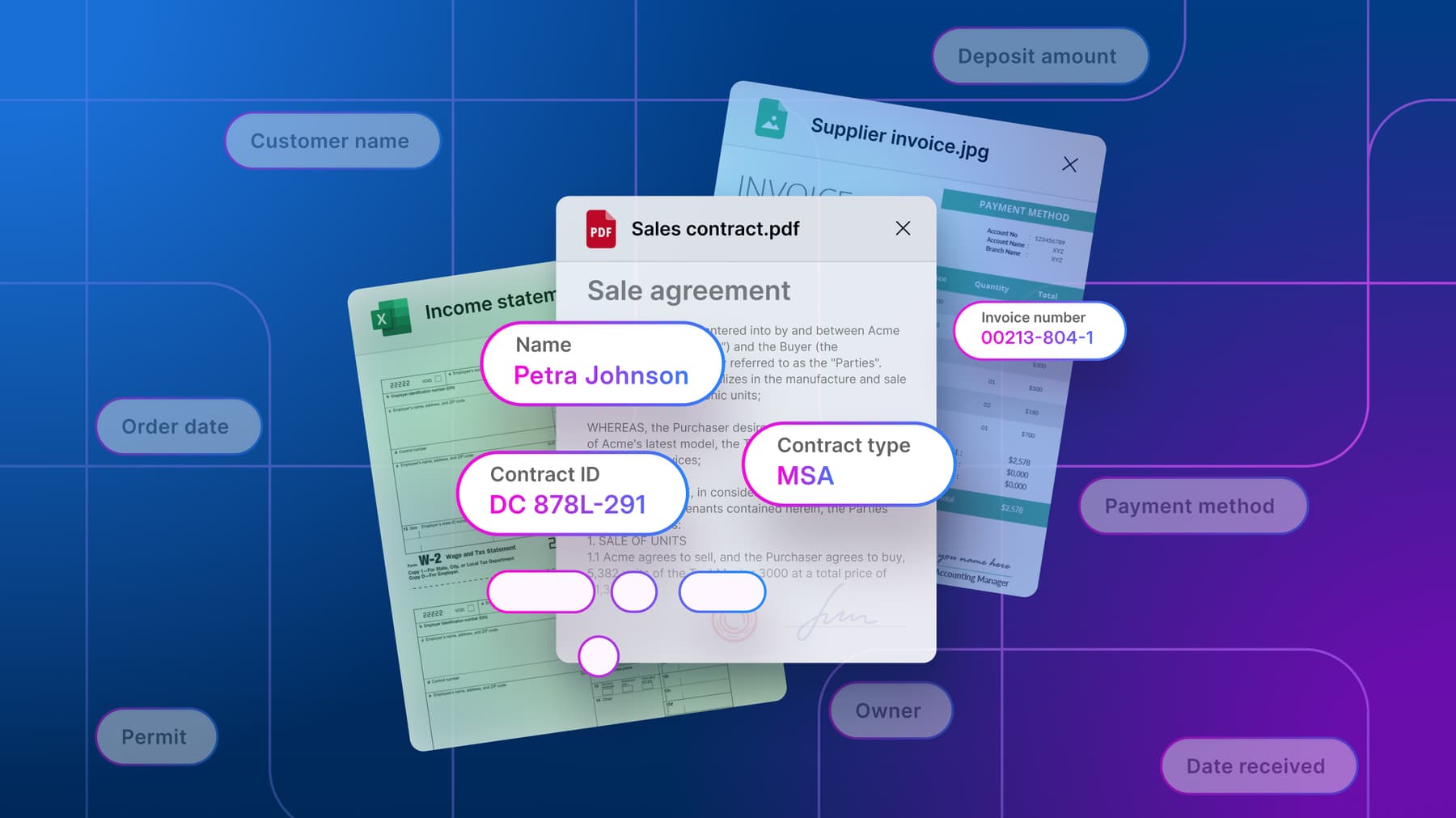
You can use AI in knowledge management to automate metadata tagging. AI systems read through large volumes of content, identify key information such as names, dates, clauses, topics, and risks, and automatically apply consistent metadata.
AI tagging and auto-classification in knowledge management make enterprise metadata management processes smoother. For example, imagine reviewing 200 vendor agreements. Instead of scrolling through each PDF, AI extracts renewal terms, payment details, responsible teams, and risk-related language, then it stores all that information as metadata you can filter, search, or route in seconds.
AI-generated metadata helps you:
- Look through key document details without opening files
- Improve accuracy in search and classification
- Eliminate inconsistent manual tags
- Feed clean, structured information into workflows, dashboards, and approval processes
Find out why metadata matters in an AI-first era.
Reveal relationships across your content
AI makes it easier to see how pieces of information connect, especially when your knowledge lives in thousands of documents, slides, spreadsheets, and email threads. AI models don’t treat your files as isolated records. They look at the concepts, entities, and themes inside your content, uncovering links you may not have realized were there.
AI knowledge management reveals links across your content by:
- Detecting shared concepts or entities in different files and surfacing related documents even when they’re stored in different places or written in different formats
- Highlighting patterns such as recurring customer topics, repeated risks, or common project themes
- Grouping content by relevance, not just by folder structure, so you can quickly move from one connected resource to the next
- Providing contextual AI summaries that explain how documents relate to a topic, project, or account
Discover a new approach to enterprise content management.
Automate workflows with AI-enriched data
When your documents carry rich, accurate metadata, an AI-based knowledge management system helps you automate workflows by routing files, triggering next steps in the content review process, and updating records. Rather than waiting for someone to copy-paste information or move a task forward, AI uses the data already extracted from your work to keep processes running in real time, without constant manual follow-up.
Learn how AI workflow automation works.
Key benefits of AI in knowledge management for large enterprises
According to McKinsey’s State of AI in 2025, knowledge management is one of the top two business functions where companies are already scaling AI agents. It makes sense: when AI strengthens information retrieval, improves data quality, and lifts the burden of manual knowledge work, large enterprises gain speed, clarity, and more consistent decision-making across teams.

Key benefits of AI in knowledge management include:
- Faster information retrieval: AI provides quick answers from large, complex repositories, eliminating the need to dig through folders or outdated files
- Higher data quality:Multi-agent systems flag inconsistencies, normalize metadata, and enrich content so knowledge stays accurate and reliable
- Better decision support: Teams get clearer insights from the content they already have, reducing guesswork and helping leaders speed up operations
- Reduced operational friction: Automated tagging, routing, and summarization eliminate manual steps that slow down reviews and handoffs
- More consistent knowledge access: AI applies the same logic across documents in your cloud storage systems, giving every team a predictable, unified way to find and use information
What features should I look for in an AI-based knowledge management system?
An effective AI-based knowledge management system should help you get accurate answers quickly, maintain consistent content tagging, and reduce routine work that slows teams down. The right platform should feel intuitive and reliable, even as your knowledge base grows.
Key features of AI knowledge management systems for large organizations include:
- Semantic and intent-driven search that understands meaning and context
- Automatic metadata enrichment to improve structure, accuracy, and data quality
- Permissions-aware, relevantfiltering so results always match user access
- Intelligent Content Management tools that keep unstructured information organized and ready for AI use
- Continuous learning loops that refine outputs based on user interactions
- Compliance-ready governance with document audit trails, retention rules, and security controls
- Flexible integrations to connect your content with CRM, ERP, support, and analytics tools

Power your organization with AI knowledge management tools from Box
Box gives enterprises a simple, secure way to turn company knowledge into business value. With AI embedded directly into our Intelligent Content Management platform, you can leverage the context from your content and fuel smarter connections across your files — without switching between systems.
Box AI can:
- Deliver accurate answers sourced from governed content, tailored to user permissions
- Summarize and interpret documents so you grasp key insights and act quickly
- Surface related information using semantic and agentic capabilities that reveal patterns across content
- Reduce manual effort by triggering document reviews, routing, and updates
Turn scattered information into clear, usable intelligence with AI knowledge management tools from Box. Contact us today.

Frequently asked questions
How can AI support knowledge management?
AI supports knowledge management by helping teams find the right information faster and with far less effort. With natural language processing (NLP), artificial intelligence models understand context, phrasing, and intent, not just keywords, so people get answers that actually match what they mean.
AI-based knowledge management can:
- Automatically tag and enrich content so it’s easier to search and reuse
- Connect related files across departments
- Summarize long documents and highlight what matters
- Adapt results to the user’s role, task, or past interactions
Are there any disadvantages of AI in knowledge management?
Yes. One of the main disadvantages of AI in knowledge management is the risk of inaccurate answers when repositories aren’t well-maintained. According to Forrester, poorly maintained knowledge repositories may yield incorrect or irrelevant AI outputs, propagating hallucinations.
To mitigate this issue:
- Keep knowledge sources current and consistently reviewed
- Standardize metadata and tagging practices
- Monitor AI outputs and refine prompts, extraction rules, and validation steps
To support these efforts, Box helps you manage your enterprise content with the highest standards of security, compliance, and privacy. Learn more about the Box commitment to responsible AI trust.
Which AI-powered knowledge management system is the best?
The best AI-powered knowledge management system is one that adapts to the way your teams actually work. Leading platforms with API-driven app development, like Box, integrate deeply with your content layer, support semantic discovery, automatically generate metadata, and connect to downstream tools to enable faster decision-making.