A COO’s perspective: Stages we passed through, lessons we learned
Becoming an AI-first company doesn’t happen overnight.
For most of us, the journey has just begun. Even AI natives with no legacy tech stack or processes need to be purposeful in how they build and operate in this new world.
As COO of Box, I enjoy the collaborative problem-solving and ongoing learning that our AI explorations have entailed — not just with Boxers but with peers. We’re all immersed in the same issues as we grapple with what it means to operate in a world of generative AI. In the spirit of this shared journey, here’s a year-long timeline of Box’s often-messy AI transformation — strategies we tried, mistakes we made, and a few lessons we learned along the way.
Key Takeaways
- The Box AI journey moved through distinct phases — ideation ("Let a thousand flowers bloom"), universal education ("No Boxer left behind"), scaling to production, and strategic redesign — each valuable, while not always according to plan.
- Closing the AI adoption gap requires mandatory training, change management, and structured oversight; without them, innovation benefits only the early adopters while others fall behind.
- Agents are only as good as the curated, reliable content they draw from — making knowledge hubs and content governance non-negotiable prerequisites for any meaningful AI transformation.
Spring 2025: Mapping the agent efficiency curve
Box’s own AI journey began with our customers.
We saw tremendous opportunity for our customers to unlock value with AI.
Specifically, we knew that people going to work every day hadn’t really been able to leverage AI when it came to the documents they wrote, the images they created, and the presentations they gave.
Our customers were engaging with their content, but mostly finding it difficult to know what was in it.
The insights were lost in years of product roadmaps, customer stories hidden in numerous interactions, and on and on. “We don’t really know what’s in our company’s documents,” people would say. “We know it’s an asset, but it’s not clear how to get new value out of it.”
Any given piece of content would be worked on for a while, referenced a few times, but then, for all intents and purposes, lost. Over the course of 2024, we found that customers and prospects moved from “We don’t really have a content strategy” to “We need a content strategy,” and from “Is AI something I should pay attention to?” to “Where do I start?”
So as 2025 began, we started organizing our own thinking in order to better help our customers. We knew it was possible to think differently about using content to drive transformation. But how exactly does one become AI-first? How do you get going? How do you prioritize AI investments? We needed to establish our own philosophy.
Ultimately we put our thinking into a whitepaper, "How To Be an AI-First Company," which Box CEO Aaron Levie and I co-wrote last spring to answer a straightforward but crucial question: If you wanted to start leveraging AI today, how would you do it? How would all the companies out there that were already well into building their businesses make the pivot to being “AI-first?” And really, what did being “AI-first” even mean?
To anchor our thinking we created a framework to think about where AI agents would most likely drive transformation in the enterprise. Our goal was to differentiate between personal productivity tasks where AI’s impact would be more incremental, and truly valuable workflows where the technology could lead to company transformation. Our theory was that two factors best identified where human-AI collaboration would yield the highest return: how frequently a process repeats and how much intellectual lift it requires.
The best AI investments, we argued, lay along or above an efficiency curve. High-frequency, high-lift tasks like contract management and code review were no-brainers.

But processes like drug research and discovery (less frequent but greater complexity) and customer support and claims processing (high frequency but lower complexity) could be just as valuable.
One question we were asking at the time was “Who will determine what agents will be built?” In a sense it was a hiring question. Effectively, what agents would be hired and who made that decision? One question that emerged among peer operators was whether IT will become the new HR. My perspective was that this wouldn’t be the case. IT plays a critical role in any organization. But I expected that functional leaders would be closest to the business problems and thus best suited to determining what agents would be most useful for any given task.
As the Box leadership team, we were hearing and discussing topics like these in daily conversations in the ecosystem. When our Chief Information Officer, Ravi Malick, talked to IT decision-makers, they would ask, “How are you becoming AI-first?” Our Chief People Officer, Jess Swank, was having conversations with her peers about how Box was dealing with AI’s emergence, what skill sets we now found important and how it was impacting who and how we hired. I myself was being asked by customers how teams at Box were using AI to transform ourselves and the way we get work done.
In other words, we were all hearing the same interest, but from different angles. If we wanted to crack this nut, we’d have to team up. Aaron Levie, our CEO, was constantly thinking about AI-first’s implications. By the middle of last year, Ravi, Jess, and I (and the rest of EStaff) started working to figure out how to make those implications real.
This was going to be a fun but messy ride.
Summer 2025: Let a thousand flowers bloom
In mid-2025 we were using Box AI, and we’d deployed select third-party AI tools. But we hadn't built our own agents yet. How exactly should we apply the framework we’d developed? We had to figure out how this would work if we were going to help our customers do the same thing themselves.
In the end, we began Box’s AI transformation by diving in.
While I still believe the concept behind our 2×2’s efficiency curve is correct, we decided our first priority had to be to get ideas going. Box’s transformation would be fueled by passionate team members who felt inspired to use AI in their daily work and were willing to invest the time to play around with Box AI.
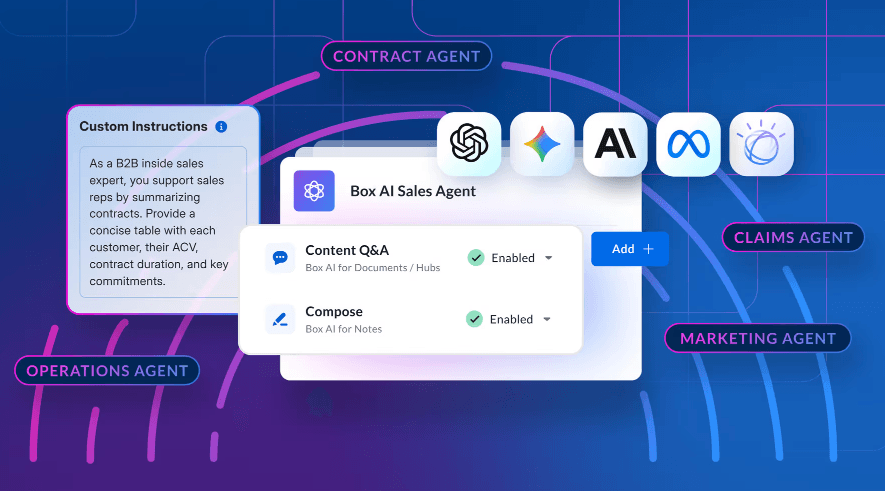
So we launched into a phase we lovingly called ”letting a thousand flowers bloom.” This meant launching a program that let Boxers try creating their own AI agents in a safe, sandboxed environment. How might AI take the busywork out of content-related tasks by performing them far faster and better? The most immediately valuable action turned out to finding ways to activate AI on secure content like customer information, product messaging, and employee guidelines. We’d released Box Hubs two years earlier, and Boxers had already had a field day with it. We had a Sales Enablement Hub, a product marketing hub, and employee policy hubs. Now AI enabled Boxers to query, discover, and create new content and insights off this curated internal company content.

Enabling Boxers to create agents in sandbox environments helped us start getting actionable intelligence from those Hubs and the rest of our content. People created all sorts of agents: a marketing blog creator agent, a marketing material editor agent, RFP agent, use case agent, Enterprise Advanced use case agent, Shield Pro use case agent, MEDDPIC agent, customer meeting prep agent, product support for Customer Success agent — 97 agents by the end of last fall. It was pretty glorious. You could ask questions of 1,000+ documents and get accurate answers. We were unlocking real value by getting dependable intelligence from our content. And we had zero concerns about who accessed what information, because AI followed permissioning mapped to individuals at the document level. There was no scariness of people seeing other people’s performance reviews or salaries.
I’m sure this “thousand flowers blooming” process will show up differently at different organizations, but the concept is the same: Let your people use AI to solve problems they see in front of them. Give them the gratification of seeing their creativity’s impact, even if it’s on relatively small lifts. We embraced this democratic approach to innovation and adoption even though it was far from the most efficient. We’d worry later about sifting through what was valuable and what wasn’t.


Fall 2025
Part I: No Boxer left behind
Change is hard, and AI represents real disruption. At an all-hands meeting I’d asked for a show of hands: “Who here has played around with Box AI? Who has created an agent?” I‘d seen before how the nature of change results in a predictable pattern: A third of people embrace change and roar ahead, a third are neutral, and a third never tap in at all.
I was worried that democratizing AI at Box was only widening our learning gap. Some people were playing with AI on nights and weekends and figuring out creative new ways to get work done. Others hadn’t dipped a toe in. Our innovators would soon be accomplishing more at higher quality; our laggards risked falling hopelessly behind.
How could we get it so that everyone was raising their hand? In August we kicked off a requirement that all Boxers become AI-certified. We asked our Chief Technology Officer, Ben Kus, to record parts of the training — the emergence of AI, generative AI tenets and market trends, and the capabilities of Box AI.

We also launched an AI-First section at Friday Lunch, our weekly virtual company gathering. We used that time to spotlight the innovative work of Boxers who’d created AI agents. They would explain the problem they faced, how they went about building their agents, and how those agents wound up improving their workflows.
This wave of education had two goals: to do right by our team members by helping them grow professionally, and to support Box’s future by making sure we all engaged with AI in our day-to-day work.
Becoming an AI-first company demands a ‘no one left behind’ approach. This journey had to be accessible to everyone.
Part 2: Scaling
Letting a thousand flowers bloom and doubling down with universal training increased the number of Boxers who engaged with AI. But in crucial respects, our transformation was still in its infancy. We had secure, curated content (a win) that we could query as sources of truth for agents. But sandbox agents were limited to the users who built them. I could create an agent in AI Studio but couldn’t share it with my teammates. Individual productivity was great, but we needed to achieve it at the company level.
We also lacked a system for comparing agent quality. We had people creating duplicative agents, or using agents that were inferior to existing ones.
All to say, our AI transformation was pretty messy. We needed to productionize our process, which, because of the time and effort involved, included prioritizing which agents to build first.
As we sifted through the 97 sandbox agents, we went back to last spring’s 2×2 and were delighted to see some of these “thousand flowers” fell above the efficiency curve. The next step was to make them usable by teams across Box. In October our small but mighty tools team launched a simple process for prioritizing and putting the agents into scaled production.
It turned out to be easy to identify agents that would be useful to the greatest number of Boxers — usually because they addressed simple, highly repeated tasks. We put those into production first. Not surprisingly, we found ourselves starting with agents that helped Product Support answer questions from customers, agents helped sellers prep for customer meetings, and agents that helped our Professional Services team answer RFPs. We were off to the races!
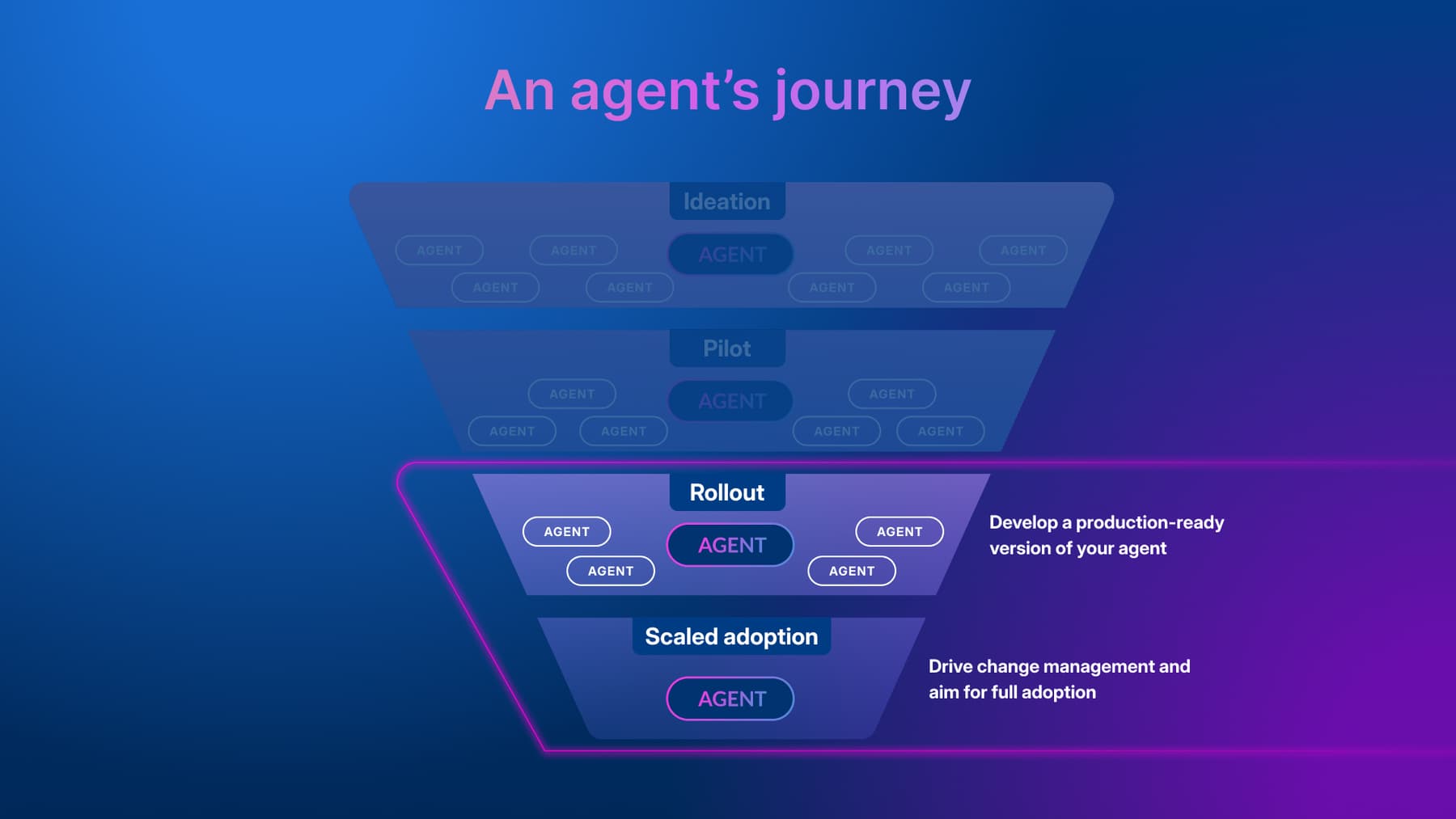

Winter 2025: Strategy, finally
At last we had three engines up and running — ideation, education, and production. This gave us a moment to breathe and think more strategically. We pulled together our core team of enterprise systems, tools, and strategy and operations leaders to take stock. Were our existing agents addressing our company’s highest points of leverage? And who would define which agents should be built next?
To answer this question for our go-to-market (GTM) organization, Nora Soza, who leads our GTM Systems and Enablement teams, mapped out the agents that had been built against our key processes and tasks. Her work showed us where we had gaps.
While centralized coordination was important, purpose-built agents still needed to be created and vetted by thought leaders and experienced operators from each function. They, in turn, would need to partner with IT to sanity-check agent performance, verify data, and confirm governance. We decided to go down two levels to solve for the gaps. The Box GTM organization is structured into Marketing, Sales, Customer Success, and Operations. And within those functions are three to four groups, each with unique needs. The Sales function, for instance, includes teams of SDRs/OBRs, sellers, sales engineering, and partnerships, each with their own AI needs. And then at the next level, the Public Sector sellers need different agents than our Enterprise sellers.
These nuances needed to be captured by the leaders within the functions as they went to design different agents that solved the needs of their teams.

For each of the company’s major areas — Engineering, Product, GTM, People, Legal — we appointed a functional leader who was responsible for designing, hiring for, and managing an AI team. In GTM we wound up with around 18 sub-functions that each needed an AI manager. The resulting team — we called it the Operating Committee — met for the first time in early December. We went over the list of agents we already had, those our functional leaders had requested, which ones we’d decided to commit to and why, and the resources we’d need to productionize them and make the transformation real.
This gave us an intentional roadmap of agent creation.
The winter taught us something very important — content curation was more critical than ever. Agents didn’t work if the content hubs they were leveraging weren't reliable sources of truth. So our AI leaders had to appoint content curators. Our head of PMM, for example, was tasked with creating a clean Product Marketing Hub from which different Box agents could retrieve accurate positioning about our products. We also established a hub certification process — a framework to ensure the curated content has a strategic leader, governance to ensure content ownership and staying up to date, and enablement strategies. We ended the winter by identifying key knowledge hubs that our agents would be dipping in and out of as they completed their tasks. Once identified, we assigned them owners.
As we started a new year, our AI transformation was starting to feel almost, well, real.
Spring 2026: Now reimagine everything
Today, as we complete another lap around the sun on our AI-first journey, we’re still finding new change management challenges. We’re at a stage where we’re realizing we need to start redesigning processes based on the capabilities of the agents that will work within them.

Here are a couple early examples.
Getting information for customer support calls was always an inefficient process. A Customer Service Manager (CSM) who was asked a question they couldn’t answer would ping a Product Support person. The whole process would turn into a series of threads, and it was hard to go back into those threads to find that answer again later.
Once a CSM has gotten a given question answered once, we felt, no CSM should have to ask it again. So the team aggregated our support documentation into a Box Hub and used AI to query it. Now, instead of the CSM pinging back and forth with Product Support, they just ask the knowledge hub and get an instant response. The workflow itself has changed. We’ve lost the need for thousands of pings and gained back hours of time.
Another one of our process redesigns involves account planning. Every new fiscal year our account reps get new customer accounts and have to build a plan for what we want to achieve with them that year.
We know a lot about these customers. We have information about existing engagements, executive business reviews, meeting notes, call transcripts. There could be five years’ worth of content sitting in the customer folder. And instead of an account rep having to spend 20 hours studying it all to answer key questions — What lines of business is this customer in? What are they using Box for? What conversations have we had? Which contacts have we talked to? — our new account planning agent instantly summarizes it.
Another one that we’re currently beta testing is industry agents. Box has deep company knowledge around customer success stories and our business impact that is specific to industries, and to personas within those industries. That information is siloed with our managing directors (MDs). We've worked to move all that information into industry Hubs and create industry agents — what we lovingly call “Industry MDs in your pocket” — for our sellers.
What we’ve found is that our account planning and industry agents weren’t just efficiency gains. They helped us take a big step forward, from just saving time to also achieving better quality.
This spring, as we continue our journey of becoming an AI-first company, I couldn’t be more excited about the opportunity ahead. Box AI now can take on more complex tasks, simultaneously tap into multiple knowledge hubs to complete a task, and be part of a workflow where agents hand off tasks to other agents. This will turbocharge the agents we’ve already built as we continue to push the envelope on the complexity of the processes we take on.
I have no doubt that there will continue to be ups and downs and times where we need to adjust direction and solve for speed. We’ll need to define, coach, align, and educate our team members — including AI agents — at every stage in this journey. And, in the end, AI transformation is still human-led change.
What we've learned
We haven't completed this journey. But we're further along than we were, and we learn valuable lessons every day. Here are a few that stand out:
You have to do the work to learn what you didn’t foresee
No framework, no matter how elegant, survives first contact with reality. Our 2×2 was pure a hypothesis until we started building agents and learning where they had impact and where they did not.
Mistakes are great for future development
The things you get wrong can be a great feedback loop for getting things right the next time. As we implement new agents, we learn what each agent can and can't do. Some of the can't-dos are solvable, others are just too nirvana-esque to be realistic. Either way, our learnings inform Box’s next round of innovation.
AI agents are employees, not appliances
They need onboarding, coaching, and ongoing management. So does curation of the content that they leverage. Set-it-and-forget-it should not be part of agentic workflow design.
Governance isn't optional
Letting a thousand flowers bloom is great for innovation and it can (and needs to be) done in a secure and governed way; innovation can happen while still protecting employees, customers, and partners.
AI agents need curated content to work on
Understanding where your knowledge sits is key. Beautifully designed agents can return bad results or completely stall out if they don’t have content they can dependably work with.
The hardest part will be building the human muscle
Much time is spent on tools. Really the biggest lift will be training our people on AI, redesigning how we work, and how teams drive impact. Companies just starting out don’t face this change management. But those moving to become AI-first have will need to focus most of all on their people.
Learn more about the Box AI journey in our AI-First Transformation series.