This article is part of a series on how Box executes as an AI-first company. See our first article here.
Big bets start small. A simple idea to organize messaging for outreach. The solution to a friction point in vendor onboarding. A concept for scaling customer service.
In the crucial Ideation phase of AI transformation, raw ideas like these are forged into working prototypes. Of those, only a few — deemed impactful enough to potentially make waves business-wide — become the bets Box leans into as part of its growth strategy. These elites are known as “hero agents.”

Prospecting Agent: An experiment is born
To see Ideation in action, we dive into the early stages of a pivotal sales agent, championed by Senior Director of Sales Development Alex Hudzik.
As experimentation unfolded across Sales at Box, multiple overlapping initiatives emerged from both EMEA and US teams addressing similar outbound prospecting challenges. Rather than running efforts in parallel, teams opted to fuse them into a single powerful solution, the Intelligent Prospecting Agent.

“If we could shrink time to figure out, ‘What account should I target? Who within those accounts? And what do I say to them?’ then that’s like 90% of what sales reps do,” Hudzik says. “We could bring that down to 10%, and then they’d have the other 90% to actually talk to customers.”
Combining the functionality of early experimental agents, Box’s Prospecting Agent evolved into a significant big bet for Box. Soon, it will also connect to Salesforce data, tap into product usage analytics, and leverage our product marketing Hub to ensure consistent messaging.
“It’s very much a 1.0 version,” Hudzik says. “There’s a lot of fine-tuning still to be done — and a lot of other integrations that we want to add.”
With approximately 20 sales representatives in the Pilot (and a goal of dozens once the agent scales), Box’s prospector is poised to become a hero by essentially placing “a product marketer in every seller’s back pocket,” Hudzik says.
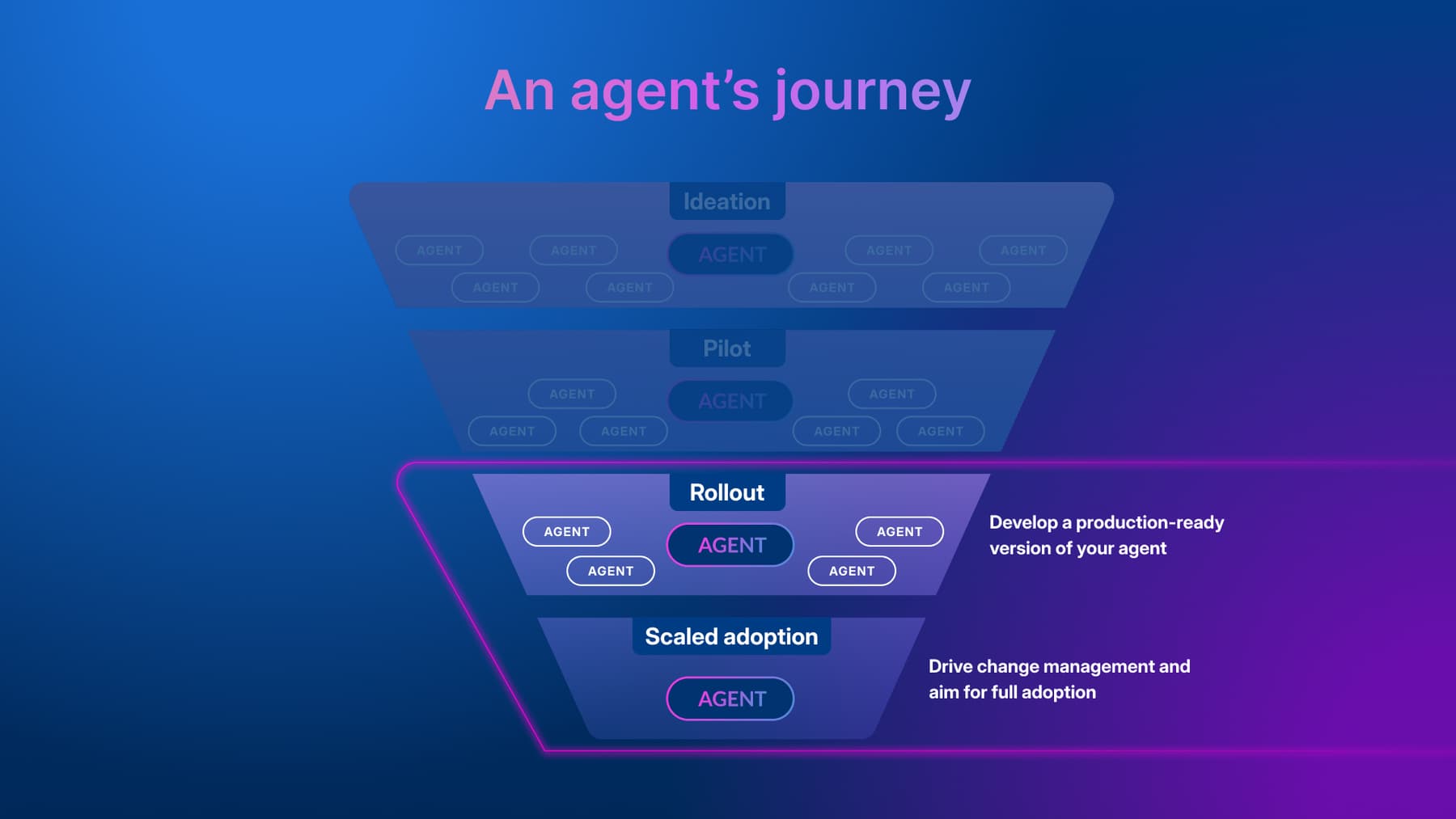
But first, the agent must survive the rigors of Box’s four-phased approach to AI transformation and prove its ability to produce high-impact results.
Ready to identify your AI transformation priorities?
Ideation defined
Ideation calls for examining internal pain points and inefficiencies. During this phase, businesses begin deciding which ideas to pursue with a combination of teamwide experimentation and strategic prioritization.
“Ideation comes in the form of exploring what you’re trying to achieve from a business process perspective, then process mapping and thinking about where AI can have impact,” Nora Soza, Senior Director of GTM Strategy and Operations, explains.

Ideation comes in the form of exploring what you’re trying to achieve from a business process perspective, then process mapping and thinking about where AI can have impact.
Key avenues for Ideation
Ideating at Box happens in a few ways. First, teams can initiate organic experimentation. This can occur within Box AI Studio demo accounts, through submission forms, or during annual hackathons. In addition, Functional Leaders can provide guidance on prioritization that helps seed ideas.
“Agents that are becoming our hero agents are not necessarily dictated from the top,” Robert Ferguson, Box’s Head of Corporate Strategy & Chief of Staff to the CEO, says. “It’s been this middle ground. Maybe the idea came from someone in the line of business, but it got picked up and championed by a Functional Leader.”


1. Bottom-up ideas
Organic creation in Box demo accounts
Inside the sandbox of Box AI Studio, Box employees are always demoing agents that may become new hero agents at Box.
Among them, Hudzik’s Prospecting Agent. It provides what he describes as “a turboboost to sales enablement.”
It started with a simple idea to improve how teams pull together audience insights and messaging across outreach emails. During the Ideation phase, leadership identified this challenge as a high-repeatability, critical thinking opportunity — qualifying the challenge as a “big bet.”
It allows the dream of every seller to have a mini product marketer in their backpocket to ensure all their messaging is consistent.
Since then, Box has integrated the agent with apps like Salesforce and Tableau, along with a growing knowledge Hub.
“To be truly powerful, it needed to be connected to customer and product data,” Ferguson explains. “So we ended up getting the data science team involved and built a data insights portal, which sits on top of our product data in GCP.”
Hudzik says it “cuts through noise” with specific data and relevant insights.
“It allows the dream of every seller to have a mini product marketer in their backpocket to ensure all their messaging is consistent, leads with clear customer pains, accurately differentiates, and contains value-based storytelling tailored to the right audience,” he adds.
More bottom-up ideas that leaders later championed: a knowledge base that streamlines customer service and a “Doc Bot” that generates custom developer documentation.

Removing the builder barrier
Recognizing that a lack of coding prowess should never maim a brilliant concept, Box leveled the playing field, allowing anyone from any department to pitch the next big thing.
“We wanted to remove that barrier of entry to say that you need to know how to build an agent to bring an idea to the table,” Soza said. “So we reduced that to say, ‘What is your business process? What is your objective? You can submit that.’ We took away all of the extra pieces to say you have had to have built it.”
To gather ideas on an ongoing basis, Box maintains a working Hub where employees can submit a form requesting a custom agent be created. For every form submitted, Box Doc Gen automatically builds a document reflecting the details. These documents then populate a custom Box App — where performance gets tracked.
Idea generation through hackathons
Box hackathons, the likes of which bring together global teams of engineers, designers, product managers, and customers for 24 hours of creativity and collaboration — can also help shed light on ideas that might otherwise not see the light of day. That way, concepts get the traction they need to impact business.
“There’s been this huge bottom-up effort, which has been enabled by hackathons, people having ideas, and Box AI Studio rolling out to more and more folks,” Box Chief Operating Officer Olivia Nottebohm says.
Tips to power Ideation across your business
- Let your teams experiment with AI agents
- Empower employees to submit ideas
- Host a hackathon to generate concepts

2. Functional focus
Following initial Ideation, Functional Leaders help bolster the Ideation process to ensure the most impactful AI innovations are woven directly into the fabric of Box’s operations.
Their understanding of grassroots business workflows, Ferguson says, makes them ideally suited to spearhead prioritization, own AI transformation across different teams, and track success. It’s a plan for systemic, long-term value rather than just incremental improvements to daily tasks.
“We’re trying to evolve to more of a ‘How do we think about big process objectives, and how can AI help transform them?’ We’re auditing overall business processes that will help us achieve our lofty goals for fiscal year 2027 and thinking about AI as part of our team for actually helping to achieve those,” Soza adds.
Talent is critical to our growth strategy, and the faster we can find, recruit, and hire the right person — the better.
For example, Functional Leaders identified that Recruiting could benefit from additional support in speeding up and optimizing how Box hires. This led to prioritization within our People team on building agents for recruitment over other areas of HR.
“Talent is critical to our growth strategy, and the faster we can find, recruit, and hire the right person — the better,” Ferguson says.
In another example, Box prioritized an agent that would help teams surface relevant use cases, so every sales person could better speak to customers. Other ideas like executive briefing preparation and partner identification, while potentially useful, proved niche in application.
From suggestions to strategic pipeline
Competing initiatives are evaluated and prioritized using Box’s 2×2 repeatability and critical thinking framework, discussed in article one of this series.
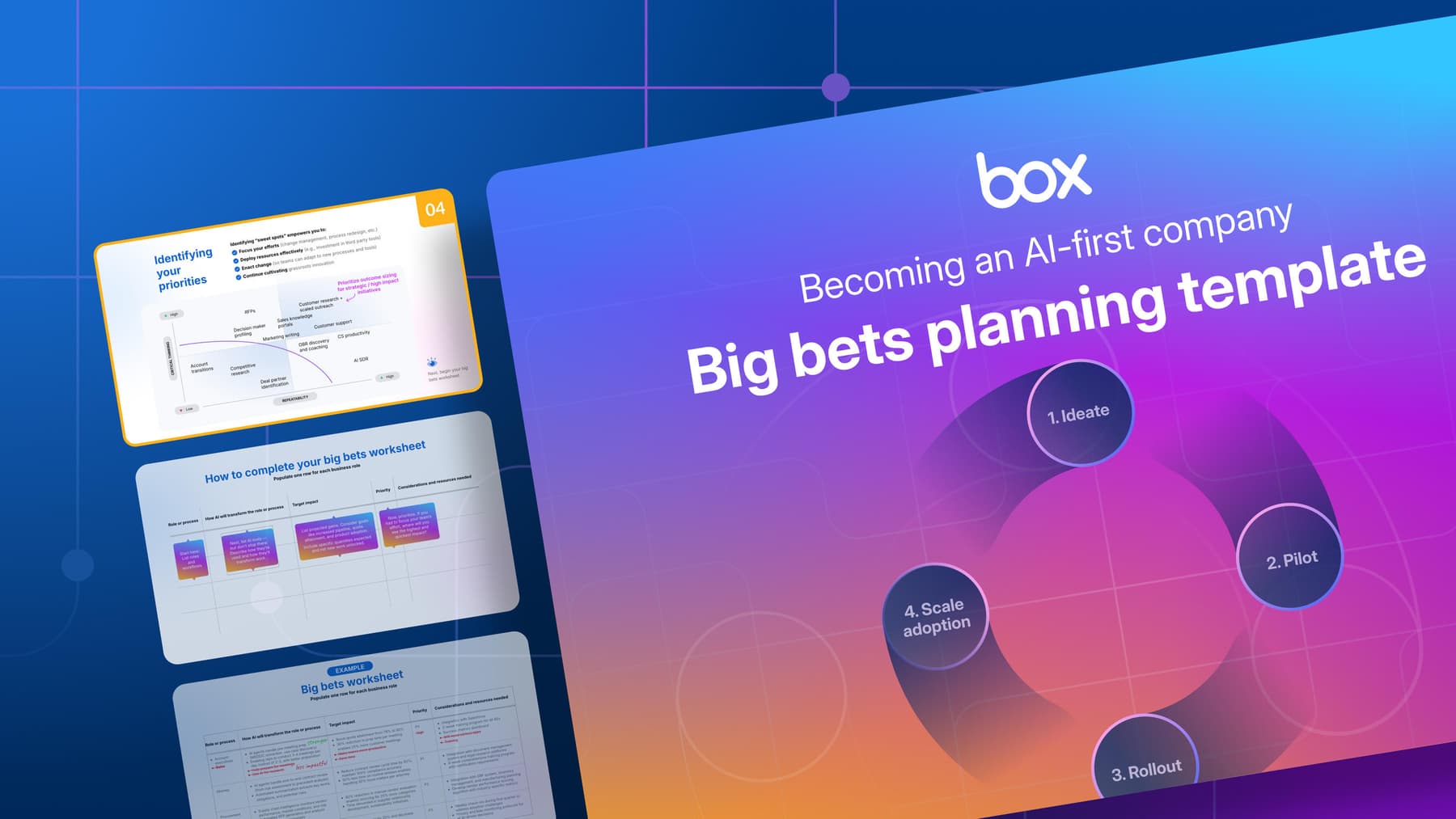
Download your own copy of the 2x2 prioritization matrix, and the “big bets” planning template used internally at Box.
Ready to identify your AI transformation priorities?
Grassroots sparks become scalable when paired with functional sponsorship, clear enablement, and a focus on end-to-end process change. Promising ideas are prototyped by curious builders, then vetted and consolidated by AI managers — and redundant point-solutions are merged into purpose-built agents.
“It’s about using multiple methodologies to get the best ideas and then to essentially think about how you would develop your road map against that,” Soza says.

Setting phase one to repeat
At Box, idea generation remains a perpetual engine even as strategic execution takes center stage.
“It’s not just about us transforming our work,” Soza says. “We’re using this as a feedback loop, to push information back to our product team.”
Feedback cycles help evaluate what’s working.
Innovation, she explains, requires both bottom-up creativity and strategic direction. In other words, ideation feeds innovation.
This philosophy reflects Box’s understanding that feedback cycles help evaluate what’s working. Feeding fresh perspectives into our execution framework ensures we’re balancing the act of transforming work while welcoming unexpected innovations that might emerge from anywhere in the company.
As for Hudzik’s Prospecting Agent: Its journey from experiment to strategic big bet is just getting started.
In our next article, we’ll follow this agent into the Pilot phase — where promising prototypes face the real test, proving they can deliver measurable impact.