You’ve got files and content everywhere. Some of it is structured. Most of it is unstructured. But how do you actually get value out of it in the world of AI?

The problem isn’t just that your data is scattered. It’s that the vast majority of your data is trapped inside unstructured formats. Those critical renewal dates, contract values, and business terms sitting in PDFs and Word documents? They’re essentially invisible to automated systems. AI can’t access them, can’t reason about them, can’t act on them.
This content never gets re-accessed for two reasons: It’s too much for any human to keep in their head — and until now, it’s been completely inaccessible to AI. You have thousands of agreements defining how your business works, but that structured intelligence remains locked away, unusable.
We sat down with Blake Walsh, Staff Product Manager of Box Apps at Box, to discuss how the newly updated Box Apps provides what he calls a “single pane of glass” — transforming trapped data into actionable business intelligence through AI-powered visualization and no-code application building.
Key takeaways:
- Box Apps turns unstructured data into actionable intelligence by combining extracted metadata with a no-code app layer for visualization and workflows
- Box Extract unlocks buried contract terms and dates so businesses can automate and act on critical information without manual review
- Box AI enables natural language search and chat-driven exploration, letting users ask outcomes-focused questions instead of navigating complex filters
- Enterprise-grade security and per-user permissions ensure dashboards and charts respect access controls while surfacing relevant results
- Pre-built apps and deeper Box AI integrations accelerate adoption by giving teams concrete examples to start building real business processes
Why can’t businesses build automation on their existing content?
Most content exists as unstructured data. Yes, there’s structured data living in these files: renewal dates, contract values, critical terms. But when these are trapped in PDFs and Word documents, that structured data is essentially invisible to automation systems.
That’s where AI innovations like Box Extract really come to bear — this new capability that allows unstructured content to become structured metadata.
The data about your data where you can say, “I want to look at my agreements that are set to expire in the next 45 days.”
You’re not going to spend human time sifting through your backlog of agreements. But you can automate bringing that into a structured format with AI, with a human in the loop to verify accuracy.
Why can’t businesses just “vibe code” their way to AI-powered apps?
There’s definitely an interesting moment happening around one-shot application building, or vibe coding. It definitely lowers the floor for hobbyists to build toy applications
But you’re not going to run a very important enterprise-grade business process on a vibe-coded application.
Think of the smiling curve — hobbyists get an amazing benefit. On the other end, software developers have dramatically accelerated their builds with AI, because they know what these tools are best for when it comes to creating software.
However, enterprises looking to get value out of their content need determinism. You don’t want hundreds of thousands of lines of code that a human’s never read or audited being part of your business process.
The middle is ambiguous, but for enterprise-grade acceleration of very specific instructions — you’re never going to have a human review your backlog of decades of agreements, but an AI agent will happily do that. That’s where the real value lies.
How does Box Apps transform unstructured data into actionable intelligence?
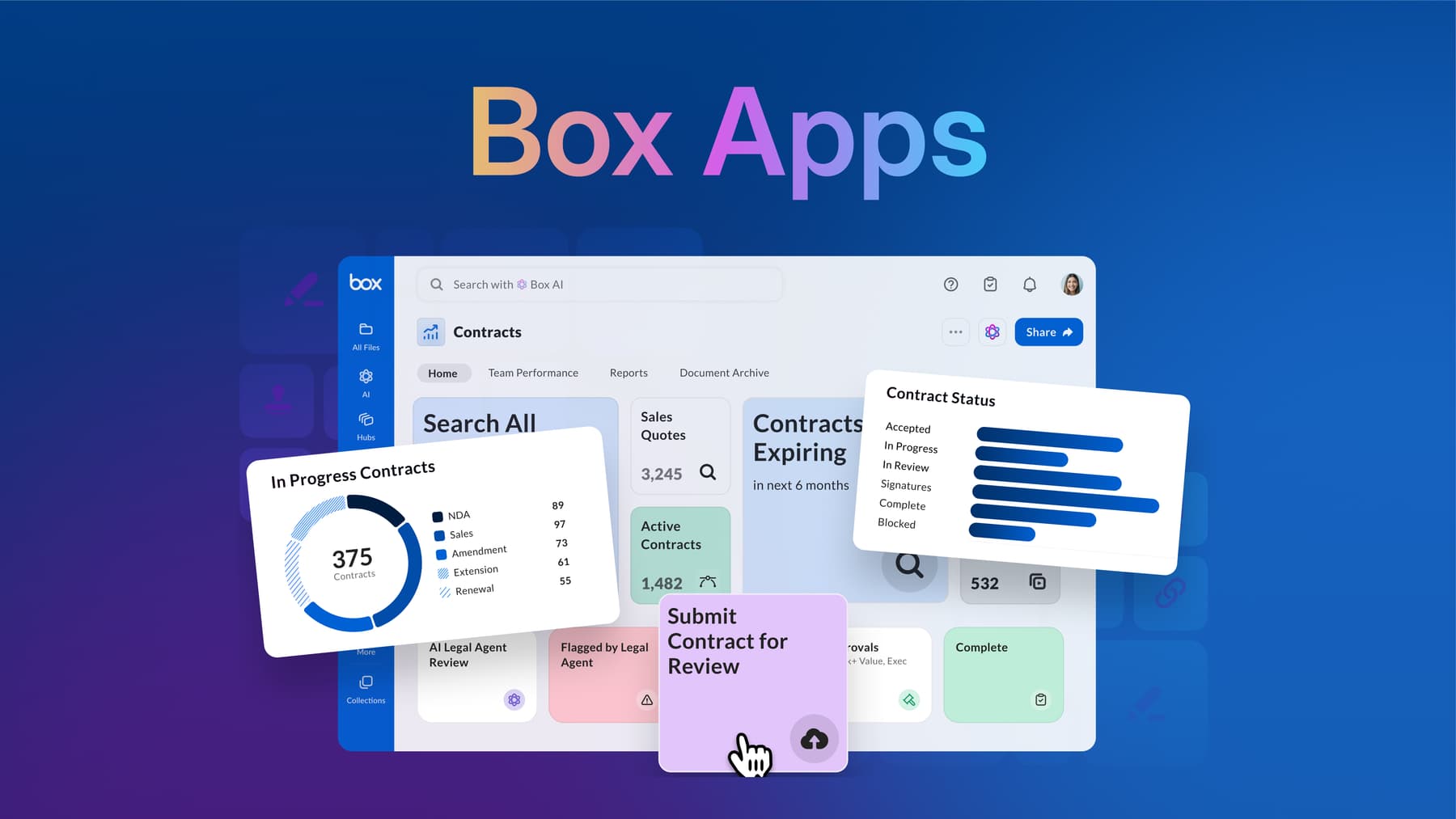
Box Apps is how you move from unstructured data to taking action on your structured data. It’s a no-code application builder where you can bring together your content, workflows, and users all in one place — no expensive point solutions, no indefinite maintainability costs.
Box Apps is really that single pane of glass.
It’s an amalgamation of all these different object types you have in Box — a place where you can search for files, pull up Box Forms, where the automation that Box Automate provides can surface. You can have a dashboard view showing: Here are my agreements in process, these are rejected, these are approved, these are up for renewal. You can literally see files move through a pipeline depending on what your business process is.
Box Extract is the technology that allows you to extract the information. Box Apps is the interface layer to interface with that information. Extract pulls the structured data out; Apps lets you visualize and act on it independent of folder and file hierarchy.
The really big changes we’re introducing at BoxWorks infuse Box AI into Box Apps, beyond even AI Q&A with your files, and the extraction of metadata. Instead of having to think in terms of clicking filters, you can be outcome-oriented. Just say to the search bar, “I want to find all my agreements over this value in these regions,” and Box AI will drive the UI for you.
Walk me through a legal department use case.
Imagine I’m new to a legal department and I’ve been tasked with figuring out which agreements are expiring soon that might have nontraditional clauses.
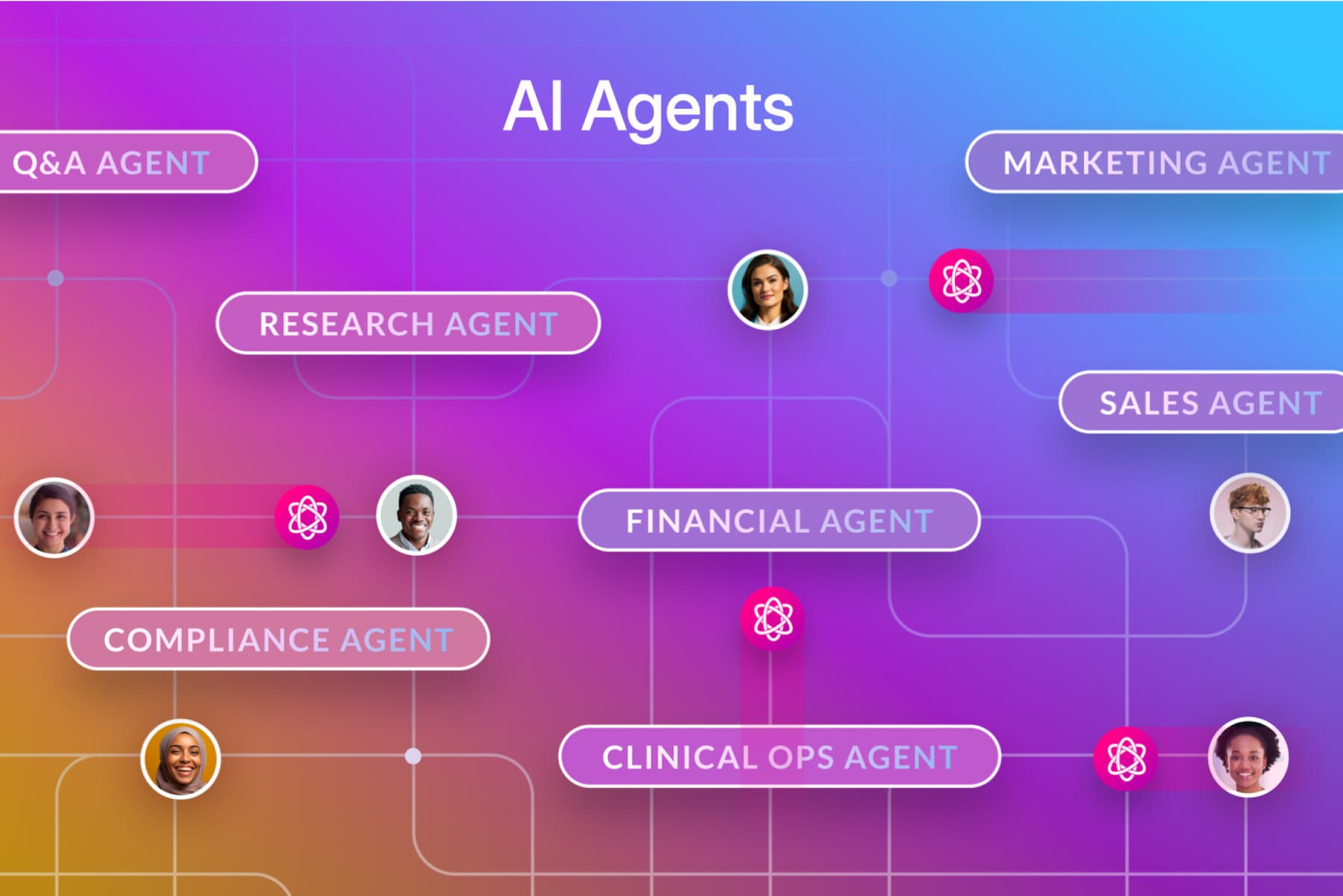
In the past, some of your peers had run Box Extract agents on these files and pulled out whether agreements would be classified as high, medium, or low risk based on internal classifications. That just lives as part of the files as metadata.
I come in, I join the organization. Maybe I don’t have that history or context. I can actually just come into a Box app and search for “high risk agreements.” Because that metadata is already there from past Box AI activity, we just set the filters for you. You don’t have to look for the filters or know that they’re there. We show you the high risk agreements.
Then you think, “Well, in the past, a human or AI agent tagged these as high risk, but I want to understand why.” That’s where Box AI also comes in — you can chat with the content. You’ve used AI to search for the content, you’ve benefited from past AI usage in setting that metadata, and now you can actually chat with a custom Contract Review Box AI agent and say, “Why do we think these are high risk agreements? Can you pull out specific terms?”

How does this work for marketing teams managing massive digital asset libraries?
Marketing departments have massive amounts of images and content for various use cases.
They need to know: Is the primary color blue? Is this approved for external use? Do we have a license until a specific date?
How do you sift through potentially hundreds of thousands of files? This lends itself to natural language querying: “I want photos that I can use for the next 90 days externally.” If we took a photographer to BoxWorks who shot a thousand photos, I could say, “Find me the five photos in landscape orientation with these colors and some of these keywords,” and it would pull those out.
The technical challenge here isn’t just showing information — it’s showing the right information to the right people at scale.
How do you ensure the right people see only the right information?
If we’re on the same legal team looking at agreements to process, I might see 47 things and you might see 22, based on our individual permissions. These saved searches run from everyone’s individual perspective.
This became particularly important for charts in Box Apps. Not only do we need to know there are five results for this search as one user, but seven as another. Everyone’s charts can be different based on their access levels, respecting the enterprise-grade security you’ve already built up over years in Box.
What role will AI play in the modern workplace?
We’re still defining the role of AI in the modern workplace. Norms are still forming. What we are doing here is giving people a new way to use AI that is accessible.
AI is showing itself to be a tireless coworker, a tireless peer that can do a lot of the work that, yes, you and I could do. But do we really want to spend thousands of hours categorizing contracts based on rigid criteria?
You have to consider the opportunity cost of our time.
Everyone is curious. Everyone is trying certain things, and there’s a lot of value being realized very quickly. It’s a tool at the end of the day. We’re definitely, as a society, figuring out what it’s best at and learning what it’s for.
There was an era where people didn’t know how to do a Google search. We learned what syntax worked well. I’m definitely still in the era where the specific Google syntax is locked into my brain. But it’s so much more natural to ask a question, right?
And that’s what you see people doing with the modern LLM-based applications that are out there now. We’re in that era where those norms are still forming with AI.
Given that, the value proposition of Box Apps as this interface layer — this way to use AI more straightforwardly, using natural language for chatting and searching — is even more powerful.
What’s next?
Keep an eye out for more searching and charting capabilities, and pre-built apps — working examples of all the complexity you can build, helping you understand what’s possible.
Everyone has different use cases for their business workflows. Seeing a working example gets you past the blank screen with a blinking cursor problem.
And of course, ever more integrations with Box AI helping you get work done for you and with you.
Ready to dive deeper into BoxWorks? Get insights on all our announcements and new innovations in this event recap.