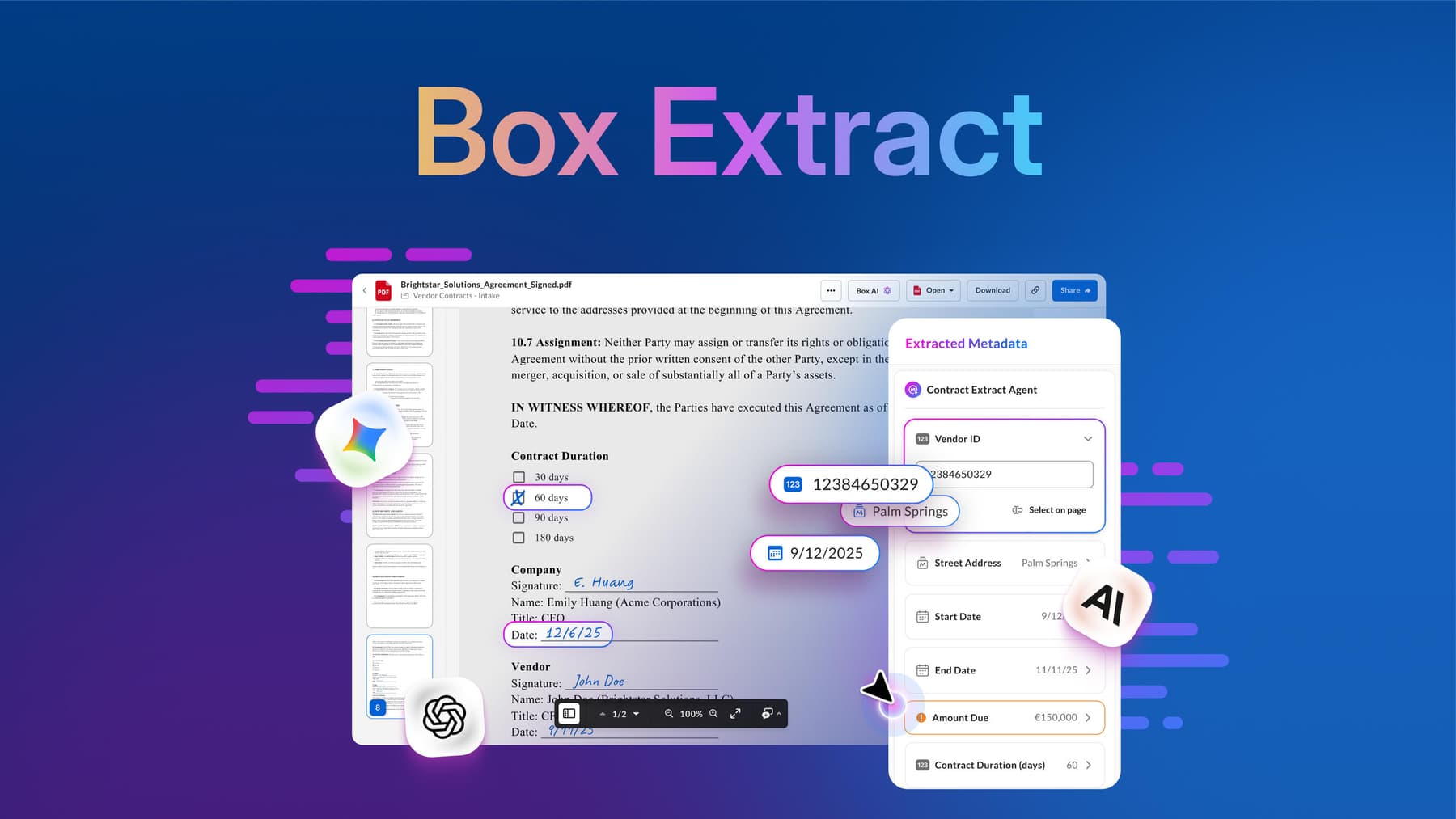
Utah State University manages 55 campuses, serves thousands of students, and runs public programs from gardening education to childcare training. Now, the university is using Box Extract to automate document processing across all of it — starting with a 99.7% accuracy rate on 2,500+ financial records.
This breakthrough in expense documentation demonstrates how higher education institutions can leverage AI-powered workflows to eliminate manual data entry while maintaining the accuracy required for financial audits and compliance. Because while the expense processing use case is a good one, the bigger story is how an enormous higher education institution smoothly replaced its legacy systems with Intelligent Content Management.
When Utah State University originally instituted Box, it was mainly as a cloud storage solution. But its use of Box has transformed in the last year with Box Extract, enabling Utah State to:
- Achieve a 99.7% success rate in automatically extracting data from over 2,500 financial documents
- Consolidate its document management by making Box its "sole source" for file storage, effectively replacing platforms like OneDrive
- Streamline diverse academic and administrative workflows, from student essay submissions to automated policy and contract approval processes
The challenge of managing unstructured data across 55 campuses
As a public university, Utah State faced a complex challenge: coordinating financial documentation and approval processes across dozens of campuses while maintaining audit-ready records. Because the university’s unique mission extends beyond traditional degree programs, making document management more efficient is critical to serving diverse communities statewide.
Chandler Hansen, who was hired specifically to integrate Box into university processes, came on board to find departments smothered with manual work. “I’ve had so many situations where we met with somebody and heard, ‘We’ve been just recording everything in a spreadsheet and manually updating it for the past ten years’,” Hansen explains.
As just one example, university staff who use departmental debit cards to make work-related purchases had to periodically submit expense receipts. Hansen discovered that they were handing over crumpled gas station receipts and email printouts to the dedicated purchasing department. The purchasing agent then had to manually review each paper receipt to extract basic information like purchase dates and dollar amounts.
This was a time-consuming process subject to human error — and a liability during audits, when incomplete or illegible records could trigger compliance flags. So receipt logging and auditing became one of Hansen’s first test cases for Box Extract.
Box Extract delivers 99.7% accuracy on financial documents
Hansen’s team subjected Box Extract to rigorous testing during the beta program, processing approximately 2,500 files ranging from pristine PDFs to photos of crumpled receipts. “I wanted to put Extract through its paces,” Hansen explains, “to try to figure out where the limits were and how far we could take it. I tried to get as big of a range of file types and qualities as I could.”
Box Extract successfully captured the required information from all but seven files — a 99.7% success rate.
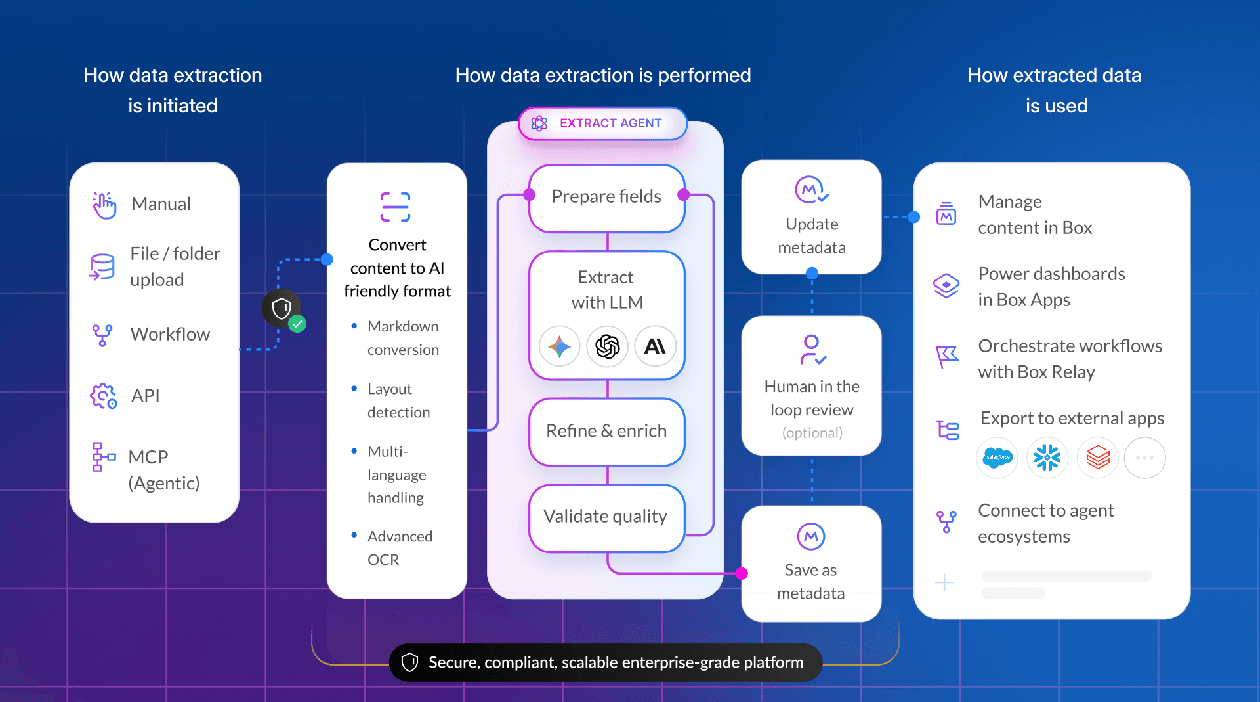
The university leveraged Box Extract’s ability to automatically process documents when uploaded to designated folders, eliminating the manual step of initiating extraction. The results exceeded expectations: Box Extract successfully captured the required information from all but seven files — a 99.7% success rate. This automation proved crucial for scaling the solution across multiple departments and campuses.
Transforming document workflows university-wide
Utah State University now uses Box as its primary collaboration platform. Hansen says, “Box is our sole source for file storage these days. We did have OneDrive at one point, but it's been pretty much phased out of our organization just because of how much more seamless Box has become — not only working with [integrations like] Excel or Word, but also communicating between other apps and platforms that we use.”
Key implementations Hansen has made possible with Box:
- Policy and contract management: Teams use Box’s built-in approval tools and metadata tracking to move documents through complex approval processes
- Student-professor collaboration: Box serves as the primary platform for students submitting essays and documents for feedback, streamlining the academic review process
- Job description standardization: The university is implementing Box Extract to analyze existing job descriptions stored in PDFs, identifying common elements to support a major hiring process revision
Integration with ServiceNow extends automation capabilities
The University has also developed a powerful integration between Box and ServiceNow. As Chandler Hansen explains, ServiceNow serves as the university’s primary platform for workflow automation and process management.. Through the integration, the university leverages Box to handle unstructured content such as files, documents, and collaborative materials — creating a highly complementary technology stack. The Box + ServiceNow integration creates a seamless workflow where processes can begin in ServiceNow, transition to Box for file handling or real-time collaboration, and then return enriched data back to ServiceNow. As Hansen describes it, the system “works like a smoothly oiled machine.”
The integration extends further through Workflow Data Fabric, which connects Box content directly into ServiceNow workflows via External Content Connectors, Integration Hub spokes, and MCP, making unstructured content from Box accessible and actionable across the Now Platform without moving or duplicating data.
The Box + ServiceNow integration creates a seamless workflow where processes can begin in ServiceNow, transition to Box for file handling or real-time collaboration.
The university is currently exploring ways to deepen this integration using Box Extract. By storing unstructured documents in Box and using Extract to pull critical data into metadata fields, they can then transfer that structured information into ServiceNow via APIs.. This approach will transform previously inaccessible document data into actionable information within ServiceNow workflows — closing the loop between unstructured content and the processes that depend on it.

Looking ahead at continued innovation and partnership
Utah State University continues to explore Box’s expanding capabilities, including participation in the Box Automate beta program. The combination of Box Extract for pulling data from unstructured documents and Box Doc Gen for document generation capabilities promises even greater efficiency gains. In the meantime, Box has enhanced the university’s ability to serve both traditional students and public program participants by making document sharing as simple as sharing a secure link.
For universities balancing compliance demands with the need to move faster, Utah State's results show what's possible when AI-powered automation actually works in practice. By starting with a focused use case (receipt processing) and demonstrating measurable results, the university built momentum for broader digital transformation initiatives.
Read about other higher education institutions using Box for Intelligent Content Management.