By automating workflows with Box Forms and Box Doc Gen, Sage Hospitality Group eliminated hours of manual paperwork, freeing staff to focus on delivering exceptional guest experiences.
When you operate more than 60 hotels and 60 restaurants across the US, the paperwork never stops. For a long time at Sage Hospitality Group, this paperwork was endlessly consuming: Vendor contracts routed through email. Access requests tracked in spreadsheets. The operational complexity behind every guest experience was largely manual for this Denver-based hospitality development, investment, and management company.
That’s changing with the ability Box provides to automate content-based workflows from end to end. The time property managers spend chasing approvals can now be better used supporting the guests and staff who depend on them.
Key takeaways:
- Sage Hospitality greatly reduced manual paperwork by using Box Forms and Box Doc Gen to generate, route, and store over 500 access request documents per week directly into designated Box folders
- Box integrates AI to understand content context, extract key data, summarize information, and trigger multi-step workflows without manual review
- Sage plans to extend automated workflows across other departments and explore advanced capabilities, like contract management dashboards via Box Apps, native e-signatures with Box Sign, automated metadata extraction via Box AI, and organized content portals using Box Hubs
Manual requests become automated workflows
Sage Hospitality first put Box to work in the realm of user access management, a process that sounds simple but generates a steady stream of paperwork at scale.
“Using Box Doc Gen with Box Forms has helped us automate and simplify our user access request process,” says Barret Giant, Senior Helpdesk Manager at Sage Hospitality. “The documents are generated and automatically stored in the correct Box folder, making them easy to access and manage.”
Using Box Doc Gen with Box Forms has helped us automate and simplify our user access request process.
The new, largely automated workflow is straightforward in design but powerful in impact.
- A user submits a new access request through Box Forms, which initiates a workflow that triggers Box Doc Gen to automatically generate the access request document
- That document is then routed and stored in the right Box folder, without manual filing, chasing down approvers, or wondering where the record ended up
- The entire process is powered by automation from Box, connecting form submission to document generation to organized storage in a single, continuous flow
Sage Hospitality is currently generating 500+ documents per week with Box Doc Gen, and the team is just getting started. “We’re preparing to expand its use by assisting other departments in building similar workflows with Box Forms and Doc Gen,” Giant says.
Automated analysis of vendor contracts
Property managers at Sage Hospitality were also spending a lot of time working through vendor contracts, so the company’s IT team decided to proactively pursue a better option.
Collaborating on contracts within Box, versus sending files back and forth over email, creates automatic version control while allowing direct collaboration with external vendors. Because of this, property owners don’t have to be the middleman in every single file transaction, and sensitive contracts can be secured with Box permissions-based sharing.
Meanwhile, Box Forms, Box Doc Gen, and the workflow automation capabilities Box enables can automate the creation and signature processes for standard contracts.
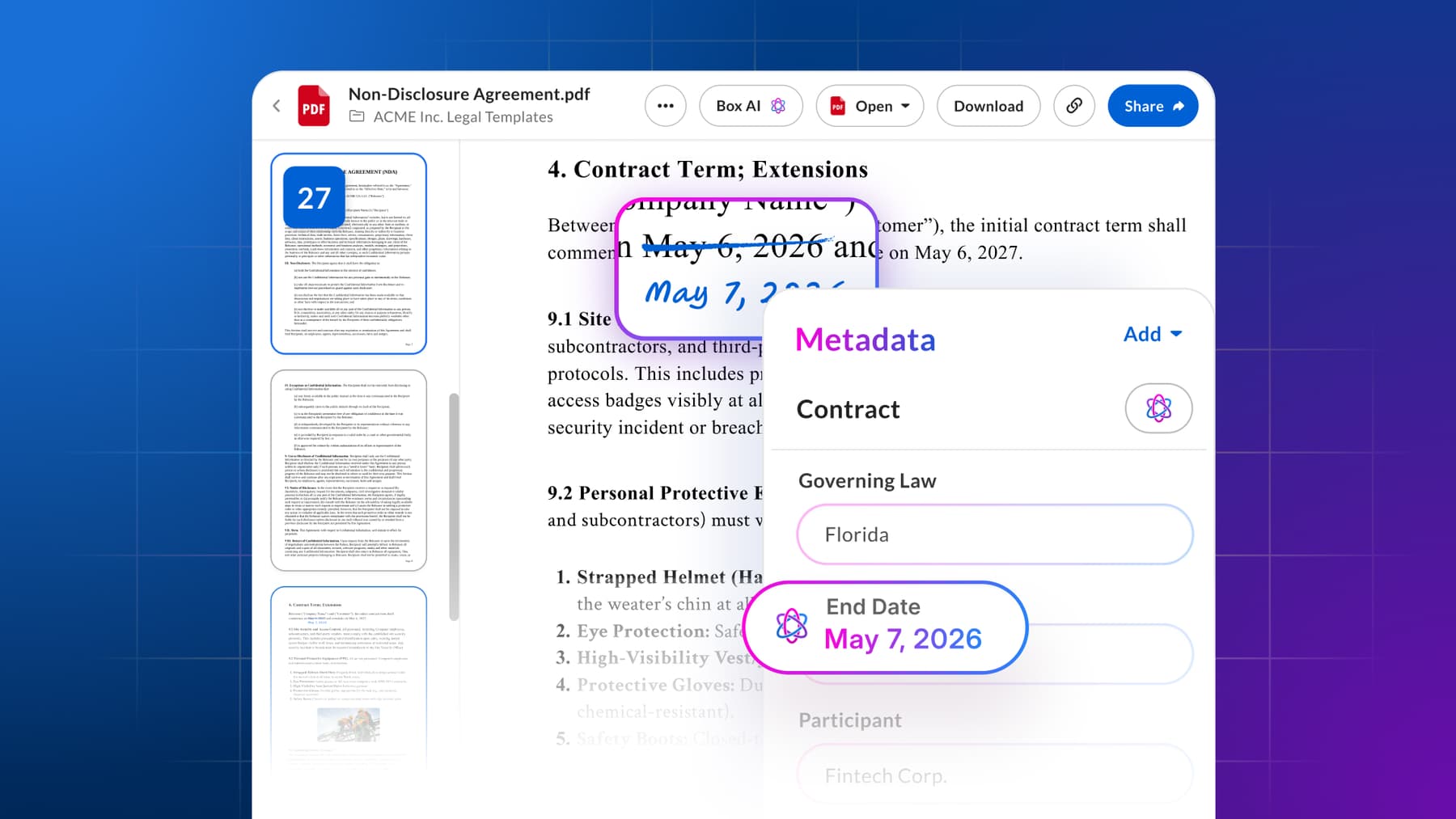
The clincher, though, is that Box enables workflow automation while giving organizations access to secure, permissions-based AI.
Workflow automation in the age of AI
Traditional automation tools were built for structured data. They required predictable fields, fixed templates, and rule-based logic. But real business workflows don’t always work that way. Many of the files associated with business processes rely on unstructured data in all kinds of formats, containing all kinds of information.
Contracts, by default created in a word-processing app, are inherently unstructured. While they may often contain predictable types of information (vendor name, dates, terms), that “data” is not in a cell or a field, and it’s not consistently located in every contract. Contracts can differ depending on property and region — and where they originate. Many workflows depend on understanding what’s inside these documents, but since they’re unstructured, traditional automation tools can’t easily or accurately extract all the information they need.
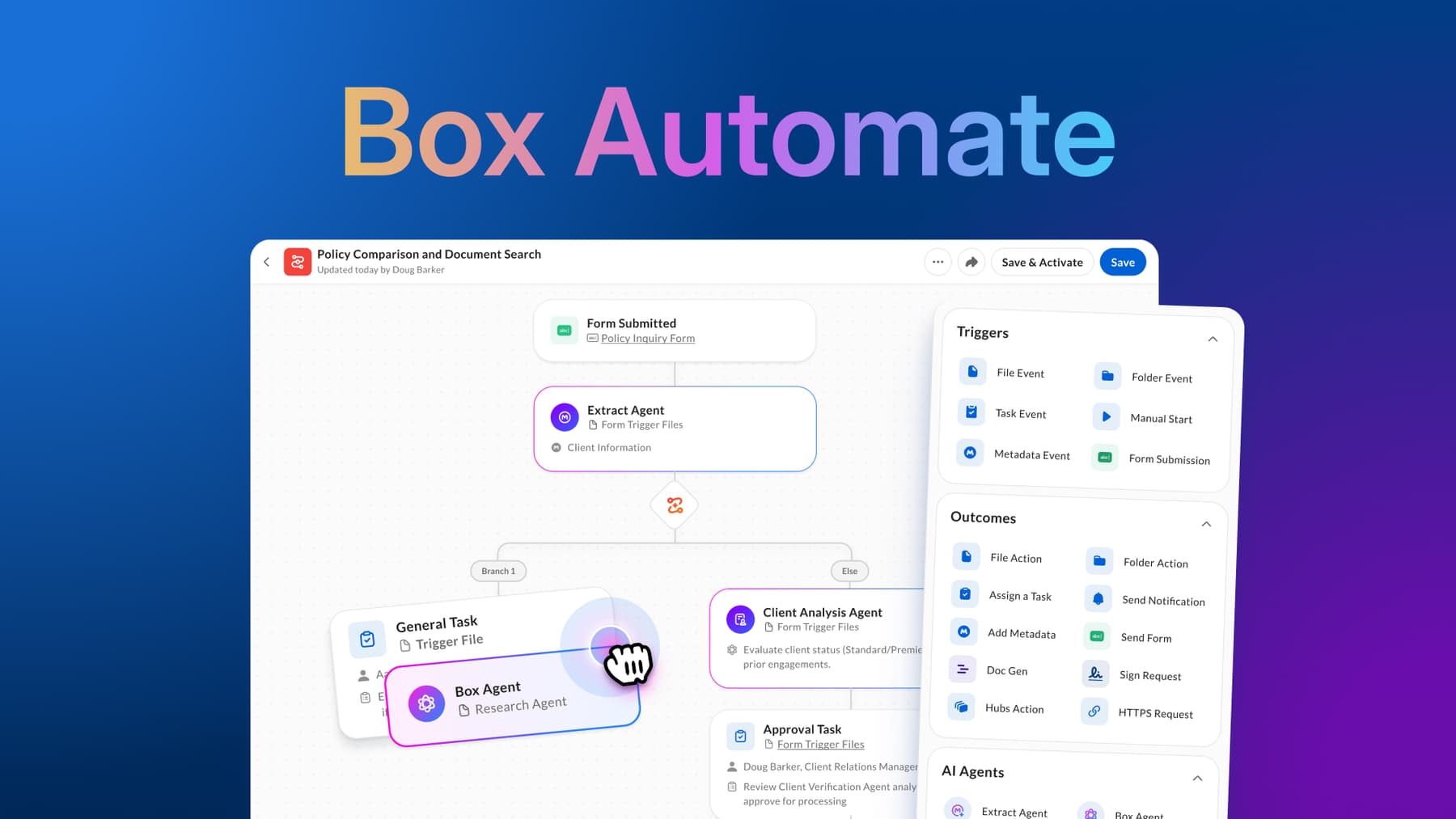

Box’s automation capability brings AI directly into the workflow — not just following instructions, but understanding the context of content. Because of this, workflows can be triggered based on document changes, detailed updates, or insights extracted by AI. Instead of manual review of every file, Box can automatically extract key data from documents, analyze and summarize content, route files for approval, and trigger next steps across systems.
Advanced capabilities available now and down the road
While Sage Hospitality’s journey with Box is still in its early chapters, the company is exploring a roadmap that includes taking advantage of the greater Box suite of products, including Box Sign for e-signatures along with Box Apps to create visibility into upcoming contract expirations and renewals.
AI agents could also drive further productivity gains across the enterprise. For instance, Box AI could enable Sage Hospitality to autofill metadata templates on new contracts, reducing data entry time and human error.
Box Hubs could enable the company to organize decades-worth of content into curated portals for particular hotels, teams, or types of property, opening up myriad use cases for applying Box AI to specific subsets of content.
By partnering with Box and creating a secure content layer, Sage Hospitality has positioned itself to be ready to adopt these next-level features easily. The company is building the foundation for how a modern hospitality enterprise manages its operational content: securely, intelligently, and at scale.
The foundation for modern hospitality
Box treats content as the core of the business process, not just something passed between systems. Now organizations can move beyond simply storing content in the cloud to actually orchestrating work through it.
For a company whose business is built on delivering exceptional experiences, the ability to automate the operational work behind the scenes is what frees people to focus on what they do best: creating the moments that guests remember.