Trademark Property Co. replaced a costly, 48-hour manual lease abstraction process with Box Extract, Box Apps, and Box AI Studio: cutting turnaround to minutes, eliminating per-document offshore costs, and giving property managers instant cross-portfolio search across thousands of lease documents for the first time.
Piles of leases, amendments, rent commencement letters, and related documents stuffed in hundreds of folders, loosely organized by property or tenant, with no easy way to see across them. For property management companies today, this scenario might not be literal; most files are now digital. But the metaphor holds.
Within these enormous volumes of files, finding a single clause or a critical renewal date can mean hours of manual searching. Turning that hidden data into automated workflows? Impossible.
That handicap is getting harder to ignore as property portfolios grow and the cost of a missed obligation rises. Trademark Property Co., a retail real estate company managing a portfolio of shopping centers, decided to solve it with Box AI.
Key takeaways:
- Trademark replaced a 48-hour, $150–$200-per-document process with a workflow that runs in minutes, using Box AI (with potential savings of $450K-$800K)
- Workflows are future-proofed to scale — important, as the current 3,000 to 4,000 documents in the system will triple as interns work through older backlog files
- Searches accomplished in minutes (instead of hours) across hundreds of folders, with metadata extraction across 13 unique metadata templates and filtering in Box Apps

The cost of manual data extraction from documents
Trademark Property initially adopted Box years ago as a platform for secure document storage and easy external sharing with partners. Doug Harmonson, Vice President of Research & Technology, notes that for years, Box was simply “where we stored our documents.”
File storage was certainly a valuable use case, but the real challenge the company faced was lease management workflows. Trademark’s portfolio generates thousands of documents, all critical to running the business, and each one is long, complicated, and full of terms. Rent escalation clauses, exclusive use provisions, co-tenancy requirements, commencement and expiration date language — all of this information matters, but to find it required laborious manual search through files, one at a time.
As a workaround, the company hired an offshore team to manually open each document, pull out key details, and update internal trackers. The cost: roughly $150 to $200 per document. The turnaround: about 48 hours. And the volume was only growing.
"It was slow, error-prone, expensive, and limited our ability to act quickly on critical lease obligations," said Harmonson.
Even after documents were abstracted, finding them was another problem. Files were spread across hundreds of folders. If a property manager needed to see every lease at a shopping center that contained a specific exclusivity clause, they might spend an hour or two just gathering the right documents — before doing any actual analysis.
AI extraction, metadata, and a new way to search
Trademark Property created a new workflow using Box Extract, Box Apps, Box Relay, and Box Hubs.
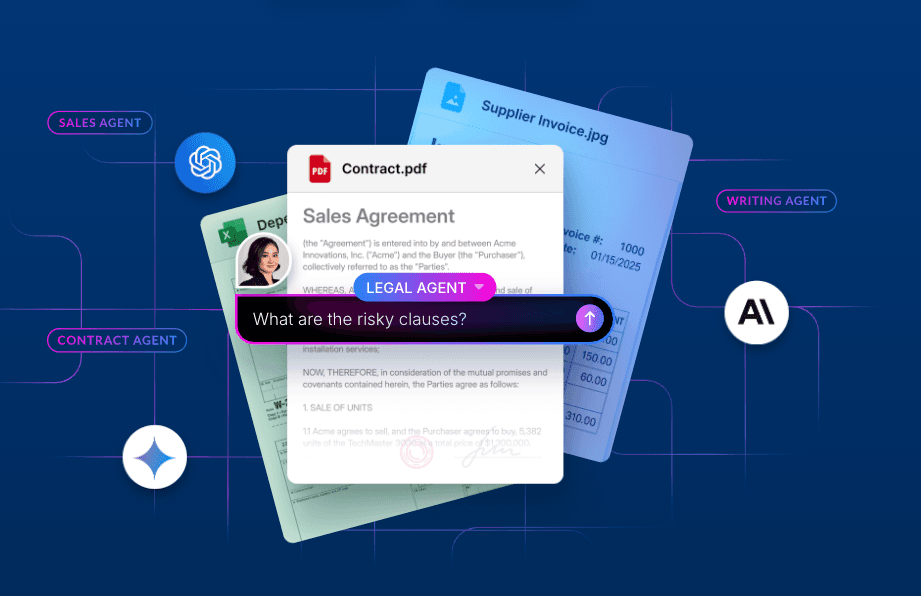
The core of the workflow is AI-powered metadata extraction. When a newly executed document arrives, it’s dropped into a designated folder. Box APIs run extraction programmatically, pulling over 80 pre-defined fields, including:
- Tenant name
- Property
- Commencement date
- Expiration date
- Rent amount
- Escalation clauses
This information is then automatically written back as metadata directly to the file, according to 13 unique metadata templates that address the range of document types across the company’s portfolio. That metadata can now power automation.
Using Box Apps, property managers, asset managers, and accounting teams can filter across every property document by clause type, tenant, date, or any other metadata field — and get results in minutes or less, compared to the hour or two it used to take.
People are able to go in and look for documents across the property, see all the documents that may have a particular lease clause in them, and filter those very easily, which is something we've never been able to do before.
"People are able to go in and look for documents across the property, see all the documents that may have a particular lease clause in them, and filter those very easily," Harmonson says. "That's something we've never been able to do before."
The abstraction process itself has also transformed. What once cost $150–$200 per document and took two days now happens at virtually no incremental cost, in minutes. Trademark Property currently has between 3,000 and 4,000 documents in the system, and expects that number to triple over the summer as interns work through a backlog of older documents.
Agents built for specific workflows beyond leases
Trademark's team hasn't stopped at lease abstraction. The team has built several custom agents tailored to specific workflows.
- A financial review agent identifies whether an incoming document is a personal tax return, a corporate balance sheet, or another financial statement — and then runs the appropriate prompt to extract the relevant figures
- An exclusive use tracking agent identifies exclusive use and prohibited use clauses across an entire property’s tenant set — work that previously required someone to manually copy and paste from each lease into a spreadsheet
- A lease negotiation agent reviews redline changes from a tenant and red-flags things that need attention
“During the lease negotiation process,” Harmonson says, an employee can ask the latter agent to “evaluate the redline changes from a tenant and give him a heads up as to what we should be looking for.”
Then the employee considers “Is this something we should push back on hard? Or is this something we can give a little on?”
Harmonson adds, “We still use our attorneys for that kind of stuff, but it gives [the employee] a big head start on what he anticipates the attorney will say — and also what he may not need the attorney for. He can just go right back to the tenant.”


Not just a content platform
Automating workflows has made work faster, more efficient, and less expensive for Trademark Property. But there’s another advantage Harmonson’s team has gotten that’s perhaps harder to quantify.
Box, in our world, was Box Drive. Now that AI is in there, ingrained in Box Hubs and Box Apps, people are in Box all the time.
“Up until probably the last 6 to 8 months,” Harmonson says, “Box, in our world, was Box Drive. Now that AI is in there, ingrained in Box Hubs and Box Apps, people are in Box all the time — logging in and using those tools more and more and realizing the capabilities.”
Box has evolved from a place to store files to the operational backbone of how Trademark Property manages its portfolio. “It's almost like a whole new product now,” Harmonson says of Box, “a whole new tool to us, with all the capabilities that you've been able to add.”