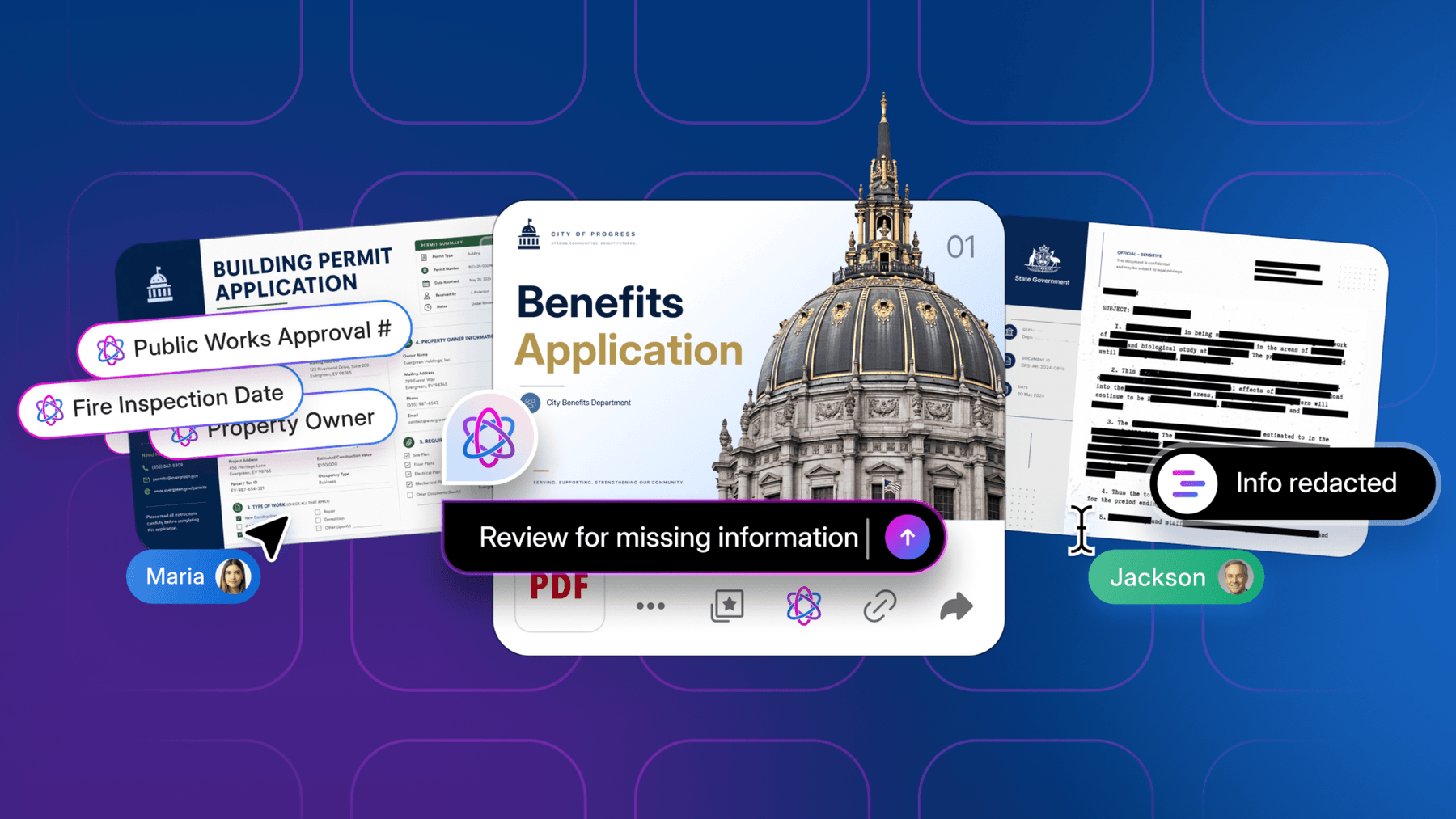
Metadata extraction is the process of automatically identifying key business information locked away in unstructured files — parties, dates, amounts, classifications, obligations, status — and storing them as structured data that applications, analytics systems, and AI agents can use.
Unlike full-text extraction, which captures the text within a document, metadata extraction identifies what that information represents and makes it actionable.
Most enterprise AI programs stall at the same point. The models work. The data does not. The structured data businesses run on sits in warehouses and CRMs, while the context and evidence that gives that data meaning remains buried in contracts, policies, claims files, and transcripts that were never structured for querying.
The gap is measurable. In Box's State of AI in the Enterprise 2026 research with The Harris Poll, 96% of organizations said it matters that their agents can reach company-specific content. Only 36% of those already using or experimenting with agents had connected them to trusted internal content across more than a handful of use cases. Nearly every enterprise wants this; only about a third have managed it. In the same research, 49% called automated structured-data extraction very important to powering downstream workflows — 70% among the most advanced adopters, 36% among those at the earliest stage.
Metadata extraction is how the other two-thirds of enterprises close that gap. Where text extraction captures the contents of a document, metadata extraction identifies what key information means and structures it as attributes associated with the source content. This guide covers what it is, how it differs from OCR, what to require of a platform, how to govern the output, and what it looks like across regulated industries.
What is metadata extraction for enterprise content?
Metadata extraction is the process of identifying important information inside unstructured content, like documents, images, PDFs, contracts, invoices, forms, etc., and converting that information into structured, usable data which is then written back as structured fields on the source file. One benefit of this process is making unstructured content easier to understand and use for AI models and agents.
Metadata extraction is one form of the broader discipline of AI-powered data extraction; it becomes enterprise metadata extraction when fields inherit the source document's permissions, version and retention policy rather than becoming a loose copy.
Let’s illustrate with this example. A contract yields customer ID, agreement type, effective date, renewal date, region, and status.
And outside of the information contained within a contract, contracts also vary in format, the fields have legal consequences, the access rules are strict, and the output has to join to records held somewhere else. By taking advantage of metadata extraction, your organization can simplify version control and record-keeping, automate more workflows, and reduce the risk of security incidents.
The distinction that matters is between extracting text and understanding what it represents. Full-text extraction can find “September 30, 2027” in a document. Metadata extraction knows it is the customer’s renewal date and captures it accordingly. That turns information buried in a document into structured data the business can search, analyze, and act on.
Extracted fields become even more valuable when they remain connected to the source file. That connection preserves the context, permissions, version history, and classification of the original content while maintaining provenance back to where the information came from. As a result, applications, workflows, and AI can use structured data without losing the source context behind it.
This separates extraction as a feature from extraction as an architecture. A tool produces fields. A governed content layer produces fields carrying the source document's permissions, version and policy with them — usable by AI applications without rebuilding an access model for each one.
How does metadata extraction differ from OCR and traditional data extraction?
Optical Character Recognition (OCR) converts an image into machine-readable characters. It does not interpret them. Legacy intelligent document processing went a step further, using techniques such as regular expressions, positional templates, machine-learning classifiers, and rules engines to identify and extract specific information.
These approaches work well for predictable document types, but often require significant configuration and maintenance as formats, layouts, and content vary. Point solutions designed around a specific department or document type can reduce that complexity, but at the cost of broader applicability.
AI-powered extraction uses the context and meaning within a document to identify fields, allowing it to handle variations across suppliers, jurisdictions, and formats without requiring a template for every variant. More advanced extraction systems can go further by combining multiple AI techniques, such as chain-of-thought reasoning, retrieval augmented generation optimized for extraction, and graders that evaluate the quality of extracted values, to determine what information to extract, validate the results, and provide confidence signals that help users and downstream systems assess their reliability.

These are market categories, not product tiers. The right-hand columns describe what an approach makes possible, not what any implementation guarantees: accuracy depends on document condition, schema quality, configuration, and validation design.
Most enterprises deploy more than one type of data extraction tool. On a contract estate that usually means OCR for documents in the scanned back catalogue and AI extraction on everything signed since, with the same metadata template applied to both.
The combination of modernized, intelligent data extraction integrated with OCR is what makes intelligent document processing a more powerful and practical metadata extraction option.
How do companies extract structured data from unstructured documents at scale?
Structured extraction turns information from unstructured documents into predictable, schema-conformant data. The desired structure is defined upfront, for example, through a metadata template, and the system identifies and returns the corresponding values, potentially with confidence signals that indicate the reliability of each extracted field.
This differs from freeform extraction, where a natural-language prompt asks a model to interpret or return information without requiring it to conform to a predefined schema. By producing consistent, structured output even when the underlying documents vary, structured extraction makes document data usable at scale across applications, analytics, workflows, and AI.
What is unstructured data extraction?
Unstructured data extraction identifies useful information within content that does not conform to a predefined data model, including documents, emails, scans, and images. Metadata extraction adds structure and business meaning to that information by capturing it as defined fields, such as customer name, contract value, renewal date, or document type, rather than simply returning raw text. The same approach can be applied to visual content, where AI can identify and structure information contained in scanned documents, photographs, and other images.
How does agentic document extraction differ from traditional OCR?
OCR tells you what a document says. Agentic document extraction determines what the information means and turns it into structured data that applications, workflows, analytics, and AI can use. It can also validate extracted values and provide confidence signals, helping organizations automate document-intensive processes with greater reliability.
How do companies automate metadata extraction from documents?
Companies automate metadata extraction by using AI to identify business-relevant information within documents, structure it according to a predefined schema, and make that data available to applications, workflows, analytics, and AI. At enterprise scale, extraction can run automatically as new content arrives, be initiated on demand, or be triggered programmatically through APIs.
A typical automated document extraction process can involve five stages: ingest, classify, extract, validate, and act.
Ingest. Content enters the extraction process from sources such as uploads, email, scanners, APIs, or existing content repositories.
Classify. When necessary, the system determines what type of document it is—such as a contract, invoice, claim, or application—so the appropriate extraction schema can be applied. In other cases, the document type or schema may already be known based on its location or the process that initiated extraction.
Extract. AI identifies the information defined by the schema and captures it as structured fields. For a contract, those fields might include counterparty, effective date, renewal date, contract value, governing law, and payment terms.
Validate. Extracted values can be evaluated for accuracy and assigned confidence signals. Organizations can use those signals to determine when information can move forward automatically and when a field may require human review.
Act. Once information has been structured and validated, it can be used to search and organize content, populate applications and systems of record, power analytics, or trigger downstream business processes.
Consider contract management. When a new agreement arrives, AI can identify the type of agreement and extract fields such as the customer, contract value, effective date, and renewal date. The resulting metadata can remain associated with the agreement while also being used across other enterprise systems. A low-confidence value could be routed for review, while a confirmed renewal date could automatically initiate a renewal workflow for the account team.
Using metadata schemas for structured extraction
Structured metadata extraction works by defining the information an organization wants to capture. A metadata schema or template establishes fields such as customer name, invoice amount, policy number, renewal date, or document type, and AI identifies the corresponding values within unstructured content.
Organizations can use existing enterprise metadata schemas as extraction targets rather than creating a separate data model specifically for AI. This allows extracted information to become part of the same metadata structure used to organize, govern, search, and automate content. Common identifiers can also connect document metadata with structured information stored in CRM, ERP, data warehouse, and other enterprise systems.
Importantly, the source documents themselves do not need to share an identical structure. AI-powered extraction can produce consistent, schema-conformant metadata across variations in document layouts, formats, suppliers, customers, or jurisdictions.
Automating metadata extraction at enterprise scale
Modern AI extraction increasingly turns what was once a custom engineering project into a configurable capability. Organizations can configure what information should be extracted and automatically process content as it enters a repository or business process.
Extraction can also be initiated on demand for individual documents or invoked through APIs for high-volume use cases such as migrations, backfile processing, and continuous ingestion. No-code configuration can make extraction accessible to the business users who understand which information matters, while APIs allow development teams to incorporate the same capabilities into larger applications and automated processes.
Enterprise extraction also needs to account for the content lifecycle. Documents are updated, replaced, reclassified, moved, and deleted over time. Keeping extracted metadata and downstream systems synchronized with the source content helps prevent applications, indexes, and analytical systems from operating on outdated information.
Turning extracted metadata into business value
Extraction itself is not the end goal. Its value comes from turning information previously trapped inside unstructured content into structured data the business can use.
Once metadata exists, users can search, filter, and organize content based on what it contains rather than where it is stored or what a file is named. Applications and analytics can surface information across thousands or millions of documents. Workflows can respond to values such as contract amount, renewal date, claim type, or approval status. AI agents can use the same structured information to reason over enterprise content with additional business context.
Manually identifying and applying this metadata across enterprise content does not scale. Box Extract uses AI-powered Extract Agents to identify key information within unstructured content and apply it as structured metadata directly to files in Box. Because that metadata remains connected to the source content, organizations can use it across search, applications, analytics, AI, and automated workflows.
What features should an enterprise metadata extraction platform have?
An enterprise metadata extraction platform should do more than extract fields from documents. It should produce reliable, structured data across diverse content, provide ways to validate and trace extracted information, integrate with enterprise systems and workflows, and protect the security and governance of the underlying content.
When evaluating enterprise metadata extraction platforms, consider these capabilities:
- Extraction accuracy and evaluation. Test the platform against your own documents and the fields that matter to your business. Evaluation should account for different document types, layouts, formats, and edge cases rather than relying solely on an aggregate accuracy measure.
- Field-level confidence and validation. Look for confidence signals at the individual field level so organizations can apply different validation rules based on business risk. A contract value or bank account number, for example, may warrant greater scrutiny than a lower-risk field. The platform should also support workflows for reviewing and correcting uncertain values when human validation is required.
- Broad document and content support. Enterprise content rarely follows a single format. Evaluate performance across native digital documents, PDFs, scans, photographs, handwriting, tables, complex layouts, and the languages your organization uses.
- Flexible schema management. The platform should allow organizations to define the structured information they want to extract through reusable schemas or metadata templates. Look for support for field definitions, data types, extraction instructions, and reuse across document types and business processes.
- Provenance and source grounding. Extracted values should remain traceable to the content they came from. Capabilities such as citations, page references, and bounding boxes can help users verify where a value was found and provide evidence for downstream applications and AI-generated answers.
- Human review and exception handling. Not every extraction result should be treated the same way. Enterprise platforms should provide mechanisms to route uncertain or high-risk values for review, allow users to correct them, and incorporate validated results into downstream processes.
- Security, governance, and compliance. Extracting information should not create an ungoverned copy of sensitive enterprise data. Evaluate how the platform handles permissions, access controls, encryption, auditability, retention, data residency, and the use of customer data by underlying AI models.
- Integration and automation. Extracted metadata becomes more valuable when other systems can use it. Look for APIs, batch processing, event-driven processing, and integrations that allow structured data to flow into applications, analytics platforms, systems of record, and automated workflows.
- Scalability and operational management. Evaluate how the platform handles large document volumes, concurrent extraction jobs, failures, retries, monitoring, and changes to schemas over time. Enterprise extraction should scale without requiring a custom pipeline for every new document type or business process.
- Adaptability as AI evolves. AI models will continue to change. An enterprise extraction architecture should allow organizations to benefit from improvements in underlying models without repeatedly rebuilding schemas, integrations, governance policies, or downstream processes.
For metadata extraction platforms that operate directly within a content management system, additional capabilities can provide significant value. Keeping extracted metadata connected to the source content can make it immediately available for search, filtering, applications, workflows, analytics, and AI while preserving the content's existing context and governance.
What questions should you ask when choosing a metadata extraction solution?
Choosing an enterprise metadata extraction solution requires evaluating more than whether a platform can extract a few fields from a sample document. Buyers should test how accurately and reliably the system performs across their own content, how easily it can be configured and governed, and how extracted data can be used across the business.
Consider asking vendors these questions:
- How accurate is extraction on our documents and fields? Ask vendors to test against representative content—including different document types, layouts, formats, and edge cases—and explain how extraction quality is measured.
- How does the platform communicate uncertainty and handle exceptions? Determine whether confidence is available at the field level, how those signals should be interpreted, and whether uncertain or high-risk values can be routed for human review.
- How much configuration is required to support a new document type or use case? Ask whether business users can define extraction schemas and instructions themselves or whether new use cases require vendor services, model training, or custom engineering.
- Can we define, reuse, and manage our own metadata schemas? Understand whether schemas can be shared across use cases, changed over time, and integrated with metadata structures your organization already uses.
- How does the platform perform across the content we actually have? Test native documents, PDFs, scans, images, handwriting, tables, complex layouts, languages, and variations within the same document type that are relevant to your organization.
- How is each extracted value connected to its source? Ask what provenance information is available, including the source file, document version, page, citation, or bounding box, and how users can verify an extracted value against the underlying content.
- How are security, permissions, and governance applied to extracted data? Determine whether extracting information creates a separate access model or whether existing content permissions and governance policies continue to protect the resulting metadata.
- How is customer content handled by the underlying AI models? Ask whether customer data is used for model training, where processing occurs, how long data is retained, and what controls are available for sensitive or regulated information.
- How does extracted metadata integrate with the rest of our technology stack? Evaluate APIs, batch processing, event-driven automation, and integrations with applications, analytics platforms, AI agents, workflows, and systems of record.
- What happens when the source content changes? Understand how extracted metadata and downstream systems respond when documents are updated, replaced, reclassified, moved, deleted, or placed under retention or legal hold.
- How does the platform adapt as AI models evolve? Determine whether improvements to underlying models can be adopted without requiring your organization to rebuild schemas, integrations, governance policies, or downstream workflows.
- What enterprise security, compliance, and audit capabilities are available? Review relevant certifications, audit logs, data residency options, encryption, retention controls, and other requirements specific to your industry and regulatory environment.
- How does the platform scale operationally and economically? Understand processing limits, throughput, monitoring, failure handling, and how pricing or consumption changes as extraction expands across more documents, fields, and business processes.
How do companies govern AI-extracted data?
AI-extracted data should be governed with the same rigor as the source content it comes from. As extracted metadata is copied into indexes, data platforms, applications, and AI systems, organizations need to maintain clear authority, access controls, lineage, and lifecycle management across every representation.
Every copy of extracted data creates additional governance work. That does not mean copies should be avoided—vector indexes, warehouses, lakehouses, and operational systems all serve legitimate purposes. The key is to establish which system or record is authoritative and how every derived representation remains traceable to and synchronized with that source.
A governed extraction architecture therefore needs to answer several questions: Who is allowed to access the source information? Where did an extracted value come from? What happens when the source changes? Which copies contain the information? And how can an organization demonstrate those controls during an audit?
Frameworks such as the NIST AI Risk Management Framework can help organizations establish broader AI governance practices. NIST organizes AI risk management around four functions—Govern, Map, Measure, and Manage—while data-protection guidance such as that published by the UK Information Commissioner's Office addresses considerations including lawfulness, transparency, accuracy, security, and accountability. These frameworks do not prescribe a specific extraction architecture, but they help define the outcomes organizations should be able to demonstrate.
Five controls are particularly important for governed metadata extraction:
- Access control. Extracted information should not allow users, applications, or AI agents to bypass the permissions protecting the underlying content. Authorization should remain current as content and user access change.
- Lineage and provenance. Organizations should be able to trace extracted information back to its source, including the relevant document and version and, where appropriate, the location within the document and the process that produced the value.
- Validation and human oversight. Organizations should be able to determine when extracted information can be used automatically and when business risk, regulatory requirements, or uncertainty require human review. Review decisions and corrections should be recorded when appropriate.
- Auditability. Extraction, access, review, and downstream use should generate audit records appropriate to the organization's security, compliance, and regulatory requirements.
- Lifecycle management. When source content is updated, replaced, reclassified, deleted, retained, or placed under legal hold, organizations need mechanisms to ensure derived metadata and downstream representations remain consistent with those changes.
Consider a contract whose renewal date has been extracted into both document metadata and an analytical system. If an amendment changes that renewal date, downstream representations need to reflect the updated authoritative information. If access to the contract changes, organizations must ensure that replicated data does not create an unintended path to restricted information. And if the agreement is placed under legal hold, its associated information must be managed according to the organization's retention and legal requirements.
How do teams manage data privacy in data extraction workflows?
Data privacy in extraction workflows depends on controlling how source content and extracted information are processed, stored, accessed, retained, and shared. Organizations should understand where content is sent for extraction, what data is retained by the service, whether customer content is used for model training, what residency requirements apply, and how derived metadata is protected after extraction.
Extracting information directly within the governed content environment can reduce the number of additional copies and access models an organization needs to manage. When information is replicated into other systems, maintaining lineage back to the authoritative source and applying appropriate controls to each derived representation helps preserve accountability across the data lifecycle.
How is metadata extraction used across industries?
Metadata extraction is used across industries wherever important business information is trapped inside documents and other unstructured content. The specific fields vary by use case, but the pattern is consistent: identify relevant information, structure it according to a defined schema, and make it available for search, analytics, applications, and automated workflows.
Legal. Legal teams use metadata extraction to turn contracts into structured, searchable data. AI can capture parties, governing law, effective and expiration dates, renewal terms, indemnity provisions, assignment restrictions, and other key obligations across a contract portfolio. This makes it possible to answer questions such as which agreements auto-renew next quarter or which contracts contain a specific obligation without reviewing every document individually. Law firms can use the same approach to build searchable libraries of clauses and precedents across MSAs, NDAs, and other agreements. Barnett Capital, working with documents that run to hundreds of pages, uses extracted metadata to build views organized by which lease agreements expire soonest, and reports asking 35 to 40 questions of every document.
Financial services. Financial institutions use document and metadata extraction to capture structured information from invoices, loan agreements, investment records, statements, and other financial content. Extracted fields can include vendor names, invoice amounts, purchase-order numbers, borrower information, loan terms, interest rates, maturity dates, and covenant details. Once structured, that information can accelerate underwriting, support reconciliation, populate downstream systems, and identify exceptions that require review. Barnett Capital reports speeding up underwriting sixtyfold using metadata extraction. Makena Capital Management held 800,000 legacy financial documents in a flat structure inherited from a prior system; extracting metadata against them cut targeted analyst searches from around an hour to about a minute.
Insurance. Insurance teams use metadata extraction across claims forms, photographs, adjuster notes, correspondence, certificates of insurance, endorsements, statements of values, and loss runs. Extracted information might include policy number, claimant, date of loss, vehicle VIN, injury details, amounts, and other claim attributes. That structured data can populate claim systems, support triage, identify missing or inconsistent information, and help determine when a case can proceed automatically or requires adjuster review. Forrester's Craig LeClair argues claims are a larger opportunity than invoice processing, because first notice of loss and complex auto-accident workflows need case-building extraction rather than field capture. US Acute Care Solutions applies this to medical claims, using extraction to establish from the claim documents whether there is evidence of a motor vehicle accident.
Human resources. HR teams can extract candidate and employee information from resumes, offer letters, onboarding packets, and personnel files. Fields such as contact details, interview dates, compensation, start date, role, and employee identifiers can be used to populate applicant tracking and HCM systems, automate onboarding, and organize employee records. Because HR content often contains sensitive personal information, extraction workflows should preserve appropriate access controls, retention policies, and privacy protections.
Government and public sector. Public-sector organizations use metadata extraction across permitting and licensing, public-records processing, grant administration, benefits casework, procurement, and other document-intensive services. AI can extract application details, case identifiers, dates, addresses, funding amounts, eligibility information, and statutory deadlines so records can be routed, tracked, searched, and processed more consistently.
How to build an automated metadata extraction workflow with AI
An automated metadata extraction workflow connects unstructured content to the systems and processes that need structured business data. A typical implementation defines what information should be extracted, determines when extraction should run, validates the output, and makes the resulting metadata available to applications, workflows, analytics, or AI.
Choose how extraction is triggered
Metadata extraction can run in several ways depending on the use case. It may start automatically when a document is uploaded or changed, run on demand for an individual file, process large batches through an API, or be invoked by an AI agent as part of a broader task.
APIs and SDKs are well suited to deterministic operations where the application already knows what needs to happen—for example, extracting a defined field set from a document, processing a batch of files, or writing structured output into another system.
Agent tools and protocols such as MCP can support more dynamic workflows in which an AI agent determines the next action based on context. An agent might search for a policy, retrieve a contract, compare document versions, extract specific information, or initiate another business action. In enterprise environments, those tools should operate within the same security and authorization boundaries that govern the underlying content.
Define the extraction schema
For repeatable business processes, structured extraction begins with a defined schema that specifies the information the system should return. A contract schema, for example, might include counterparty, effective date, renewal date, contract value, and governing law.
The source documents themselves do not need to follow the same layout. AI-powered extraction can map information from different formats, suppliers, jurisdictions, or document variations into a consistent set of structured fields.
Freeform extraction serves a different purpose. Instead of returning values against a predefined schema, it uses a natural-language prompt to retrieve or summarize information that may not yet have been modeled as structured metadata. Freeform approaches are useful for exploration, while structured extraction is better suited to repeatable processes that require predictable downstream data.
Design for reliability at scale
Building a production extraction workflow requires more than calling a model. Common operational considerations include managing processing volume and concurrency, handling file events and retries, validating outputs, monitoring failures, and maintaining predictable behavior as models and schemas evolve.
Platforms that provide these capabilities natively can reduce the amount of custom infrastructure teams need to build and maintain, allowing developers to focus more on business logic and integration.
Decide where extracted data should live
Different systems may need different representations of the same information. A content platform can remain authoritative for the source document and its native metadata, while search indexes provide fast retrieval and data platforms support reporting and analytics.
Common patterns include:
- Request-time access, where applications retrieve current information directly from the authoritative source when needed
- Indexed retrieval, where selected content or representations are stored in a search or vector index for faster discovery while maintaining linkage back to the source
- Analytical replication, where selected extracted metadata is copied into a warehouse, lakehouse, or other data platform for reporting and modeling
The goal is not to eliminate copies, but to preserve authority, permissions, provenance, and lifecycle consistency wherever extracted information is used.
Start with one repeatable business process
A practical first implementation is to choose one document type and one clearly defined business outcome. Define the metadata schema, run extraction automatically when relevant documents arrive, validate important fields, and make the resulting metadata available to one downstream application or workflow.
For example, a contract-renewal workflow might extract customer, renewal date, contract value, and agreement identifiers. The metadata can remain connected to the agreement while selected fields are also made available to CRM or analytics systems. That allows teams to identify upcoming renewals, trigger account workflows, and trace the underlying information back to the source agreement.
How Box supports automated metadata extraction
Box Extract enables organizations to define structured metadata schemas and use AI-powered Extract Agents to identify and apply that information directly to content in Box. Extraction can be automated as content arrives, initiated on demand, or invoked programmatically through APIs.
Because extracted metadata can remain connected to the source content, organizations can use it across search, applications, analytics, workflows, and AI while maintaining the context, permissions, and governance of the underlying files. Box can also connect enterprise content to external systems and AI applications without requiring those systems to become the authoritative repository for the content itself.
FAQ
What is agentic data extraction and how does it work?
Agentic data extraction uses AI to identify, interpret, and structure information from documents as part of a multi-step process rather than relying only on a single extraction request. More advanced systems may combine retrieval augmented generation, chain-of-thought reasoning, AI graders, retrieval, validation, and evaluation techniques to improve reliability, resolve ambiguity, and determine when extracted values require additional review.
Can AI extract structured data from unstructured documents?
Yes. AI can identify business-relevant information within unstructured documents and map it to a predefined schema, even when documents vary in layout, wording, or format. For example, the same extraction schema can capture supplier, invoice amount, and payment date across invoices that look very different from one another.
How do companies ensure accuracy in AI-powered data extraction?
Organizations improve extraction accuracy by defining clear schemas and field instructions, testing against representative documents, evaluating results at the field level, and using confidence signals or business rules to identify values that may require review. Human validation can be added for high-risk, ambiguous, or uncertain fields.
What compliance requirements apply to metadata extraction?
Compliance requirements depend on the type of content, industry, jurisdiction, and how extracted data is processed and stored. Organizations may need to account for requirements related to privacy, retention, access control, auditability, data residency, and sector-specific regulations. Extracted metadata should be governed appropriately whether it remains with the source content or is replicated into another system.
How do organizations audit data extraction processes?
Organizations can audit extraction by maintaining records of what content was processed, which values were extracted, when extraction occurred, what source and version the values came from, and how results were subsequently reviewed or changed. Depending on the use case, audit records may also include user and application access, model or service information, and downstream actions.
How do companies secure sensitive data during extraction?
Companies secure sensitive data by controlling where content is processed, enforcing appropriate permissions, encrypting data in transit and at rest, limiting retention, and applying governance policies to both source content and extracted metadata. Extracting within an existing governed content environment can reduce the number of additional copies and access models an organization must manage.
What should you look for in an AI document extraction API?
A strong document extraction API should support structured schemas, predictable output, batch and asynchronous processing, provenance or source references, error handling, and integration with downstream systems and workflows. Buyers should also evaluate security, governance, scalability, document-format coverage, and how the API handles changes to schemas and underlying AI models.
How do insurance companies extract data from claims documents?
Insurance companies can define claims schemas for information such as policy number, claimant, date of loss, vehicle VIN, injury details, and claim amounts, then extract those fields across forms, photographs, correspondence, and adjuster notes. The resulting metadata can populate claims systems, support triage, identify missing information, and help determine when adjuster review is needed.
How do HR teams extract data from employee documents?
HR teams can extract candidate and employee information such as contact details, interview dates, offer terms, compensation, start date, role, and employee identifiers from resumes, offer packets, onboarding documents, and personnel files. That structured data can populate applicant tracking or HCM systems and support onboarding and records-management workflows.
How do financial services firms extract data from loan documents?
Financial services firms use AI extraction to capture information such as borrower and counterparty names, loan amounts, interest rates, maturity dates, covenant terms, and payment obligations from loan documents. The resulting metadata can support underwriting, servicing, compliance review, analytics, and downstream system updates.
How do companies extract data from invoices automatically?
Companies can define an invoice schema containing fields such as supplier, invoice number, purchase-order number, amount, tax, and due date, then automatically extract those values when invoices arrive. Validated metadata can be sent to finance or ERP systems, while exceptions can be routed for review.
How do government agencies use metadata extraction?
Government agencies can use metadata extraction across permitting, licensing, grants, benefits casework, public-records processing, procurement, and other document-intensive workflows. Extracted fields such as applicant details, case identifiers, dates, addresses, fees, eligibility information, and statutory deadlines can make records easier to search, route, track, and process.
What industries benefit most from metadata extraction?
Metadata extraction is especially valuable in industries with large volumes of document-based work, complex business rules, or significant compliance requirements, including financial services, insurance, legal, healthcare and life sciences, government, and manufacturing. The greatest value usually appears where manually finding, re-keying, or validating information creates cost, delay, or operational risk.
Ready to see how this works on your content? Box manages enterprise content with its versions, metadata, permissions, classifications and lifecycle policies, and keeps those controls attached as employees, applications and agents work with the file. → Talk to a Box specialist
Sources
- Box, Box Extract Messaging Brief (internal), for product capability, use-case detail, and analyst input.
- Box and The Harris Poll, State of AI in the Enterprise 2026, pp. 16 and 18. Survey fielded 30 April–8 May 2026.
- Box customer proof points (Makena Capital Management, Barnett Capital, US Acute Care Solutions), State of AI in the Enterprise 2026, "Our Approach / Proof Points", 2026.
- Box AI Extract engineering interview, Norbert Raus, 14 August 2025 (transcript).
- Box, AI in Action: AI-Powered Metadata Templates, 6 August 2026 (transcript).
- Box, FY27 Q2 Product Showcase: Extract Webinar, 26 June 2026 (transcript).
- Gartner, CDAO Leadership Vision for 2026, ID 844020.
- Gartner press release on generative AI and cross-border data risk, 2025 (prediction: >40% of AI-related data breaches by 2027 arising from improper cross-border use of generative AI). Verify the exact release title and date with analyst relations before publication.
- NIST, Artificial Intelligence Risk Management Framework (AI RMF 1.0), NIST AI 100-1.
- Information Commissioner's Office (UK), Guidance on AI and data protection.
- Box Developer Documentation — Box Developer Platform and Box API Reference, box.dev
- Box Developer Documentation — Box AI tutorials, box.dev/guides/box-ai/ai-tutorials/