Enterprise AI maturity is the degree to which an organization can responsibly use artificial intelligence across data, workflows, decision-making, platforms, and business models in order to create measurable enterprise value.
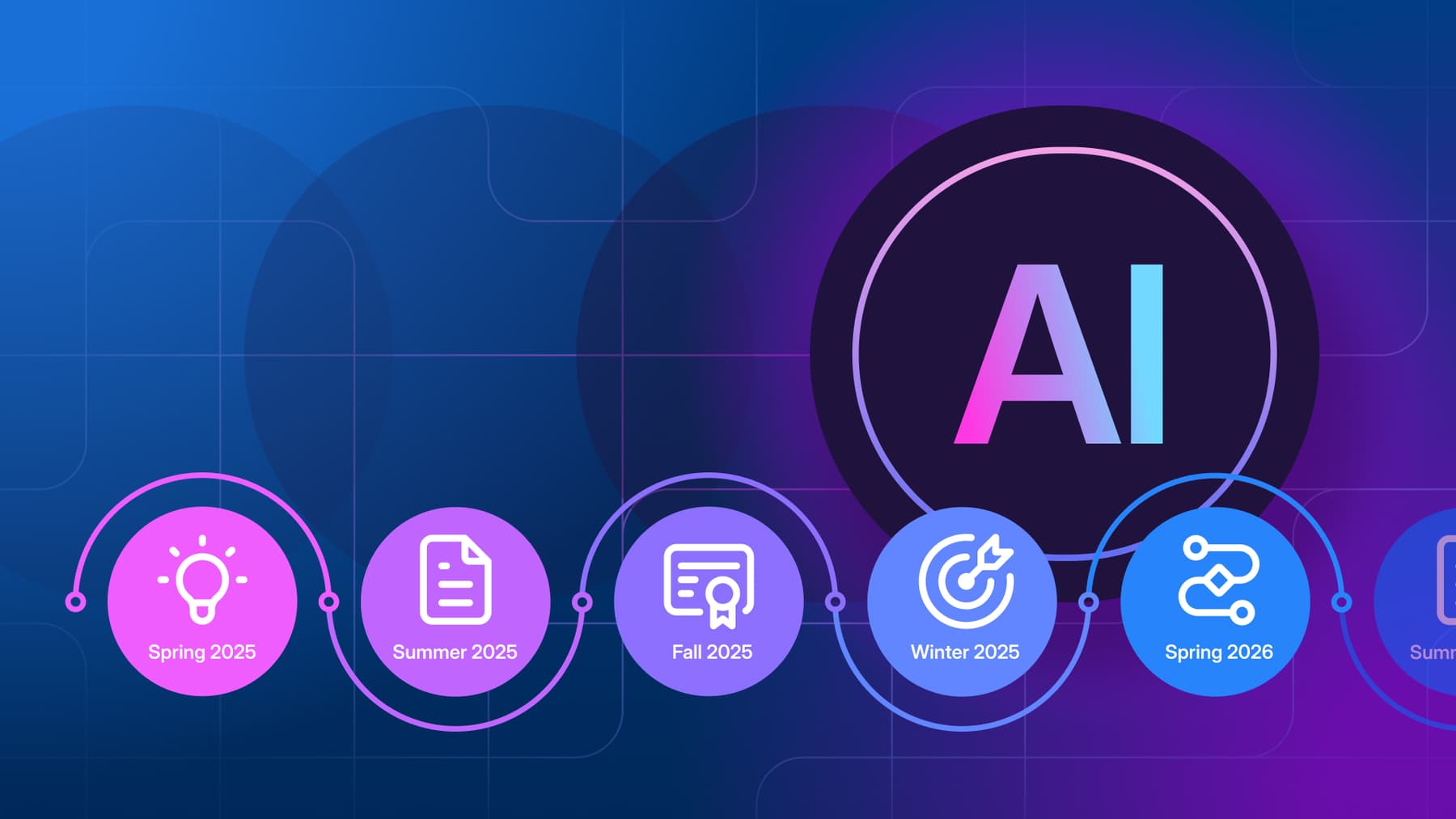
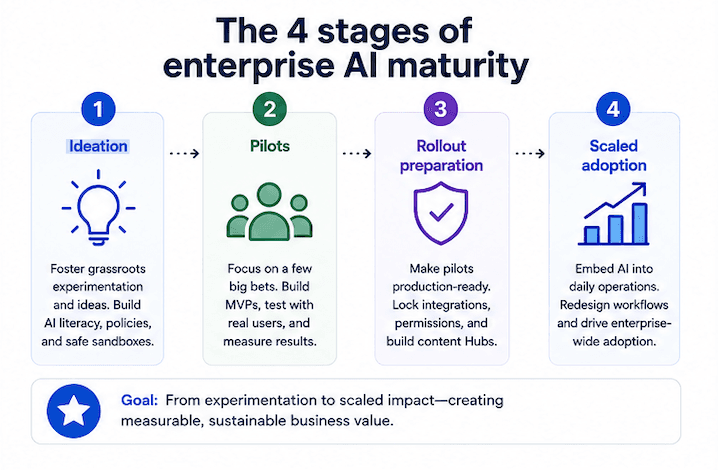
From this perspective, maturity is a spectrum, but at Box, our own journey of deploying AI at scale was broken down into four distinct stages: Ideation, Pilots, Rollout Preparation, and Scaled Adoption.
This framework demonstrates how all kinds of enterprise organizations can progress from distributed, grassroots experimentation to focused, high-impact execution that delivers measurable, sustainable, scalable business value.
How can your organization get to stage-four enterprise AI maturity? Read on.
Key stages of AI transformation:
- Stage 1 (Ideation) focuses on bottom-up experimentation, removing technical barriers to entry, and establishing clear policy guidelines rather than restrictive technical boundaries
- Stage 2 (Pilots)moves from broad exploration to disciplined execution by consolidating overlapping capabilities into a few “big bets” and validating them with real users against clear metrics
- Stage 3 (Rollout Preparation) transforms successful pilots into production-ready enterprise solutions by establishing minimum thresholds of reliability, locking down technical integrations, and building structured content Hubs as a single source of truth
- Stage 4 (Scaled Adoption) focuses on change management, workflow redesign, and establishing clear accountability through functional leaders and AI Managers to embed AI into daily operations
Why enterprise AI maturity matters
Progressing along the AI maturity spectrum represents a fundamental shift in how an organization handles data, structures its workflows, and establishes trust. Enterprise leaders face intense pressure to adopt AI, but true value doesn't come from grassroots experimentation alone.
As organizations mature in their AI journey, they must cross a critical chasm: moving from distributed, organic innovation to disciplined, high-impact business transformation. In the early stages, the focus is naturally cultural and behavioral: building AI literacy, establishing acceptable use guidelines (here are Box’s), and fostering a safe sandbox environment for curiosity.
But this bottom-up experimentation inevitably hits an operational ceiling. Left unguided, grassroots adoption leads to tool sprawl, inconsistent security models, and fragmented point solutions that confuse users and fail to scale.
Maturity progresses as organizations deliberately consolidate isolated pilot programs into unified platforms. By establishing rigorous reliability thresholds, locking down technical integrations, and centralizing knowledge, the enterprise shifts from asking “What can AI do?” to showing “What AI can consistently deliver.”
True maturity is reached when AI is seamlessly woven into the fabric of daily operations, rather than being treated as an optional side tool or a novel assistant. At this advanced stage, functional leaders redesign core workflows, embed agentic decision-making, and track continuous operational rhythms, turning AI into a permanent, scalable catalyst for net-new business capabilities.
And all of this is dependent on content.
Why content matters to enterprise AI maturity
“The power of gen AI is great, but without content, it can’t really do much,” Fernando Cerenza, Box’s Senior Team Director of Product Management, noted recently.
Box approaches enterprise AI maturity from a specific vantage point: the belief that most enterprise work is grounded in content like contracts, policies, financial documents, medical records, creative assets, compliance records, and operational files. The organizations that can govern, access, and activate that content securely are better positioned to move from experimentation to scaled AI adoption.
As Box CEO Aaron Levie put it during a recent fireside chat, “We fundamentally believe that the vast majority of the context that makes agents effective and unique to a business is living inside of enterprise content.”
We fundamentally believe that the vast majority of the context that makes agents effective and unique to a business is living inside of enterprise content.
That conviction is what connects Box’s content management heritage directly to the enterprise AI maturity journey.
“When ChatGPT came out,” Cerenza says, “people started manually uploading all their files directly, and that created a lot of headaches and questions in this industry, like ‘What’s the ideal model in which enterprises should be adopting AI?’ CIOs understood that having a single content layer that can power all their AI use cases was a really important part of everyone’s architecture.”
What does the Box model measure?
The Box enterprise AI maturity framework describes how enterprises build AI capability over time. It’s a cumulative model, and each stage depends on organizational, technical, and cultural foundations established at the prior stage.
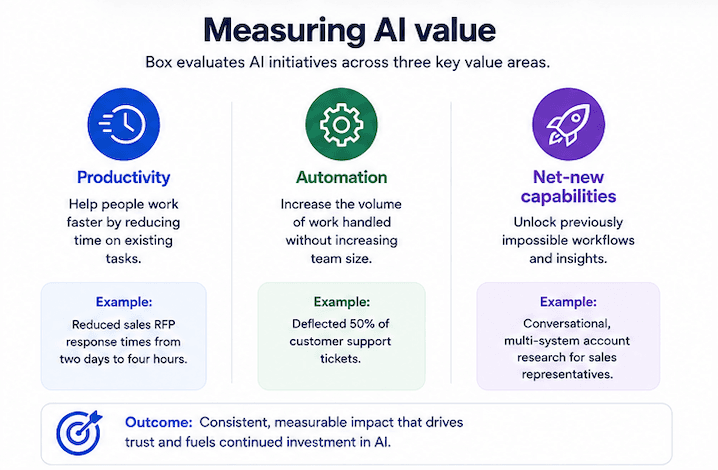
The model is based on Box’s real-world experience deploying over 100 internal AI agents and consolidating them into high-impact big bets, which have a high potential for impact. To measure success, Box evaluates AI initiatives across three distinct value areas:
- Productivity: Measuring how much faster employees can complete existing tasks (like reducing sales RFP response times from two days to four hours)
- Automation: Tracking ratio changes where agents handle significantly more volume with the same team size (like deflecting 50% of customer support tickets)
- Net-new capabilities: Unlocking previously impossible workflows, such as conversational, multi-system account research for sales representatives
The four stages of enterprise AI maturity at a glance
Stage 1: Ideation
The first stage is about building readiness and fostering organic innovation. Enterprises at this early stage aren’t deploying AI at scale. They’re preparing the workforce, data environment, governance model, and oversight structures required for the organization to use AI to create value responsibly.
Typical Stage 1 activities include:
- Training employees and leaders on what AI is and how to use it safely and effectively
- Establishing acceptable use policies and initial guidelines
- Improving access to enterprise data and sandbox environments like Box AI Studio
- Encouraging bottom-up idea submissions and hosting hackathons
- Process mapping to identify where AI can have the most significant impact
Box CIO Ravi Malick highlights the importance of this open approach: “The thing that we did really well out of the gate is let people experiment. We put policy guidelines in place, not technical guidelines. We didn’t block everything.”
The thing that we did really well out of the gate is let people experiment. We put policy guidelines in place, not technical guidelines. We didn’t block everything.
Nora Soza, Senior Director of GTM Strategy and Operations at Box, adds that “The spark of innovation was with the team and with individuals. You can’t undercut how valuable that is. They’re the ones who are living and breathing the job and are able to give the most realistic view of how AI can transform their work.”
But while grassroots experimentation is vital, the true spark of individual productivity happens when users can securely connect their daily experiments to their actual work context, which lives in unstructured enterprise content.
Stage 2: Pilots
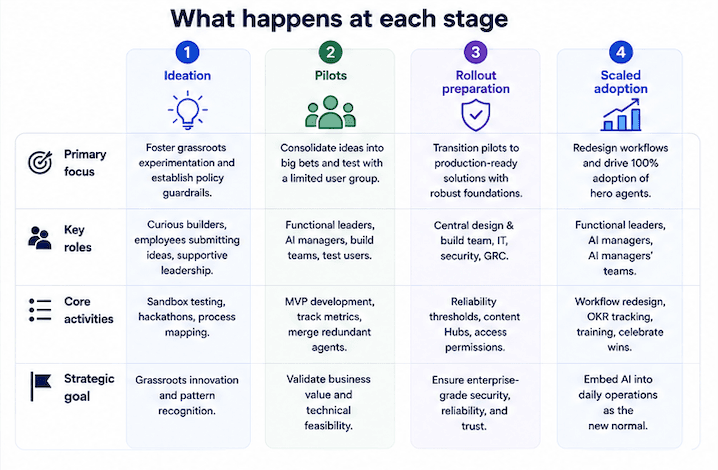
At the second stage, organizations move from broad experimentation to disciplined piloting: handpicking big bets and testing them with a limited set of users in a production environment.
A core Stage 2 practice is tracking value. Defining metrics before pilots launch, monitoring outcomes, and communicating these results builds organizational confidence and creates institutional knowledge for designing better pilots.
Box Chief Operating Officer Olivia Nottebohm explains the strategic shift from Stage 1 to Stage 2: “While there might have been this belief that you can just spin up your own agent and get going, yes, that’s true for some smaller tasks. But if you’re really trying to transform your business, you probably want to be a little more intentional about it.”
Nottebohm continues, “A lot of small agents that people haven’t explicitly understood how to work into their workflows lead to little impact. Having ten people use an agent isn’t a win, no matter how good the agent is. You need 300 people to use two to three agents that are consistently helpful and can transform workflows.”
For agents to drive impact, you need 300 people to use two to three agents that are consistently helpful and can transform workflows.
To make pilots successful and drive adoption in Stage 2, organizations must consolidate fragmented point-agent tools into a single, cohesive platform experience. “To get this type of knowledge work done,” explains Matt Terrell, Director of Product Management for Box AI Agents, “you don’t want multiple agents. Multiple agents and multiple tools lead to user confusion on what to use and when. That friction can be the difference in adoption.”
An effective pilot also demands that organizations establish clear roles. As Robert Ferguson, Box’s head of corporate strategy & chief of staff to the CEO, notes: “The functional leader is going to be someone fairly senior who’s overseeing an entire departmental area. Their role is to define the pilot’s outcomes — what success looks like.”
Stage 3: Rollout preparation
Stage 3 is the maturity inflection point where enterprises move from validated pilots to production-ready enterprise solutions. The defining Stage 3 activity is ensuring that the agent is operationally robust, secure, and integrated with core business systems.
Stage 3 capabilities include:
- Establishing minimum thresholds of reliability and accuracy
- Locking down technical integrations and data pipelines (for instance, connecting agents to Salesforce, GCP, or internal databases)
- Building structured content Hubsto serve as a single source of truth for agent knowledge
- Implementing strict governance, safety, and permission controls
Ferguson emphasizes that customer-facing agents require rigorous standards: “Any time AI is interacting with customers and prospects, you have a high bar. Rollout is the stage at which Box decides whether, for any new AI agent, that bar has been met.”
In order to prevent their agents from hallucinating or referencing outdated information, organizations must treat knowledge management as infrastructure. “If it’s pulling the latest go-to-market messaging,” Ferguson explains, “we need to make sure it’s actually pointing to the right place. Do we have a plan in place for ensuring that that is maintained?”
Connecting your agents to the right unstructured data is critical to this stage. If you don't, you have an existential problem getting in the way of being able to deploy agents at scale in an enterprise.
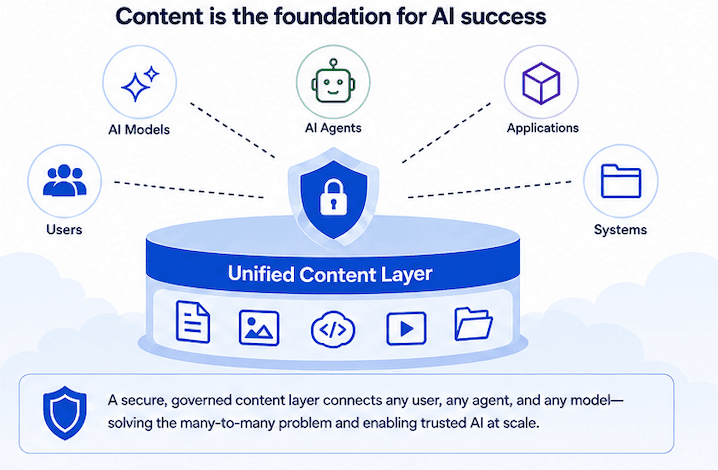
But rollout preparation isn’t just about connecting Agent A to Database B; it’s about establishing a unified content layer (via protocols like MCP) that solves the “many-to-many” problem, allowing any frontier model (Gemini, ChatGPT, Claude) to securely access enterprise data without creating new silos.
Stage 4: Scaled adoption
At Stage 4, the most advanced stage of enterprise AI maturity, piloted big bets graduate to hero agents, ready for full enterprise-wide integration and fully embedded into daily operations. By this point AI has moved beyond productivity tools to become a fundamental part of how the enterprise operates and competes.
Stage 4 enterprises focus heavily on change management, workflow redesign, and continuous operational rhythms. Functional leaders take on the role of communicating that agent use is the new normal of work, setting explicit usage targets and OKRs.
Ferguson explains the necessity of workflow redesign: “This is the moment when leaders ask themselves, ‘Okay, the agent worked really well in Pilot. But are there activities the team is doing today that they don’t need to do anymore because this agent replaces them? Can we just slot the agent into people’s existing workflow? Or do we actually need to rethink how they do work?'"
Ferguson believes “If you don’t redesign the workflow, the agent becomes a side tool. And side tools don’t scale."
If you don’t redesign the workflow, the agent becomes a side tool. And side tools don’t scale
To maintain momentum, Box operates this stage on a continuous loop. “Ideation doesn’t stop just because we’ve begun rolling out and scaling several agents,” Ferguson notes. “This will be a continual process with regular touchpoints every month reviewing what’s being piloted, what’s scaling, what’s working, and what’s not.”
As agents transition from passive assistants to autonomous workflow participants, security can’t just be an afterthought. Scaling AI safely requires an intelligent security plane (like Box Shield Pro and action guardrails) built directly into the content layer to inspect what files are directing agents to do.
“Traditional security tools are built for the network and identity layer, not for what an agent is being told to do inside a document,” says Manoj Asnani, Box Vice President for Product Management for Security & Compliance. “When AI agents are accessing your content, you need to know: Is this access authorized? Is my data protected? Am I in control?”
How Box supports the 4 stages of AI transformation
In Stage 1, the readiness prerequisites described by the Box model (accessible data, governance policies, and defined oversight structures) map directly to the services provided by our Intelligent Content Management platform. Box Shield threat detection and access controls combined with Box Governance’s retention and disposition policies give organizations a defensible foundation for responsible AI use before any model touches enterprise content.
That vision animates every layer of Box’s product architecture. “What if enterprises had a platform that could securely connect enterprise content with the right access controls and data governance to all of their AI agents?” Levie asks. “That’s what we’re building with our Intelligent Content Management platform, which powers the entire lifecycle of content — security, governance, compliance, workflow — and connects it to all our agents across the organization.”
That single-platform model is precisely what enables the governed AI foundation that Stage 1 demands.
In Stage 2, as the priority shifts to measurable pilots and process simplification, Box AI can analyze, summarize, and extract insights from the same enterprise documents that knowledge workers have always had to review manually.
Box Automate supports turning successful pilots into repeatable workflows, and Box Sign and Box Doc Gen address the document-centric processes (agreements, approvals, generated business documents) that appear in nearly every early use case. Because these capabilities operate on content that already lives within Box, teams spend less time wiring together point solutions and more time measuring results.
A consistent challenge at this stage is the fragmentation problem: enterprises want multiple AI agents and tools to operate against the same enterprise data, but that data is scattered across systems with inconsistent permissions and no shared security model. The Box Platform and its APIs become central at the Stage 3 inflection point, where enterprises industrialize AI through reusable platforms and architectures rather than rebuilding for every use case.
Levie framed this challenge during a recent customer event. “You’re going to want to be able to have lots of different agents work with your data,” he observed. “So now you have a many-to-many problem: How do I make sure all of my systems that have access to unstructured data are also accessible by all the different agents that I have?”
For instance, he continues: “I might want some agents from Gemini, ChatGPT, Anthropic. How do I make sure that I can connect all those agents to that data?”
You should assume that anything the agent can access, any user who has access to that agent, can get that information.
Box’s role as a unified content layer is designed to resolve exactly that problem by exposing content, metadata, permissions, and workflow events to agents and applications consistently, whether those agents are built natively in Box AI Studio or connected via the Box MCP server to external systems like Claude, Gemini, or Copilot Studio.
At Stage 4, where AI is embedded in core operations and enterprises begin orchestrating analytical, generative, and agentic AI together, Box Automate supports multi-step workflows where AI agents handle document verification, risk assessment, and routing while humans remain in the loop at defined decision points.
Box Apps provides an application layer for building purpose-built, content-driven experiences (dashboards, process monitors, and workflow interfaces) directly on top of enterprise content. AI-specific Box Shield capabilities, including prompt injection detection, action guardrails, and output safety controls, address the security risks that become acute when agents operate with broad content access.
The urgency behind those controls comes directly from how agents behave in the wild. “You should assume that anything the agent can access, any user who has access to that agent, can get that information,” Levie explains. “So agents will actually become one of the new vectors. If they have access to information, then the user who has access to that information can get it as well.”
Prompt injection detection, action guardrails, and output safety controls are the mechanisms Box built to address that threat directly.
Across all stages, Box takes the position that AI value depends on a trusted, well-governed content foundation. The enterprises that progress furthest are the ones that treated content infrastructure as a prerequisite rather than an afterthought.
That observation is borne out across the enterprise customers Box works with. As Ravi Malick noted on the Box AI-First Podcast: “I certainly see CIOs contemplating, and in some cases struggling with, how to scale AI and how they get to that. And what they’re realizing is that it’s highly dependent on unstructured data.”
Malick says, “Most places have relatively good discipline on managing access to structured data, but the unstructured side has been somewhat neglected." Organizations that close that gap earliest have the clearest path to Stage 3 and beyond.
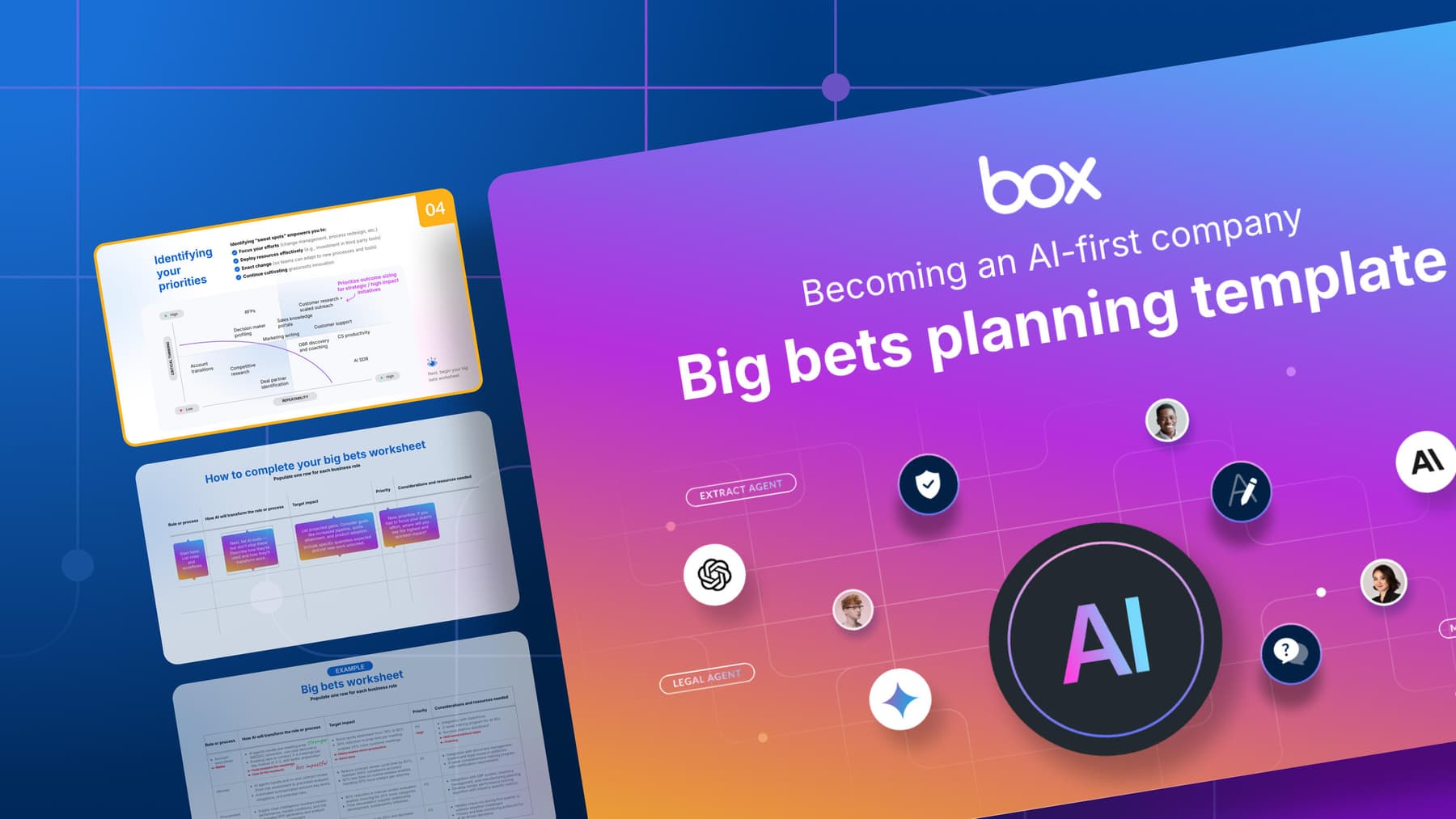
For additional straightforward advice on moving through the 4 stages of AI transformation, read the ebook Becoming an AI-First Company.
Ready to identify your AI transformation priorities?
Frequently asked questions
What does enterprise AI maturity mean?
Enterprise AI maturity is an organization’s capability to use AI responsibly and effectively across data, workflows, decisions, platforms, and business models. Higher maturity means AI isn’t limited to isolated pilots but is embedded into repeatable operations and measurable business outcomes.
What are the four stages of Box’s enterprise AI maturity model?
The four stages are Ideation, Pilots, Rollout Preparation, and Scaled Adoption. The stages describe a cumulative progression from grassroots experimentation and MVP validation to production-ready technical integration and workflow redesign.
How does Box measure the value of AI initiatives?
Box measures AI value across three areas: productivity (helping people work faster), automation (increasing the volume of work handled without human intervention), and net-new capabilities (unlocking previously impossible workflows and insights).
Why is Stage 3 (Rollout Preparation) an operational milestone?
Stage 3 is where piloted agents are made production-ready. This requires establishing strict reliability thresholds, locking down technical integrations with enterprise systems (like Salesforce and GCP), building structured content Hubs, and setting precise access permissions.
What’s the difference between a “big bet” and a “hero agent”?
A big bet is an agent concept selected for pilot development due to its high potential impact. A hero agent is a piloted agent that has successfully met its performance metrics and is being rolled out for scaled adoption across the enterprise.
How can an enterprise assess its current AI maturity stage?
An enterprise can assess AI maturity by evaluating its governance, data infrastructure, workforce skills, workflow automation, reusable platform architecture, measurement discipline, and use of AI in decision-making. Leadership teams should identify current constraints and set measurable targets for advancing to the next stage.
How does Box support enterprise AI maturity?
Box supports enterprise AI maturity by providing a secure, governed content layer for AI-enabled work. Capabilities include Box AI, Box Shield, Box Governance, Box Relay, Box Hubs, Box Sign, Box Doc Gen, Box Apps, and Box Platform/APIs to help organizations manage content, automate workflows, apply AI to enterprise information, and maintain governance as AI scales.