If your legal team got a customer’s 50-page main service agreement at 4pm on the last day of the quarter, it would likely trigger an all-nighter — and potentially blown deadlines. But what if that eight-hour review could be completed in just one hour?
That’s the goal for Box’s own legal team, who are transforming contract workflows with an intelligent contract management system aimed at saving thousands of hours annually while maintaining rigorous legal standards.
The real cost of manual contract review
Before diving into the solution, let’s talk numbers. When Box’s VP of Commercial Legal, Maninder Sagoo, analyzed his team’s contract review process, the findings were sobering:
- First review of a customer’s MSA: 8 hours without AI assistance
- Annual time spent on 12 customer MSAs: 96 hours
- Cost at $175K average legal salary: $10,993 per year
And that’s just for one type of contract. Multiply this across all contract types, team members, and the inevitable back-and-forth negotiations, and you could be looking at hundreds of thousands of dollars in manual review costs.
But the hidden costs run even deeper. As Sagoo notes, “Your company might have a seven-page template MSA that’s tailored to your service, but the customer sends over their 50-page MSA or 100-page MSA, which they use for buying anything and everything, and that’s just a really long slog.”
These marathon review sessions delay deals, frustrate sales teams, and create bottlenecks that ripple across the organization.
Box’s end-to-end contract automation journey
Transformation Box begins with a simple question: How can AI help legal teams work faster without sacrificing quality? Box’s answer is a seamlessly integrated workflow designed to handle everything from risk assessment to final signature — all in one place.
Step 1: AI-powered risk assessment that understands your business
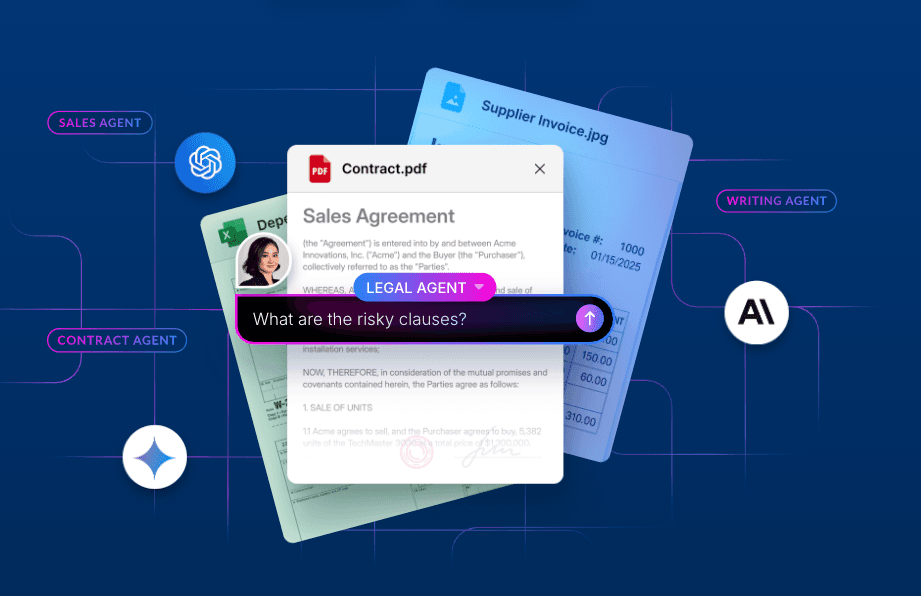
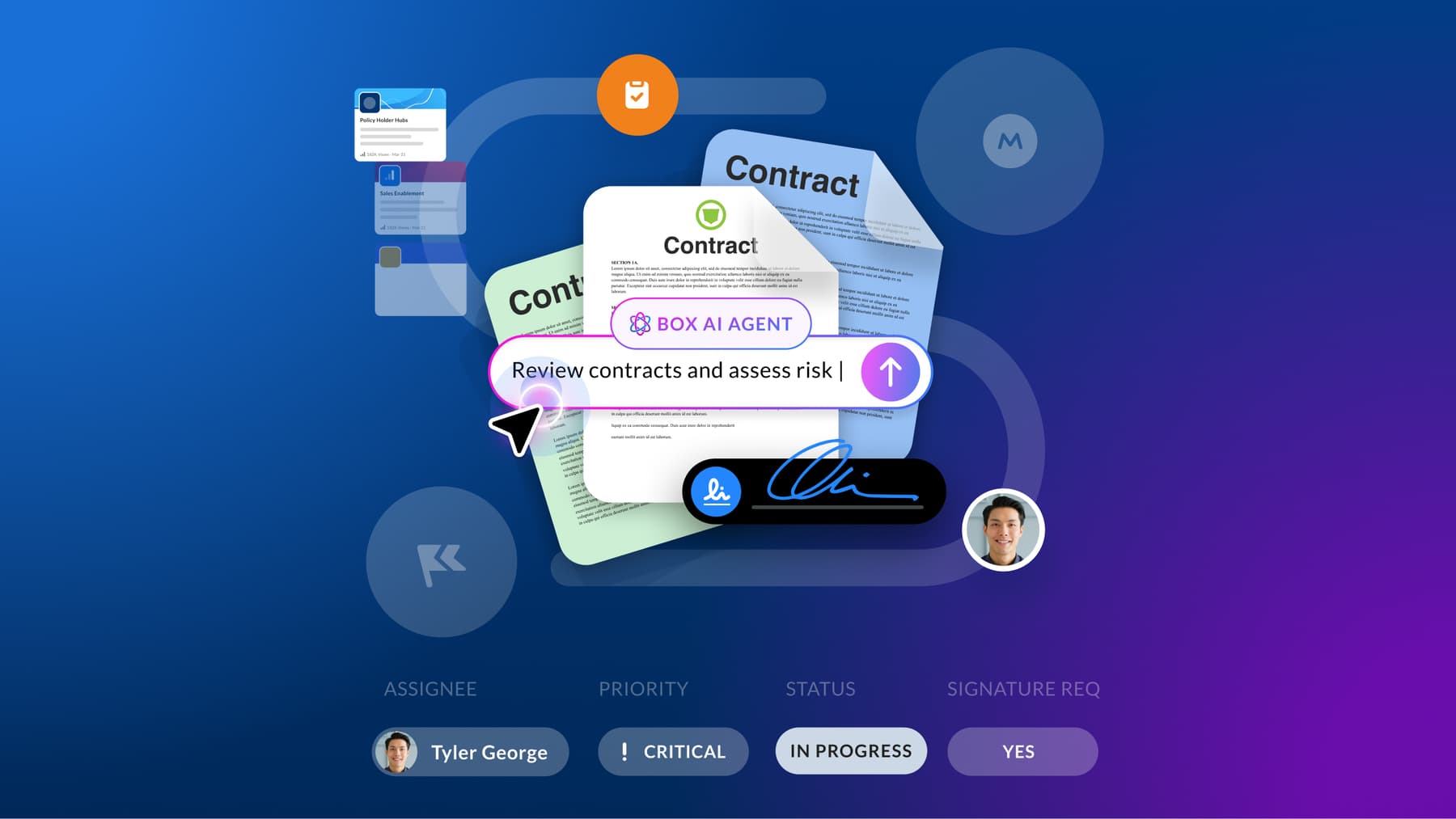
When external parties send their template contracts, that’s where Box AI truly shines. It allows you to build an intelligent AI agent that can be customized to read your customer’s submitted template and assess it against your legal team’s specific contract guidebook, risk matrix, contract history, and clause library in order to understand what may or may not be acceptable to your organization.
The agent automatically:
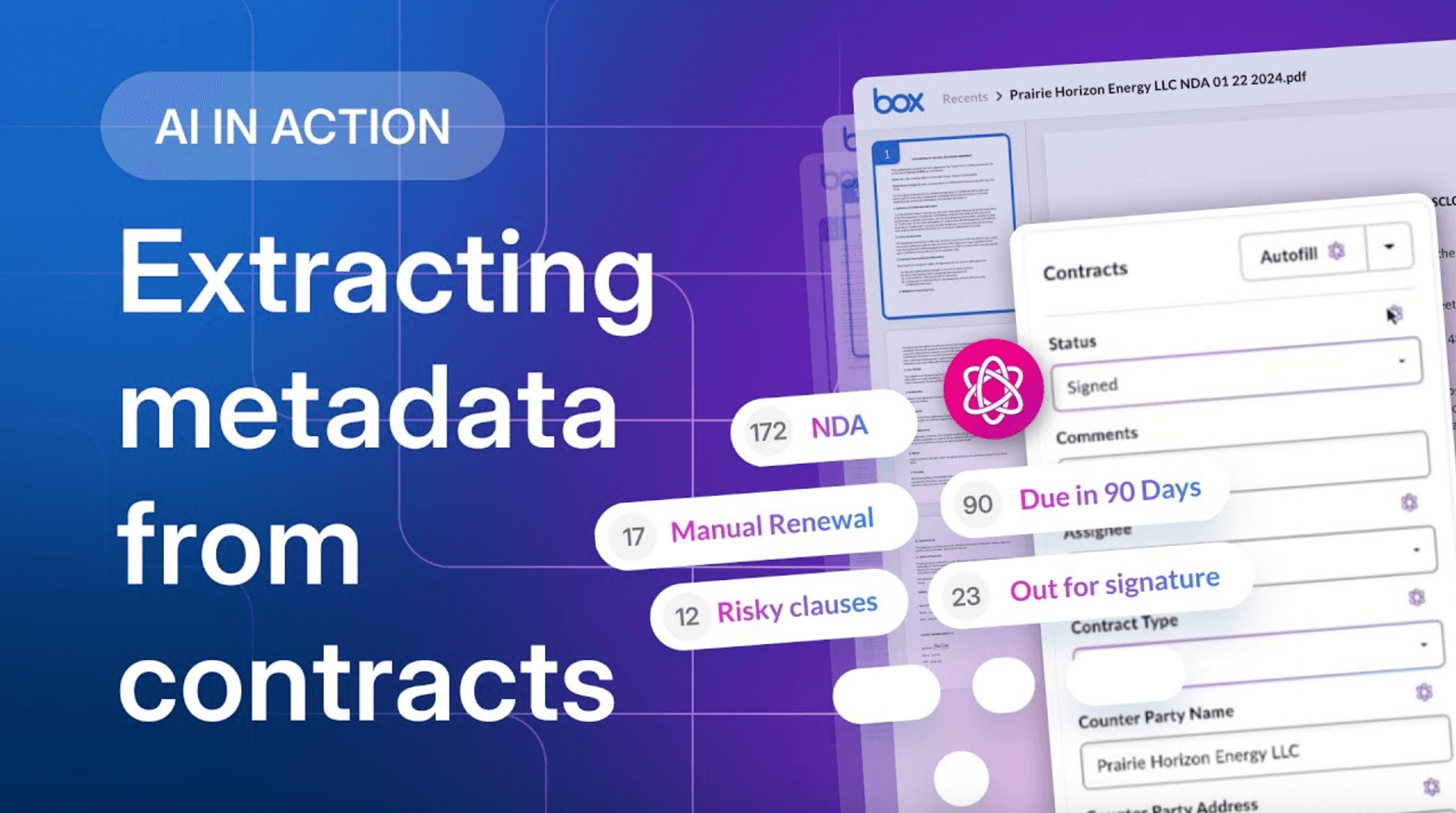
- Extracts metadata from uploaded contracts
- Identifies high-risk clauses based on your organization’s criteria
- Compares terms against your approved contract library
- Provides specific recommendations based on negotiation context
“The agent is working on your instructions,” Sagoo emphasizes. “It’s not making up its own risk assessment. It’s working with knowledge of your corporate documentation, your risk profile, your business model.”
Step 2: Context-aware negotiation assistance
Perhaps the most impressive capability is AI’s ability to understand negotiation dynamics. When prompted with additional context of “Assume we don’t have much leverage, because it’s the end of the quarter,” the AI agent adjusted its recommendations accordingly to support a faster sales cycle, always anchored in corporate-approved positions.
Contextual intelligence means more realistic negotiation strategies, faster paths to acceptable terms, reduced back-and-forth between parties, and preservation of important business relationships.
This contextual intelligence means more realistic negotiation strategies, faster paths to acceptable terms, reduced back-and-forth between parties, and preservation of important business relationships. AI can even draft some alternative language, complete with strikethrough and bold formatting for easy review and incorporation into the redline document being prepared.
Step 3: Easy, safe e-signatures
Once terms are agreed upon, Box Sign keeps everything within the ecosystem. Every signed document automatically returns to the contract folder with a complete signing log, maintaining that crucial chain of custody.
A command center for contract intelligence
Traditional folder structures don’t cut it for contract management. Box’s Legal teams now have dashboard views that surface contracts based on the key details within them, e.g., payment terms, governing law and so on.
Contract lifecycle management in Box enables you to surface content based on what’s in it, not just based on the folder organization.
The customizable dashboard can be configured to display new contracts, a high-risk agreement queue, expiring contracts subject to auto-renewal, contract status across all stages, and much more.
“It’s fundamentally a different way of looking at content in Box,” Sagoo explains. “This kind of view where you’re surfacing content based on what’s in it, not just based on the folder organization, is part of what makes contract lifecycle management on Box possible.”
50x faster report development
The proof is in the results. SSAI, currently implementing this system, has achieved:
- Report development time: Reduced from 24 hours to 30 minutes
- Process acceleration: 50x improvement in speed
- Tool consolidation: Eliminated multiple point solutions
- Workflow unification: Everything happens in one environment
For Box’s own legal team, the impact promises to be transformative, with goals including:
- 87.5% reduction in initial contract review time (8 hours to 1 hour)
- $41,040 annual savings on end-to-end review of 12 custom MSAs
- Dramatic reduction in sales team friction
- Consistent application of legal standards
- Faster time to revenue by accelerating deal cycles (fewer review bottlenecks and faster paths to acceptable terms)
The 80/20 rule of contract management
Sagoo brings a refreshing perspective to the CLM conversation: “I’ve bought tools; I’ve retired tools. I have a sense of how much those things cost, how complex they can be to implement, and how they typically result in additional content silos, additional spend, and technical complexity.”
His approach? Focus on the 80% of features that deliver real value:
Must-haves (80%): Automated contract generation, intelligent risk assessment, version control and collaboration, e-signature capabilities, automated metadata extraction, and a searchable contract repository
Nice-to-haves (20%): Native inline editing, complex approval matrices, specialized clause libraries, and advanced analytics dashboards
“Those features,” Sagoo notes, “often end up being nice to have but aren’t really used that much — or nice to have but really, really expensive.”
Building your AI-first legal operations
The transformation doesn’t happen overnight, but Box’s approach offers a practical roadmap:
- Start with templates: Identify your highest-volume contracts and create intelligent forms
- Enable your AI: Feed your playbooks, guidelines, and “gold standard” contracts into Box AI, giving your agent knowledge
- Define your risk criteria: Establish what constitutes low, medium, and high risk for your organization
- Pilot and iterate: Begin with one contract type and expand based on success
- Measure everything: Track time savings, cost reduction, and deal velocity improvements
The future of legal work: Augmented, not replaced
The Box Legal team's implementation approach demonstrates that AI is all about amplifying the capabilities of every lawyer and contract manager on the team.
“If you’re doing something today that’s net-new, the question I want you to ask yourself is, ‘How can AI help me do it faster and more efficiently?’” Sagoo says in reference to asking his commercial legal team to think about Box AI.
If you’re doing something today that’s net-new, the question I want you to ask yourself is, ‘How can AI help me do it faster and more efficiently?’
When routine tasks that once consumed days now take hours, legal teams can focus on what truly matters: strategic counsel, complex negotiations, and building stronger business partnerships.
Ready to transform your contract workflows? Learn more about Box for Legal, browse our Solutions Marketplace, or watch this webinar to learn more about Box Solutions.