AI agents are no longer experimental. Enterprises are deploying them to retrieve records, execute transactions, route documents, and coordinate with other agents — often without a human in the loop. That shift from AI that advises to AI that acts changes the nature of organizational risk in ways that vendor vetting alone cannot address.
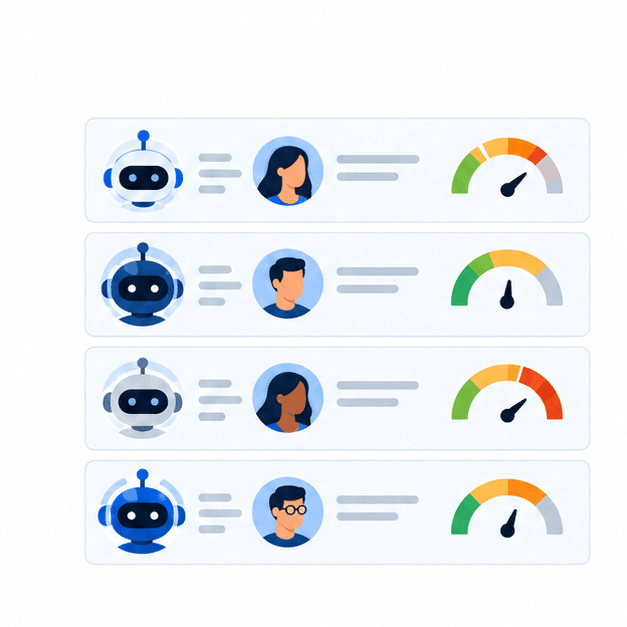
Third-party AI agent governance defines, enforces, and reviews what externally provided AI agents may access and do inside an organization. Agents from the same vendor can carry very different risk profiles; governance must be applied not at the level of the provider relationship but at the level of individual agents, based on each agent’s access, autonomy, authority, and potential impact.
The stakes become clearer when you consider what agents actually do with enterprise content. As Aaron Levie, CEO of Box, observed in a fireside chat on content and AI, "Agents will find everything. So that means that that thing that was shared five years ago, that was sort of left as sort of this drift, the agent will just go and find." This reality makes governance questions — what each agent can actually do, and with what data — far more urgent than a standard vendor review.
This article explains how to assess agent authority, apply controls during execution, distinguish observability from governance, preserve accountability across multi-agent delegation chains, and govern the enterprise content those agents use.
Key takeaways for governing third-party AI agents
- An agent inventory should identify ownership, purpose, deployment environment, permissions, and third-party dependencies
- A trusted vendor can supply agents with very different risk profiles; govern each agent by its access, autonomy, authority, and potential impact
- Least privilege limits the data and tools an agent is able to access; least agency limits the actions it can take without supervision
- Observability records agent behavior, while governance also defines permitted behavior and allows intervention before an unauthorized action occurs
- Approval thresholds, data boundaries, and escalation paths work best when enforced as agents act, not left solely in policy documents
Why third-party AI agent governance matters
For IT and security leaders, third-party agents raise a different question from traditional vendor risk: what can each agent actually do? An agent that summarizes public information poses different risks from one that retrieves customer records or changes financial accounts.
And the speed that makes agents so efficient can also amplify mistakes. A customer-service agent that gives one traveler incorrect flight information creates a containable problem; an autonomous agent repeating the error across many interactions can create a much wider one before anyone notices. Controls that operate during execution can limit that spread.
This speed-and-scale risk isn’t just a matter of volume. As Bakhshi Malhotra, Staff Product Marketing Manager at Box, put it in a recent webinar on agent security and governance, "The important change isn’t simply that more employees are using AI. It's that AI systems are being given more autonomy to act on behalf of users. The security model must therefore govern both what an agent can see and what it can do." That framing — governing both access and action — is precisely what distinguishes agent governance from traditional software risk management.
For content, compliance, and operations teams, governance makes delegation possible. An agent might independently reconcile transactions and flag discrepancies while a person approves changes to financial records. Clear boundaries let teams use automation without surrendering accountability.
Core concepts in third-party AI agent governance
How to identify AI agents and define their authority
Before an agent participates in a consequential process, an organization needs a record of what it is and who is accountable for it.
That record should answer questions like:
- Who operates the agent?
- What business purpose does it serve and where is it deployed?
- Which systems and data can the agent access?
- Can the agent recommend, approve, or execute independently?
- Is the agent part of a multi-agent or multi-tool deployment?
Least privilege vs. least agency for AI agents
Least privilege means granting an agent only the data and tool access that are required in order for it to complete its task. Least agency means granting only the decision-making and execution authority that task requires. An agent that is asked to recommend a refund, for example, doesn’t necessarily need permission to issue one.
These principles work together. A finance agent might reconcile transactions and identify discrepancies using limited access, while changes to financial records require a human signature. The boundary should reflect both what the agent can reach and what it can do with what it finds.
Agent observability vs. agent governance
Observability helps teams reconstruct what happened: which tools an agent used, how it performed, and where an error occurred. Governance also defines allowed behavior, assigns accountability, and provides ways to intervene when an action crosses a boundary.
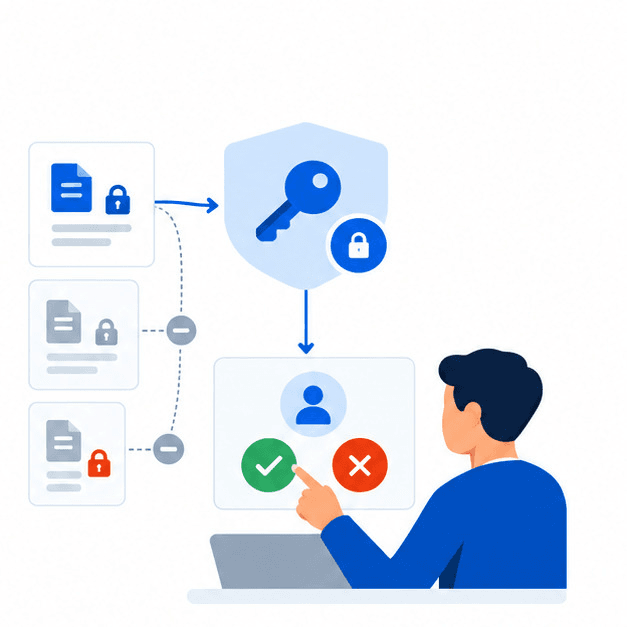
Suppose a customer-service agent needs approval for refunds above a specified amount. Observability can show that it exceeded the threshold after the fact. An enforceable governance control can stop or route the proposed refund for approval before it is issued.
Enforcing agent policies during execution
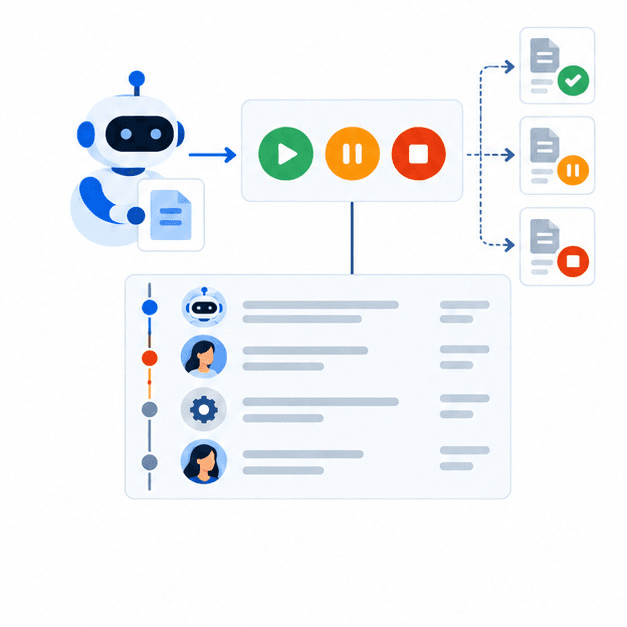
Agent governance cannot rely solely on periodic reviews or written rules when agents act at software speed. Business rules, data boundaries, approval gates, and escalation paths need to operate when an agent attempts an action.
A practical governance cycle has five steps:
- Inventory agents. Record ownership, operation, purpose, environment, and dependencies
- Classify capabilities and impact. Evaluate autonomy, access, authority, and potential consequences
- Limit access and agency. Give each agent only the permissions and decision rights its work requires
- Enforce boundaries during execution. Pause, redirect, approve, or halt actions that would exceed defined limits
- Monitor and reassess. Preserve evidence, investigate incidents, and revisit controls when models, tools, permissions, providers, or purposes change
Monitoring can reveal drift and show whether controls continue to work. For regulated processes, the resulting evidence also supports investigation and accountability.
Governing delegation across multiple AI agents
A single task may pass from a person to an internal agent, then to a third-party agent, an external tool, and an enterprise system. Reviewing each component separately doesn’t fully explain who authorized an action or how it occurred.
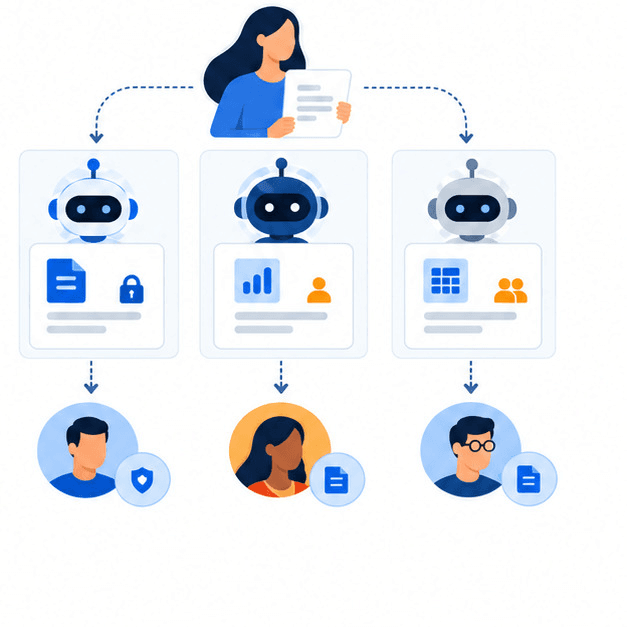
Trust and authority shouldn’t automatically pass along that chain. If an internal agent can access several systems, a third-party agent handling one delegated step should receive only the context and permissions that are needed for that step. Governance must track identity, authority, and accountability across the workflow, including environments run by different providers.
How Box governs the content AI agents use
The Box perspective centers on a critical part of agent governance: controlling the enterprise content an agent can access and the work it can initiate with that content. Agent-level authorization and runtime controls remain necessary, but they’re harder to apply responsibly if documents, permissions, workflows, and retention requirements aren’t understood.
Box Hubs provides a governed place for enterprise content that’s used in collaboration and business processes. Its access controls connect directly to users, their files, and their folders, so that an agent acting on someone’s behalf can’t reach anything that person couldn’t already reach. That default speaks directly to least privilege; the agent’s content access is bounded by the same permissions model as the human it serves, not a separate, broader grant made at build time.
Box Shield extends that boundary with content-focused security controls, including action guardrails and the audit trails that are needed in order to observe what an agent actually did with the content it touched. Box Governance applies retention schedules and legal holds to the sessions and outputs that agents create, not only to documents a person created by hand.
For tasks involving enterprise documents, Box AI connects AI-assisted work to content in Box. Custom agents can be scoped to specific content, instructions, and audiences so a task doesn’t quietly expand what an agent is able to see.
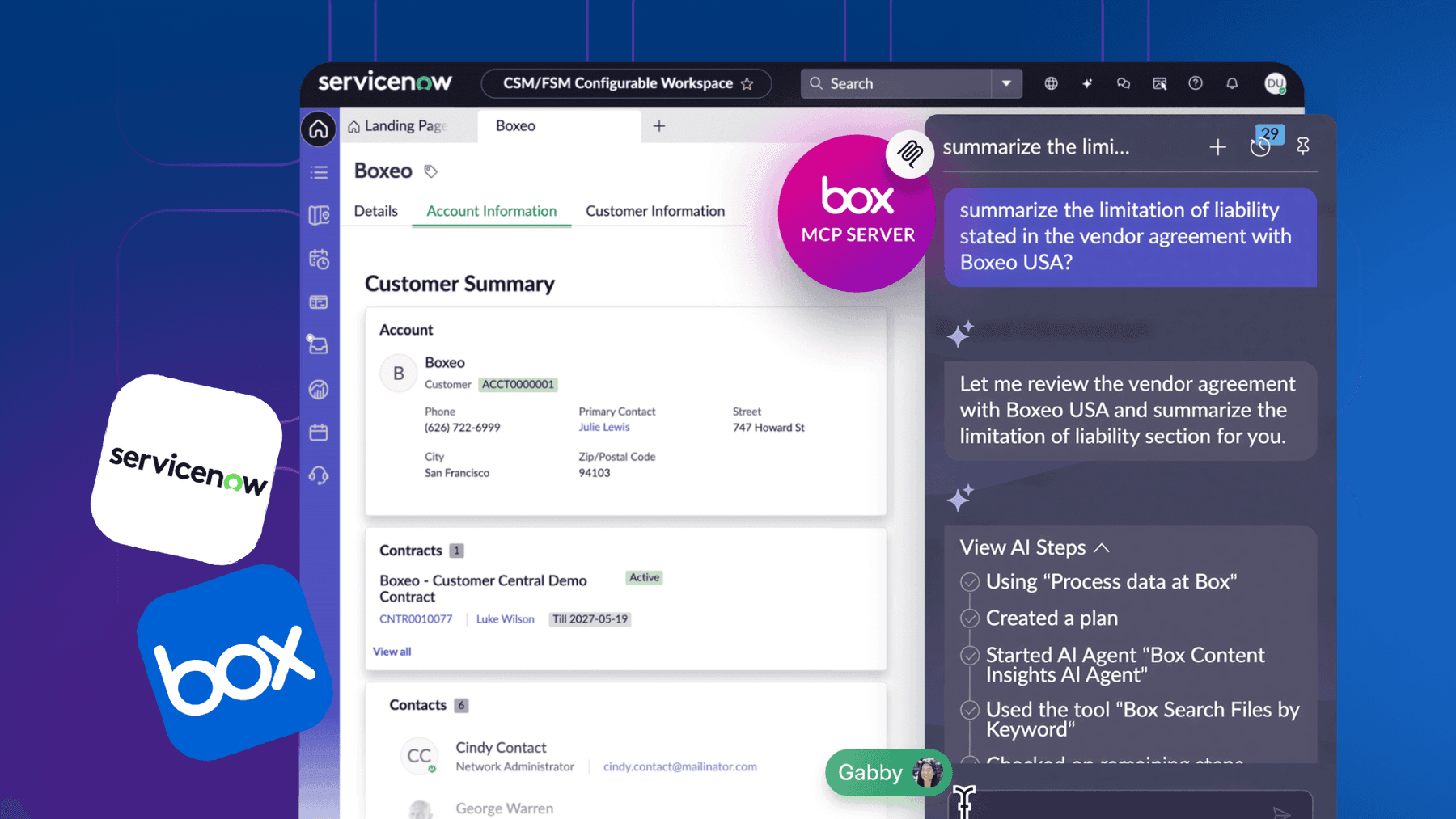
When a third-party agent operating in another platform needs to pull from Box, the Box MCP Server lets it inherit the requesting user’s existing permissions rather than receive a standing grant of its own. That keeps authority from expanding simply because a step was handed off to an external agent or tool.
When a process needs human participation, Box Relay and Box Automate can embed approval steps directly into a workflow, pausing for sign-off before a recommendation becomes an executed action. Box Sign can capture the resulting signature. Box Platform and APIs connect content to broader agent and application workflows, where teams must still define the agent’s identity, permissions, and permitted actions. Box content controls and workflows can therefore form part of an enterprise governance design; they shouldn’t be mistaken for a universal runtime control plane for every third-party agent or external tool.
Frequently asked questions about third-party AI agent governance
What is a third-party AI agent?
A third-party AI agent is an agent that is supplied or operated outside an organization that performs tasks using data, tools, or systems that are made available to it. Its governance requirements depend on its actual access and authority, not simply on the fact that its provider passed a vendor review.
Is vendor vetting enough to govern an agent?
No. Vendor vetting assesses matters such as a provider’s security, compliance, and data-handling practices, but agents from the same provider can have very different permissions and consequences. Each consequential agent needs its own defined purpose, owner, boundaries, and controls.
What’s the difference between least privilege and least agency?
Least privilege limits the data, systems, and tools an agent can access. Least agency limits what the agent is able to decide or execute on its own. An agent may need access to review a record without needing authority to change it.
How is agent governance different from observability?
Governance defines permitted behavior and provides controls to approve, stop, or redirect an action before it exceeds an agent’s authority. Observability, on the other hand, records and explains agent behavior, including tool use and errors.
When should an AI agent require human approval?
Human approval is useful when an action is consequential and the benefits of autonomous execution don’t justify the added risk. Examples include changes to financial records or refunds above an organization’s approval threshold. The appropriate boundary depends on the process.
What should an organization include in an agent inventory?
An agent inventory should identify the owner, operator, business purpose, deployment environment, accessible systems and data, available actions, and third-party dependencies. It should also record whether the agent can delegate work to other agents or tools.
Does an internal agent’s permission carry over to a third-party agent it calls?
No. Delegation shouldn’t automatically transfer the internal agent’s full access or authority. The receiving agent should get only the context and permissions that are needed in order to complete its assigned step, with accountability preserved across the chain.
When should agent controls be reassessed?
Controls should be reassessed when an agent’s model, tools, permissions, provider, or business purpose changes. Continuous monitoring can also reveal behavior that differs from expectations and warrants investigation.
Can content governance replace agent runtime governance?
No. Content governance helps control access to information, retention, and content-related workflows, while agent runtime governance addresses what an agent may do as it acts across systems. Organizations need both in situations where agents use enterprise content to recommend or execute consequential actions.