Every business has an enormous cache of digital content that’s growing every day.
Assets power work in every industry: Think client agreements and claims in financial services, clinical trial files in life sciences, movie trailers and scripts in M&E, and so much more. Whether you work in manufacturing, retail, life sciences, government, or any other industry, you have digital assets to manage.
When those assets are managed well, you get three key things: brand consistency, productivity, and risk reduction. Poorly managed assets negate all these benefits and more: lost revenue, reputation dings, and legal exposure. AI brings enormous potential to help manage, secure, and govern assets.
Yet, all this digital content —the unstructured data that makes up 90% of your enterprise data — sits almost entirely outside where enterprise AI dollars are flowing. IDC notes that less than 1% of unstructured data is being used in gen AI today. As a result, the average employee still loses about 60% of their time to “work about work,” including searching for information and seeking status updates.
Imagine what teams could do with all that time back. Intelligent digital asset management is the solution.
Key takeaways:
- Most teams have an AI readiness problem because their most valuable content — their digital assets — live in unstructured formats that AI cannot easily use
- Poor content management creates operational drag, from duplicated work and slow approvals to growing compliance and rights-related risk
- The path forward is to structure content from the start with metadata, governance, and automated workflows so AI can be used safely and effectively at scale


Manual asset management is working against your content and your business
Most DAMs were designed for creative assets only. But today, all companies accumulate huge volumes of digital assets in every line of business. With these assets scattered across the enterprise and various siloed systems, it’s increasingly impossible to find files, collaborate securely, or use AI to extract value from content.
As a result, on average businesses lose 19 days per year to repetitive asset tasks, including reviewing, renaming, re-uploading, and chasing approvals through email threads and attachments. The instinct is to reach for more collaboration fixes — add a Slack channel, move to shared drives, send off a flurry of additional emails — but these tools don’t fix content structured badly and inefficient legacy content management systems. Traditional DAMs were built for an earlier, smaller world. The gap between content volume and management capability widens with every production cycle, and simply tacking on new tools doesn't close it.
One massive underlying problem with traditional DAMs and content management systems is a lack of metadata. When assets get created and metadata is applied incorrectly (or not at all), the assets become invisible: stored, but operationally lost. Manual tagging doesn’t scale, and naming conventions degrade. Folder structures that worked at 50,000 assets collapse at five million.
AI does not erase weak foundations but actually exposes them — and, in some cases, accelerates their failure.
The content lifecycle, reimagined
The typical digital asset lifecycle looks something like this:
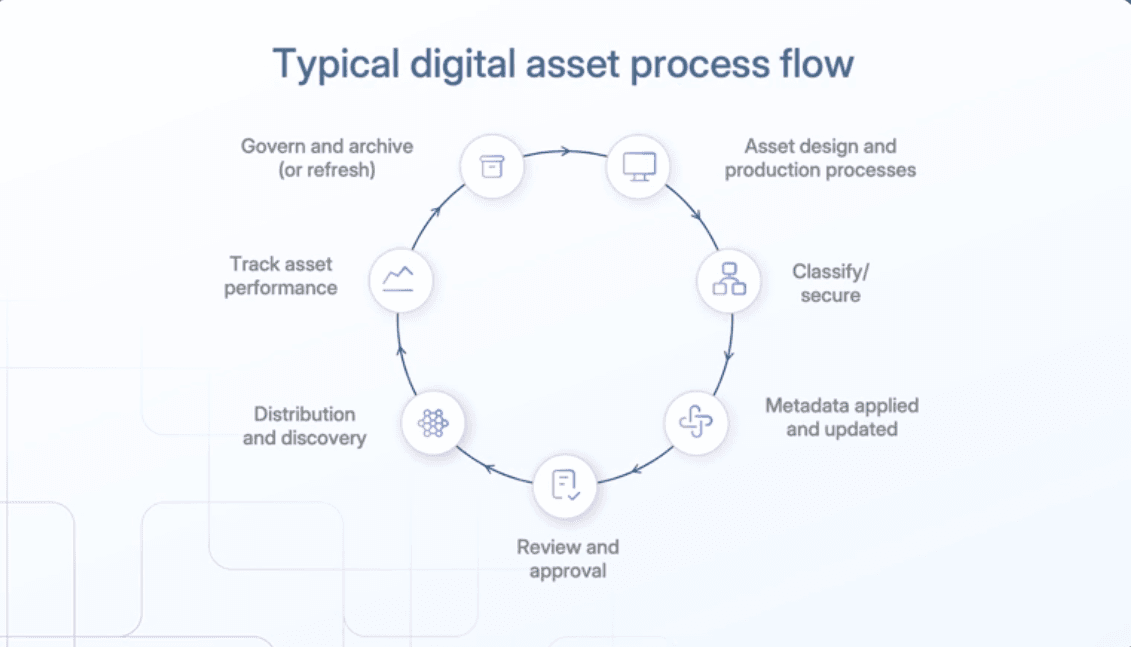
Assets are created and enter the production process. They’re classified and secured, with metadata applied. They go through review and approval, into distribution and discovery, and are tracked over their lifecycle.
But this is an ideal scenario. Often, assets are created in isolation, with metadata supplied inconsistently or not at all. Intake requests come in through different channels and don’t get tracked properly. A lack of structure sabotages organization by the time the asset reaches review.
An AI-powered DAM lets you centralize, secure, and accelerate your content lifecycle by combining AI search, security, governance, and integrations to other tools in your ecosystem. It reins in the asset sprawl and gives you control across your content by:
- Speeding up production with version history, tasks, and automatic approval routing
- Automatically extracting metadata to enable fast, accurate search across massive volumes of content
- Surfacing assets by meaning, visual similarity, objects, colors, and metadata — not just keywords
- Curating content libraries or collections to give easy access to teams and partners
- Applying retention and disposition policies and archiving cold media while preserving audit trails and ownership metadata
- Protecting IP from data loss and helping comply with regulations
Digital asset management with Box
As a foundation for digital asset management, Box enables you to structure, search, govern, and act on your content across its full lifecycle. Intelligent Content Management from Box brings metadata, workflows, permissions, and AI together so teams can create, review, approve, distribute, and archive content in a way that makes it easier to find, safer to govern, and ready for AI to use.
Consider a standard campaign asset approval. Here’s what the workflow can look like with Box:
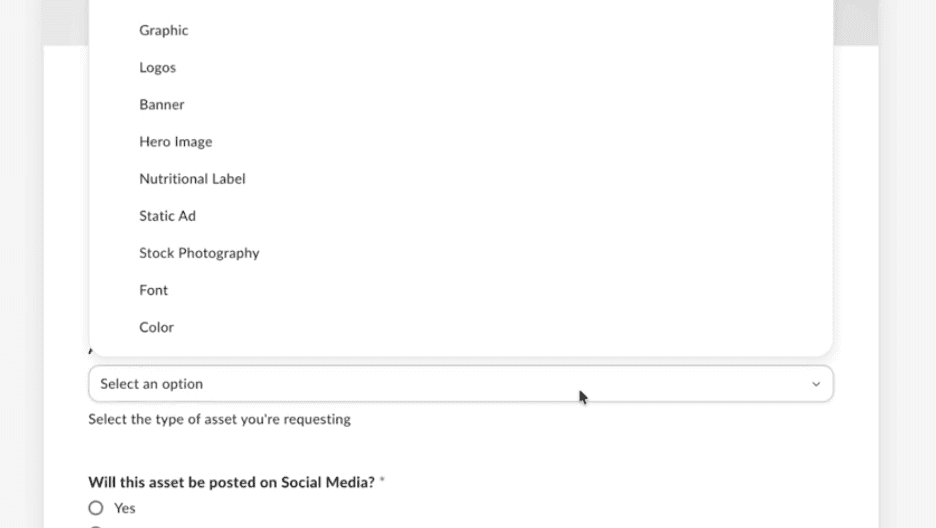
A creative brief request comes in through a structured intake form, made with Box Forms, that captures asset type, rights information, campaign association, and distribution scope.
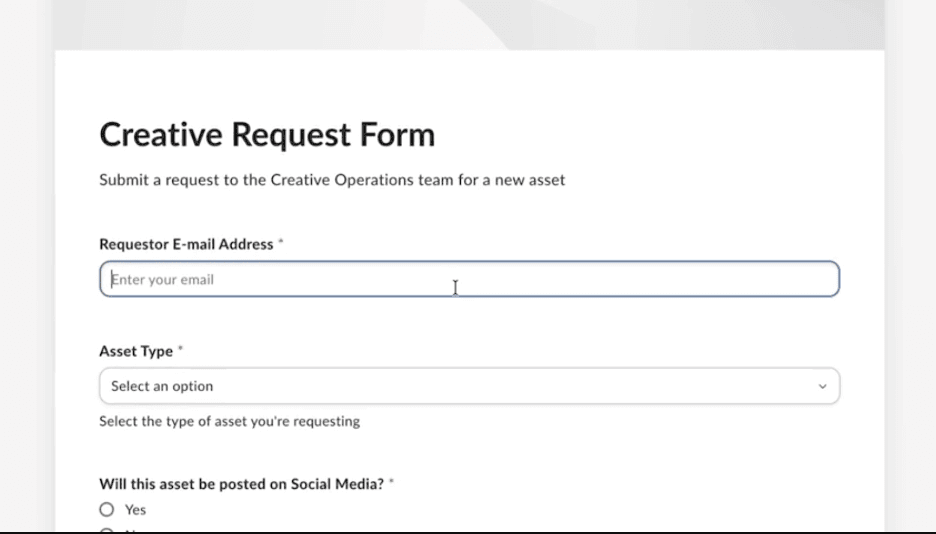
Box Extractpulls key metadata fields automatically — no manual tagging, no follow-up emails.
Submission of the firm triggers automated workflows via Box Automate: Updating the asset status, generating a creative brief, and kicking off sequential steps.
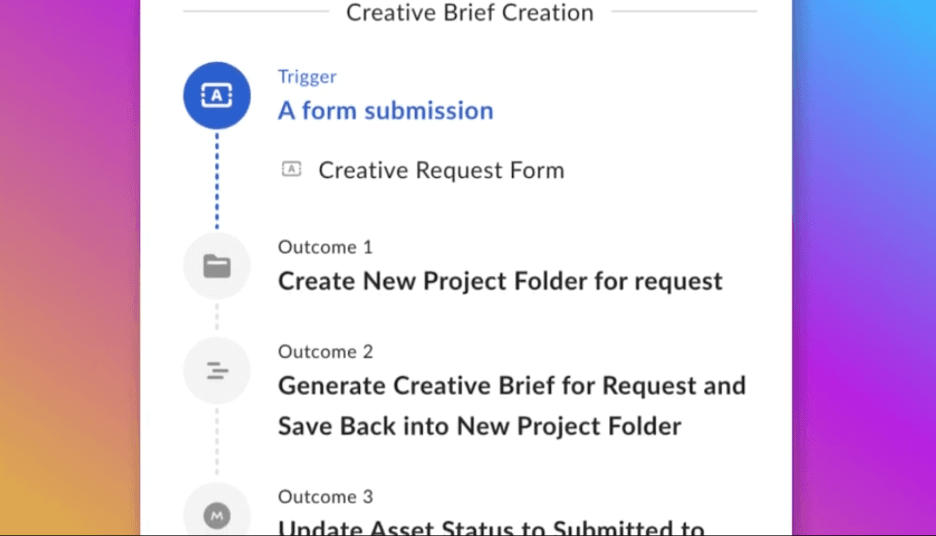
Box Automate routes the asset to the right reviewers in sequence, with deadlines assigned and version history maintained throughout. Box Automate continues to update metadata for this and any additional content that becomes part of the workflow. At the reviewing and approval stage, Box Automate uses automatic approval workflows.
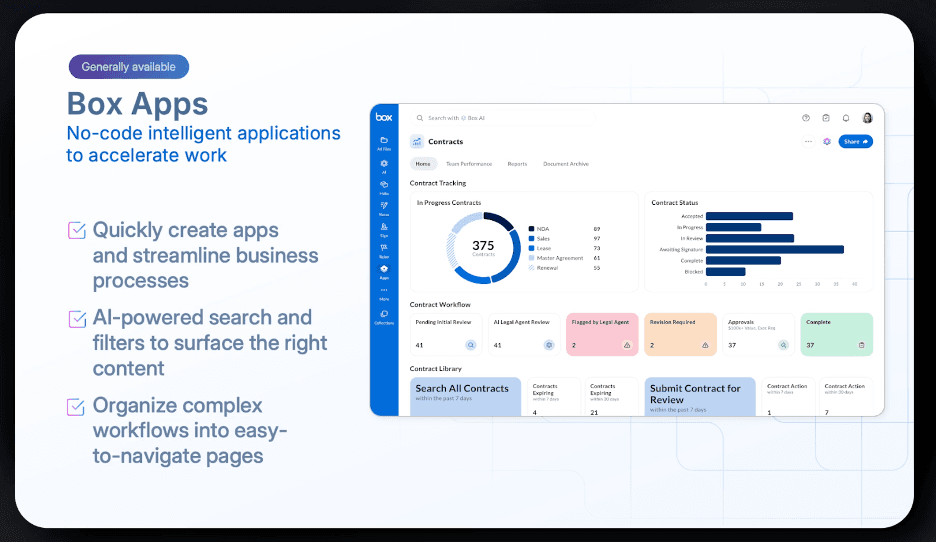
With Box Apps, teams can configure custom dashboards for the project, tapping into the established metadata of files so teams always have accurate, updated insight into their workflows.
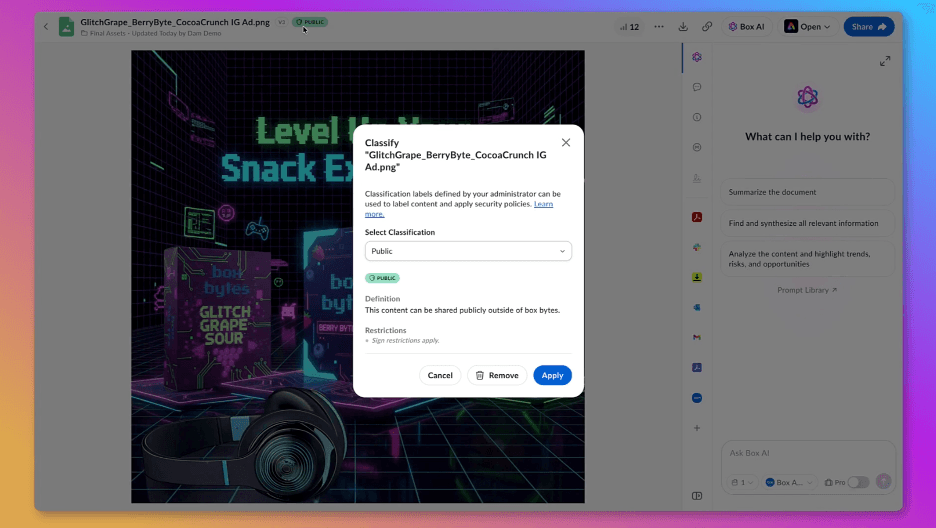
When the asset clears approval, Box Shielduses agentic AI to automatically classify it from internal-only to distribution-ready and applies controls that secure and govern the asset throughout its entire lifecycle.
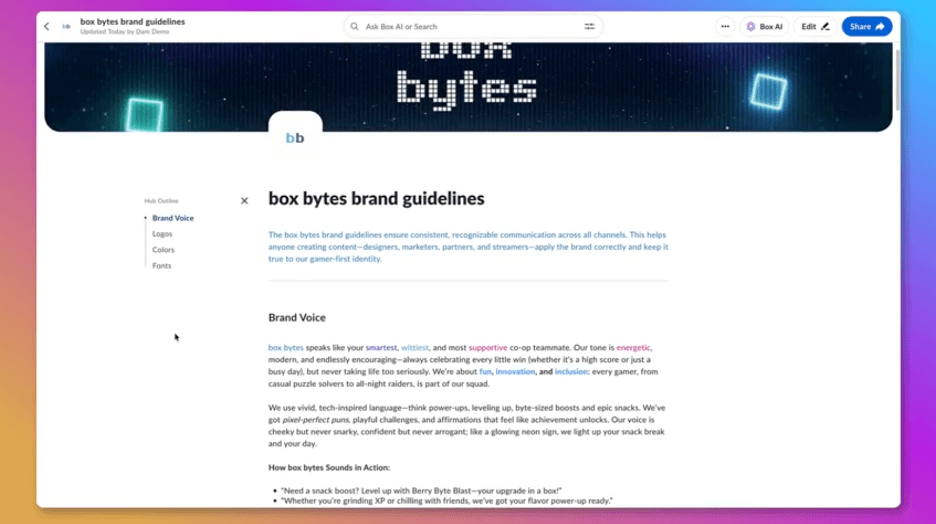
Box Hubs publishes the approved asset to a portal where regional teams and agency partners can find exactly what they need in an easy-to-navigate format, without emailing anyone for a link or access to specific assets.
The entire workflow runs on one platform, and the result is a library that doesn’t sprawl as content accumulates, resulting in fewer rebuilds, approval bottlenecks, and compliance incidents.
What a secure, structured, AI-powered DAM looks like in practice
Many of the clearest proof points for AI-powered DAMs come from creative agencies using Box to manage large asset libraries, client approvals, rights-sensitive content, and external collaboration.
Bluedog Design, a heavy hitter product-innovation consultancy serving Fortune 100 CPG and quick-service restaurant clients, created a DAM based on rich metadata from decades of product photography. This enormous archival project now gives Bluedog’s clients a clear global view of contextual packaging trends, competitive positioning, and market evolution.
“We’ve tried for years to find a way to search these archives,” says Melissa Krchma, Director of Workplace & Digital Empowerment. “It’s been a literal two-year dream.”
Critically for an agency that works with freelancers, customers, and partners outside its walls, this DAM doesn’t create identity management obstacles. Krchma notes that because Box integrates with Slack for messaging, Microsoft 365 for productivity, and Adobe Creative Suite for design work, the new DAM is composed of building blocks that work together and enable a modular approach.
With content on Box, agencies can automate their most critical workflows with AI. WongDoody, another global creative agency working with huge brand-name clients, uses Box AI to help evaluate and respond to requests for proposal (RFPs) and requests for information (RFIs). The agency has reduced time spent on these tasks from 24 hours to about 15 minutes.


The teams that move first
The companies building structured, governed content infrastructure now aren’t just solving one DAM problem or making file-sharing easier. They’re preparing for the future of AI by building the only foundation on which AI can understand their brand — their IP, their approvals, their rights history, their production context.
An AI tool that can quickly answer questions like “Which version of this document is approved for regional distribution?” or “What supporting materials are finalized for this project?” is a capability advantage, available only to organizations that have structured their content well enough for AI to use it reliably.
To move forward with an AI-enabled DAM, Intelligent Content Management is the foundational layer. The teams that move first with AI will be the ones that structure, govern, and activate their content before the next production cycle begins.
Learn more about Box’s digital asset management solution.