Note-taking is a valuable skill most of us learn as students and take with us into every meeting room and industry conference throughout our lives. But the quality of our notes greatly affects our ability to understand and retain information.
Naturally, finding the right note-taking method may seem like a lifelong and highly personal pursuit. But there are effective best practices — along with game-changing technologies like artificial intelligence (AI) — to help you better retain information.

In this guide, we’ll cover the best note-taking methods and how to apply them. We’ll also give you some tips for effective note-taking and how you can use tools to optimize your learning.
Key highlights:
- Effective note-taking methods significantly improve understanding, retention, and the ability to organize complex information
- Choosing the best note-taking method — such as outline, Cornell, mapping, or charting — depends on the type of content and your learning style
- Reviewing notes, asking questions, and experimenting with multiple note-taking strategies enhances long-term learning and recall
- Box, the leader in Intelligent Content Management, provides a secure, collaborative platform with AI-powered tools to organize, summarize, and streamline digital note-taking
The top 7 types of note-taking
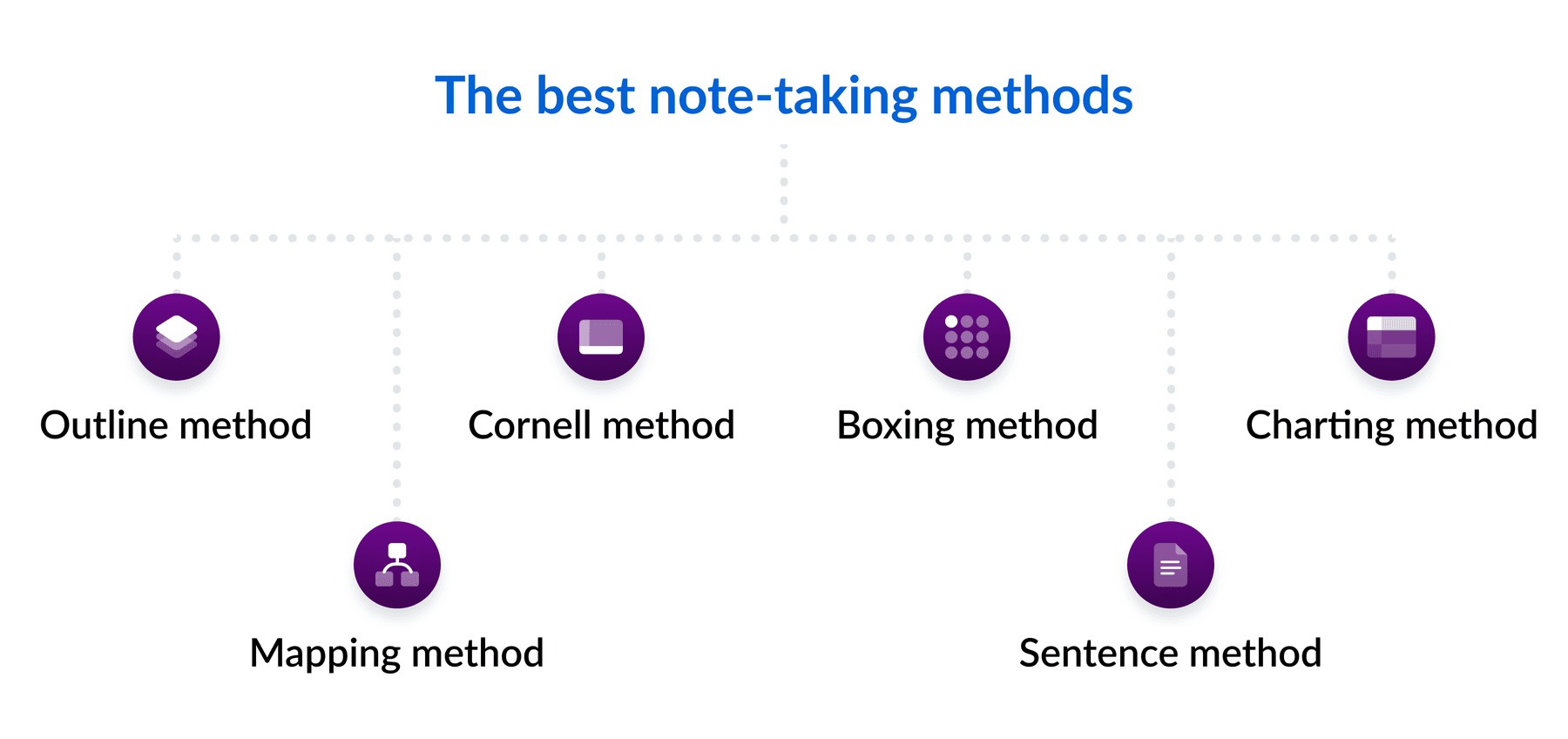
Here are seven of the best types of note-taking. You’ll see how each approach works, where it applies, and what makes it effective or limiting.
1. The outline note-taking method
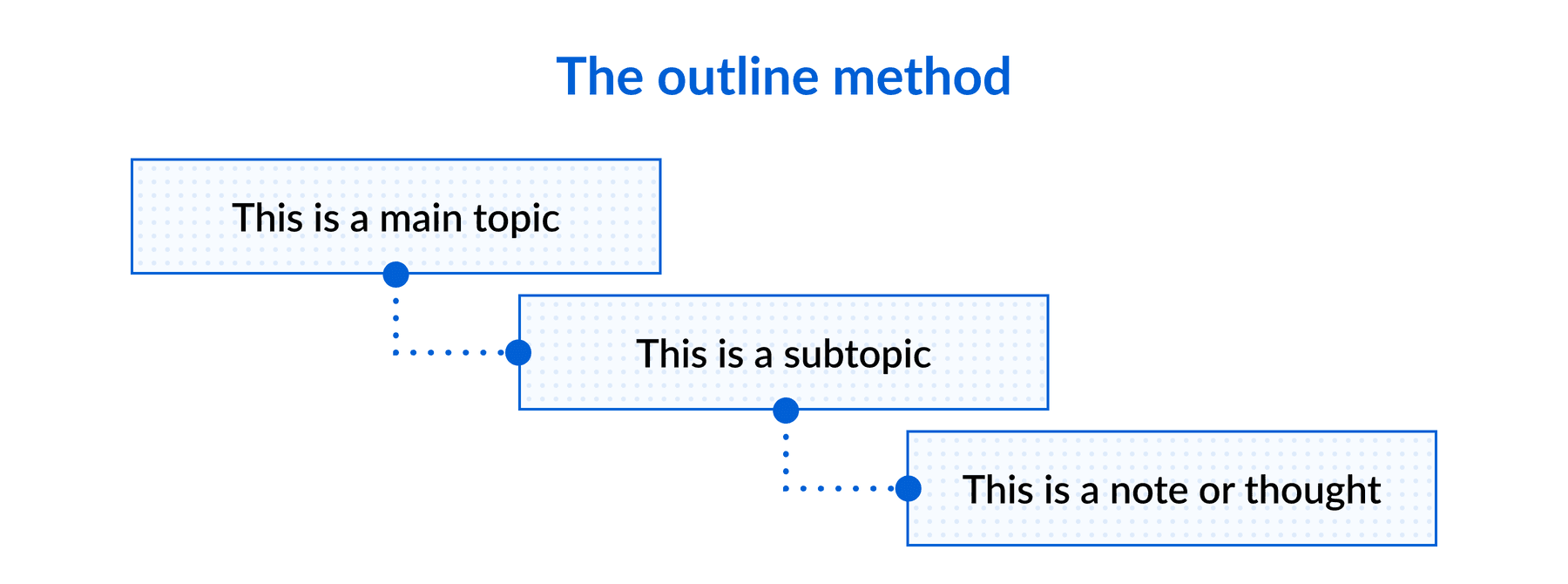
The outline method of taking notes is one of the most intuitive and simplest options on this list. As the name suggests, this method organizes information hierarchically, giving your notes a clear structure and logical flow. Use this strategy by taking notes by hand or digitally. Add headings and subheadings to create a clear structure, especially for complex or lengthy information.
How to take notes with the outline note-taking method
- Title the main topics on the far left of the page
- Use bullet points to add subtopics below each topic, indenting them toward the right
- Expand on each subtopic with supporting facts, notes, or questions, indented even further to the right
When using this note-taking method on paper, you must gauge how much space you need below each subtopic heading for all your notes. With a digital note-taking app, you can always adjust that space as you go. With practice, you can become highly efficient at taking notes this way while keeping them neat and professional.
When to use this note-taking format
This is the best method of note-taking for lectures, presentations, or meetings with a clear agenda. Use it when information naturally falls into topics and subtopics. This method is especially effective for subjects with hierarchies, such as collaborative project planning, as it lets you capture dependencies and responsibilities in an organized way.
Pros
The outline note-taking method enables you to:
- Produce visually clean and organized notes
- Naturally draw connections between topics
- Easily convert outlined notes into summaries or study questions for easier review
Because of how simple and clean the outline method is, it can help you save time when reviewing and learning later.
Cons
The disadvantages of the outline method of note-taking include:
- Clunkiness when trying to add graphs and diagrams
- The requirement that content be innately highly structured
- Lengthier notes, as this method can lead to more detailed sections
Since the outline method requires you to leave space for subtopic notes, you might end up concentrating on filling the gaps instead of focusing on the key content.
2. The Cornell note-taking method
The Cornell method of note-taking was designed for students by Cornell University professor Walter Pauk. Similar to the outline method, Cornell encourages note-takers to keep clean, organized, condensed notes. It’s an especially useful method for revisiting your notes, reviewing what you learned, and consolidating your new knowledge.
How to take good notes with the Cornell method
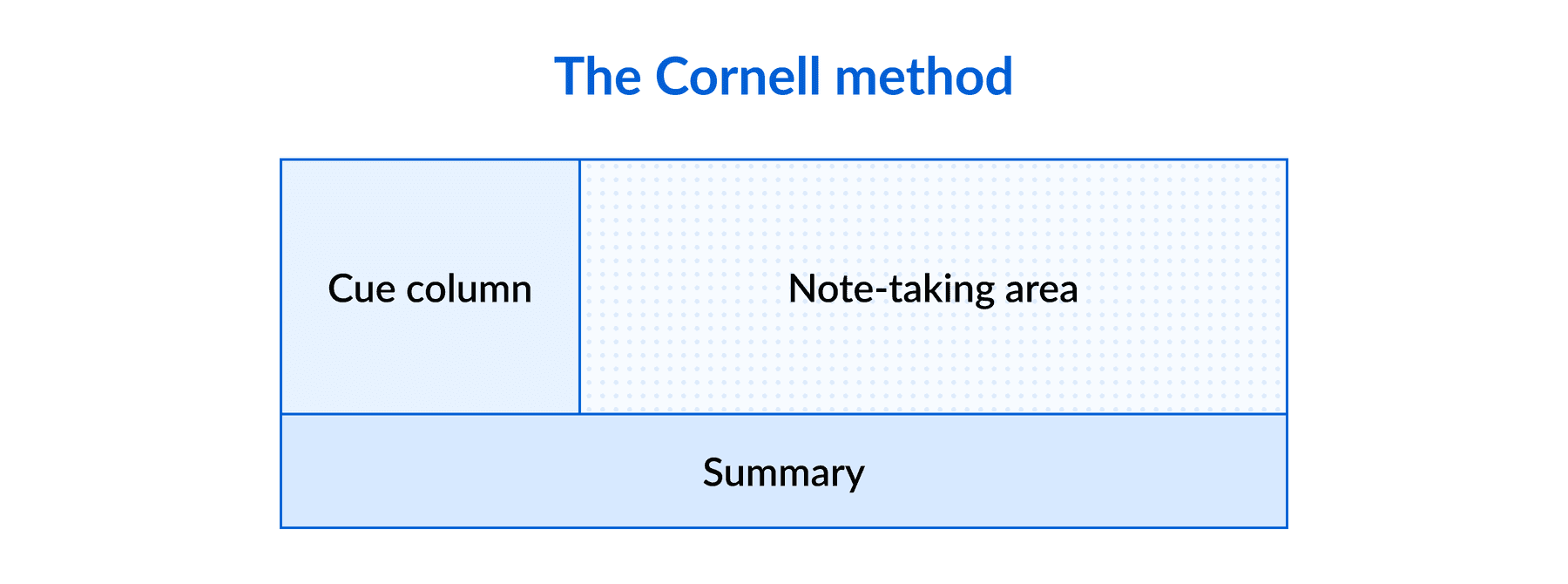
- Divide your page into two equal vertical columns
- Divide the lower one-third to one-quarter of the page from the columns, creating an upside-down T on the page
- Use the left column to cue keywords or ideas and the right side for expanded notes
- Summarize the material in the space at the bottom of the page
While the Cornell method is well-known for handwritten notes, people can also use digital note-taking tools with it. Cornell is also an effective note-taking approach for self-testing, which is a proven way to learn and retain new information.
When to use this note-taking format
One of the best note-taking methods for studying and reviewing notes, the Cornell method works well in classrooms, workshops, and strategy sessions because turning key ideas into short summaries makes them easier to remember.
Pros
The advantages of the Cornell method include letting you:
- Easily reviewand summarize information for better retention
- Keep notes organized and easy to review
- Learn the most important ideas and terms as you take notes
With a heavy focus on summarizing information, the Cornell method helps you save time when reviewing in the future.
Cons
The disadvantages of the Cornell method:
- Not suitable for sessions with heavy terminology and statistics
- Requires summarizing information immediately following the lecture, meeting, or conference
- Contingent on preparing notes pages before the lecture
The Cornell method is typically geared toward abstract subjects with central ideas rather than just a need to memorize dates or definitions.
3. The boxing method of note-taking
The boxing method of note-taking is geared toward those who are visual-dominant learners. This form of note-taking consists of creating boxes or outlines to represent different sections or ideas within your notes.
Similar to mind mapping, boxed notes allow people to see how ideas connect and flow from each other. You can take boxing notes by hand or digitally with the help of visual collaboration tools like a lasso tool, which allows you to easily group items together.
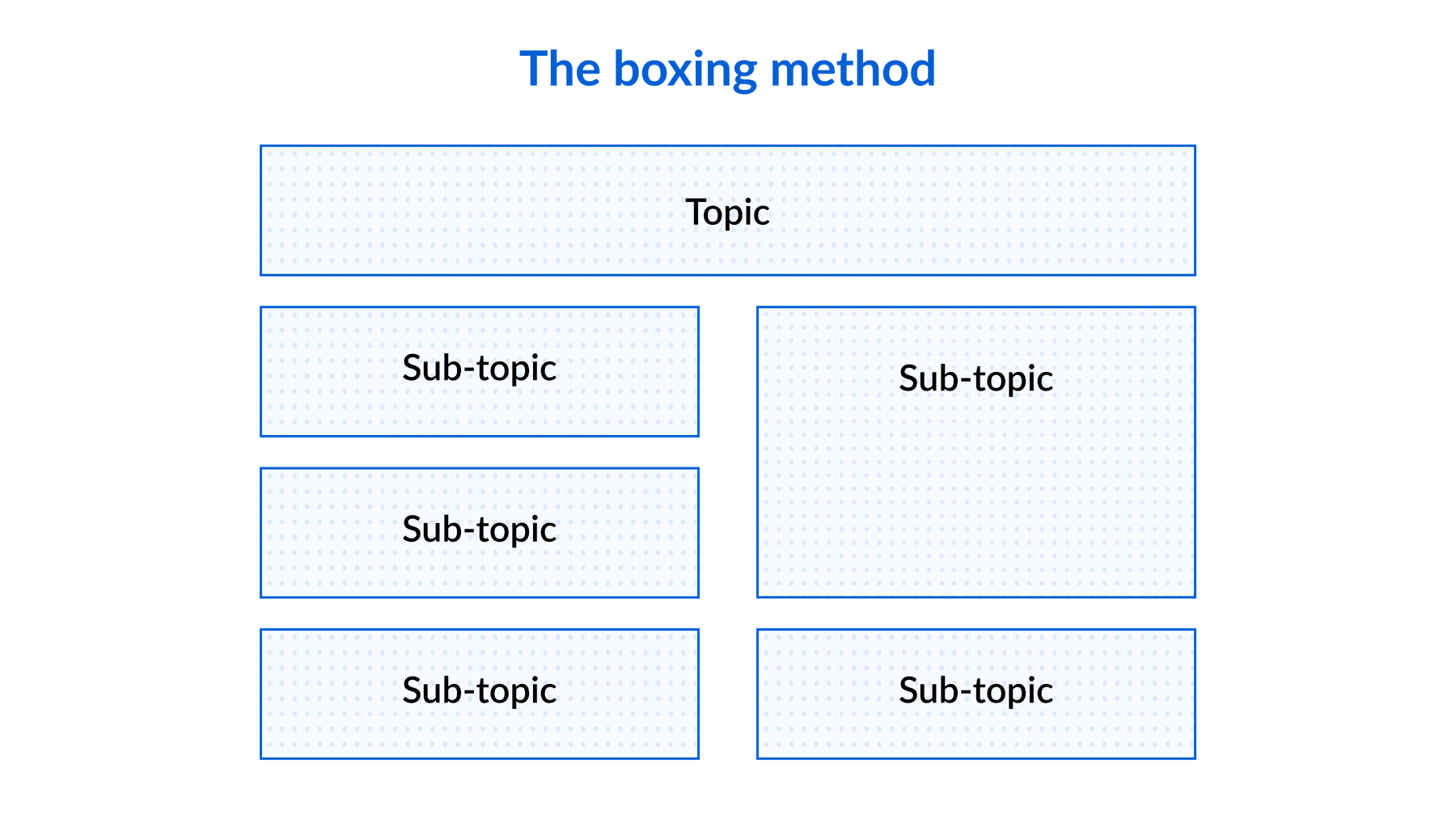
How to take good notes with the boxing method
- Divide the page into two columns
- Add topic headers for each core idea and expand with key points directly below the topic
- After completing notes for each header, draw a box around the entire note section and header
The final page will appear as multiple different-sized boxes neatly containing each core topic and its notes. From there, you can either mind map by drawing connecting arrows between ideas or leave the boxes separate. By grouping topics in clusters, learners can take deeper dives into each subtopic while still understanding how ideas relate.
When to use this note-taking format
This note-taking method is useful when you need to group ideas visually, like brainstorming sessions, design reviews, or workshops with multiple discussion tracks. Best for visual learners who benefit from seeing topics separated into clusters.
Pros
The boxing method of note-taking lets you:
- Easily rewrite notes into boxes, which reinforces retention
- Improve recall with visual representations of ideas and how they connect
- Focus on clarity and brevity due to the need to condense notes into boxes
The boxing method is suitable for people who like to prioritize the aesthetic look of their notes and enjoy being creative.
Cons
Here are the disadvantages of the boxing method:
- Unsuitable for those who want a quick and hierarchical solution
- Requires prior understanding of how ideas connect
- May distract learners with the layout rather than the content
This note-taking method isn’t a good fit for lectures or meetings that focus on a single idea or don’t break down neatly into separate topics.
Explore the best visual brainstorming techniques.
4. The charting note-taking method
The charting method of note-taking is one of the most effective for fact- and data-heavy content. It involves creating a diagram to represent the relationships between different concepts or ideas. When the content is highly structured and uniform, the charting method provides an efficient way to keep up with the material.
Because this method of note-taking is based on facts and keywords, it’s a beneficial way to memorize information and test yourself with recall exercises. It’s less ideal for abstract concepts and ideas.
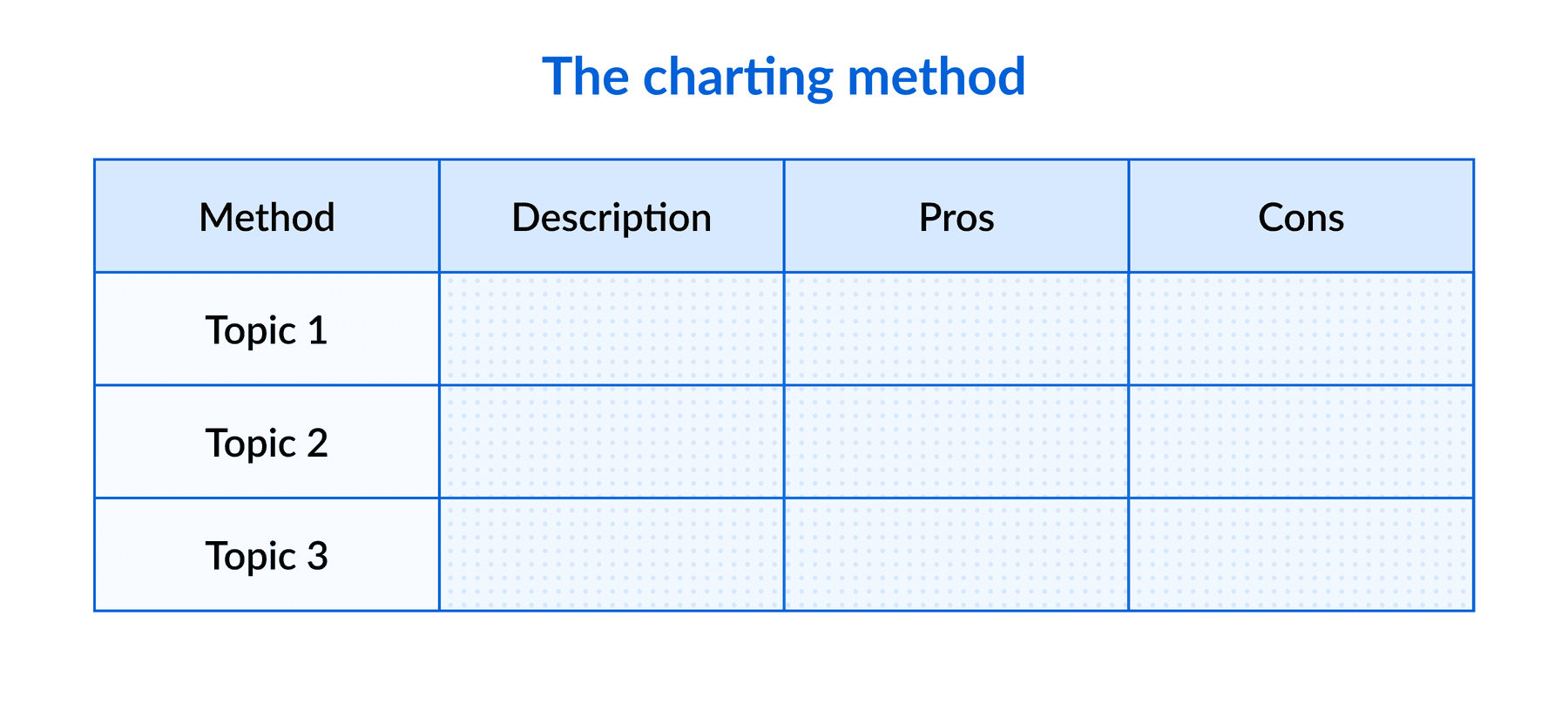
How to take good notes with the charting method
- Determine what topics the lecture will cover
- Divide the page into multiple columns, each with its own relevant keyword
- Record relevant notes under each applicable keyword
You can take charting notes by hand, dividing up your page in a freehand way, or take charting notes digitally using a document management system that integrates with your text editor (or even a spreadsheet application).
When to use this note-taking format
This method of note-taking works well for research sessions or business meetings that involve a lot of statistics, comparisons, or definitions. It’s also useful when you need side-by-side columns for quick reference and memorization.
Pros
The advantages of the charting method of note-taking include the ability to:
- Improve memorization of facts and statistics
- Easily summarize and review content for exams
- Take concise, clean, organized notes
Charting is one of the best note-taking methods for comparing and contrasting similar terms or ideas.
Cons
The disadvantages of the charting method include:
- Incompatibility with sessions that don’t provide the structure beforehand
- Extra time needed to prepare note pages in advance
- Unsuitability for use during lectures or meetings with heavy discussions
If it’s difficult to categorize the content, then it will be challenging to apply the charting method.
5. The mapping method for note-taking
Mapping is one of the favorite note-taking strategies in both the education and business worlds. This visual approach involves creating a diagram or map to represent the relationships between concepts or ideas.
When learning or covering complex, abstract information, mapping helps eliminate the fuzziness around highly involved topics. While visual learners tend to prefer this method, it’s useful for anyone trying to connect big ideas and themes and discover how they flow from each other.
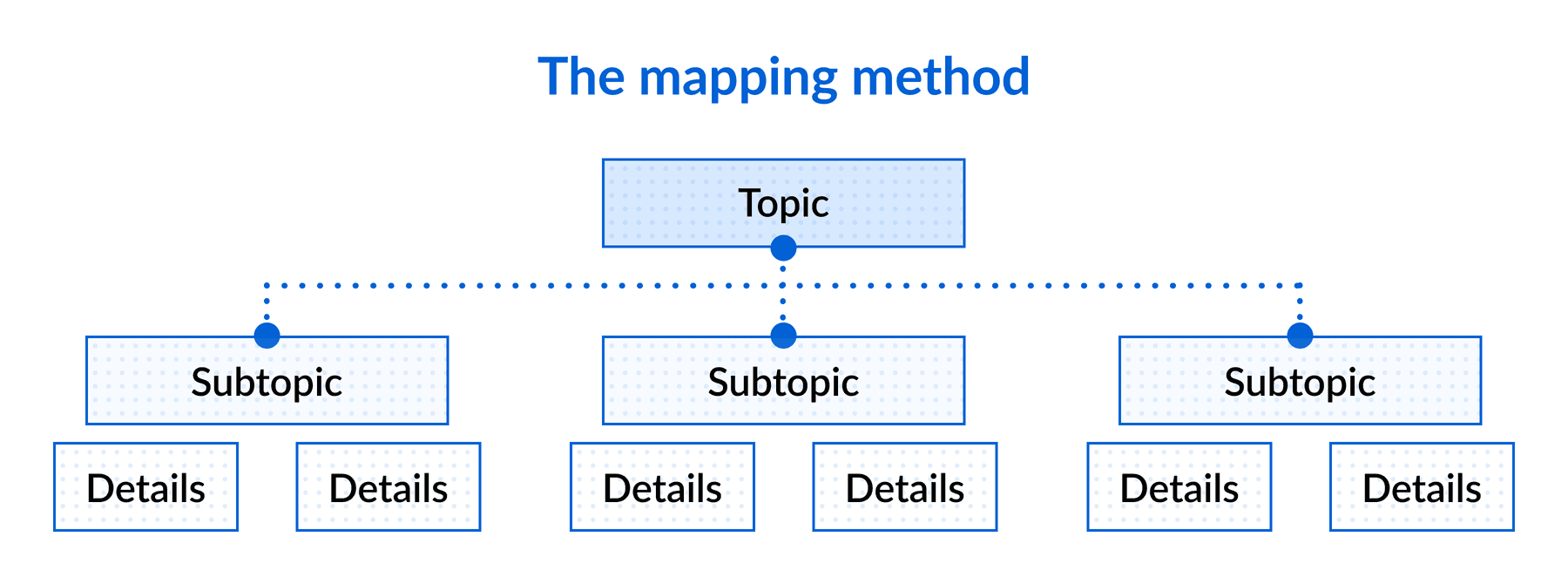
How to take good notes with the mapping method
- Write the main topic at the top of the page
- Create one branch for each subtopic, stemming from the topic before it
- Continue dividing the subtopics downward and outward on the page
- Add relevant notes directly under each subtopic
The final result should be a web or hierarchy of information, similar to a flow chart. This note-taking method allows you to be creative, using colors or symbols to represent how ideas compare or relate. You can map notes by hand or digitally.
When to use this note-taking format
Best for complex and interconnected content, particularly when hand-writing on a white board or large piece of paper. You can use this method well when exploring broad concepts, such as strategy development, science topics, or brainstorming big ideas. Mapping helps when you need to visualize how themes connect rather than just list them.
Pros
The advantages of the mapping method of note-taking include letting you:
- Effectively review and study through reorganizing original notes into a map
- Learn deeply and understanding complex topics
- Lean into visual learning and memory recall
The mapping method is visually appealing and a great way to rewrite your original notes during a study, meeting, or review session.
Cons
The mapping method also has some limitations:
- Space is constrained, requiring careful placement to ensure all notes fit within a single map
- Notes need frequent revision to prevent confusion
- Mapping takes up time if relationships between ideas aren’t clear to the note-taker
The mapping method is not always ideal for taking your first round of notes since it can be difficult to gauge how much space you will need.
6. The sentence method of note-taking
The sentence method of note-taking is the simplest and least structured strategy. It involves writing each idea as a complete sentence. When the content itself is not outlined, then the sentence method can help give your notes a slight structure that the topic is missing.
The sentence method is particularly useful for fast-paced conferences, workshops, or meetings that cover a lot of content. It works for either handwritten or digital notes.

How to take good notes with the sentence method
- Record content, such as terms, facts, or ideas in sentences
- Move to the next line for each new point
- Number each new sentence as you progress through the content
People who have nothing prepared ahead of a lecture or session tend to jot down notes in sentence form, making this one of the best methods for taking notes, as it's natural and straightforward.
When to use this note-taking format
A go-to for fast-paced, unstructured sessions where information flows quickly and doesn’t follow a neat outline, this method often works best for live events and meetings where capturing as much as possible matters more than organization in the moment. Later, you can restructure into another format.
Pros
The advantages of the sentence method include helping you:
- Easily capture key information without missing anything
- Create clear chronological organization of content
- Set up to later convert notes into other formats
The sentence method is a spontaneous way to keep notes without the need for advanced preparation.
Cons
The disadvantages of the sentence method include:
- Lack of the visual structure that many people need
- Difficulty in reviewing later if the material appears disjointed
- Incompatibility with content with graphs and charts
This method of note-taking is often a last resort when it’s impossible to prepare for a meeting or lecture and when the content is too all-over-the-place to slot into any of the above methods.
7. Zettelkasten method
Zettelkasten, which means “slip box” in German, is the best note-taking method to build your own personal knowledge base over time. Instead of writing long pages of notes, you break things down into small, focused notes, each one covering just a single idea. Then, you connect those notes together, creating a web of related thoughts.
The Zettelkasten method helps you generate new insights by showing how different ideas relate. Originally created by sociologist Niklas Luhmann, this method is now a favorite among researchers, writers, and anyone who works with big, complex ideas.

How to take notes with the Zettelkasten method
- Write each note on a separate card or digital memo, focusing on one idea per note
- Give each note a unique identifier or tag for easy retrieval
- Link related notes together by referencing their identifiers or tags
- Organize notes into clusters of related topics, building a network of ideas
You can use paper index cards, but digital note-taking tools make it easier to search and connect your notes over time.
When to use this note-taking format
The Zettelkasten method is best for long-term projects, research, and writing. It works well when you want to develop ideas gradually, explore connections between concepts, and revisit material over time.
Pros
The advantages of the Zettelkasten method include allowing you to:
- Deeply understand a topic by connecting ideas rather than isolating them
- Better manage long-term projects such as books, research papers, or creative work
- Create a personal knowledge system that strengthens as you add to it
Cons
The disadvantages of the Zettelkasten method include:
- Slower progress due to time needed to set up and maintain notes
- Steeper learning curve for users unfamiliar with structured note systems
Initial overwhelm because benefits grow over time, not immediately
Handwritten vs. digital notes: Which should you choose?
Along with choosing your preferred note-taking strategy, there’s another key decision: the choice between writing notes by hand or capturing them digitally. For some people, the debate between handwritten and digital notes is contentious, with some learners having a clear preference for one method over another.

The choice between handwritten vs. digital notes comes down to what works best for you. While one option might feel cleaner or faster, the real priority is choosing the style that helps you learn, remember, and review more effectively.
Handwritten notes
There are some factors to consider when handwriting notes. A study by the Norwegian University of Science and Technology analyzed the brain activity of young adults and 12-year-old children and found that handwriting with a digital pen activated brain regions associated with memory and learning more effectively than typewriting.
It’s also easier to be distracted by other applications when taking notes on a device. However, handwriting notes may prove too time-consuming for fast-paced work or study environments.
Digital notes
Compared to handwritten versions, digital notes are a fast and clean method for efficient note-taking. They allow you to add graphs, charts, and clipped images, while some options offer AI tools so you can write a summary in seconds to streamline your learning process. Digital notes are easy to share and also easy to go back and edit later.
However, digital note-taking may encourage transcription rather than deep learning, as many students focus on typing every word rather than actually paying attention to the content.
There is also a popular hybrid approach. You can take initial notes by hand and then transcribe them to a digital version, cleaning them up in the process. This allows you to convert your original handwritten notes into the best method for the final version.
Tips for effective note-taking
Regardless of your chosen strategy, some general note-taking tips apply to everyone. The following best practices can help you take your learning to the next level.
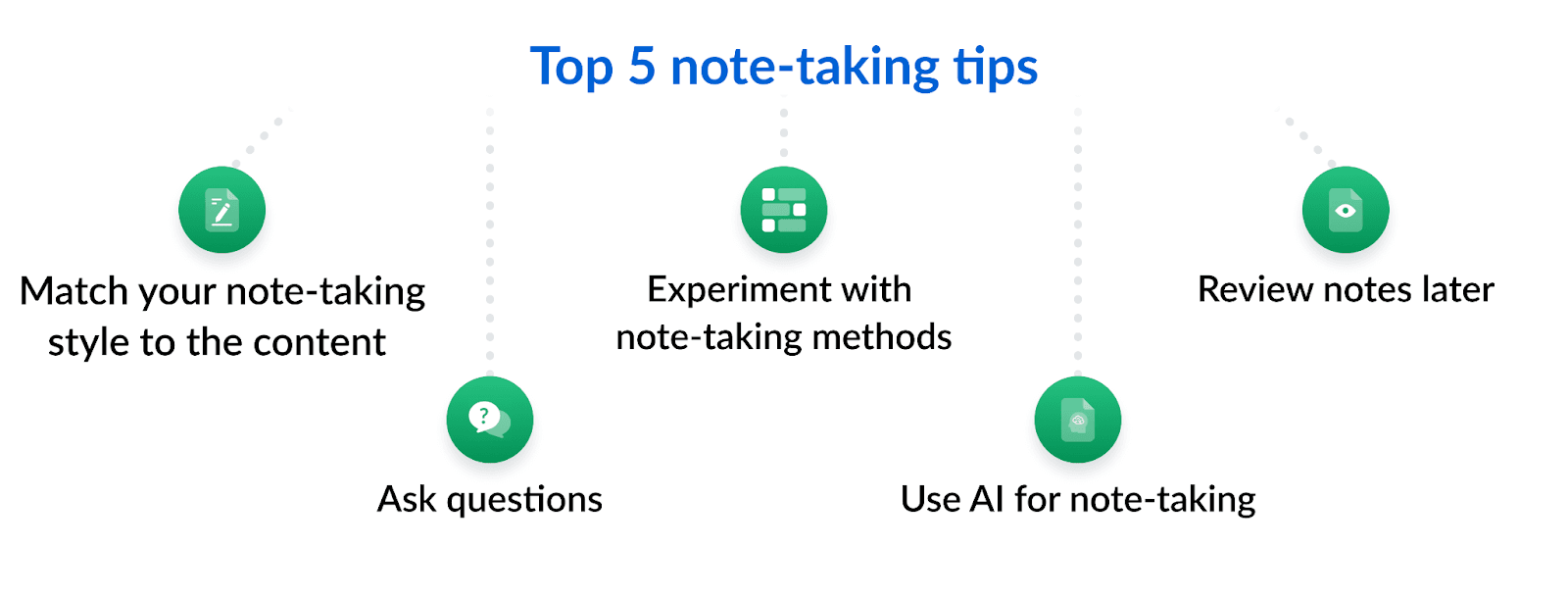
Match your note-taking style to the content
One of the best note-taking tips is to adjust how you take notes depending on whether you’re dealing with big ideas, fast details, or heavy data. Certain methods are more suitable for various types of content. For example, you probably wouldn’t want to spend an entire in-person meeting typing notes on your phone, but using a notebook or laptop can help you stay engaged while still capturing key points.
Some content focuses on big ideas, while other content is fact-based, focusing on data or details. Knowing what kind of content you’re dealing with makes it easier to pick a note-taking method that matches.
Experiment with note-taking methods
Your ultimate goal should be to find the most applicable method for the type of content you’re dealing with. To discover the best one, you may need to experiment with different styles. By comparing the pros and cons of each method, you’ll eventually find how to take effective notes your way.
Keep in mind that it’s also possible to combine multiple methods of taking notes. For instance, you can have one page for terms and facts and another page for mapping ideas and concepts. Applying different ideas helps you come up with a custom system that you can refine over time.
Review notes later
Effective learning is more than just taking notes. What you do with your notes after a learning session is crucial to move your newly acquired knowledge from the surface to the deeper parts of your memory.
Things you can do later:
- Schedule a block of time to review your notes
- Create a summary or overview of your notes
- Test yourself on the new material
- Write down questions you have
- Highlight information that’s still unclear
By taking the time to follow up and review your notes later on, you increase your chances of performing well and retaining the information.
Ask questions
Effective note-taking isn’t sufficient for learning and retaining information. You must also engage with the content and test yourself, finding your knowledge gaps and filling them with missing information. As you take notes, write down questions to ask later. This practice helps clarify core topics and strengthen your understanding.
Additionally, spending time with instructors, lecturers, and subject-matter experts helps you deepen your knowledge in areas of genuine interest to you. By asking questions, you have the opportunity to assess your own thinking. You’ll also identify where you can improve your grasp of the material.
Use AI for note-taking
AI content generation is one of the top uses of AI tools in workplaces. With AI, you can write, organize, and categorize notes instantly.
Need inspiration on how to use AI for note-taking? Explore these ideas.
- AI summarization: LLMs can transform lengthy meeting transcriptions into clear briefs, highlighting the most critical information and saving you time on review
- AI content discovery: Searching through your notes becomes faster and more intuitive with AI, as the technology understands context and relevance, providing more accurate results
- Content retrieval: When integrated with methodologies like retrieval-augmented generation (RAG), AI tools can locate files or specific key points from your notes, ensuring that important details don’t get overlooked
See how AI data extraction helps you uncover more insights from your notes.
Leverage Box as your note-taking platform
Whether you take digital notes exclusively or like to transfer your handwritten thoughts to digital later on, you’ll need to organize your material in a secure and user-friendly way. That’s where Box, the leading Intelligent Content Management platform, comes in.

Check out the top ways Box can help enable effective note-taking.
Box Notes
Let Box Notes be your go-to source for high-quality, user-friendly note-taking. Write down documents quickly and efficiently in real time, or transcribe your notes the way you want them to look. With Box, you can create convenient templates to use for each course or meeting, saving you time.
You can also embed videos and other media within a Box Note, add comments for collaborative note-taking, and integrate Box AI to generate text or summarize extensive documents, ebooks, or presentations in a few seconds.
Integrations
Optimize your annotations with Box Integrations. With over 1,500 different applications available, you can connect your favorite productivity, studying, or editing programs to Box.
Rather than re-inventing your current note-taking system, seamlessly integrate it into your Box workspace for more efficient learning.
Collaboration
Streamline your study sessions or group projects by collaborating with Box. Using Box Notes or any other file type, work together with your team members on a single project in real time.
Use Box as a central workspace to edit, review, and share notes. Assign tasks and add comments to make sure everyone is on the same page.
Maximize your note-taking efforts with Box
Box, the leading Intelligent Content Management platform, empowers you to keep all your notes in one central place so, you always have the material you need at your fingertips.
Explore all the ways that Box can help you improve your note-taking methods. Contact us today.
Frequently asked questions
What does note-taking mean?
Note-taking is capturing and organizing information so you can understand it and use it later. It’s about selecting what’s important, putting it into your own words, and creating a record that makes sense to you.
Good note-taking techniques give you a tool for review, a way to spot gaps in your understanding, and a personal resource you can return to when you need to recall details or big ideas.
What are the most common mistakes in note-taking?
The most common mistakes in note-taking include:
- Using the wrong note-taking style: Choosing a method that doesn’t fit the material can make your notes hard to understand or leave out important points
- Copying too much: Writing everything word for word without processing the meaning makes it harder to learn
- Not reviewing: Skipping the step of summarizing, testing yourself, or revisiting notes reduces how much you retain
- Over-focusing on format: Spending too much time on perfect layouts can distract from capturing the actual content
Avoiding these mistakes helps you get more out of your note-taking styles.
What are examples of good note-taking strategies?
Examples of good note-taking strategies include:
- Listen for key ideas, not every word: Focus on the main points and supporting details instead of trying to write everything down
- Leave space for additions: Skip lines or leave margins so you can add clarifications and examples later
- Highlight important points: Use symbols, underlining, or colors to make the most critical information stand out
- Review soon after the session: Go back over your notes the same day, add summaries, and fill in gaps before you forget
- Categorize documents for easy retrieval: Keep notes in a system (whether folders, notebooks, or digital apps) that makes them easy to find later
These note-taking strategies work across different methods and formats, helping you take notes that are not just neat but also useful for learning and retention.
What is the best way to take notes?
The best way to take notes depends on:
- Your goal for the notes: If you need quick recall, short bullet points or charts may work best, and if you’re building a long-term knowledge base, methods like Zettelkasten provide more value
- Your personal style: Some people remember more when writing by hand, while others value the speed and searchability of digital notes
- The type of content: While structured content (like agendas or textbooks) pairs well with outlines or charts, unstructured content (like brainstorming sessions) calls for mapping or boxing
Ultimately, the best note-taking program for you is the one that will encourage you to learn and retain information as effectively as possible.