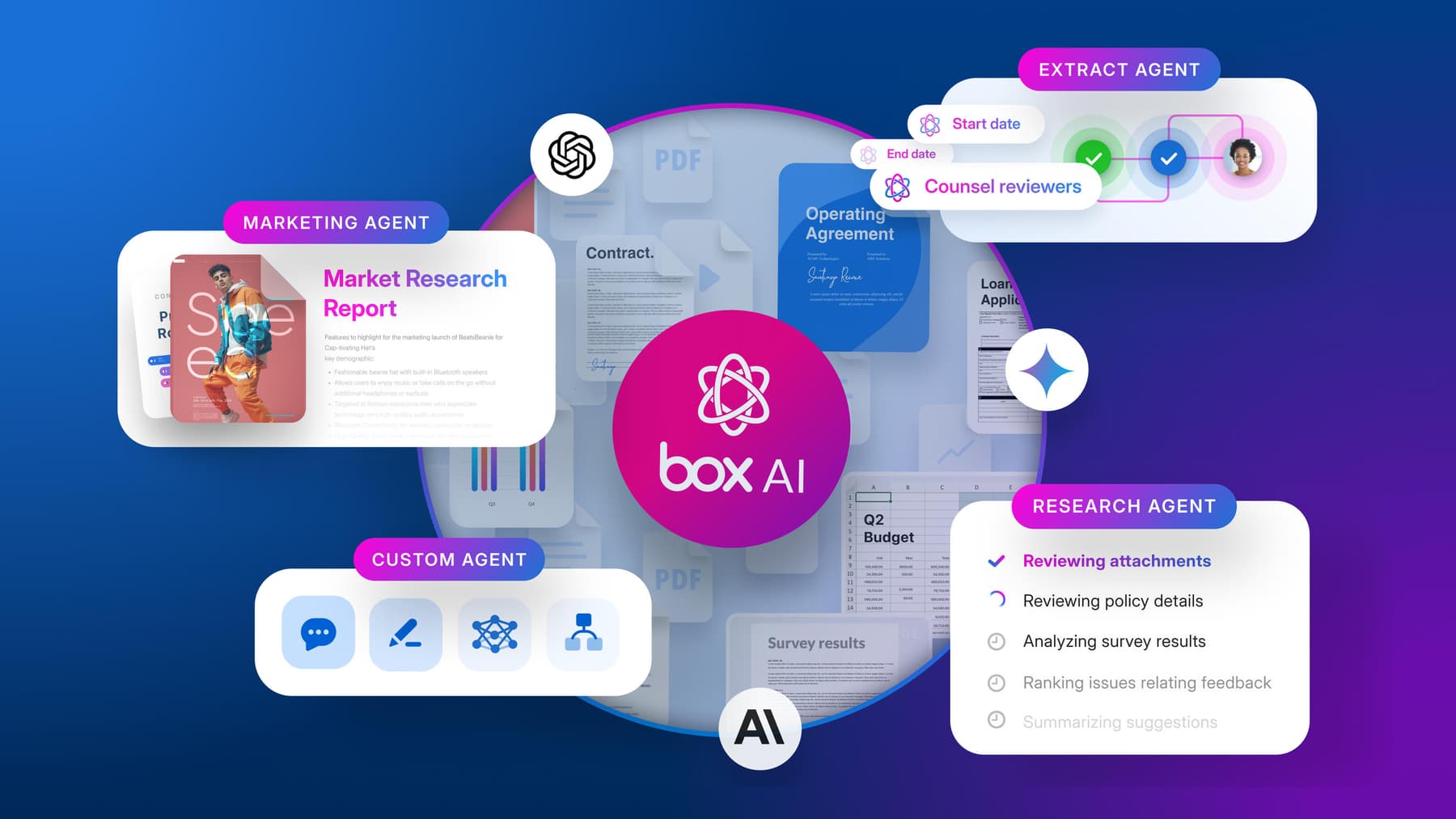
This playbook is a two-part guide designed to help you turn enterprise AI potential into real business impact. Part I covers the foundations: You’ll discover what AI agents are, how they’re structured, and how to identify the right use cases for your organization. Part II is hands-on: You’ll learn how to design, configure, and deploy Agents in Box AI Studio, from crafting instructions and grounding it in your content to testing and scaling across teams. Together, these two sections provide you both the why and the how of building AI Agents that work securely, reliably, and at enterprise scale.
Enterprise AI agents work with company content by securely retrieving permissioned files, applying a defined objective and instructions, reasoning over that content with approved AI models, and then taking actions such as summarizing, extracting, classifying, generating, routing, or triggering workflows. For enterprise content management, an AI agent is a purpose-built assistant that can securely understand, act on, and automate work across governed business content — contracts, policies, reports, presentations, and records.

Part I:
Introduction: From AI tools to AI teammates
Key takeaways for enterprise teams
AI agents are most effective when they are grounded in approved company content rather than disconnected from enterprise systems
Permission-aware retrieval ensures agents use only the content each user is authorized to access
The strongest use cases combine content understanding with action: summarization, extraction, risk identification, Q&A, and workflow automation
Governance, auditability, and human oversight are essential for scaling AI agents across departments.
The nature of work is changing. The old model of search-and-click — endless digging through files and folders — is giving way to a new paradigm: ask-and-create. But to power this shift, AI needs access to your most valuable asset: your enterprise content.
The challenge is that most of this critical information is dark data locked away in unstructured formats like contracts, presentations, research reports, and videos. It’s passive, hard to search, and untouched by automation.
Box AI, the secure native AI layer built into our Intelligent Content Management platform, is designed to solve this exact problem. It transforms your unstructured content into actionable intelligence.
With Box AI, you can:
- Work smarter in AI-powered spaces that unify search, summarization, and creation
- Enable seamless data extraction from your content living in Box
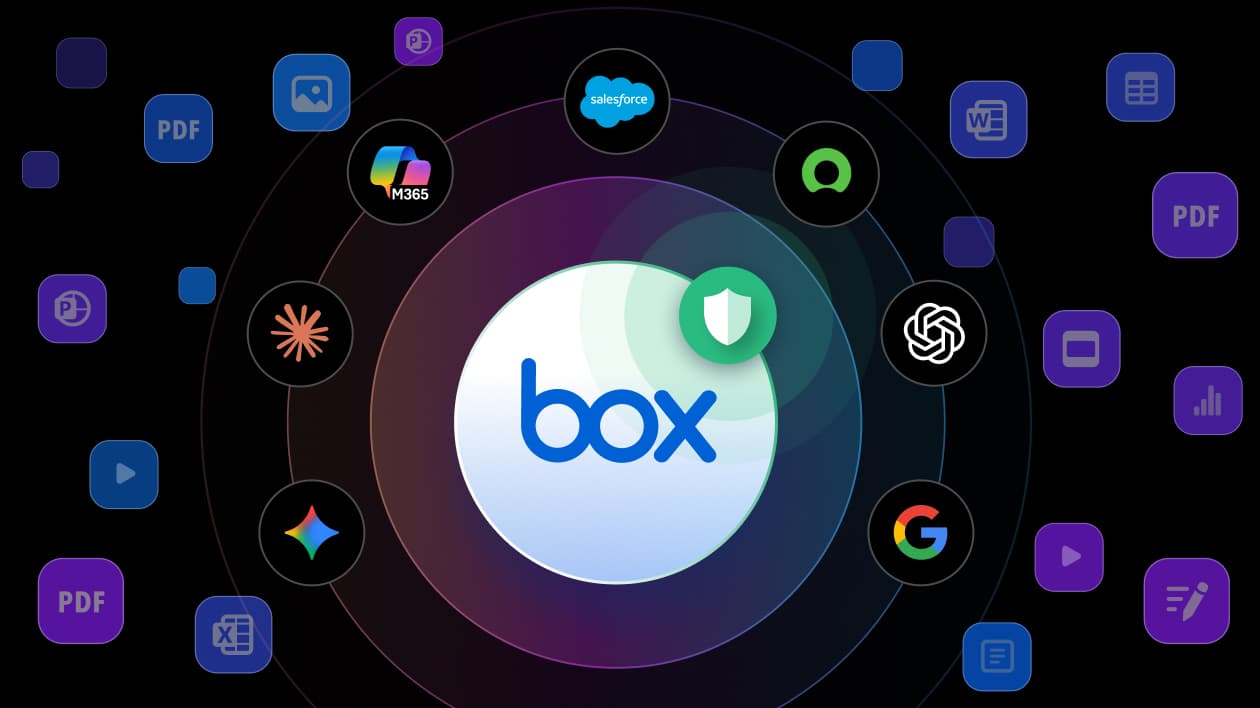
- Bring intelligence to your entire tech stack with a secure AI platform layer that extends to all your apps
Finally, you can bridge the gap between your data and your business outcomes. It’s all possible with specialized AI Agents in Box AI Studio.
What is an AI agent for enterprise content management?
An AI agent for enterprise content management is a secure, task-specific AI system that uses company content to answer questions, generate insights, automate document tasks, and trigger workflows — while staying within enterprise permissions, compliance, and audit requirements.
In practice, these agents help turn static enterprise content into active work. An AI agent can summarize a long policy, extract obligations from a contract, compare versions of a proposal, answer questions across research reports, tag a file with metadata, identify risks, or route a document for review. The agent combines a model, a business objective, instructions, tools, secure content access, and governance controls to produce useful outputs without bypassing enterprise security.
How do enterprise AI agents work with company content?
Enterprise AI agents work with company content by combining secure content access, retrieval, reasoning, instructions, and action.
The agent connects to approved content repositories — documents, PDFs, presentations, spreadsheets, contracts, research reports, and videos — retrieves only the information the user is authorized to access, applies the agent's objective and instructions, and uses AI models to summarize, compare, extract, classify, or generate content-specific outputs.
In practice, this means a company can ask an AI agent to review contracts for risk, summarize long reports, extract obligations, prepare sales briefings, answer policy questions, or surface insights across a controlled set of files. The agent does not need every document copied into a separate AI tool; instead, it works inside a governed content layer where permissions, metadata, retention rules, and audit trails already exist.
For enterprise teams, the value comes from turning passive, unstructured content into active business intelligence. A well-designed AI agent can understand the context of company content, follow role-specific instructions, and trigger next steps in a workflow while keeping humans in control for sensitive or high-impact decisions.
Chapter 1: The anatomy of a Box AI Agent
Every Box AI Agent is designed with purpose, powered by advanced models, and grounded in enterprise content. Here’s what makes them effective and trustworthy:
- Thinks with the best models
- Agents use state-of-the-art foundation models from OpenAI, Anthropic, or others, orchestrated by Box
- The right model is matched to each use case to maximize accuracy, reasoning, and business alignment

- Built for a specific goal
- Every Agent starts with a clear objective, from summarizing a 90-page report, to extracting contract clauses, or identifying compliance risks
- This ensures output is targeted, relevant, and actionable for your business needs

- Follows a thoughtful plan
- Agents are guided by structured instructions: step-by-step logic that defines how to achieve a goal
- Instructions can specify format, tone, or workflows, ensuring consistent results across teams and use cases

- Uses capabilities and tools to take action
- Beyond reasoning, Agents act, applying skills like summarization, classification, and Q&A — and invoking Box-native or external APIs
- They go beyond understanding content to generate outcomes directly in the flow of work

- Engages securely with your content
- Agents are grounded in your enterprise content and use secure, permission-aware retrieval
- They only access what a user is allowed to see, always operating within Box’s security, compliance, and governance boundaries.

- Transparent and governed by you
- Every Agent is designed for enterprise oversight with visible and auditable instructions, actions, and outputs
- Human control and governance ensure trust, accountability, and responsible use at scale
6 Benefits of Box AI Agents
Any AI model can provide an answer. Box AI Agents deliver trusted, scalable AI experiences, built on an enterprise-grade foundation.
- Secure by design: Box AI Agents have governance baked in, automatically inheriting the granular permissions and access policies of Box
- Grounded in truth: Turn dark data into decision-ready intelligence with AI Agents grounded only in your specified content, virtually eliminating hallucinations and ensuring answers stay based in your business reality
- Contextually aware: Box AI is contextual, meaning AI Agents leverage file classifications and metadata to ensure appropriate actions (for example, they understand the difference between a “Draft proposal” and an “Executed contract”)
- Action-oriented: Agents go beyond chat, with capabilities to Ask, Summarize, and Generate; they turn passive content into active business processes
- Governable and auditable: Every agent’s activity is logged, providing a clear audit trail, and you get full control over who can build, use, and modify agents
- Low-code, high-impact: With AI Studio, admins and business users — not just developers — can create the custom agents they need, accelerating time-to-value
Chapter 2: Inside Box AI Studio
If AI Agents are the “what,” Box AI Studio is the “how.” It’s the secure, enterprise-grade canvas where you design, test, and launch custom AI Agents that work directly with your content in Box. Think of it as a workshop. You bring your business challenges and goals, and AI Studio gives you the tools to turn them into real, functioning Agents.
At its core, AI Studio is designed to bridge two worlds: the sophistication of large language models (LLMs) and the day-to-day needs of enterprise teams. It provides the scaffolding to create Agents that are not just clever with text, but truly useful in workflows — whether that’s summarizing a 90-page engineering report, extracting obligations from contracts, or generating a year-end strategy deck.
Box AI Studio empowers teams to:
- Choose the right intelligence. AI Studio gives you access to frontier, state-of-the-art models and lets you test them directly against your use case. You can refine instructions, and decide which model (or combination of models) delivers the best reasoning, accuracy, and output for your business.
- Ground AI Agents in your content. Agents in AI Studio don’t just generate answers out of thin air. They’re securely grounded in the content you already have in Box — documents, presentations, spreadsheets, PDFs — respecting permissions at every step. That means an Agent can only access what a given user is authorized to see, ensuring governance never gets sacrificed for speed.
- Design with purpose. Every Agent is built around a clear, specific goal: summarization, Q&A, classification, risk identification, or content generation. AI Studio provides a guided way to set that goal, so an Agent’s purpose is always tied to tangible business outcomes.
- Shape the reasoning. Instructions are where the magic happens. AI Studio lets you write and refine step-by-step logic, output formats, and tone, essentially teaching your Agent how to think. Over time, you can iterate to get more precise, consistent results across different users and use cases.
- Extend custom Agents via AI APIs or the Box MCP server. Beyond core reasoning, Agents can also be used via Box AI APIs or external APIs, giving them the power not just to analyze content, but to trigger actions and automate tasks.
- Experiment, then scale. AI Studio is designed for iteration. Admins can prototype Agents, test them with real content, and quickly see what works. Once refined, those Agents can be deployed across the enterprise — ready to augment teams wherever content lives.
AI Studio isn’t about abstract AI experiments. It’s about creating the kinds of Agents that move real work forward, grounded in the security and compliance Box is known for. It’s where enterprise ideas — from “How do we speed up contract review?” to “How do we prepare sales teams with the right insights before meetings?” — become action.
Chapter 3: Spotting the right use cases for AI Agents
Not every task requires an Agent. The best candidates are those where AI can add speed, consistency, and scale.
Prioritize use cases where teams repeatedly search, read, compare, summarize, extract, or route content across large volumes of company files.
Here are a few ways business leaders can identify where Agents will deliver real value:
Look for repetitive, knowledge-heavy tasks
If your team spends hours every week reviewing reports, scanning contracts, or pulling insights from large files, an Agent can take on the heavy lifting. For example, a legal team can automate first-pass NDA reviews to flag risky clauses before lawyers step in.Target moments where speed matters
Deadlines, client meetings, quarterly reviews, regulatory filings — these are high-pressure moments where instant access to insights can change outcomes. Imagine a sales manager prepping for a client meeting with a tailored briefing assembled in minutes.Follow the content trail
Agents are only as good as the content they can access. Start with workflows where your source material (plans, playbooks, transcripts, contracts, datasets) already lives in Box. A marketing leader drafting the FY27 strategy could ask an Agent to pull insights from prior campaigns, customer feedback, and market research in one place.Focus on decisions, not distractions
The best use cases free your people to make higher-level calls. Instead of combing through 200 pages of trial data, imagine getting a one-page summary of research outcomes with key risks and recommendations (agents aren’t replacing judgment; they’re clearing the noise).Start small, expand naturally
You don’t need a massive rollout. Pick one workflow that’s already painful, pilot an Agent there, then expand to adjacent teams. The right use cases will spread themselves: Once a finance team uses an Agent to generate monthly reporting packs, other departments will want in.
The takeaway: the “sweet spot” for Agents is where human expertise meets high-volume, high-stakes content. That’s where AI can amplify your team’s impact without introducing risk or disruption.
With the fundamentals in place, like understanding what AI Agents are, how they’re structured, and how to spot the right opportunities, you now have the foundation to start building an Agent in AI Studio.
In Part II of this playbook, we’ll show you the “how” with a practical walkthrough of shaping instructions, grounding your Agent in content, testing outputs, and scaling securely across your business.
Enterprise AI agents FAQs
How do enterprise AI agents work with company content?
Enterprise AI agents work with company content by securely retrieving approved files, applying a defined business objective, reasoning over relevant information, and then producing an output or taking an action. They can summarize reports, answer questions, extract clauses, classify files, generate drafts, or trigger workflows while respecting user permissions and governance rules.
What makes an AI agent different from a chatbot?
A chatbot responds to prompts in a conversational interface. An AI agent is more purpose-built: it has a defined goal, instructions, access to specific content, and capabilities that can take action. In enterprise settings, agents can be designed for contract review, sales enablement, financial analysis, compliance review, research, or customer support.
Why does enterprise content matter for AI agents?
Enterprise content contains the context AI needs to produce relevant answers: contracts, policies, presentations, research, customer files, meeting notes, project plans, and reports. Without secure access to this content, AI agents produce generic answers. With governed access, agents provide outputs grounded in the company's actual business information.
How do AI agents stay secure when using company content?
Secure AI agents use permission-aware retrieval, so they only access content a user is allowed to see. They also operate within enterprise controls for authentication, metadata, data classification, retention, audit logs, and compliance review — allowing teams to scale AI without exposing sensitive information.
What types of company content can AI agents analyze?
AI agents can analyze many types of enterprise content, including PDFs, Word documents, spreadsheets, presentations, contracts, policies, images, transcripts, research reports, and other unstructured files. The best use cases depend on whether the content is high-volume, knowledge-heavy, and tied to a repeatable business process.
What are the best use cases for enterprise AI agents?
Strong use cases include first-pass contract review, policy Q&A, sales briefing generation, research summarization, compliance risk identification, invoice or document extraction, employee onboarding support, and monthly reporting. These workflows benefit from speed, consistency, and secure access to trusted content.
How should companies choose where to start with AI agents?
Companies should start with a painful, repeatable workflow where employees spend significant time searching, reading, summarizing, extracting, or routing content. The best pilot use cases have clear source content, measurable business outcomes, human review checkpoints, and a path to expand across related teams.
How do AI agents reduce hallucinations?
AI agents reduce hallucinations when they are grounded in specific, permissioned content and instructed to answer from that source material. Clear instructions, defined output formats, retrieval from trusted files, confidence checks, and human review for sensitive decisions all help keep responses accurate and accountable.
What governance controls do enterprise AI agents need?
Enterprise AI agents need controls for access permissions, admin configuration, approved models, content scope, logging, audit trails, data retention, human review, and usage monitoring. These controls make it easier to scale agentic AI while maintaining security, compliance, and accountability.
Can business users create AI agents without developers?
Yes. Low-code AI agent tools allow business users and admins to create agents by defining objectives, instructions, content sources, and output formats. Developers may still help with advanced integrations, APIs, and governance, but many common workflows can be configured by the teams closest to the business process.
What is an AI agent for enterprise content management?
An AI agent for enterprise content management is a purpose-built AI assistant that works with a company's governed files and workflows. It can search, summarize, classify, extract, generate, and route content while following defined instructions, user permissions, metadata, retention rules, and audit requirements.
How is an enterprise content management AI agent different from a general AI assistant?
A general AI assistant can answer broad questions, but an enterprise content management AI agent is grounded in approved business content and configured for a specific workflow. It uses company files, follows role- or task-specific instructions, and operates within security and governance controls.
What can AI agents do inside an enterprise content management platform?
AI agents can summarize documents, answer questions across files, extract contract clauses, classify records, apply metadata, identify risks, generate drafts, route documents for approval, and trigger follow-up actions in connected business systems.
Why should AI agents be grounded in enterprise content?
Grounding agents in enterprise content ensures answers are based on the company's actual documents, policies, contracts, reports, and records. This improves relevance, reduces generic responses, and helps teams make decisions from trusted business context.
How do AI agents support governed content workflows?
AI agents support governed workflows by using permission-aware retrieval, approved instructions, metadata, audit logs, human review steps, and workflow rules — allowing teams to automate content-heavy tasks without losing control over sensitive or regulated information.