While claims systems of record are faster and more sophisticated than ever, the unstructured documents feeding them are dragging the entire operation to a crawl. Manual document handling can consume 60–70% of the insurance claim cycle and cost large carriers more than $100 million a year, according to Box analysis of carrier benchmarks.
Generally speaking, 90% of enterprise data is unstructured. In insurance specifically, that 90% is where the actual claims work gets done. The data that drives claims decisions arrives as documents: loss runs, broker statements, adjuster notes, medical records, police reports, repair estimates, photos, contractor invoices, attorney demand packets. These might come in as text docs, PDFs, images, or any number of other file types.
Until the important details are extracted from these documents and keyed into the system of record, for all practical purposes, they don’t exist. As each unstructured document related to a claim arrives, someone opens it, reads through it, finds the relevant data points, and rekeys them into the claim system. Multiply that effort by claims volume, and enormous inefficiency is exposed.
The solution is AI-powered claims processing, which removes the extraction, formatting, and rekeying work that sits between a file arriving and a claim record moving forward.
Key takeaways:
- AI document automation eliminates manual data entry by automatically classifying, extracting, and formatting document data, allowing skilled adjusters to focus on expert evaluation
- Box serves as the intelligent content layer by integrating directly with systems like Guidewire to handle secure ingestion, malware scanning, and data extraction within existing IT controls
Shelter Insurance expects payout times to drop from two weeks to hours by applying Box AI to automate document extraction and payment reconciliation

Claims automation breaks when document data stays trapped
Most insurance carriers run sophisticated systems of record. For the sake of this explanation, we’ll use the P&C platform Guidewire as an example. Guidewire excels at orchestrating the core transactional lifecycle of a claim. Once structured data is inside the platform, Guidewire seamlessly automates complex downstream workflows such as business-rule-based routing, claim scoring, financial reserves management, and automated payment execution.
A modern claims platform like Guidewire can automate routing, scoring, and payment. Guidewire serves as a highly efficient engine of record, but it requires clean, structured data inputs to trigger these automated capabilities.
It’s getting the data that’s the problem, which is why manual work has to happen before a record gets updated. Until that step changes, every downstream workflow still depends on a person with a keyboard.
It’s a slow cycle, and it’s also a skills mismatch, since adjusters are trained to evaluate claims — to assess liability, make coverage decisions, and reach settlements. Yet, much of their working day is lost to data entry. Those are hours adjusters could be spending evaluating claims and making judgment calls based on their expertise.
Every hour of manual document handling extends the cycle. Extended cycles reduce customer satisfaction and raise the likelihood of reopened claims. The cost shows up at the claim level and at the organizational level, and the source is the same in both cases.
AI has the power to change this status quo. In fact, one MetLife analysis found that the company could save $100 million in three years by applying intelligent process automation to unstructured data. But before AI can be applied to the claims cycle, unstructured data must be available to it.
Underwriting has the same document bottleneck
It’s not just claims; the same document problem applies to other areas of the insurance business. Before an underwriter can price a risk, for instance, they have to assemble the facts from a broker submission, an ACORD application, a loss run, financial statements, supplemental forms, and motor vehicle reports. Every one of these clues arrives as a document that’s not yet ready for the underwriting system.

The loss run (a report generated by an insurance company that summarizes a policyholder's claims history over a specific period) clearly illustrates this problem. A five-year loss run can run to hundreds of pages: dates, amounts, loss types, and claim status descriptions across years of history.
Before the underwriter can assess the risk, they have to turn that raw history into a usable picture of the account — summarizing it, cross-referencing against the application, and flagging discrepancies that could affect pricing or eligibility. That process can consume the better part of an hour per submission.
A carrier that automates claims documents but leaves underwriting intake untouched has only solved half the constraint. In this insurance workflow, too, AI can automate the intake of documents — classifying them upon receipt, extracting required data, formatting that data for the downstream system, and routing exceptions for human review. The human underwriter then comes in to review the details automatically populated into the system, skipping human manual data keying.
AI document automation turns claim files into system-ready data

Automating these insurance workflows is a multi-step process ideal for agentic AI. Extracting information from files is the first step, and is a process that involves using AI to tag documents with metadata — the step that turns the unstructured data into structured fields. The next step is to enter it into the receiving system, which also requires intelligence.
A medical code written in one notation needs to be recognized and reformatted to match the claims system’s spec. A clinical note spanning several paragraphs needs to be condensed to fit a character-limited field. A provider name needs to be matched to an existing contact record, not treated as new text. Each of those steps requires the system to understand what it’s looking at, not just where it appears on the page.
Generic AI tools and publicly available models are not ideal for claims workflows. A chatbot can summarize a PDF, but it doesn’t know the receiving system’s field structure, permission model, retention requirements, or exception-routing rules. For claims automation to work, document intelligence has to sit inside a governed workflow: reading the file, extracting the right data, formatting it for the claim record, and preserving the controls IT already depends on.
Security and compliance are major factors here, too. The data used in insurance workflows is heavily regulated proprietary information, and cannot be accessed by public models. This type of work requires a secure, compliant document layer: Box.
Box as the document intelligent layer for claims automation
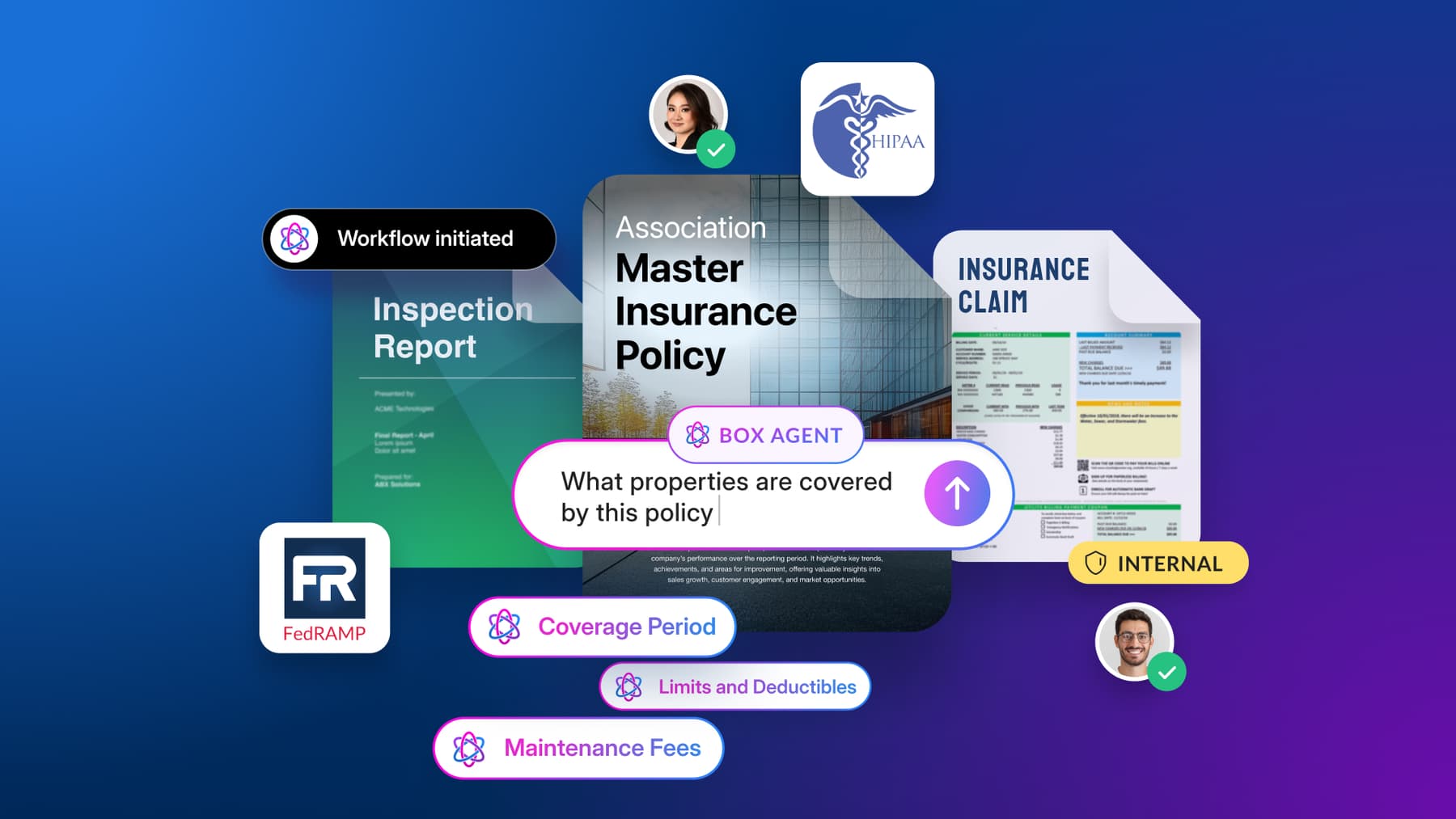
With an integration with the insurance system of record, like Guidewire, Box operates as the document intelligence layer between unstructured content and the claims system. Guidewire ClaimCenter remains the system of record. Box handles what happens before the record gets updated: ingestion, classification, extraction, formatting, and population. This symbiosis ensures not just a streamlined insurance workflow but data security, compliance, and governance.
With Box as the content layer underneath AI automation, security controls apply at ingestion, not as an afterthought. Documents are scanned for malware on arrival. Box Shield automatically detects personally identifiable information, applies a sensitivity classification, and assigns the appropriate retention policy, without per-file configuration. For a team processing hundreds of documents daily from external parties, that’s operational risk management built into the intake process.
Since the Box + Guidewire partnership announced in 2024, Box integrates across Guidewire ClaimCenter, PolicyCenter, and BillingCenter through the Guidewire Cloud integration framework and Box APIs. When Box was named Guidewire Global Technology Partner of the Year, Guidewire’s CEO Mike Rosenbaum cited this integration specifically, calling out the ability to extract data from files and populate insurance suite records across claims documents, policy numbers, incident details, and customer data.

The high value of human review
Automation needs clear boundaries. High-severity claims, low-confidence extractions, missing documents, and regulated data types should still route to human review. The goal isn’t to remove adjuster judgment, it’s to stop using adjusters as the integration layer between documents and systems.
High-severity claims, low-confidence extractions, missing documents, and regulated data types should still route to human review.
By integrating Box AI directly into the ingestion pipeline, carriers can establish automated guardrails that keep humans firmly in the loop. Any high-severity claims, or complex, regulated document types are automatically flagged and routed to a dedicated review queue in Guidewire.
This ensures that adjusters focus their expertise where it matters most — evaluating exceptions and making final judgment calls — rather than manually keying in routine data.
What IT should evaluate before automating claims documents
For insurance IT teams, AI evaluation isn’t just about whether a tool can extract text. It’s whether the document workflow can operate safely inside the systems and controls the carrier already uses.
Five capabilities matter:
- Document classification: Can the system distinguish a loss run from a police report, demand packet, invoice, or medical record?
- Field-level extraction: Can it pull the specific data the claim or underwriting workflow actually needs, not just summarize the document?
- System-ready formatting: Can it convert extracted information into the structure, codes, and field lengths the downstream system expects?
- Exception routing: Can it send low-confidence, high-risk, or incomplete records to the right person for review?
- Governance at ingestion: Can it apply malware scanning, sensitivity classification, retention, and access controls as documents arrive, without per-file configuration?
A tool that answers only the first two questions is performing document summarization, not claims documentation automation. This difference matters when the output has to populate a Guidewire record, satisfy a compliance audit, or flag a potential discrepancy.
Document intelligence in real life
Shelter Insurance, a property, casualty, and life carrier operating across 15 states, started with Box as a claims content layer. It has since expanded to policy, billing, and digital, with AI now being applied across claims document extraction, underwriting workflows, fraud detection, and adjuster knowledge management. Once the document intelligence layer is in place, the same architecture supports claims, underwriting, billing, fraud, and knowledge workflows.
Attorney demand packets at Shelter Insurance can run to hundreds of pages. Before automation, an adjuster read through each one, extracting settlement offers and medical bill amounts, and keyed them into multiple systems, one entry at a time. Box Extract automates that work, pulling relevant details from documents directly into Shelter’s system records.
The underwriting side of the business faced the same challenge at a different scale. Shelter Insurance processes thousands of electronic transactions and physical checks each month related to homeowner insurance payments, arriving from different sources in different formats. Staff were reconciling them manually against expected system amounts.
Now, Box AI is being applied to automate that reconciliation, moving Shelter Insurance employees away from payment matching and back toward work that requires their judgment.
A lot of this is at the intersection of structured and unstructured data. And that’s where Box is really powerful.
With this system fully in place, across the claims operation, Shelter Insurance expects payout times to fall from two weeks to hours. That reduction reflects automating the document extraction and routing work that currently sits between a claim being opened and a decision being made, not a change to the adjudication process itself.
Matt Schwartz, VP of Strategy at Shelter Insurance, frames the competitive stakes: “Everyone thinks AI is about driving efficiencies. But even more important is the competitive advantage you get from AI specifically advancing agentic workflows.”
For Shelter Insurance, document automation is the foundation that makes faster, more accurate decisions possible at scale.


ROI starts with adjuster hours returned
Based on Box carrier benchmarks, insurance customers stand to get back 400,000 adjuster hours by enlisting AI to help process a million claims per year. Here’s how the math works out:
- Claim validation averages 30 minutes per claim at that volume — 500,000 hours of administrative work per year
- Automate 80% of it, and 400,000 of those hours come back
- At an average adjuster rate of $42 per hour, that’s $16.8 million in recovered capacity
That estimate only captures recovered capacity. It doesn't account for faster cycle times, reduced customer complaints, fewer reopened claims, lower compliance risk exposure, or the revenue retention that comes from paying faster.
This model is adjustable. An insurer processing 500,000 claims with higher-than-average document complexity — more medical records, more legal correspondence, more multi-party submissions — produces a different number. The structure of the calculation holds. The inputs change.
The document problem is no longer just a technology gap. The infrastructure exists. The harder question is whether carriers will prioritize the work before manual intake becomes an even larger cost disadvantage.
FAQ
What is AI claims document automation?
AI claims document automation uses AI to classify incoming claim documents, extract required data, format it for the downstream claims system, and route exceptions for human review. It eliminates the manual extraction and rekeying that sits between a document arriving and a claim record being updated, reducing the portion of the claim cycle spent on document handling.
What percentage of insurance claim cycle time is spent on document handling?
Manual document intake and review can account for 60–70% of the total claim cycle at most carriers, according to Box analysis of carrier benchmarks. This covers reading files, identifying relevant data points, and rekeying them into the claims system across every document type received during a claim, from medical records and repair estimates to police reports and attorney demand packets.
How does AI document automation integrate with Guidewire ClaimCenter?
Box integrates with Guidewire ClaimCenter, PolicyCenter, and BillingCenter through the Guidewire Cloud integration framework and Box APIs. When a document lands in Box from within Guidewire, Box AI classifies it, extracts the relevant structured data, formats it for the receiving system, and populates the claim record automatically. Box was named Guidewire Global Technology Partner of the Year at Guidewire Connections 2025.
How do insurers maintain compliance and data security when automating document workflows?
Document automation should apply security controls at ingestion. Box scans every incoming document for malware, assesses it for personally identifiable information, classifies it for sensitivity via Box Shield, and assigns a retention policy, without per-file configuration. These controls apply to every document regardless of source or type.
Does AI document automation apply to underwriting as well as claims?
Yes. The same capability pattern — classify, extract, format, route — applies across underwriting submissions. Loss runs, ACORD applications, broker submissions, financial statements, and motor vehicle reports can all be processed automatically, reducing the manual document assembly work that currently precedes risk evaluation.