As AI usage becomes mainstream among leading businesses, the strategic question that enterprises should be asking shifts from "can we build this" to "what should we build, and can we trust the content behind it?" Answering that takes ongoing content management, governance, and prioritization of your organization’s context layer.
Enterprise AI context is the complete set of documents, data, permissions, relationships, and institutional history that an intelligent AI system needs to produce an answer a business can act on, rather than one that merely sounds plausible.
Conversations about enterprise AI often focus on model capability: which large language model (LLM) is smartest, which one codes best, which one wins the latest leaderboard. Inside an organization, the harder question is whether the system can find the right information, understand how it connects to other information, respect access permissions, and flag what it can't confirm.
This article explains why context, rather than raw model intelligence, is the bottleneck to reliable enterprise AI. It covers how structured and unstructured data fit together, the emerging discipline of "context architecture," why benchmarks alone can't establish whether a deployment is trustworthy, and a maturity model for matching AI tooling to the complexity of a task. It closes with how Box's platform maps to each stage.
Enterprise AI context: key takeaways
- The bottleneck in enterprise AI is usually context, not model quality. A capable model can still produce an unreliable answer if it lacks the right documents, permissions, or relationships
- AI content use cases depend on context for everything from single-document summarization to enterprise-scale, relationship-aware reasoning. A project’s scale gives teams a way to decide how much structure (metadata, taxonomy, ontology, graph, governance) a given use case requires
- Context engineering, context infrastructure, and context architecture are three distinct disciplines — infrastructure stores information, engineering assembles it for a task, and architecture defines the permissions, memory, and guardrails around it
- More context is not automatically better. Model attention can degrade as context grows, and real workflows face hard constraints: an estimated 20,000 tokens per task and latency budgets as tight as 200 milliseconds in production systems
Why enterprise AI reliability matters to business teams
For knowledge workers, enterprise AI promises faster answers, less digging through folders and email threads, and assistance with real work. But an answer loses its value if it's wrong, outdated, or based on a document the user shouldn't have seen.
For IT and data leaders, this reframes the AI roadmap. The question isn't only "which model do we license," but "do we have the metadata, permissions, taxonomy, and provenance in place to let any model perform reliably?" That shift puts responsibility, and opportunity, back in the organization's own data practices, which are far more controllable than model internals.
For compliance, security, and legal stakeholders, the stakes are concrete. An AI system that confidently answers a contract question using an outdated clause, or surfaces content a user shouldn't access, creates a governance failure. Before scaling an agent into a regulated or high-stakes workflow, teams need to distinguish a system that performs well on a benchmark from one audited for that specific production use case.
These groups need a shared vocabulary for diagnosing AI failures and a framework for deciding how much infrastructure each use case warrants, without over-building or under-engineering the systems behind each answer.
How enterprise AI context works
Enterprise AI context, explained
Context is the information an AI agent needs to complete a specific task reliably. It goes beyond text in a prompt: it includes documents, database records, instructions, available tools, access permissions, relationships between pieces of information, and the working history of a task or conversation.
Consider a supplier-contract question: "If we terminate this agreement, what obligations remain, and for how long?"
Answering it correctly requires the original contract, any amendments, the governing law, effective dates, and the user's access rights, assembled correctly and in the right order. A model can be excellent at language and still get this wrong if any one of those pieces is missing, outdated, or inaccessible. The problem isn't the model's intelligence; it's the context it was given.
The work of enterprise AI starts with assembling the right context for a reliable action, not simply generating an answer.
Why more context can make AI answers less reliable
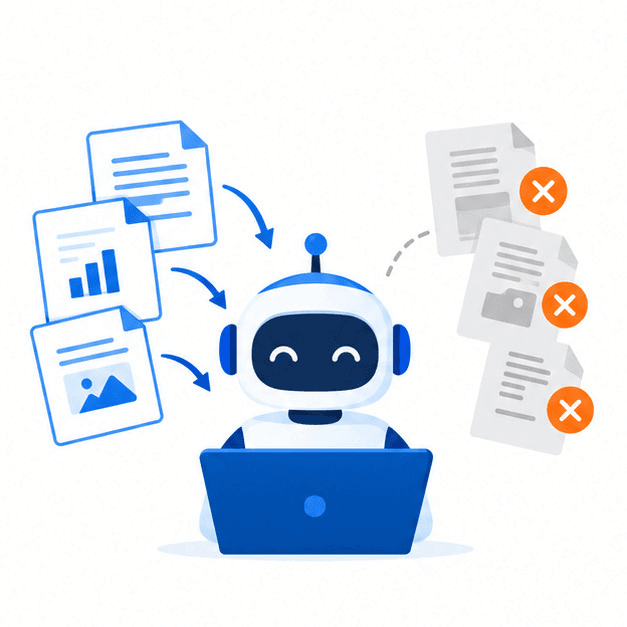
Feeding an LLM the entire corpus might seem like the safest way to get an answer. But According to a Box-sponsored IDC whitepaper, roughly 90% of enterprise data is unstructured, meaning most of what an AI agent needs to reason over isn't sitting in a clean database row. It's buried in documents, slides, and files. Confusing an AI agent with unnecessary or incorrect data can result in unreliable answers, with potentially catastrophic results for your business.
Enterprise information sits on a continuum, not in two clean buckets:
- Structured data: Formal database transactions, supplier master records, and reference codes stored in defined fields
- Semi-structured data: Formats like JSON or spreadsheets that carry some organization but aren't fully normalized
- Unstructured data: Content in the form of PDFs, images, video, and narrative documents — the format most business knowledge lives in
Real documents rarely fit neatly into one category. A single supplier contract might contain narrative clauses, structured tables of pricing terms, and metadata about ownership and effective dates. AI can extract dates, obligations, and named entities into structured fields.
Tools like Box Extract do exactly this, capturing information from documents as usable metadata. But those fields need to retain a link to the original source evidence. Extraction without provenance is a liability; validation requirements should scale with the consequences of getting it wrong.
In regulated workflows, the cost of an unreviewed AI error isn't just a wrong answer – you could be exposed to legal or financial consequences, which is why precision and provenance matter more than raw throughput in these settings.
In practice, an AI’s output might be unreliable for three reasons:
- Cost. Every additional document or field adds token overhead
- Latency. Real-time enterprise workflows often have only a narrow window — described by researcher Dan McCreary as "the 200 millisecond problem" — to find and assemble relevant information before a response is expected
- Attention degradation. Research indicates models can struggle to use information consistently as context grows, even when the answer is technically present somewhere in it
To address these problems, we must turn to the field of context engineering: assembling the right information, relationships, permissions, and controls for a task instead of handing the model as much information as possible.
Context infrastructure vs. engineering vs. architecture
These three terms get used interchangeably, but they describe distinct layers of the problem:
The layers that give AI agents usable enterprise context
As task-specific AI agents proliferate across the enterprise, organizations are assembling infrastructure to give those agents reliable context.
Several long-standing data concepts are becoming foundational again:
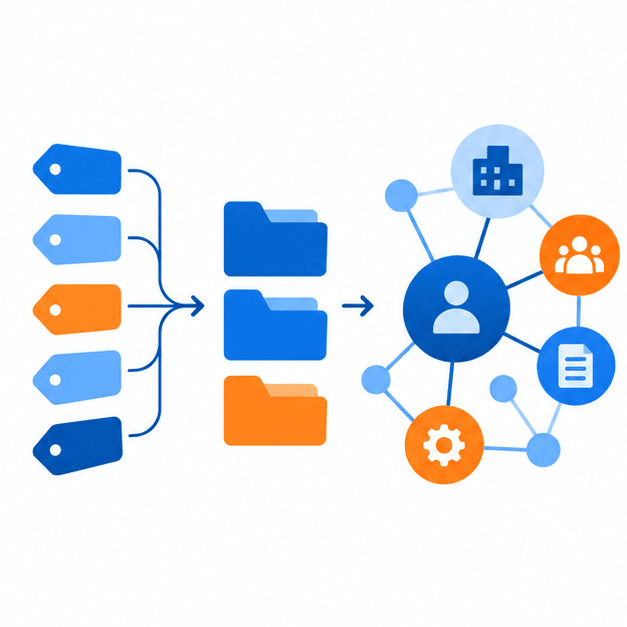
- Metadata describes an asset and its attributes (owner, supplier ID, effective date)
- Taxonomy organizes content using consistent categories (Agreement → Supplier Agreement)
- Ontology defines business concepts and their relationships (an amendment modifies an agreement)
- Knowledge graph represents specific entities and their connections using those shared definitions (Amendment B modifies Agreement A)

AI benchmarks vs. deployment audits
Definitional callout: A benchmark is comparative performance evidence — how capable is this model at a given task compared to others? An audit is governance and operational evidence — can this specific deployment be trusted in production, with these permissions, on this data, for this task? An enterprise AI system can score well on benchmarks and still fail an audit.
LLMs have demonstrated strengths in coding, research synthesis, summarization, and informal pattern-connection across ideas. Benchmarks for complex enterprise workflows show rapid progress on these fronts. Separate research shows that adding structure, such as ontologies, can materially improve LLM accuracy on question-answering tasks, with the largest gains on questions involving complex schemas and more relationships to navigate.
Audits — assessments of whether a specific deployment is governed, explainable, and operationally safe — remain far less common than capability benchmarks. NIST's generative AI evaluation framework is the closest thing to an established audit-adjacent standard today, but it's a risk-management framework, not a certification that a given deployment is safe or effective. The industry still needs to close that gap.
In practice, use AI for interpretation and flexible reasoning; use structure for precision, scale, governance, and repeatability.
Nine levels of enterprise AI content use cases
Start with the simplest approach that can reliably answer the question. Add structure when the question, risk, scale, or required precision demands it.
Levels 1–4: Understanding and finding content
Levels 5–7: Acting on content and comparing evidence
Levels 8–9: Relationship-aware and enterprise-scale intelligence
How to choose the right context tools for an AI use case
Use this decision tree to decide on the right tool to use for any new scenarios:
Can a person answer it reliably from a small set of documents?
    Yes → Use AI over raw content.

Does the system need to find the right documents from a larger corpus?
    Yes → Add search and retrieval.

Does the question depend on exact fields or filters?
    Yes → Add metadata.

Are important terms inconsistent or ambiguous?
    Yes → Add a data dictionary and taxonomy.

Must the system classify, route, or trigger an action consistently?
    Yes → Add rules, workflows, and governed metadata.

Does the answer require relationships across entities and documents?
    Yes → Add an ontology or content graph.

Is the answer regulated, high-impact, or auditable?
    Yes → Add provenance, permissions, evaluations, human review, and auditability.
Enterprise AI context terms, explained
How Box supports enterprise AI context
Box views the enterprise AI reliability gap as a content and context problem. Our platform provides progressively richer layers of context rather than a single AI feature.
The capabilities we provide help agents and LLMs categorize, interpret, and use data, from foundational content management to structured, governed, relationship-aware AI. Here are the steps we follow to make that happen.
Make content searchable, understandable, and trusted
Box Content Cloud and Box Enterprise centralize content with permissions, version history, and secure access — the baseline any reliable AI answer depends on. Box Search and Box AI add retrieval, citations, and permission-aware answers (addressing Level 2 of the hierarchy).
Box Hubs and Box AI for Hubs create curated knowledge spaces with trusted content boundaries, useful when an answer should only draw from approved documentation.
Box Extract performs repeatable field extraction with confidence checks and human review, turning unstructured contract language into structured, provenance-linked data.
Turn content into repeatable business processes
Box Apps provide role-specific, metadata-driven dashboards. Box Automate adds rules, triggers, and workflow states for operational decisions like routing high-risk contracts to Legal. Box Doc Gen generates documents from approved templates and structured source data.
Box AI Studio supports domain-specific review tasks with curated sources and evaluation criteria. Box Agent compares relevant files and prepares grounded, citation-backed recommendations for human review — addressing Levels 5 through 7 of the use case hierarchy.
Connect content, context, and governed action
Box MCP Server gives external AI agents controlled, auditable access to Box content and approved actions. Box Shield and Box Governance add classification, retention, access policies, and threat detection — the guardrails that distinguish a context architecture from context infrastructure alone.
Emerging ontology and graph capabilities at Box aim to resolve entities and preserve relationships across contracts, customers, products, and obligations, supporting Level 8 and 9 relationship-aware reasoning. Box Sign, Box Forms, and additional workflow capabilities extend this foundation by capturing structured information, securing approvals, and connecting content to downstream processes.
Frequently asked questions about enterprise AI context
What is enterprise AI context?
Enterprise AI context is the complete set of documents, records, permissions, relationships, and history an AI agent needs to complete a specific task reliably. It goes beyond text: it includes who is allowed to see what, how pieces of information relate, and the working history of a request.
Why does AI hallucinate or give wrong answers in enterprise settings?
Most enterprise AI errors trace back to missing or poorly assembled context rather than a flaw in the underlying model: a missing contract amendment, an outdated clause, or information the system should have retrieved but didn't. The fix is usually better context engineering and architecture (search, metadata, permissions, provenance), not a different model.
Do I need a knowledge graph to use AI reliably?
No. If the answer requires reasoning across relationships that don't appear together in a single document (Level 8–9 use cases), a knowledge graph or ontology helps. For simpler retrieval or summarization tasks, search and metadata are often enough.
What's the difference between an AI benchmark and an AI audit?
A benchmark is comparative performance evidence showing how capable a model is relative to others. An audit is governance and operational evidence showing whether a specific deployment can be trusted in production. A system can score well on benchmarks and still fail an audit of a particular real-world deployment.

How much context is too much for an LLM?
Token cost, latency, and attention set a practical ceiling: enterprise tasks have been estimated to consume around 20,000 tokens, and real-time workflows may only have roughly 200 milliseconds to assemble the right context. Beyond a certain point, adding more raw content degrades reliability rather than improving it. That's why targeted context engineering works better than brute-force retrieval.
What's the difference between context engineering and context architecture?
Context engineering is the practice of assembling the right information for a specific task; context architecture is the upfront design of the constraints, memory, permissions, and guardrails that govern how AI agents behave. Architecture defines the rules; engineering implements them in a given task.
Is RAG the same thing as a knowledge graph?
No. RAG retrieves relevant passages from unstructured documents to ground a generated answer and is lower-cost to set up. A knowledge graph models explicit relationships between entities and is better suited to multi-hop reasoning questions, at a higher upfront modeling cost.
Is unstructured data a problem that can simply be "cleaned up"?
Not entirely. Most enterprise content, like contracts, naturally mixes narrative text, tables, and metadata. The goal is to extract structured fields while preserving links to the original source evidence for validation.