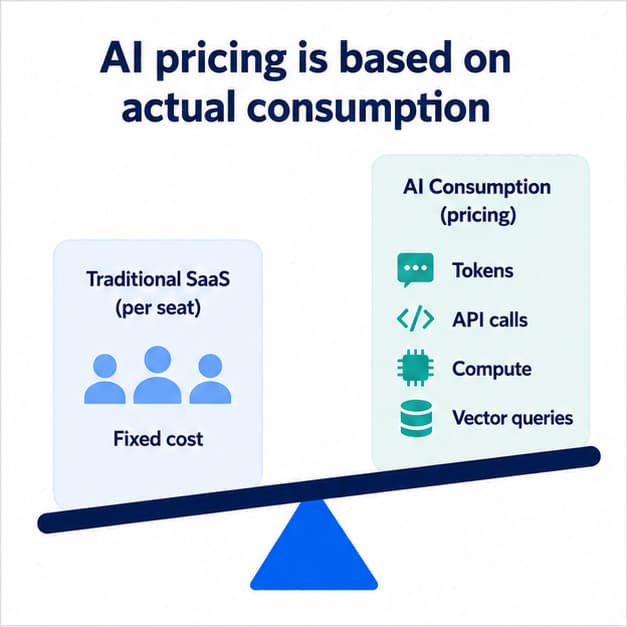
AI consumption-based pricing is a billing model in which cost scales directly with actual usage, such as tokens processed, API calls made, and compute cycles consumed, rather than with a fixed number of licensed seats.
For decades, enterprise software budgeting meant counting users and multiplying by a license fee. AI breaks that formula, because the same tool can cost pennies for a quick summary or hundreds of dollars for a complex, multi-agent reasoning task.
This article explains why AI spend behaves so differently from traditional software; which variables drive that spend; and how organizations can build a forecasting discipline that treats AI consumption as a moving, adaptive process rather than a fixed line item.
Key takeaways about AI consumption pricing
- AI consumption-based pricing ties cost to actual usage, such as tokens, API calls, GPU or compute hours, or vector database queries, rather than to a flat per-seat license fee, making it fundamentally different from traditional SaaS billing
- AI usage doesn't scale predictably because people adopt new tools at different speeds; Rogers' Diffusion of Innovation theory (Innovators, Early Adopters, Early Majority, Late Majority, and Laggards) explains why the same rollout produces wildly different consumption numbers across teams
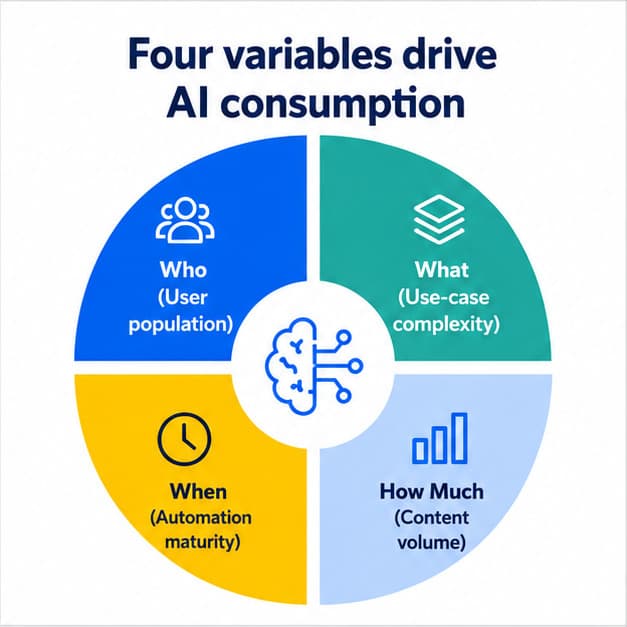
- Four categories of variables drive AI consumption: user population (Who), use-case complexity (What), content volume (How Much), and automation maturity (When)
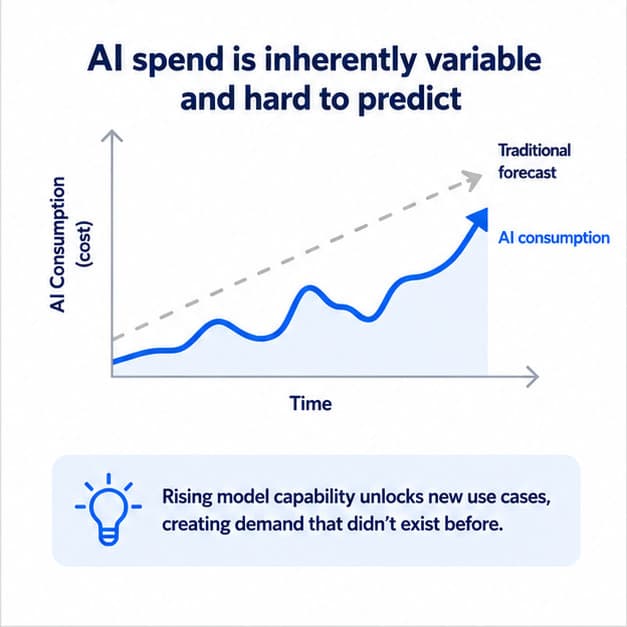
- AI forecasting is inherently unstable because rising model capability continuously unlocks new use cases, similar to how early electrification created demand that didn't exist before the appliances did
- Consumption is a cost metric; value is an outcome metric. Forrester defines customer value as what someone receives relative to what they give up, and the most successful AI programs optimize for that ratio, not for the lowest token count
Why AI consumption pricing changes enterprise budgeting
Finance leaders, IT executives, and content and compliance stakeholders are being asked to approve AI budgets without the decades of historical licensing data that made software forecasting relatively safe.
When a CFO asks, “How much will this cost next quarter?”, the honest answer for AI is, “It depends on how people use it, how complex their requests get, and how much content flows through the system”
This is an answer that doesn't fit neatly into a fixed-line spreadsheet. The resulting uncertainty creates real organizational risk on both sides. Underestimate consumption and teams get blindsided by invoices; overestimate it and leadership kills promising pilots before they demonstrate value. For IT and governance teams, the stakes are higher, because AI consumption is entangled with content volume, document complexity, and workflow automation — all things that content and information governance teams already manage.
As Aaron Levie, CEO of Box, explained at the recent Box Content+AI Summit in San Francisco: “What if enterprises had a platform that could connect that enterprise content with the right access controls, with the right data governance to all of their AI agents securely? And that is what we're building with Box — a single platform that powers the entire lifecycle of content, the security, the governance, the compliance, the workflow, and then connects it to all of our agents across the organization.”
Organizations need to shift the conversation away from “How do we minimize AI spend?” and toward “How do we connect AI spend to measurable outcomes?” Those that make this shift can move faster, secure larger AI budgets with less internal resistance, and avoid judging AI success purely by usage metrics that say nothing about business impact.
Core concepts for understanding AI consumption costs
What is AI consumption-based pricing?
AI consumption-based pricing is a billing model in which cost scales with actual usage rather than fixed access. The units of measurement typically include:
- Tokens. The fragments of text an AI model processes per request
- API calls. Discrete requests sent to an AI service
- GPU or compute hours. The processing time required to run a model
- Vector database queries. Lookups performed against embedded content for retrieval-augmented tasks
This contrasts directly with subscription pricing and per-seat licensing, where an organization pays a fixed fee per user regardless of how much, or how little, that user engages with the tool. This distinction is the starting point for any AI budgeting conversation.
AI pricing as rent versus electricity
Think of two household budgets. Rent is fixed: the same amount is due every month regardless of how the family lives inside the space. Electricity is variable: the price per kilowatt-hour is known, but the total bill depends on how many devices run, how often, and how intensely. Visiting guests, air conditioning during a heat wave, or a forgotten light left on overnight all can raise the bill.
Traditional enterprise software has always resembled rent — a predictable cost tied to the number of licenses purchased. AI, by contrast, behaves like electricity — the unit cost may be published, but total spend depends on usage frequency, task complexity, data volume, and the intelligence required to produce a result.
Organizations are no longer budgeting for access to technology; they're budgeting for consumption of intelligence.
Traditional SaaS, consumption-based, and hybrid AI pricing compared
Most AI-adjacent software today falls into one of three billing categories, each with different budgeting implications:
Hybrid pricing is an increasingly common middle path. Vendors combine a predictable seat-based foundation with a metered usage layer, giving organizations partial budget certainty while still capturing the economics of heavy usage.
Essential terms for understanding AI consumption costs
A short glossary grounds the cost model in precise language rather than loose analogy:
- Token. The basic unit of text that an AI model reads or generates; more tokens processed means more cost incurred
- Prompt. The input a user or system sends to an AI model; prompt length and complexity directly affect token consumption
- Context window. The maximum amount of text, measured in tokens, that a model can consider at once; a larger context window increases the tokens consumed per query
- Inference. The act of running a trained model against new input to produce an output; this is the compute-intensive step that drives most consumption cost
- Agentic workflow. A process in which an AI system takes multiple sequential or autonomous actions to complete a task, often consuming far more resources than a single prompt-response exchange
- Autonomous agent. An AI system capable of executing tasks with minimal human intervention, often running continuously in the background and accumulating consumption at scale
- RAG (retrieval-augmented generation). A technique in which a model retrieves relevant content from a database, often via vector queries, before generating a response, adding retrieval cost on top of inference cost
Each term maps directly to a cost lever. A larger context window means more tokens per query; an agentic workflow means more inference calls per task; RAG adds vector database queries to the generation cost.
Context windows in particular have grown substantially in recent model generations; a single query can now consume far more tokens than it would have a year ago.
As Ben Kus, CTO of Box, explained in a recent Box AI Explainer episode: “All AI models have a context window, and they're different sizes, and they come in these tokens — the newer AI models have a million token context window; 200,000 is very common now.” A larger context window means an agent can consider more information per request, but it also means more tokens consumed — and more cost incurred — with every query.
How adoption behavior affects AI consumption
A company might forecast 10,000 AI interactions a month and end up with 2,000 due to low adoption, or 500,000 because users discovered unexpected value. That swing isn't random; it maps closely to Everett Rogers' Diffusion of Innovation theory, which describes five canonical adopter categories: Innovators, Early Adopters, Early Majority, Late Majority, and Laggards.
For clarity, this framework can be simplified into three practical archetypes that most organizations will recognize in their own workforce. This version collapses Rogers' five categories for accessibility:
- The Explorer/Experimenter (maps to Innovators and Early Adopters) is comfortable playing, testing, and discovering unplanned use cases through trial and error
- The Structured Learner (maps to Early Majority) wants documentation, training, and proof before committing, and adopts deliberately once evidence accumulates
- The Preserver/Skeptic (maps to Late Majority and Laggards) waits until a tool is unavoidable, sticking with familiar workflows until forced to change
Most AI rollouts fail to account for this spread. A generic “We now have AI!” announcement gives Explorers everything they need and gives Structured Learners or Skeptics nothing. These groups need guardrails, examples, and a clear reason to change an existing workflow.
Low adoption is frequently misread as “Employees don't need this” when the real cause is a mismatched rollout strategy. AI adoption is a behavior-change challenge, not a technology challenge. Consumption forecasts that ignore this will always be wrong in one direction or the other.
Four variables that determine AI consumption
Once adoption behavior is accounted for, four categories of variables determine how much AI an organization actually consumes:
Who — User population
- Active vs. inactive users
- Power users vs. occasional users
What — Use-case complexity
- Summarization
- Content generation
- Classification
- Advanced reasoning
- Agentic workflows
How much — Content volume
- Number of files
- File size
- Document complexity (tables, handwriting, embedded images, and multi-column layouts requiring OCR)
- Frequency of updates
- Seasonal peaks and valleys in demand
When — Automation adoption
- Human-triggered interactions
- Workflow automation
- Autonomous agents operating continuously and concurrently rather than one task performed at a time
That last point matters more than it may appear. Humans work consecutively, one task after another. AI agents work concurrently, executing multiple tasks in parallel. When automation shifts previously consecutive human work into concurrent machine work, consumption can spike dramatically, but the unlocked business value typically outpaces the cost increase.
Why AI consumption forecasts keep changing
Traditional forecasting assumes stable demand patterns projected from historical data. AI resists this assumption. As models become more capable, cheaper, and easier to use, entirely new use cases emerge that weren't previously practical.
Adoption then expands into territory with no historical baseline. A forecast that looks reasonable today can be outdated in six months — not because the math was wrong, but because the underlying technology and user behavior changed beneath it.
This mirrors early electrification; as appliances became cheaper and more capable, electricity demand didn't grow in a straight line. It accelerated in bursts because every new appliance created a new reason to consume power.
Analysts tracking enterprise AI adoption have documented a similar pattern of volatility, with a well-known gap between the number of AI pilots organizations launch and the number that reach stable production consumption. That gap drives forecasting error because pilot-stage usage numbers rarely predict production-stage numbers reliably.
Token and API pricing for underlying models has also shifted meaningfully over short time horizons. The “price per unit” side of the equation is a moving target as well, not just the “how many units” side.
The right forecasting question isn't “How much AI will we use?” It's “How will consumption change as AI itself keeps changing?”
Connecting AI consumption to business value
Too much of the current AI conversation fixates on token counts and prompt volume, as if usage itself were the scoreboard. Forrester Research defines customer value as the perception of what someone receives relative to what they give up in pursuit of a goal. Most organizations talking about “AI cost” measure only the giving-up half of that equation.
A household doesn't judge electricity by kilowatt-hours consumed; it judges electricity by what it enables, including heat, light, refrigeration, and powered devices. AI consumption should be evaluated the same way, mapped against four value dimensions:
- Economic value. Is the organization using the right model for the task, minimizing cost per outcome?
- Functional value. Does the workflow get faster, better, or entirely reimagined?
- Experiential value. Is the output clean, human, and error-free, or does it feel obviously automated in the wrong ways?
- Symbolic value. Does working alongside AI make an employee's output — and reputation — better?
Consumption is a cost metric. Value is an outcome metric. Successful AI programs don't simply have low token counts; they consistently generate more value than the cost they consume.
Forecast AI as a portfolio, not just a utility
The electricity analogy explains why AI costs fluctuate, but it breaks down as a forecasting method. Electricity powers known devices doing known jobs. AI continuously creates new ways to automate work and unlocks value that didn't exist in the prior forecast cycle.
AI forecasting therefore looks like managing an investment portfolio: building multiple scenarios, watching the factors that move outcomes, and rebalancing as conditions change.
When to use utility-style forecasting:
- The deployment is single-use-case and stable (e.g., one well-defined summarization workflow)
- User population and usage patterns are already well understood
- Automation is minimal — mostly human-triggered interactions
- The organization is early in AI maturity with a narrow pilot scope
When to use portfolio-style scenario forecasting:
- Multiple departments are deploying AI for different use cases simultaneously
- Automation is expanding into agentic or autonomous workflows
- Adoption is actively evolving month over month
- The organization has moved past the pilot stage into a departmental or enterprise-wide rollout
This decision maps directly onto the three adoption scenarios below. Organizations in Conservative Adoption can often use simpler utility-style estimates, while those approaching Optimized Adoption need full scenario planning.
Conservative, moderate, and optimized AI adoption scenarios
Scenario 1: Conservative adoption. Usage is concentrated among Explorers and early adopters; limited engagement, few production workflows, minimal automation, and mostly human-triggered interactions. Useful for establishing a cost baseline and identifying early wins worth scaling
Scenario 2: Moderate adoption. AI moves from experimentation into daily operations; Structured Learners gain confidence through training and governance; multiple use cases integrate at the department level with moderate automation. This is the most common planning scenario for mid-maturity organizations
Scenario 3: Optimized adoption. AI is embedded enterprise-wide; automation is extensive; autonomous agents perform concurrent background work. Consumption rises sharply, but value tends to rise faster through productivity gains, faster cycle times, and new operating models
Building all three is about ensuring the organization is financially and operationally prepared no matter which one materializes.
How to build an AI consumption plan in four phases
Phase 1: Establish a baseline. Identify the total eligible user population, expected active-user percentage, initial adoption assumptions, primary use cases, estimated content volumes, and planned automation initiatives.
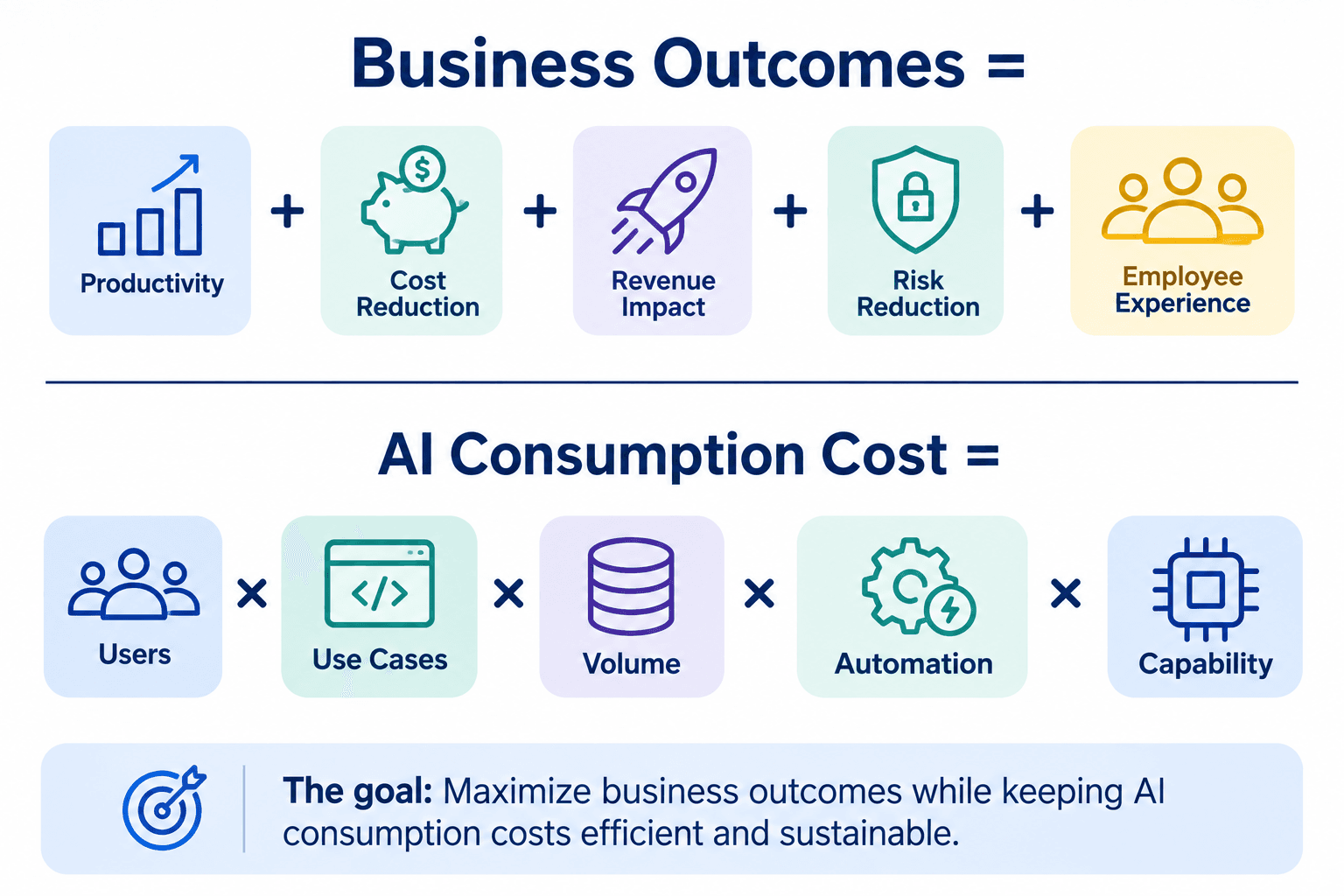
AI Consumption = Users × Use Cases × Volume × Automation × Capability
Phase 2: Model multiple scenarios. Build Conservative, Moderate, and Optimized versions of the baseline formula rather than relying on a single point estimate.
Phase 3: Connect consumption to business value.
Net AI Value = Business Outcomes − AI Consumption Cost
Here, Business Outcomes = Productivity + Cost Reduction + Revenue Impact + Risk Reduction + Employee Experience, and AI Consumption Cost = Users × Use Cases × Volume × Automation × Capability. The goal isn't to minimize consumption. It's to maximize value per unit consumed.
Phase 4: Continuously measure and refine. Unlike license renewals, AI forecasting can't be set once a year. Organizations should regularly review actual versus forecasted consumption, adoption trends, emerging use cases, automation growth, model capability changes, and realized business outcomes. Those reviews can distinguish between consumption growth that's waste and consumption growth that's value creation.
How Box connects content governance to AI consumption planning
Box treats AI consumption planning as a content problem as much as a financial one, because nearly every variable in the consumption formula above, including use-case complexity, content volume, and automation maturity, runs directly through how an organization's content is stored, governed, and processed.
Content volume is a governance lever, not just a cost driver. The “How Much” variable in the consumption model — file count, file size, document complexity, and update frequency — is exactly what Box Governance and Box metadata capabilities manage. By classifying content, retiring redundant files, and applying retention policies, organizations can directly reduce the volume of content flowing into AI processing without reducing the value AI delivers. This controls one of the four named consumption variables at the source.
Box AI operationalizes Phase 1 and Phase 3 of the framework. Establishing an honest baseline requires knowing which use cases consume AI resources today. Box AI and Box AI Studio let organizations define specific use cases — summarization, extraction, classification, and Q&A — against content already living in Box, making it possible to map real consumption patterns to real use cases rather than guessing.
Automation maturity shows up directly in Box Automate and Box Sign. The “When” variable — moving from human-triggered interactions to workflow automation — is precisely what Box Automate enables for document-centric processes and what Box Sign enables for agreement workflows. As organizations shift these processes from consecutive human steps to automated, concurrent execution, the consumption curve described in this framework becomes visible and measurable rather than theoretical.
Box Hubs and Box Canvas support the shift from access to intelligence. Traditional collaboration tools were licensed per seat. Box Hubs curates AI-ready content collections, and Box Canvas supports AI-assisted visual and written collaboration. Both reflect the article's central point that value now comes from what intelligence does with content, not simply from who has access to a tool.
Box Shield ties governance to consumption confidence. Because AI consumption often scales with how broadly content is exposed to processing, the classification and threat-detection capabilities in Box Shield give security and compliance stakeholders visibility into what content is being surfaced to AI systems. This is an important control point for Phase 4's continuous measurement discipline.
Box pricing reflects the hybrid model described above. Rather than forcing customers into a pure per-seat or pure consumption structure, Box blends predictable seat-based licensing with usage-informed AI capabilities. Customers get a foundation they can budget with confidence while still capturing the economics of variable AI usage, the same hybrid approach organizations should expect to see more often across the AI vendor landscape.
Box Platform and APIs extend consumption visibility into custom workflows. For organizations building bespoke agentic workflows or RAG-based applications on top of their content, Box APIs provide the underlying access layer where consumption patterns — including API calls, retrieval queries, and automation triggers — can be logged, monitored, and fed back into the Phase 4 continuous-refinement cycle.
Frequently asked questions about AI consumption pricing
What is AI consumption-based pricing?
AI consumption-based pricing is a billing model in which cost scales with actual usage, measured in tokens, API calls, compute hours, or database queries rather than with a fixed number of licensed seats. It differs from traditional subscription or per-seat licensing, where cost stays flat regardless of how much a tool is actually used.
Why is AI spend harder to forecast than software licensing?
Software licensing costs are tied to the number of users, which organizations can count and predict with confidence. AI costs are tied to usage: how often people engage with it, how complex their requests are, and how much content is processed. That usage can swing dramatically based on adoption speed, task complexity, and automation maturity.
What are the main variables that drive AI consumption costs?
Four categories drive AI consumption: the user population (who's using it and how actively), use-case complexity (what tasks are being performed), content volume (how much data is being processed), and automation adoption (whether work is human-triggered, workflow-automated, or run by autonomous agents).
What's the difference between AI cost and AI value?
Cost measures what an organization gives up, including tokens consumed, compute spent, and dollars billed. Value measures what an organization gets back, including productivity gains, faster cycle times, better decisions, and improved customer experience.
A program with high consumption and higher value is succeeding; a program with low consumption and no measurable outcome is not.
How often should organizations revisit AI cost forecasts?
AI forecasts should be reviewed continuously. Because model capabilities, adoption rates, and use cases keep evolving, a forecast that was reasonable six months ago can be obsolete today. Organizations need a recurring cycle to compare actual versus forecasted consumption and adjust assumptions.
Should AI be forecast like a utility bill or an investment portfolio?
Utility-style forecasting works for narrow, stable, single-use-case deployments where usage patterns are already well understood. Portfolio-style scenario planning is better suited to multi-department, evolving deployments involving automation or autonomous agents, where a single-point forecast is unlikely to hold.
What is Rogers' Diffusion of Innovation, and how does it apply to AI adoption?
Rogers' Diffusion of Innovation is a theory describing how new ideas spread through a population across five categories: Innovators, Early Adopters, Early Majority, Late Majority, and Laggards. Applied to AI, it explains why the same tool rollout produces wildly different usage levels across an organization. Explorers adopt immediately, while Structured Learners and Skeptics need training, evidence, or necessity before they engage.
What is a hybrid AI pricing model?
A hybrid pricing model combines a fixed, predictable seat-based fee with a variable, usage-based charge layered on top. It gives organizations budget stability at the base level while still capturing the economics of heavy or light AI usage, positioning it between pure subscription licensing and pure consumption pricing.
Why does content volume affect AI cost so directly?
Content volume determines how much data an AI system has to read, index, and process. More files, larger files, more complex documents — including tables, handwriting, and multi-column layouts — and more frequent updates all increase the number of tokens, API calls, or vector queries that are needed to complete a task. That's why content governance is directly tied to AI cost control.
Does higher AI consumption always mean the AI program is failing to control costs?
No. Rising consumption can signal that automation is unlocking new value rather than that spending is out of control. The key question isn't whether consumption is rising, but whether the business outcomes generated — productivity, cost reduction, and revenue impact — are rising faster than the cost of the consumption itself.