Generative AI in financial services is evolving rapidly from basic conversational tools to autonomous, multi-step agentic AI workflows. Rather than simply summarizing static text or answering isolated search prompts, AI agents can now plan, reason, and execute complex business processes across banking, wealth management, insurance, and capital markets. Practical applications range from automated digital client onboarding and insurance claims processing to compliance supervision, capital markets research, and regulatory change management.
But AI agents can’t automate what they can’t access, and they can’t optimize what they don’t understand. Because over 90% of enterprise information is unstructured, deploying AI safely and effectively requires an Intelligent Content Management (ICM) foundation. This article explores how financial institutions are transitioning to agentic AI, the core capabilities powering these workflows, and how an ICM platform provides the enterprise security, metadata extraction, and governance that are needed in order to safely put AI agents into production.
Key Takeaways:
- The shift to agentic AI: Financial services institutions are moving rapidly from basic chatbots to autonomous AI agents that can plan, reason, and execute complex, multi-step workflows securely across core business operations.
- Unstructured data is the key: More than 90% of enterprise data is unstructured (e.g., loan applications, claims records, tax forms, contracts, and regulatory filings). AI agents can’t automate processes or deliver meaningful ROI without secure, governed access to this content layer.
- Intelligent Content Management (ICM) delivers structure: Box provides the foundational content layer, AI-powered metadata extraction, and enterprise-grade security (including permissions-aware RAG) that allow financial institutions to deploy AI agents safely.
- High-impact use cases drive immediate ROI: Key areas delivering immediate business value include automated client onboarding (KYC/AML), virtual insurance claims processing, compliance supervision, and capital markets analysis.
- Peers drive rapid adoption: Financial advisors and operations teams adopt AI fastest when they see peers achieving tangible time savings (e.g., saving 5–10 hours per week using AI meeting assistants and automated note-takers).
Why agentic AI matters for financial services
Financial services depend on trust, speed, and precision. But many essential workflows still require employees to search, interpret, and reconcile information manually across fragmented repositories. Nearly every financial transaction — whether a commercial loan, mortgage, wealth advisory plan, or insurance policy — begins and lives as an unstructured document, disclosure, or contract.
While early generative AI tools helped employees summarize isolated documents or draft emails, agentic AI workflows fundamentally rewire institutional operations. As Annie Baymiller, Owens Corning CIO, noted regarding this broader industry shift:
“We’re starting to look end to end at process reimagination — how do we really become AI first, and how do we really step back and say, ‘We have a chance to, as we look at these capabilities, rewire the company for the future, for growth, and for productivity?’ The things that were shared today I’m excited to see: the agentic, the automation, and how it all actually links together.”
In financial services, agentic AI acts as a force multiplier for knowledge workers, helping institutions overcome persistent talent shortages in compliance, software engineering, and customer operations while maintaining stringent auditability.
According to Google Cloud’s Gen AI Benchmarking Study, 82% of organizations actively evaluating or using generative AI expected it to significantly reshape or transform their industry. Realizing this potential in financial services means moving beyond standalone chatbots to secure, content-grounded agentic workflows.
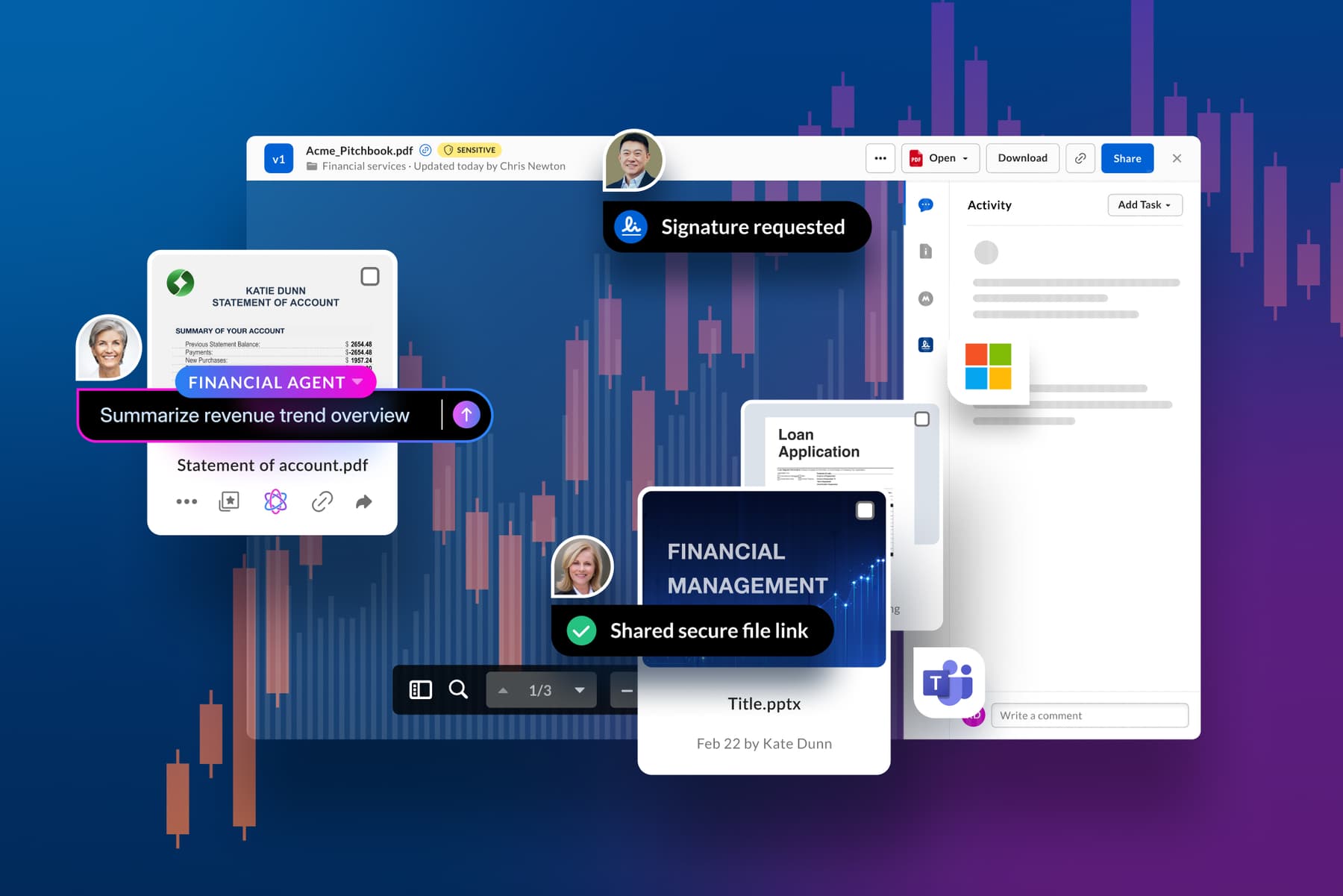
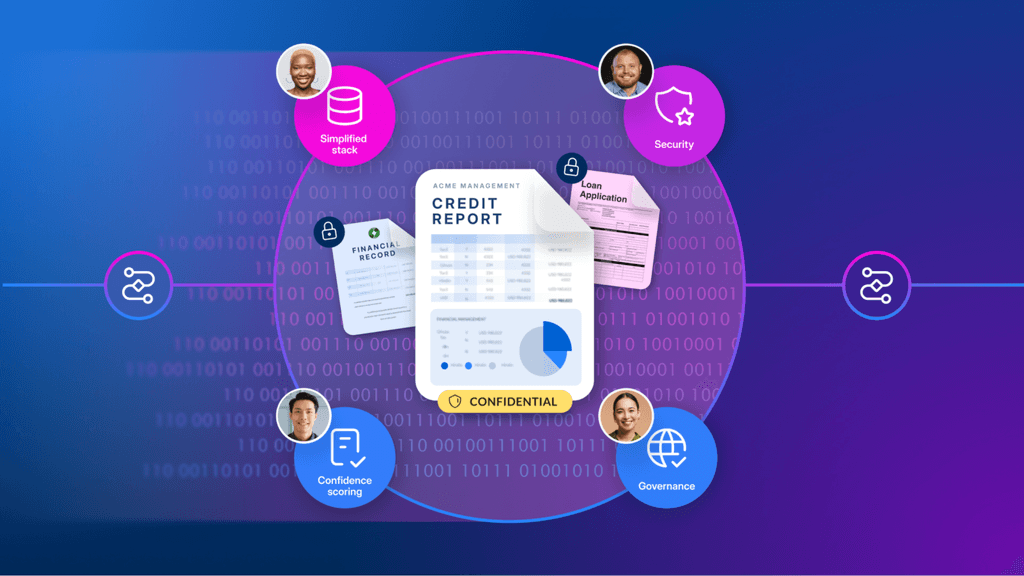
Core concepts: from generative AI to agentic workflows
Generative vs. agentic AI explained
Generative AI refers to systems and Large Language Models (LLMs) that interpret prompts to generate text, summaries, code, or media. Agentic AI builds on LLMs by giving systems the ability to autonomously plan multi-step tasks, utilize tools, call APIs, retrieve contextual data, and execute end-to-end workflows with appropriate human oversight.
“Foundational agents can work across every industry sector,” says Yashodha Bhavnani, Box’s VP of AI Product Management. “And not only for every industry sector; they can work for every single employee in the enterprise.”
Foundational agents can work across every industry sector, and not only for every industry sector; they can work for every single employee in the enterprise.
In financial institutions, AI agents function not as unmonitored replacements for human judgment, but as trusted virtual colleagues operating within strict enterprise guardrails.
Three core agentic capabilities for financial institutions
- Conversational & interactive assistance: Natural-language customer self-service, advisor copilots, and unified access to institutional knowledge.
- Autonomous data structuring & synthesis: AI-driven document extraction, multi-file research synthesis, and automated cross-referencing of unstructured content.
- Multi-step process orchestration: Autonomous execution of content-centric workflows — routing records, verifying identities, triggering approvals, and updating core banking systems.
How content-grounded agentic AI works in financial services
To prevent hallucinations and regulatory non-compliance, financial AI agents must operate under a structured, permission-aware sequence:
- Identify approved sources: The institution defines authorized repositories, policy hubs, and client files within a secure content platform.
- Receive request or workflow trigger: An event (e.g., new account application, document upload, regulatory filing) initiates the agent.
- Extract & structure metadata: Advanced extraction agents structure incoming unstructured content into standardized metadata fields.
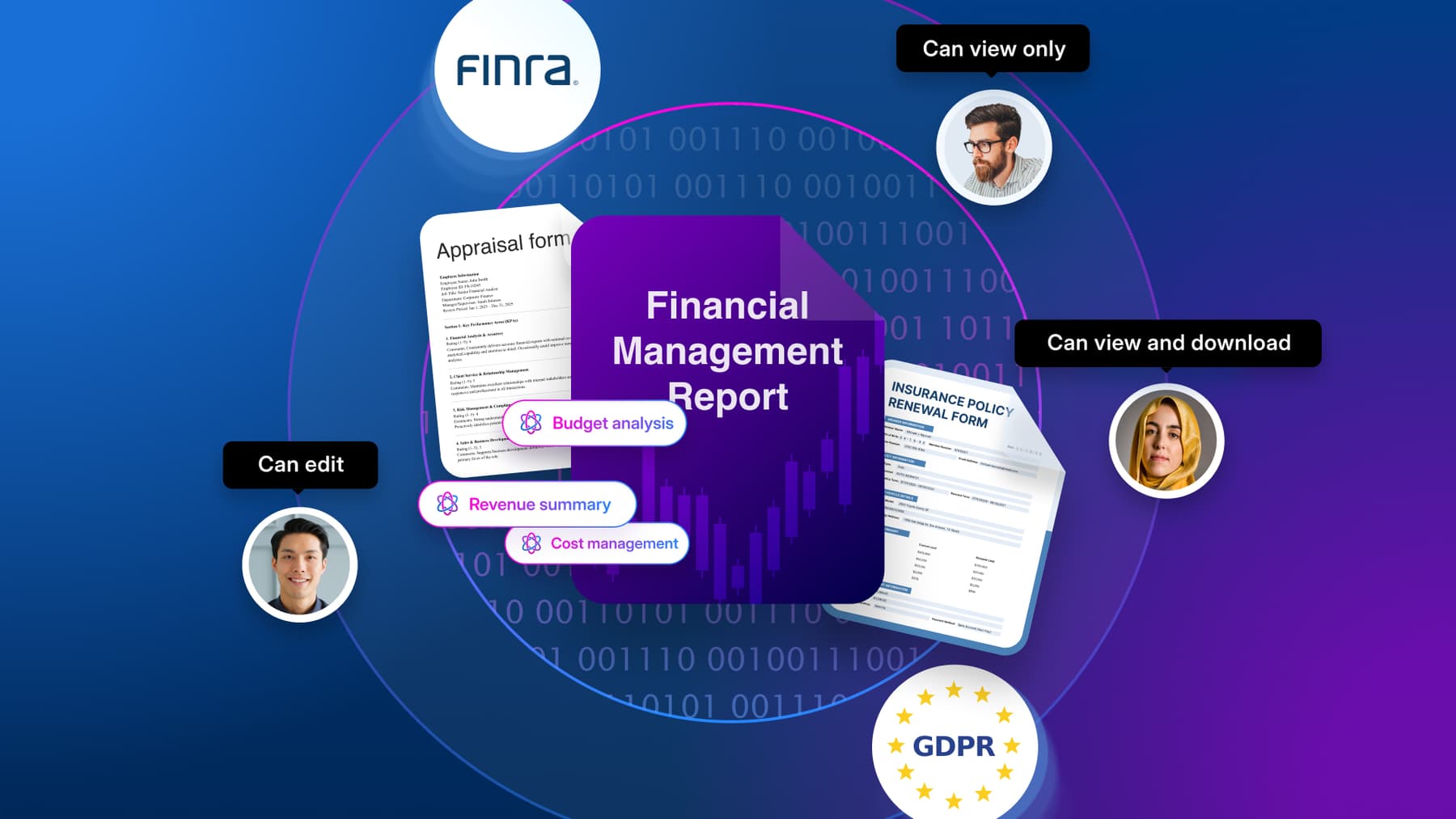
- Retrieve context (permissions-aware RAG): The agent searches only the files and data points the requesting user or process is authorized to view.
- Reason, plan & execute: The agent cross-references findings against institutional rules, drafts outputs, or performs validation checks.
- Ground & trace to source: All extracted values and generated answers link directly back to source documents for instant verification.
- Human-in-the-loop review & governance: Authorized personnel validate or sign off on critical actions before execution, while lifecycle and retention rules are automatically applied.
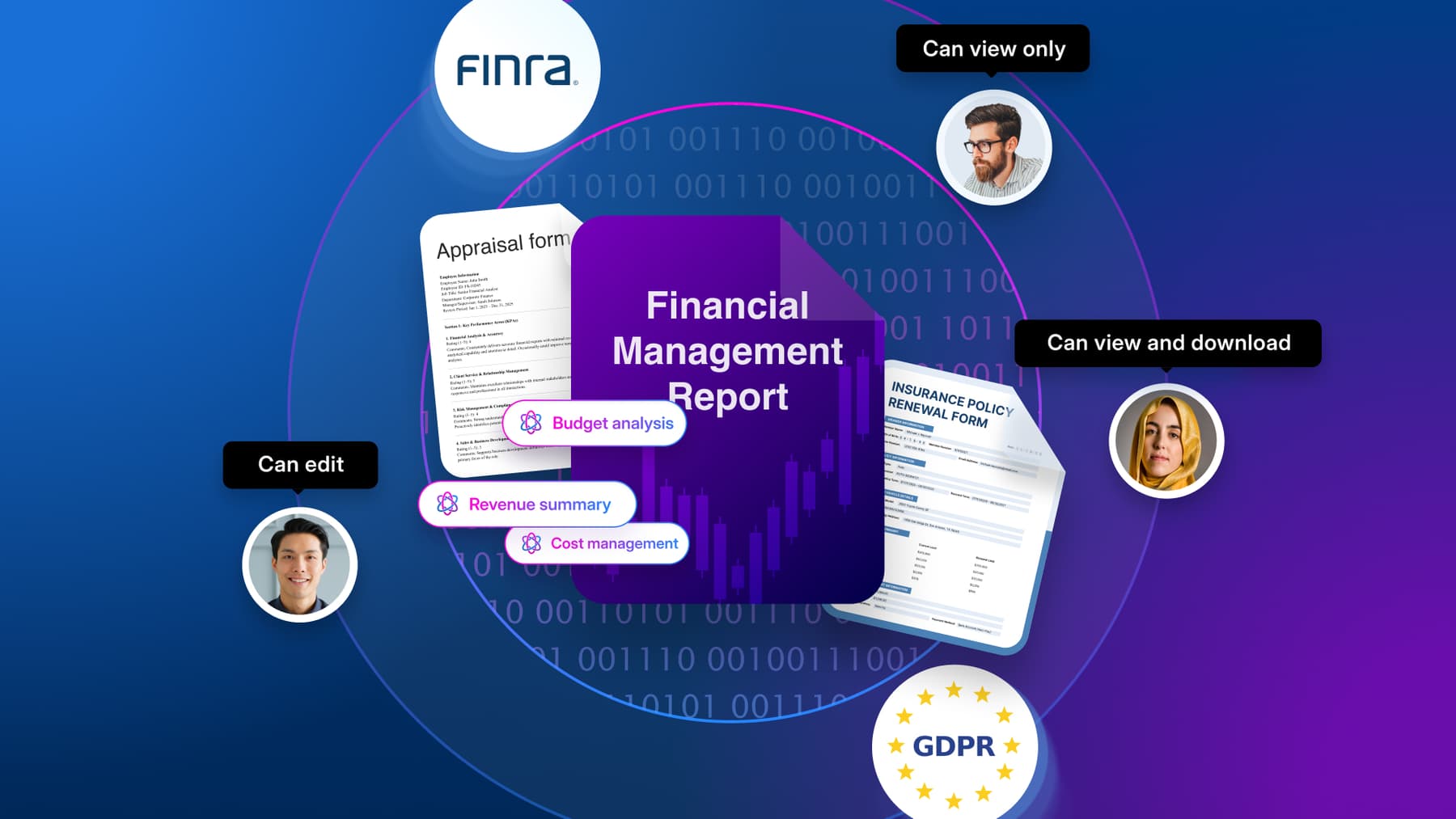

High-impact financial services personas & use cases
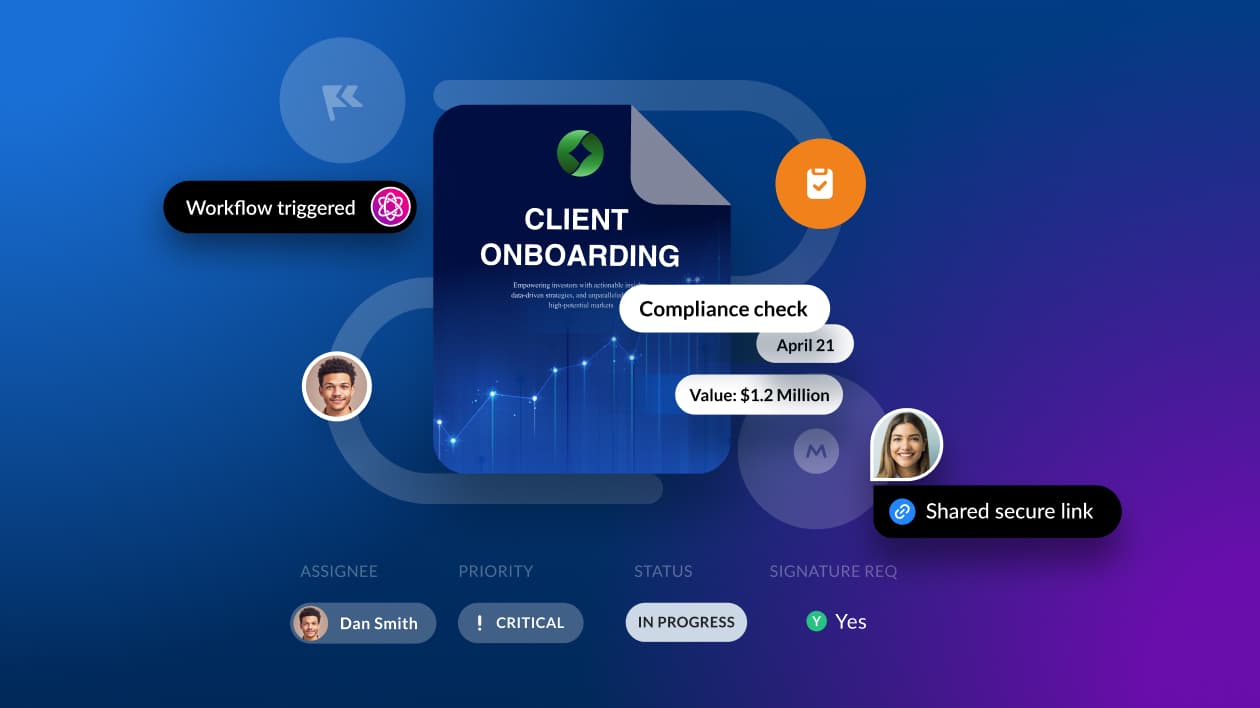
1. Digital client onboarding & lifecycle management (KYC/AML)
Aligned Persona: Head of Client Lifecycle Management / Onboarding
Traditional client onboarding in wealth management and commercial banking is slow, paper-intensive, and prone to error. In an agentic workflow:
- A prospective client uploads onboarding documents (e.g., driver's licenses, utility bills, W-2s, articles of incorporation) through a secure portal.
- Box Extract automatically structures the unstructured documents, identifying and pulling key fields such as legal names, tax identification numbers, and residential addresses.
- Box Agent compares extracted information against application data and flag discrepancies for review.
- Box Automate orchestrates the end-to-end journey, routing flagged exceptions to compliance officers in custom Box Apps dashboards and preparing standard accounts for instant approval.
2. Automated insurance claims processing
Aligned Persona: Head of Claims / VP of Claims Operations
Handling property and casualty claims traditionally takes weeks of manual review across accident reports, photos, and policy terms. With agentic AI, cycle times drop from weeks to days.
Shane Enstad, AVP of IT Product Engineering at USAA, describes how USAA uses Box to streamline claims:
“Members take pics from angles, workflow takes over, routes to adjuster, payment issued… this used to take two weeks. Now with an AI agent, a virtual AI adjuster can take it through the virtual review process and provide it to a human who can just sign off.”
In this workflow, customers submit multimedia documentation directly into Box. A virtual AI adjuster analyzes the photos and police reports, classifies, extracts, and summarizes claim content, and generates a detailed cost estimate for the human claims adjuster’s final review and sign-off.
3. Compliance supervision & advisor marketing review
Aligned Persona: Chief Compliance Officer / Head of Supervision
In wealth management, compliance teams must review thousands of advisor communications, marketing materials, and disclosures to ensure adherence to SEC and FINRA rules.
Stephen Chien, Head of AI Advisory Solutions at LPL Financial, highlighted how AI transforms supervision:
“This process has been more and more automated. And with AI, it’s improving further… helping to reduce the false positives and focus human attention on the cases that really need it is powerful.”
By deploying Box Agents configured via Box AI Studio, compliance teams can automatically scan submitted collateral against approved messaging guidelines, highlighting potentially problematic passages and prioritizing materials for human compliance review.
4. Capital markets research & investment synthesis
Investment analysts must process vast volumes of Form 10-Ks, 10-Qs, earnings transcripts, macroeconomic research, and news feeds. Box Agents, including dedicated research agents, allow analysts to query dozens of disparate filings simultaneously, extracting key financial metrics and comparing disclosures across competitors while preserving line-level provenance.
5. Regulatory change management
Frameworks like Basel III or Dodd-Frank span thousands of pages. AI agents can parse newly published regulatory texts, identify impacted internal policies or software repositories, draft necessary policy revisions, and route updates through Box Automate for legal and compliance sign-offs.
Driving adoption: Why peers accelerate AI in wealth management
Introducing AI tools into financial institutions often meets friction around workflow disruption. However, experience shows that peer validation is the strongest catalyst for firm-wide adoption.
As Stephen Chien, Head of AI Advisor Solutions at LPL Financial, noted regarding their network of 29,000 independent advisors: “Advisors love hearing from other advisors, especially the ones that are at the leading edge and can show that 'I use the AI note taker and it’s saving me five hours a week.'”
When advisors and operations specialists see colleagues saving 5 to 10 hours each week on administrative tasks, organic adoption accelerates across the entire enterprise.
How Box powers agentic AI: The Intelligent Content Management (ICM) platform
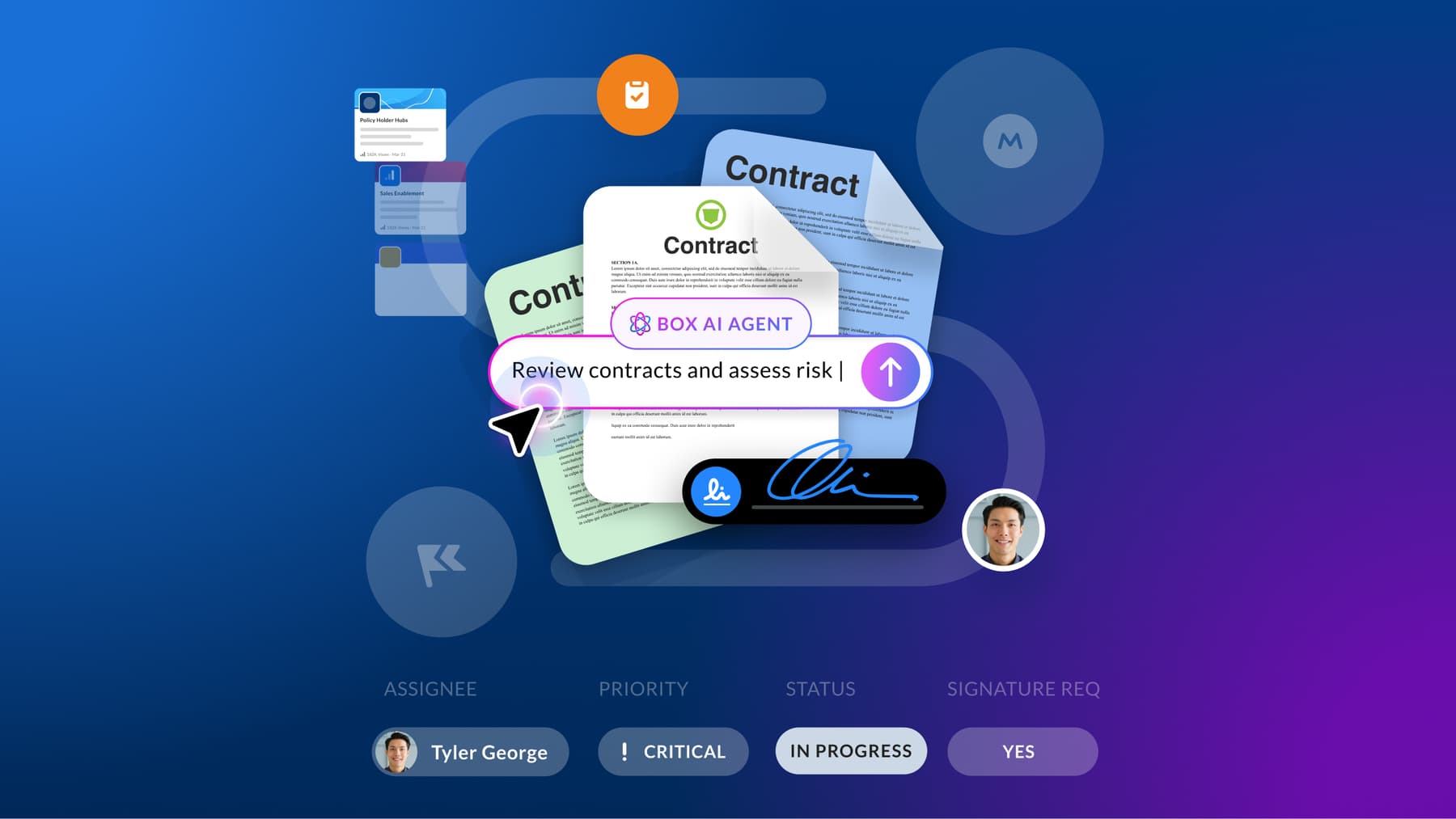
Box views AI in financial services as fundamentally a content problem: an AI agent is only as effective as the contracts, records, and disclosures it can securely access. As the Intelligent Content Management (ICM) platform, Box provides the secure foundation for enterprise agentic AI:
- Intelligent Content Management (ICM) as the System of Record: Box eliminates content fragmentation by centralizing financial documents in a single, secure repository with unified access controls and full auditability.
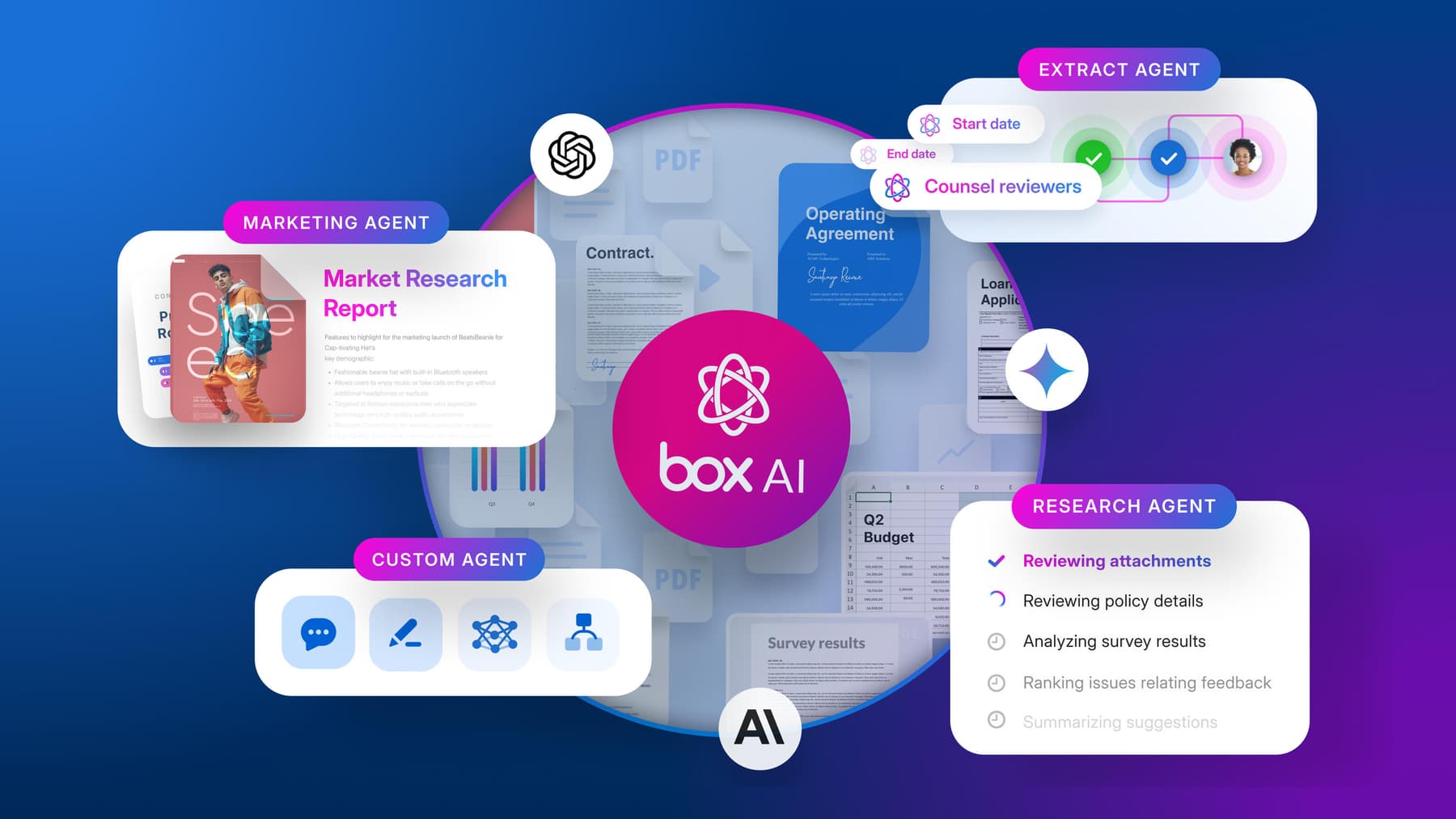
- Box AI & Customizable Box Agents: Box AI powers specialized, customizable Box Agents (such as Search Agents, Research Agents, and custom agents built in Box AI Studio) to enable teams to deploy targeted agents tailored to specific lines of business.
- Box Extract: Unstructured data is the primary barrier to AI automation. Powered by Standard and Enhanced Extract Agents, Box Extract automatically transforms unstructured PDFs, tax documents, bank statements, and agreements into structured metadata, and every extracted field retains precise source pointers for frictionless human auditing. As Gopal Vangala, SAP Technology Lead at Loves Travel Stops, emphasized, “We get documents from 5 vendors in 5 different formats… Metadata extraction is not an optional or nice-to-have. It should be there so that it helps the AI agents and models… and acts like a guardrail to doing a better search.”
- Box Automate: Box’s native agentic workflow automation engine orchestrates end-to-end, multi-step processes via an intuitive drag-and-drop builder, inserting AI agents into operational flows while keeping human decision-makers in the loop.
- Box Apps: A no-code intelligent application builder that brings together content, metadata, users, and AI agents into tailored operational dashboards.
- Box Shield Pro: Provides agentic security solutions, including automated AI-powered classification, threat analysis agents, and ransomware activity detection, ensuring sensitive financial records remain shielded before and after agent interaction.
- Box Governance: Enforces regulatory retention schedules, legal holds, and disposition policies across both source documents and AI-generated outputs.
- Box MCP Server: The Box MCP (Model Context Protocol) Server connects governed enterprise content directly to external agentic ecosystems (such as OpenAI, Anthropic, LangChain, or LlamaIndex) while preserving existing Box permissions and governance controls.
Frequently Asked Questions (FAQ)
What’s the difference between generative AI and agentic AI in financial services?
Generative AI focuses on producing content (summaries, text, answers) in response to human prompts. Agentic AI uses generative models as reasoning engines to plan, use tools, and execute autonomous, multi-step business workflows with minimal manual intervention.
Why is unstructured data critical for financial AI agents?
Over 90% of financial data exists in unstructured formats like PDF contracts, underwriting memos, loan files, and claims photos. AI agents can’t automate business processes without an Intelligent Content Management platform that structures and governs this unstructured content layer.
How does Box Extract assist with financial compliance and auditing?
Box Extract uses AI extraction agents to pull structured fields (dates, amounts, counterparties, SSNs) from complex documents. It maintains direct pointers back to the original document location, allowing auditors and human reviewers to verify data instantly.
How does Box ensure AI agents don’t access unauthorized financial data?
Box utilizes permissions-aware RAG (Retrieval-Augmented Generation), so an AI agent running on Box only accesses the exact files and metadata the requesting user is authorized to see under existing enterprise access permissions.
How do financial firms connect Box content to external AI models?
Through the Box MCP (Model Context Protocol) Server, institutions can securely connect their governed Box content repository to external AI agents and LLM ecosystems without compromising enterprise access controls or security policies.