Every morning, an intake specialist at a government agency opens a queue that never gets shorter. Applications have piled up overnight, arriving by mail, fax, walk-in, and online portal, each one consisting of piles of files, data-entry tasks, and potential opportunities for error.
Before evaluating a single case on its merits, the specialist has to find all the required information and enter each detail into a system (sometimes multiple systems). Hours pass, and the actual work of helping people (the judgment calls, the eligibility reviews, the nuanced decisions that only a seasoned caseworker can make) gets squeezed into whatever time is left.
Across health and human services agencies, public servants spend the majority of their time dealing with paperwork. One recent federal study of child welfare agencies found that paperwork and outdated technology consume an average of 4.3 hours of a caseworker’s 8-hour workday.
This is a workflow problem that’s getting harder to ignore as application volumes rise, federal compliance requirements change, and workforces that once braved legacy systems age out. Agencies are rethinking how documents are captured, classified, routed, and made available to the people who need them in order to modernize these workflows.
Three things you’ll take away from this article:
- Caseworkers lose time to manual data entry, document hunting, and system-switching, a burden that compounds across every case and every staff member
- Automated document intake, AI-powered classification, and intelligent policy review can redirect that time toward critical work that more closely supports the mission
- Agencies implementing these capabilities are seeing faster case processing, stronger compliance postures, and improved focus on the people they serve with current staffing levels

Consider the challenges with SNAP applications
The Supplemental Nutrition Assistance Program (SNAP) serves about 12% of the US population — a whopping 41.7 million people a month. Those SNAP applications arrive through multiple channels, and each submission requires manual data entry. Federal program rules require state agencies to process SNAP applications and make an eligibility determination within 30 days, which entails cross-referencing dozens of policy documents with personally identifying information (PII) flowing through many hands and electronic systems.
In addition to the challenge of keeping PII and other data secure, manual processes are often rife with human error and security risks, and staff spend an inordinate amount of time on the manual entry and document sorting of SNAP applications, which takes time away from actual case analysis.
There are more clients than ever entering the SNAP system, and the tools workers use were built for a different era when documents were often physical pieces of paper, staff involved in the review were physically in the same building, and workflows were more linear.
What the backlog costs
The downstream effects of administrative overload are often easy to underestimate because they’re distributed across thousands of individual interactions.
A caseworker who spends 70% of their day on data entry proves less productive and less accurate. Manual transcription introduces errors. Errors trigger re-work. Re-work delays determinations. Delayed determinations mean applicants wait weeks, sometimes months, for critical benefit decisions.
Some cases simply get lost in the shuffle. When steps to advance the workflow review aren’t clear and don’t have an electronics paper trail, applications can get held up in someone’s queue without them even knowing it.
For a single parent who just lost their job and needs SNAP approval, that wait might not just be an inconvenience but a crisis for the whole family.
For any public agency, the costs compound differently. Backlogs grow. Staff burn out. Compliance risk accumulates in the gaps between email chains, local spreadsheets, and documents that are duplicated across worker’s computers. And when federal auditors arrive, the scramble to reconstruct case histories is its own emergency.
The fix to both sides of the problem requires a fundamental rethinking of how the government serves its most vulnerable populations.
Now, a caseworker can open the applicant’s case — say in Salesforce, via a secure Box integration, or in a Box Apps dashboard — and easily find the right folder. Documents are organized, metadata populated, PII automatically classified. The applicant’s pay stub and their driver’s license are tagged as confidential the moment they were uploaded. All the caseworker has to do is check the work and make a determination.
It’s worth noting that AI automation is different from traditional rule-based classification. AI is given plain-language instructions on how to determine a label through context, instead of rigid keyword matching. That means the system understands intent, not just patterns. That distinction matters enormously in a benefits context, where documents are messy, partially redacted, and often submitted as photos rather than clean scans.
Intelligent Content Management redesigns agency workflows
With Intelligent Content Management, workflows look different. Say someone submits their application through an AI-enabled digital portal. Depending on the answers on each screen of the process, subsequent form fields adapt, so they’re only asked relevant questions, and only relevant information is collected. Any supporting documents they’re asked to upload, like pay stub, ID, or utility bill, get verified before submission, with their PII protected under strict compliance rules.
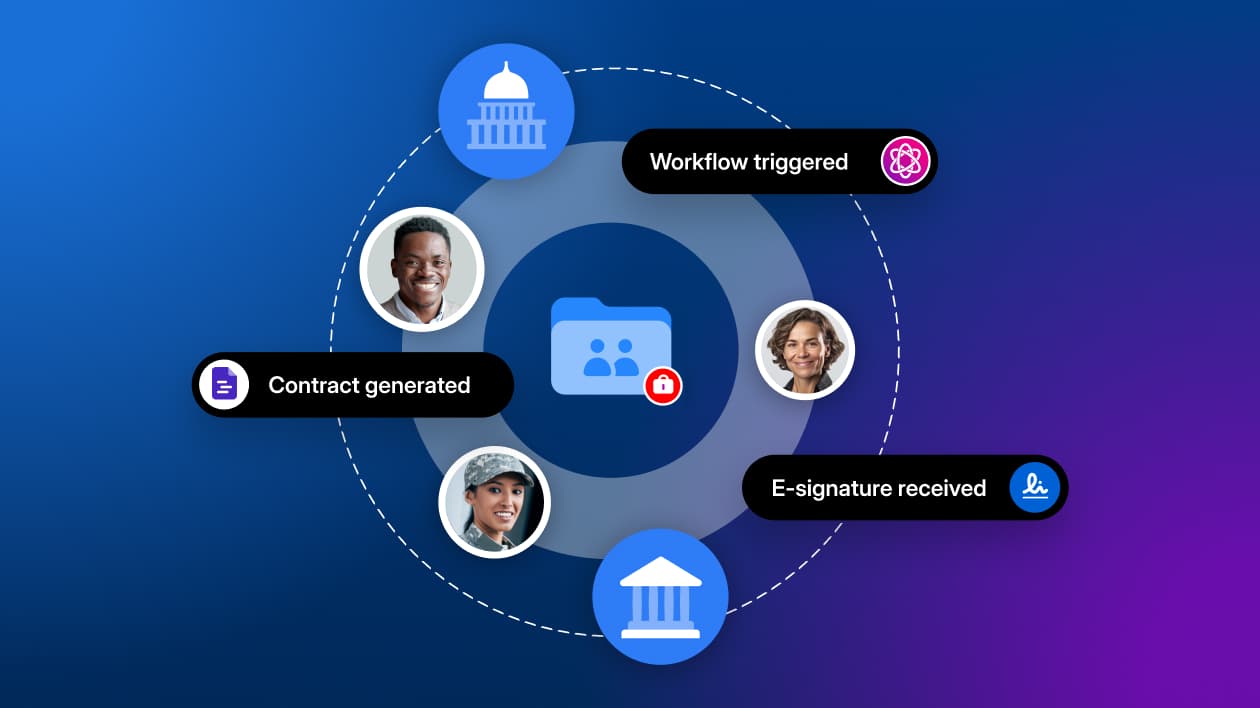
The moment they hit submit, an official application packet is automatically generated, and their key data is written as structured metadata directly onto the file. Up to this point, no staff have been involved. They’re not creating documents, tracking down signatures, or filing information. Workflow automation handles it all.
The moment they hit submit, an official application packet is automatically generated, and their key data is written as structured metadata directly onto the file.
Eligibility review taken from hours to seconds
Determining eligibility is not a straightforward process, especially when it spans multiple supporting materials, policy frameworks, and review and approval steps.
Eligibility determination requires cross-referencing applicant data against massive, complex state and federal policy manuals, a process that takes hours and leads to backlogs. While reviewing a case file, the caseworker keeps policy in mind, checking for discrepancies, calculating income thresholds, and documenting reasoning in a way that will hold up to audit. Every case is a research project.
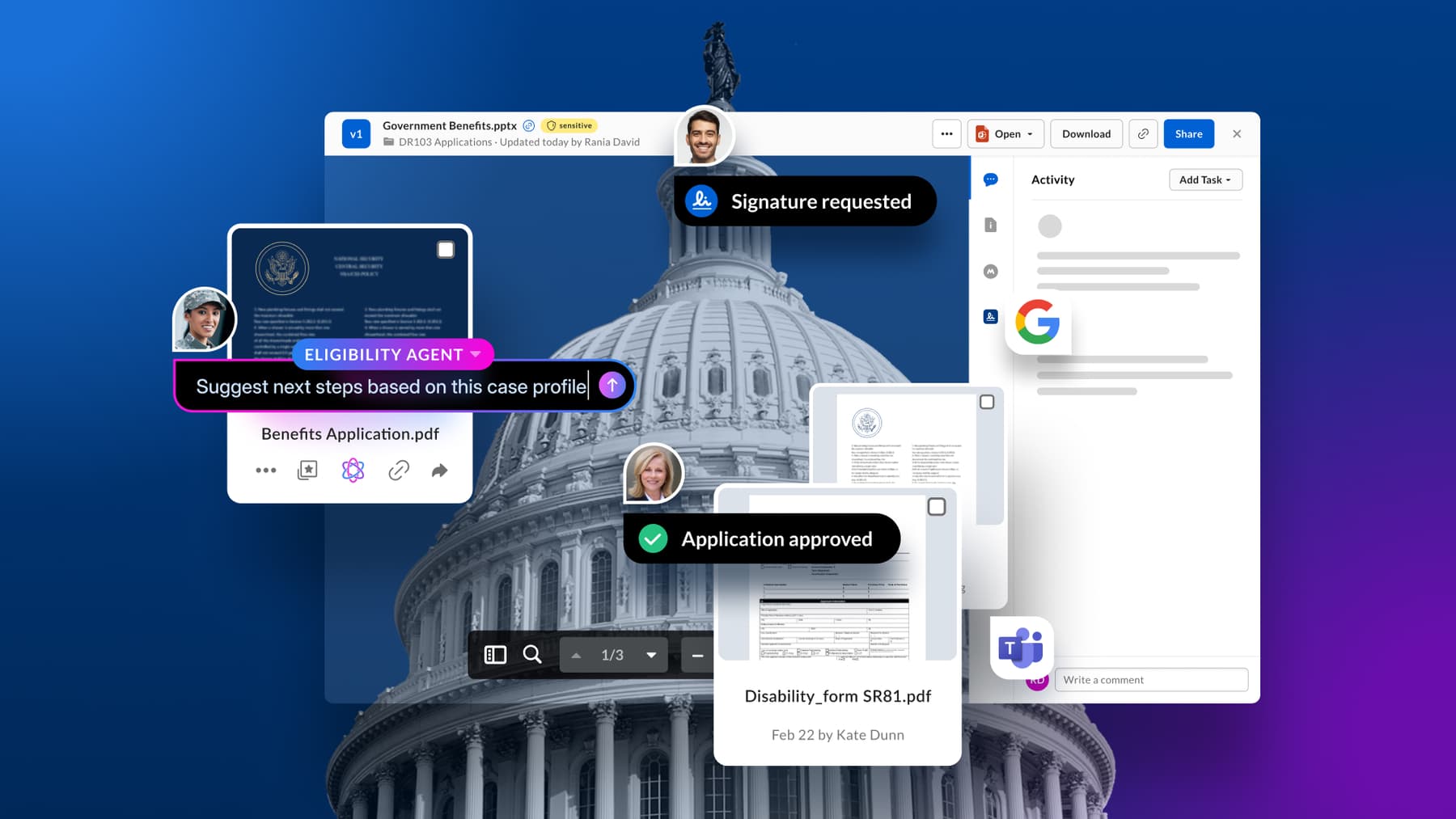
With AI-assisted policy review, the caseworker can select all the files related to a case and open a pre-configured benefits agent. Using Box, that AI agent can be built by the agency with plain language instructions and leveraging their AI model of choice (one that meets GovRAMP and FedRAMP High requirements).
Box AI immediately surfaces discrepancies between the application itself and the submitted documents, such as a difference in reported income.
Box AI immediately surfaces discrepancies between the application itself and the submitted documents, such as a difference in reported income shown on an applicant’s pay stub and what’s reported on the application. Flags like this at the beginning of the review help the caseworker determine the immediate next steps, which speeds processing timelines for ultimately determining eligibility.
Initial AI-case analysis is grounded in both the applicant’s documents and the official policy manual. Every source the AI analysis is pulling from is cited, including the relevant policy section, giving the caseworker an explainable and auditable determination. Instead of searching through multiple documents and dozens of pages of policy guidance, the casework can evaluate the entire case in minutes, with AI applying the policy logic while she remains the decision maker.
Compliance as a byproduct, not a project
Consider another agency use case. A chief compliance officer is responsible for an annual audit of the agency’s applicant relationship management tool, which takes weeks of preparation, including reconstructing case histories, confirming that retention policies have been followed, and pulling together documentation that lived in a dozen different places.
Because Box is GovRAMP and FedRAMP High authorized, and HIPAA compliant, compliance, audit trails, and retention are built in, not bolted on.
With a governed content platform, that preparation largely takes care of itself.
- Every action on every case is logged and auditable
- Retention policies are applied automatically based on case type and status
- When retention periods expire, disposition happens automatically
- When auditors arrive, the agency can produce a complete chain of custody for any case: who accessed what, when, and what actions they took
A CCO can search across five years of audit findings in seconds and confirm that policies are being enforced without opening a single folder manually. The compliance posture that used to require a dedicated sprint is now a continuous state.
Because Box is GovRAMP and FedRAMP High authorized, and HIPAA compliant, compliance, audit trails, and retention are built in, not bolted on.
What agencies are seeing in practice
The capabilities described here: structured intake, automated classification, AI-assisted eligibility review, automated audit trails, are ones agencies are implementing today with AI agents and workflow automation.
This serves three constituencies:
For applicants: Applications are guided and digital, end to end. Transparency improves with real-time status updates. Service gets faster. Access expands, and services are available 24/7 from any device.
For caseworkers: Time savings come from automated intake, intelligent extraction, AI-assisted policy review, and automated workflows. Staff can focus on judgment and service delivery, not document chasing.
For leadership: Measurable improvements in tracking historical information and transferring institutional knowledge. Stronger oversight with complete audit trails. Resource efficiency as teams handle more with the same staff, and greater public trust.
The structural problem has a structural solution
A caseworker’s queue will always have cases in it; that’s simply the nature of the work. The question is how much of their day is spent on paperwork that can easily be automated versus the judgment, connection, and expertise that only a human can provide.
Watch the on-demand presentation Modernizing case management at scale or watch the full session or download our ebook on best practices for leveraging AI in government.