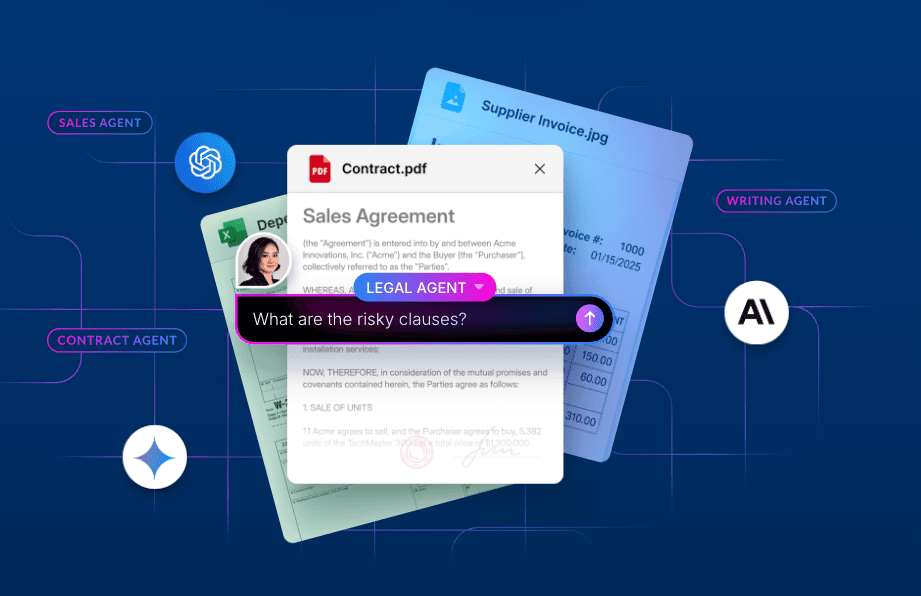
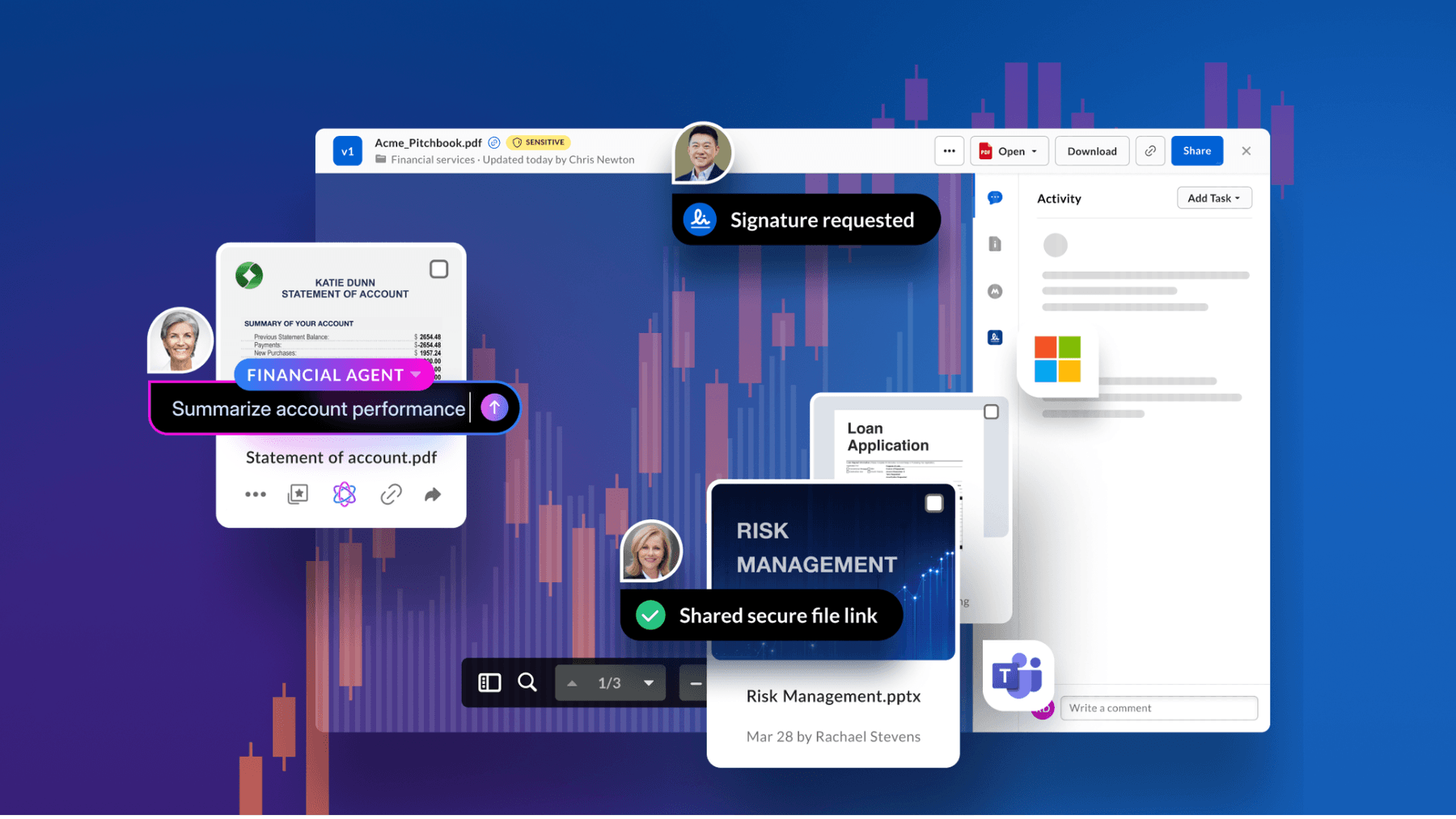
Intelligent Content Management (ICM) is a unified, AI-powered approach to managing and securing unstructured data. It provides organizations with collaboration, advanced AI capabilities, robust data protection, compliance, and workflow tools that are interoperable and customizable.
While traditional enterprise content management (ECM) platforms often fail to analyze raw data and automate tasks like summarizing a lengthy document, an Intelligent Content Management system simplifies these processes.
Thanks to Box’s Intelligent Content Management platform, teams can integrate technologies like generative AI (GenAI), machine learning (ML), and natural language processing (NLP) in one secure place. They can gather insights from reports or locate information within collective files in seconds.
Let’s take a closer look at the definition of Intelligent Content Management, its top benefits for organizations, and the basic steps required to implement a platform that helps you get the most out of your content.
Defining “intelligence” in content management

Intelligent Content Management means integrating AI and other technologies into your data management system to enhance content creation, collaboration, and analysis. Within this model, the term “intelligence” refers to a set of capabilities that make these practices more efficient and accurate.
Box’s ICM provides a secure repository for all your content. That way, it’s easier for AI agents to access the data needed to offer personalized recommendations and automate workflows
Here’s a breakdown of the main capabilities that define this content management approach.
- Advanced search and retrieval: NLP and retrieval-augmented generation (RAG) technologies allow users to query content in natural language rather than relying on specific keywords. This functionality makes it easy to find documents, and the results are more contextual and precise.
- Automation: AI and ML models automate repetitive tasks such as content tagging, categorization, and summarization using metadata. Instead of relying on users to conduct these tasks manually, Intelligent Content Management saves time and reduces the chances of human error.
- Data analysis: In this content management approach, machine learning models train on massive amounts of data so they can identify user intent and recognize patterns in a script, a presentation, or a meeting transcription.
- Personalization: An Intelligent Content Management system integrates GenAI models, which means you can create intelligent content for specific audiences, tailoring the tone and the message to better connect with different segment preferences and needs.
While intelligence in content management covers the entire content lifecycle across your organization, you can also use an approach to focus specifically on documents. Intelligent document management helps you organize, store, and access documents more efficiently by using modern solutions. It allows you to speed up content approval processes and enhance searchability for legal or financial records.
Discover how to use AI for business.
Why you need an Intelligent Content Management system
A Box-sponsored IDC white paper shows that 58% of unstructured data is never reused. Choosing an Intelligent Content Management platform allows you to expand the use of AI and other advanced capabilities to make your content intelligent, accessible, and valuable.

Explore the benefits of replacing an outdated ECM with an Intelligent Content Management platform.
- Easy collaboration. These kinds of platforms offer a simple, user-friendly interface that’s easy to navigate, helping teams work together without the frustration of complex systems
- AI-powered innovation. Intelligent Content Management integrates the latest innovation in AI that’s secure and designed to extract insights and metadata from unstructured data, maximizing the value of your content as a strategic asset
- Enhanced security and compliance. An Intelligent Content Management solution protects your content from data breaches and other cyber threats throughout its lifecycle. These solutions offer robust features like file encryption, granular access controls, and other core principles of zero-trust architecture, which preserve data integrity and meet industry regulations
- Modern automation and workflows. Powering workflows with AI reduces human error and saves time by automating repetitive tasks. Intelligent cloud platforms offer advanced search and retrieval capabilities, so you can ask questions about the content of a manual or quickly find a document containing specific information, keywords, or phrases
- Deep interoperability. A platform that integrates with your existing IT stack and other apps enables you to enhance user experience and increase productivity. This way, you connect all your tools in one place, making it easier to access information and collaborate on content
- Robust developer tools and APIs. With rich software development kits (SDKs) and flexible application programming interfaces (APIs), your tech team can create custom solutions that enhance user experiences, such as better data accessibility and intelligent document processing
- Cloud-first infrastructure. With Intelligent Content Management, you rely on cloud-first infrastructure and AI technologies to scale content creation and management, making tasks like drafting meeting agendas or customizing job offers more efficient
ICM and retrieval-augmented generation (RAG)
Retrieval-augmented generation helps an AI model answer questions using relevant information retrieved from an organization’s content. When someone asks a question, a RAG system searches for useful passages, supplies them as context to a generative model, and uses that context to produce an answer. This can make responses more relevant to company documents than relying on a model’s general training alone.
RAG depends on more than a language model and a search index. The system also needs reliable access to content, clear signals about what each item contains, and controls that determine who can see it. Box’s Intelligent Content Management platform provides a governed content layer for that work: it can organize content, apply metadata, preserve permissions, and connect information to AI experiences.
Governance matters throughout the process. If a user cannot access a sensitive file in the source system, the retrieval experience should respect that restriction. Otherwise, an answer could reveal information even when the user never opens the document itself. Content quality matters, too: current, well-organized documents are more useful context than outdated or poorly labeled files.
RAG can help people ask questions in natural language and find information across large content collections. ICM gives this experience a managed foundation, so organizations can connect AI to business content while maintaining control over how that content is accessed, governed, and used.
How intelligent document processing (IDP) works with ICM
Intelligent document processing applies AI and automation to documents. It can identify document types, extract fields, and route information into business processes. For example, an IDP workflow might recognize an invoice, capture its supplier and total, check the extracted values, and send the invoice for approval.
A typical IDP process has several stages:
- Content is ingested from uploads, email, scanners, APIs, or repositories
- The system classifies each document, either by recognizing its type or by using information about where it entered the workflow
- It then extracts fields according to a schema, such as a contract’s effective date or a claim’s policy number
- Validation checks the extracted values, sometimes using confidence signals or human review
- Finally, the data is passed to an application, analytics tool, or workflow
ICM supports the content around that process. It can provide a governed place for source documents, preserve access controls, and help teams find the original file when they need to review an extracted value. Metadata can connect a document with its type, owner, status, or business process, making it easier to organize and retrieve. Integrations and APIs can link content workflows with other business systems.
Together, ICM and IDP connect documents to action. IDP helps capture and structure information; ICM manages the content, context, and controls that surround it. This combination can reduce manual data entry and speed up processes while keeping documents available for collaboration, review, and future use.
ICM and AI agents
AI agents can use information to answer questions, make recommendations, and carry out tasks across business applications — but their usefulness hinges on the context they can access. If that context includes relevant company documents, policies, and records, an agent can respond in ways that reflect how an organization works.
An Intelligent Content Management platform provides a governed source of that context and a foundation for connecting agents to business content with context and controls. Organizations can then use AI in ways that fit with existing responsibilities and processes.
Meanwhile, teams can manage enterprise content and the permissions, metadata, and workflows associated with it. Agents get relevant files as context, and ICM ensures files only seen by to authorized users.
Metadata’s role in ICM
Metadata is information that describes content. A document’s metadata might include its title, creator, date, file type, customer, project, status, or retention category. Some values are supplied by people or business systems; others can be extracted or suggested by AI. Together, these details help people and technology understand what a file is and how it should be handled.
In an Intelligent Content Management system, metadata supports connected tasks. It improves discovery by letting people filter or search for content based on attributes, not just words in a document. It also supports automation by helping AI distinguish, for example, an invoice from a contract — and contributes to governance by recording ownership, sensitivity, retention needs, or business context.
A thoughtful metadata framework makes content easier to find, govern, automate, and use as context for AI.
How to implement an Intelligent Content Management solution in your business
Integrating AI in content management involves opting for a solution that addresses the needs of your organization. Follow these four steps to tap into the full potential of AI.
1. Understand the key difference between ECM and Intelligent Content Management solutions
Suppose you work for a media company and have a meeting with potential sponsors for a new project. At the end of the meeting, they ask a couple of questions, but you need to find specific contract clauses stored in your content management solution. Depending on the platform you use, you could get two very different results:
- By using a traditional ECM platform, you might spend a significant amount of time searching through folders and manually sorting through documents, and risk missing the exact clause you’re looking for
- In contrast, an ICM solution would let you locate specific clauses using keywords and contextual search by using AI in content discovery — which offers more accurate results and saves you significant time in the process
But Intelligent Content Management goes beyond AI capabilities. It brings together the best of traditional ECM features and other content management tools you might already use into one unified platform. Intelligent Content Management makes getting content insights easier, which can be key to responding confidently and leaving a lasting impression on potential sponsors, customers, or partners.
2. Identify content security and governance gaps
Understanding your content lifecycle helps you find bottlenecks and inefficiencies in your security and governance processes that an intelligent document management system can address. These gaps can expose sensitive information or make it difficult to comply with necessary regulations. Examples include:
- Lack of encryption for sensitive data
- Insufficient access controls
- Unclear file ownership and version tracking
- Inconsistent document retention policies
For example, you might detect that collaboration in your company often involves email back and forth between teams and clients. In this case, an Intelligent Content Management platform with secure file sharing, document version control, and integration with other platforms would enable intelligent collaboration.
If you work in highly regulated industries where data privacy and integrity are mandatory, look for features like encrypted document sharing, multi-factor authentication (MFA), and retention policies. With an ICM platform, you collaborate on documents securely while having peace of mind that your content workflows meet the proper compliance standards.
Explore the top enterprise-grade features of secure collaboration tools.
3. Choose an Intelligent Content Management platform that scales with your business
Your content output grows with your business, so consider a solution with scalable cloud data storage — you don’t want the high maintenance costs of on-prem systems and the constant hassle of hitting full capacity.
Look at your needs before making a choice. If you constantly need to send large video files to coworkers, for example, opt for a platform with flexible storage capacity (with equally flexible pricing).
4. Align the ICM implementation plan with your AI strategy
Asana’s 2024 State of AI at Work shows that only 31% of companies have implemented a formal AI strategy. Whether your business is developing a strategy or already has one, you must align it to your intelligent content management implementation.

Get started on your business’ AI strategy with these best practices.
- Select intelligent cloud services with responsible AI models. Services with clear AI principles give your company autonomy over when and how to use AI. Make sure commitments are transparent and accountable.
- Verify if the platform integrates secure RAG. Intelligent Content Management platforms with RAG offer granular access controls to protect content when collaborating with team members or clients
- With file and folder permissions, a user with no access to a sensitive document can’t locate, summarize, or search for information in it
- Establish a consistent metadata framework. A clear, standardized metadata structure enables AI platforms to understand and process content effectively. Adopting metadata management best practices, such as defining categories and establishing naming conventions, helps keep your content searchable and accurate
- Sync your ICM implementation with your AI strategy goals. Aligning strategies allows you to use all the intelligence in content management while meeting overall business objectives. Whether your company aims to scale operations, cut costs, or drive innovation with AI, remember to set KPIs that reflect your content management and business needs

Upgrade from ECM to Intelligent Content Management with Box
Box makes Intelligent Content Management simple and secure. Rather than investing in expensive, outdated ECM solutions, you can create and manage content at scale with the leading Intelligent Content Management platform, powered by the most advanced AI technologies.
We’re committed to responsible and transparent AI principles, keeping your security and privacy as our priority. Unlock the value of your content with Box AI — get answers from your documents, draft content in seconds, and make important decisions faster than ever before.
Connect Box with 1,500+ app integrations and keep track of all your content in a single solution, no matter where you created or accessed it. Let’s connect and discuss all you can do with Box as your Intelligent Content Management platform.

While we maintain our steadfast commitment to offering products and services with best-in-class privacy, security, and compliance, the information provided in this blog post is not intended to constitute legal advice. We strongly encourage prospective and current customers to perform their own due diligence when assessing compliance with applicable laws.