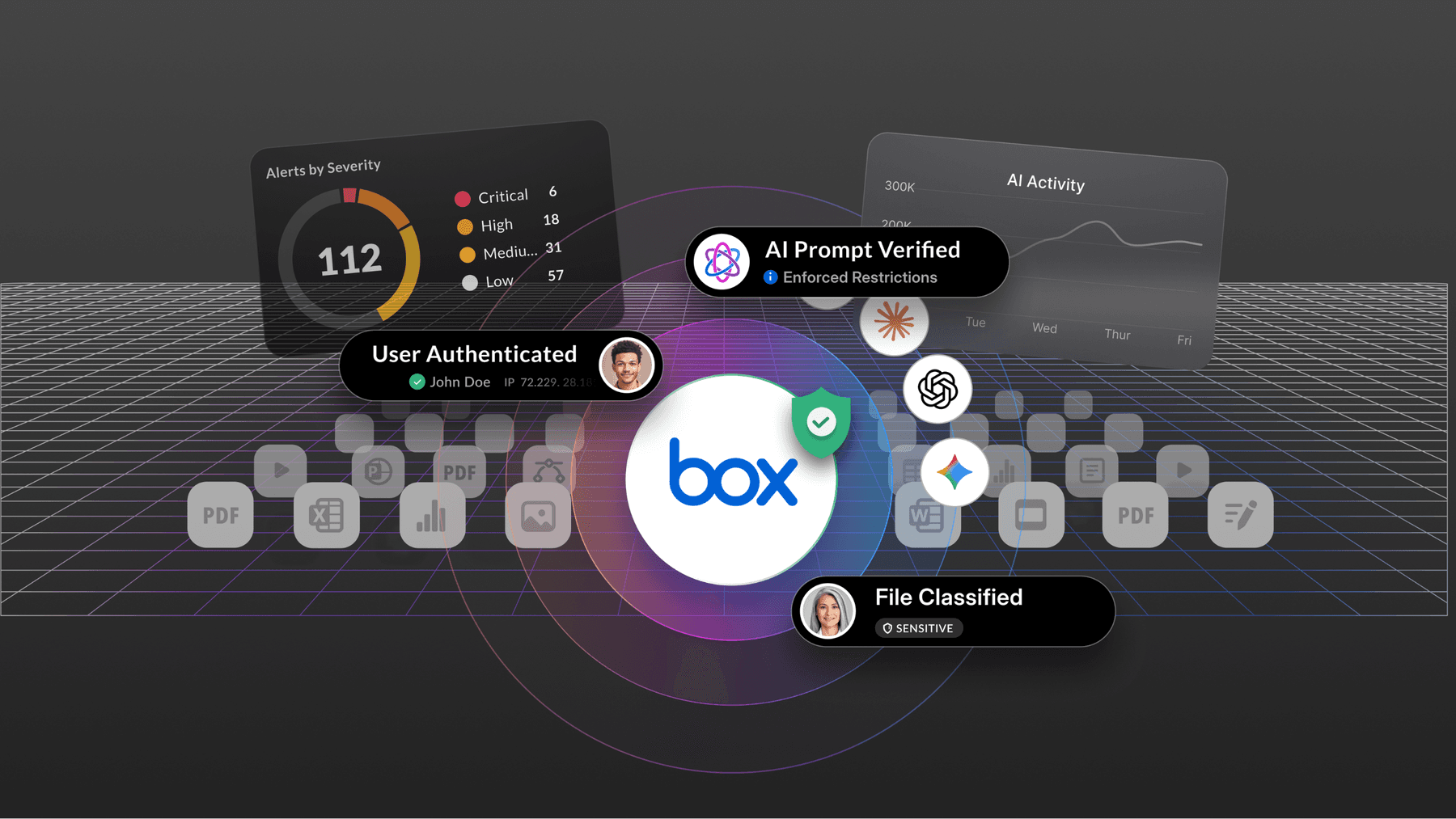
At the heart of content security is a simple truth: you can’t protect what you don’t understand. Every organization stores an ocean of contracts, roadmaps, customer records, board materials, product specs, and internal communications, all carrying different levels of sensitivity, business value, and risk.
Content classification, which we added last month to Box Shield Pro, turns understanding into action, translating “What is this?” into “How should this be handled?”, so both people and systems can consistently apply the right safeguards, automatically and at scale. Classification provides the guardrails for secure collaboration, governance, and threat response across the entire content lifecycle.


Why classification is foundational (and why it’s hard)
In modern enterprises, classification is a security imperative, because not all data is equal, and treating it that way creates risk in both directions:
- Overprotecting low-risk content slows teams down, frustrates users, and wastes security resources.
- Underprotecting sensitive content invites oversharing, leakage, non-compliance, and painful incident response.
Classification introduces the nuance security programs need. It enables organizations to distinguish between content like public-facing marketing files and highly sensitive financial strategy, HR notes, or customer data, then apply protections proportionate to risk.
It also directly addresses one of the biggest drivers of breaches: human error. Clear, consistently-applied labels (e.g., Public, Internal, Confidential, Restricted) act as both a visual cue and an enforcement trigger, helping prevent accidental exposure at the moment decisions are made, and not after the fact.
And because regulations and audits require organizations to prove they know where sensitive data lives and how it’s protected, classification provides the structure that makes it possible to apply controls consistently and simplify compliance and reporting.
The challenge is that content volume, varied formats, multiple languages, fragmented repositories, and constantly changing context make a “tag it by hand” approach to data classification unrealistic — especially given that sensitivity can evolve over time as files are edited, repurposed, and shared. That means classification at enterprise scale often breaks manual processes.
How Box uses classification to secure and govern content automatically
Box Shield treats classification as more than metadata. In Box, classification labels are enforceable. They don’t just describe sensitivity, they carry the policies that control how content can be accessed, shared, retained, and disposed of.
Automated Classification (rule-based): fast, consistent protection for known signals
Box Shield’s Automated Classification detects defined identifiers like credit card numbers, Social Security numbers, and other predictable patterns, and automatically applies the appropriate label. This is extremely effective when sensitive content has clear markers.
Box Automated Classification has helped customers classify >7 billion files in the past year.
AI Classification Agent (context-driven): expands coverage to nuanced content
But a lot of most organizations’ most critical content doesn’t contain neat identifiers. But much of an organization’s most critical content doesn’t contain neat identifiers. Strategy docs, meeting notes, M&A materials, scripts, product plans, sensitive HR narratives…there are huge amounts of content that need to be understood in context to accurately determine sensitivity.
That’s where Box Shield Pro’s AI Classification Agent expands classification dramatically:
- It inspects content using context and prompt-defined sensitivity
- It evaluates content’s “MVPs:” Meaning, Value, and Purpose
- Admins define sensitivity in plain language (custom prompts per label) and can test prompts on a subset of up to 10 files before rolling out broadly
- It applies the best-fit label automatically as content is uploaded, previewed, edited, and more, keeping the classification label current as the content evolves
- It provides a rationale/explanation for why a given label was chosen, offering better transparency and easier tuning

Smart Access controls: classification becomes the enforcement switch
Once a label is applied, whether by deterministic rules or AI, the label can automatically trigger Smart Access controls and governance policies. Here are some examples of classification-driven controls:
- Download restrictions
- Print restrictions
- Watermarking
- Shared link restrictions
- App restrictions
- External collaboration restrictions
- FTP restrictions
And beyond access controls, classification labels also carry governance controls like:
- Retention policies
- Disposition / deletion policies
- In the future, archival policies
Classification initiates the entire content protection lifecycle, from identification to enforcement to governance. Watch the demo below to see it in action.
A lifecycle view: classification as the linchpin of content protection
Classification is most powerful when it’s treated as the start of an automated chain reaction. Here’s a practical way to think about the lifecycle Box enables:
When classification is consistent and enforceable, security tools stop operating blind. Instead they’re armed with the context they need to protect organizations’ sensitive content without slowing down the rest of the business.
New capabilities expand classification’s impact even further
As classification becomes the central control plane for content protection, expanding what it can drive (and what it can cover) compounds the value.
New security capabilities continue to build on Box’s classification-driven security, including:
- Expanded Smart Access controls, like the upcoming Shared Link Expiration, that increase the number of tools admins have for automatically securing their content.
- Enhancing the granularity of our controls, like our recent introduction of customized watermarking by classification, that provide more nuanced, precise content protection.
- Extending the scope of our content security tools, such as our recent implementation of watermarking for video content (which can be applied automatically via Box Shield Automated Classification).
At Box, we are continuously innovating new ways to protect critical content, and classification helps seamlessly integrate those new innovations into the security lifecycle.
Classification: the linchpin to frictionless protection
Content security doesn’t start with a threat alert. It starts with knowing what content is sensitive, why it’s sensitive, and what should happen next.
That’s why classification is the linchpin of Box content protection; it scales understanding, reduces reliance on manual processes, and triggers the security and governance controls that protect content end-to-end, from ingest to collaboration to disposition.