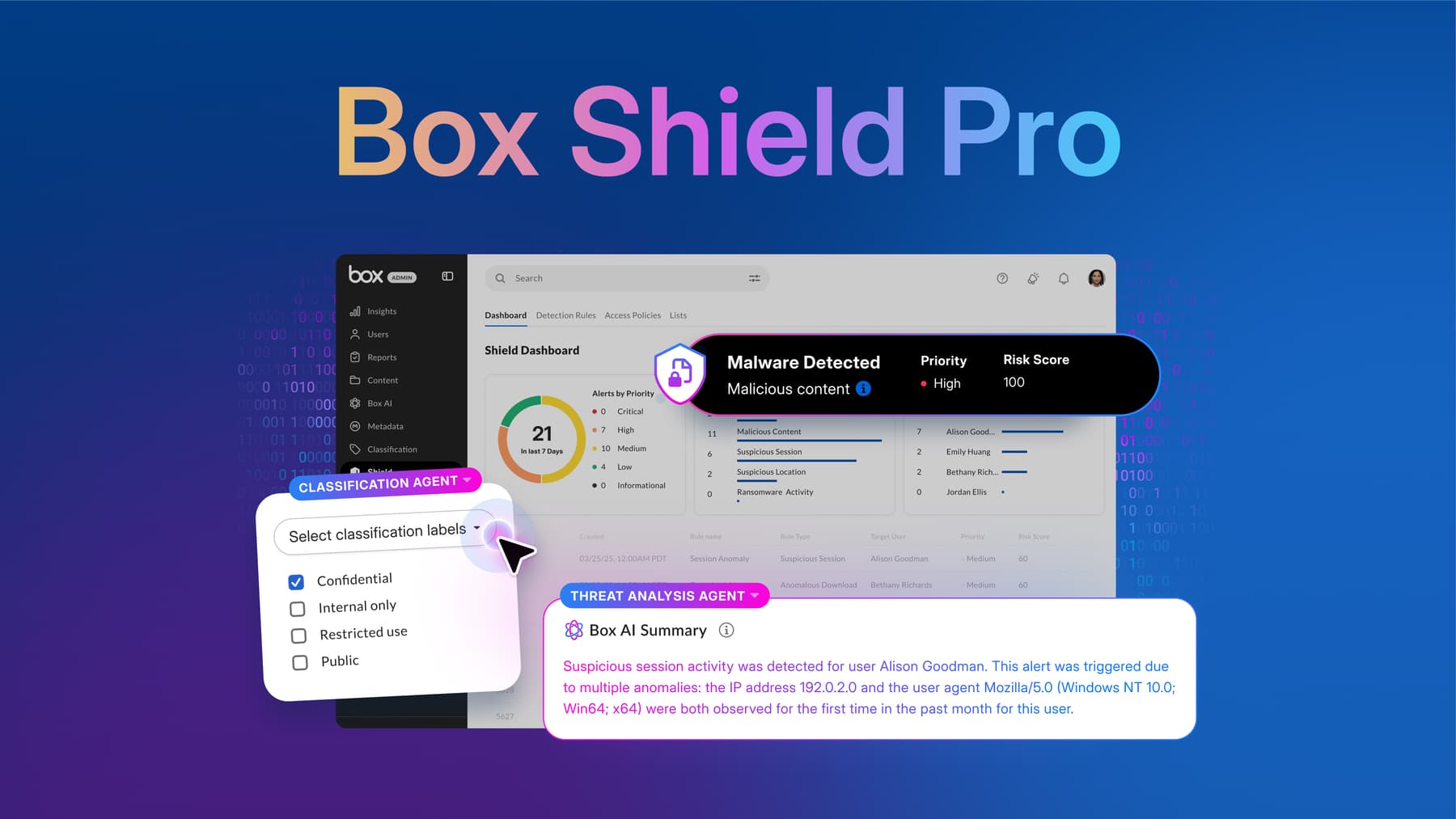
With Box Shield Pro, the global energy management company World Kinect can now automatically classify content and better secure key documents, even when collaborating with legal entities or audit firms external to the organization.
When April Jones started at World Kinect over a decade ago, the energy logistics giant had 30 Box users and five gigabytes of data. Today, April (the company’s System Administrator) oversees collaboration tools for 4,500 users and 240 terabytes of content on Box — a 48,000-fold increase in data volume.
World Kinect’s unstructured data spans the full spectrum of business operations: contracts, NDAs, financial documents, legal cases, audit compliance materials, and more. Each document type requires specific handling, access controls, and retention policies.
Multiply that complexity by 240 terabytes, and you begin to understand the magnitude of the challenge. And April’s IT team hasn’t grown proportionally to compensate for content growth over the years.
Adopting Box is a way for World Kinect to better collaborate with and secure all of this content. Specifically with Box Shield, April’s team can leverage Box AI for content protection.
As a beta Box Shield Pro tester, World Kinect gained:
- Automated content classification: Transforming manual, time-consuming classification into an AI-powered process that understands context and explains its reasoning
- Liberated IT resources: April’s small team was able to shift from reactive manual work to strategic security initiatives despite managing 240TB of content
- Simplified policy implementation: Direct translation of written security policies into automated classification rules using natural language
The hidden cost of manual classification
Classification is a critical aspect of the content conundrum for World Kinect. As April explains, “Right now, our classifications are manual, which can be time consuming.” And not just time consuming: It introduces risk.
When employees skip or simply don’t notice classification options, sensitive content can slip through unprotected. This creates what security professionals call "shadow vulnerabilities" — risks that exist not because of system failures, but because human-centered processes break down at scale.
For World Kinect, this challenge is particularly acute in external collaboration scenarios. When sharing sensitive data with legal entities or audit firms, each interaction requires careful oversight. With a manual process, the time investment to ensure secure sharing compounds quickly, pulling IT resources away from strategic initiatives.
Why traditional automation falls short
The security industry has long promised automation as the answer to scale challenges. But first-generation solutions relied on rigid pattern matching — searching for credit card numbers, Social Security numbers, or specific keywords. While these tools catch obvious cases, they miss the nuanced reality of business content.
Consider a document relevant to a merger discussion. It might not contain traditional identifiers like account numbers, but its strategic importance is undeniable. Or think about architectural drawings for a new facility: No keywords flag them as sensitive, yet they represent significant intellectual property.
Traditional tools see data; they don’t understand context.
This limitation forces organizations into an impossible choice: Over-classify and create friction that slows business, or under-classify and accept security gaps. Most choose a problematic middle ground, relying on employees to make classification decisions they’re neither trained for nor have time to execute consistently.
How Box Shield Pro enables automated content classification
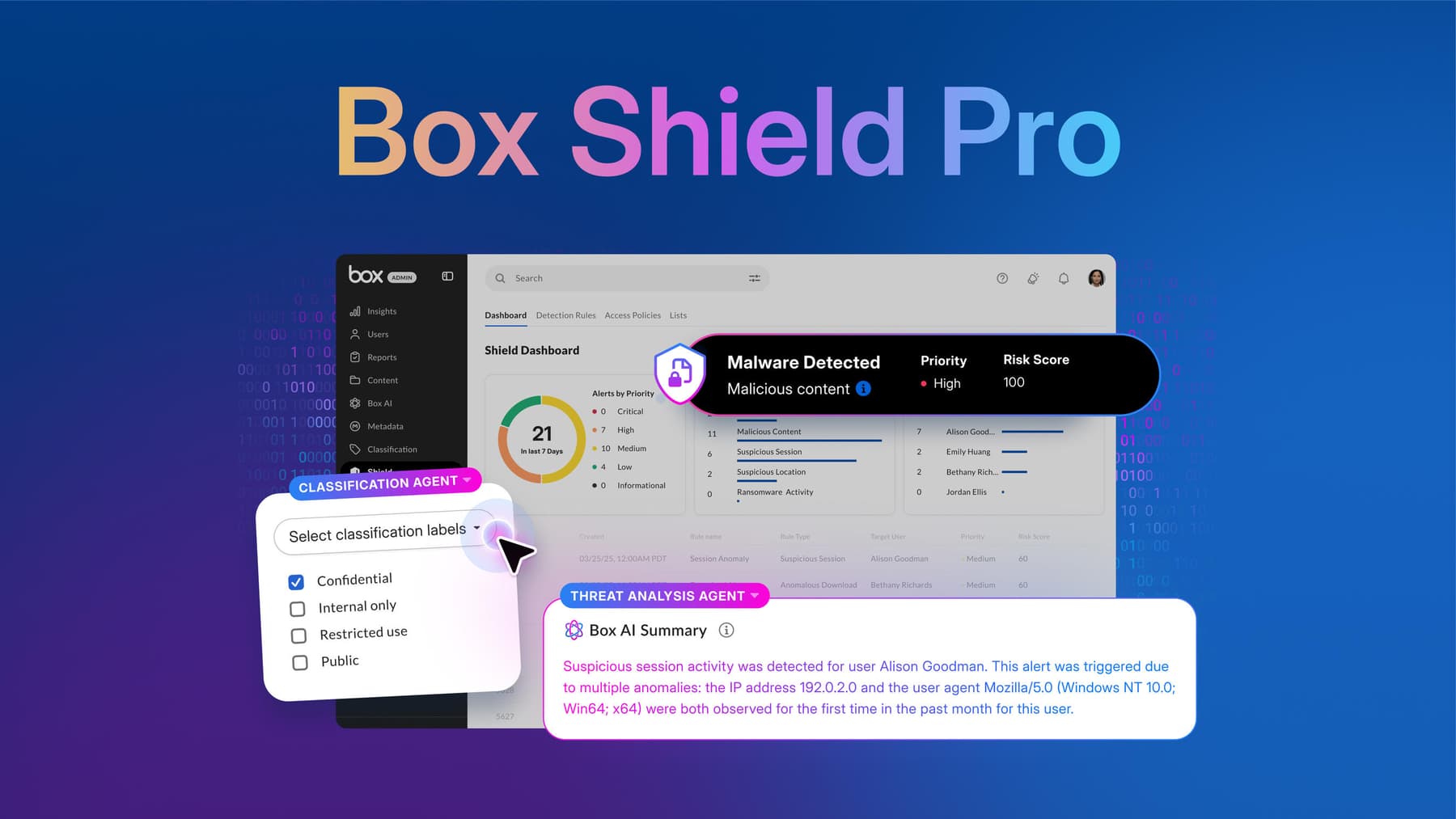
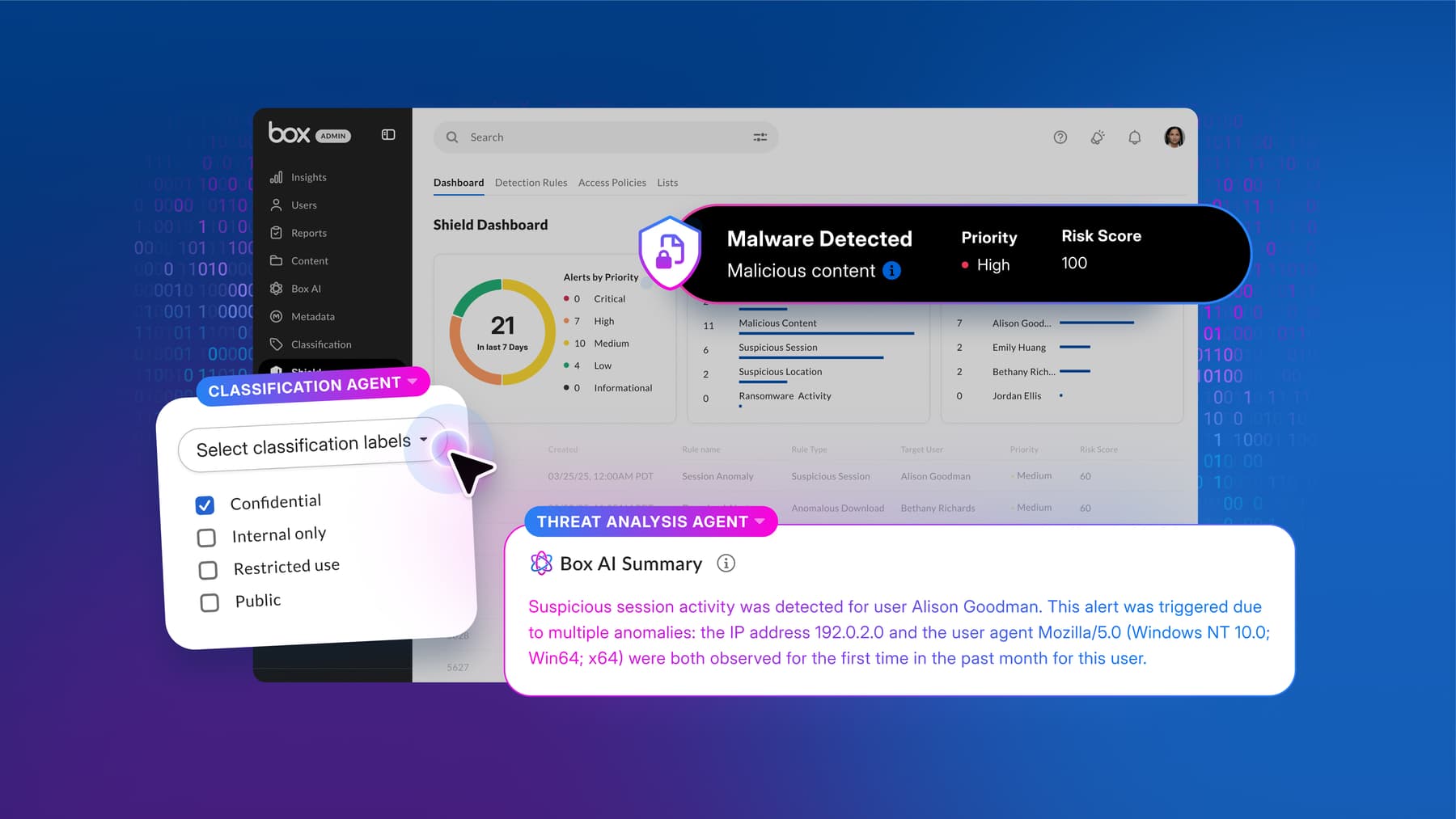
World Kinect’s participation in the Box Shield Pro beta allowed April’s team to take advantage of AI-enabled content classification. Instead of searching for patterns, AI classification understands content the way humans do: by grasping context, purpose, and implications.
“With AI classification,” says April, “I could cut and paste from my written policy, put it into the process, and the procedures and the classification labels were easily defined.”
Security policies written in natural language (the same documents that guide human decision-making) now directly inform automated classification.
Transparency transforms AI from a black box into an auditable process, crucial for regulated industries.
Box Shield Pro applies labels automatically, but it also explains its reasoning. “With the metadata, it told us why it classified something the way that it did,” April notes. This transparency transforms AI from a black box into an auditable process, crucial for regulated industries where classification decisions must withstand scrutiny.
Box Shield Pro means more time for higher-value IT work
When asked about metrics from the beta with Box Shield Pro, April focuses on an often-overlooked aspect of security automation: opportunity cost. After all, the question isn’t just how much time you have to work with. It’s what you do with it.
For resource-constrained IT teams, every hour spent on manual classification is an hour not spent on strategic security initiatives, user enablement, or innovation. The compound effect is significant. When IT teams shift from reactive classification work to proactive security design, the entire organization benefits. Security posture improves not through adding more controls, but by implementing smarter ones.
The prerequisite for AI success with Box Shield Pro (or any classification tool)
April offers crucial advice for organizations considering AI-powered security tools like Box Shield Pro: “The biggest thing is knowing what your data is and how it’s used before you can set up AI processes.”
This insight challenges the notion that AI is a plug-and-play solution. Successful implementation requires understanding your content landscape, documenting existing processes, and clearly defining security objectives. AI amplifies good security practices but doesn’t replace the need for them.
This foundational work, often unglamorous but essential, determines whether AI becomes a transformative tool or another layer of complexity.
“We have to know what the processes are first,” April emphasizes. This foundational work, often unglamorous but essential, determines whether AI becomes a transformative tool or another layer of complexity.
Reclaiming focus for work that matters
World Kinect’s journey illustrates a broader shift in enterprise security. The question is no longer whether to automate content classification, but how to do it intelligently. As data volumes continue their exponential growth, manual processes become not just inefficient but impossible.
April is looking forward to fully implementing AI classification with Box Shield Pro. Her enthusiasm reflects a pragmatic optimism, not about technology for its own sake, but about reclaiming time and focus for work that matters.
The future of content security lies in combining human insight with AI scale, creating systems that are both intelligent and efficient. World Kinect’s 48,000-fold data growth would have been unmanageable a decade ago. Today, with Intelligent Content Management, it’s an opportunity to reimagine how security works.
See how Box Shield Pro can automate classification for your team in this datasheet. Or read World Kinect’s customer story with Box.