This is chapter 2 of Box's State of AI in the Enterprise report 2026. Read more:
1: Executive Summary | 2: The Maturity Gap | 3: Context | 4: Control | 5: Change | 6: Capability | 7: Conclusion
-----
TL;DR: In twelve months, AI has spread across every function and beyond the reach of any single team. The value is real and it arrives fast — half of organizations see measurable impact within six months. But it concentrates at the top of the maturity curve, and the rest of this report is about what the leaders have built that separates them from the rest.
In 2025, the question was whether AI’s value to the enterprise was real. In 2026, that question is settled. The new one is who is capturing the value, and how.
The answer concentrates at the top of the maturity curve, where leading-edge companies use AI in more expansive ways, and build scalable operational scaffolding around the agents themselves.
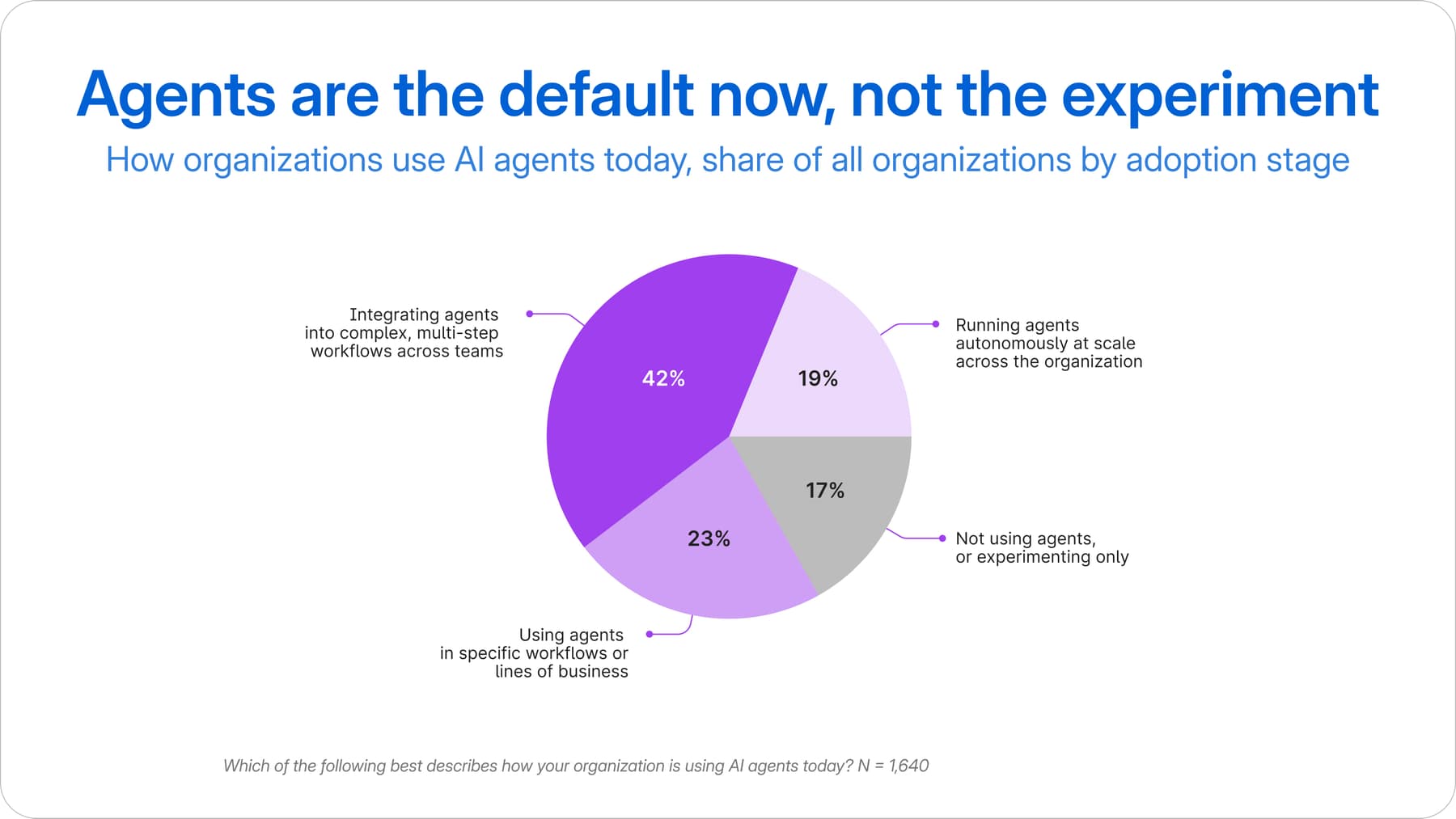
The scale of adoption is dramatic. 99% of organizations now use AI in some form; 83% run AI agents; 42% have integrated those agents into complex, multi-step workflows across teams; and 19% — roughly one in five respondents — already run agents autonomously at scale.
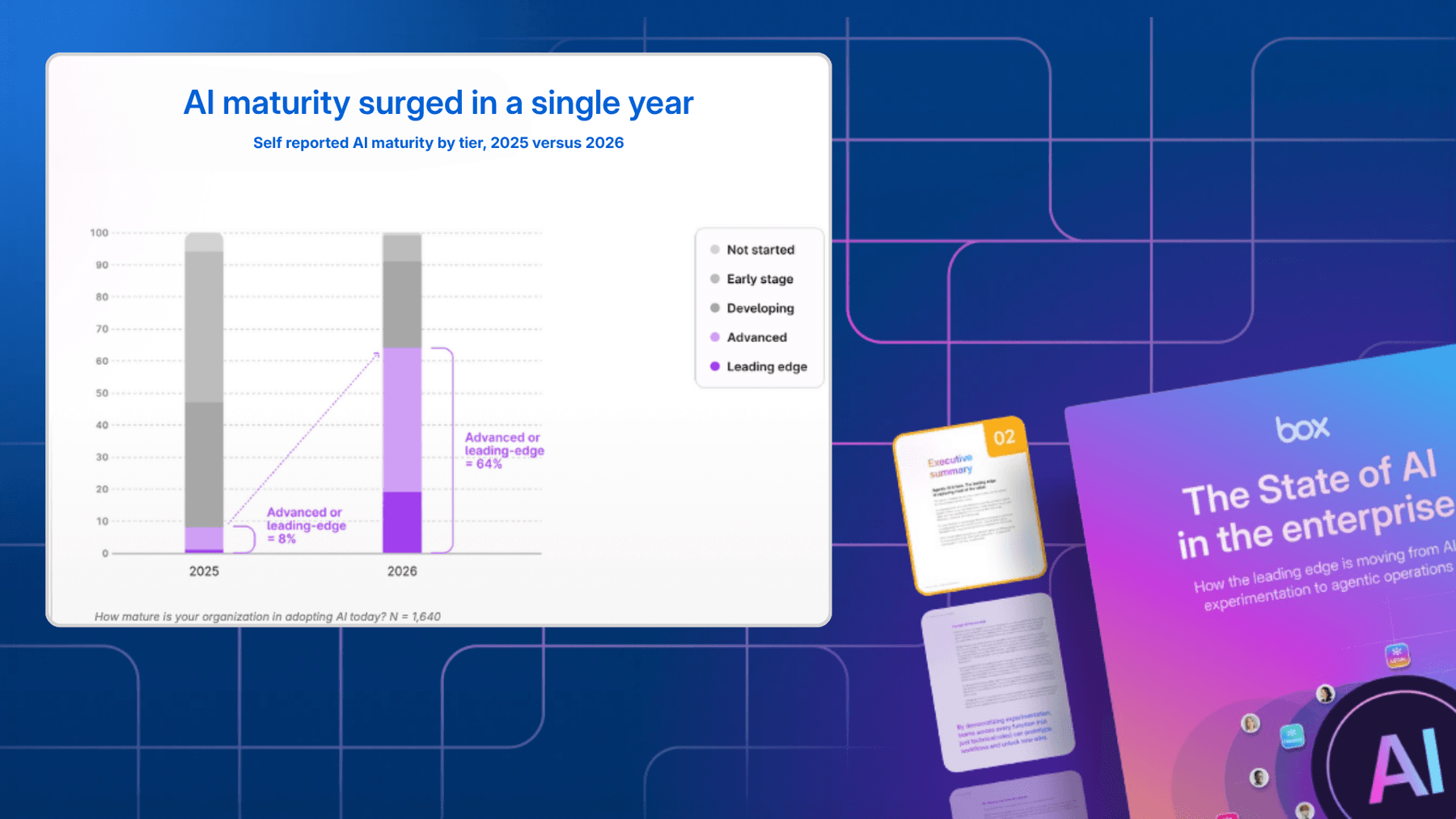
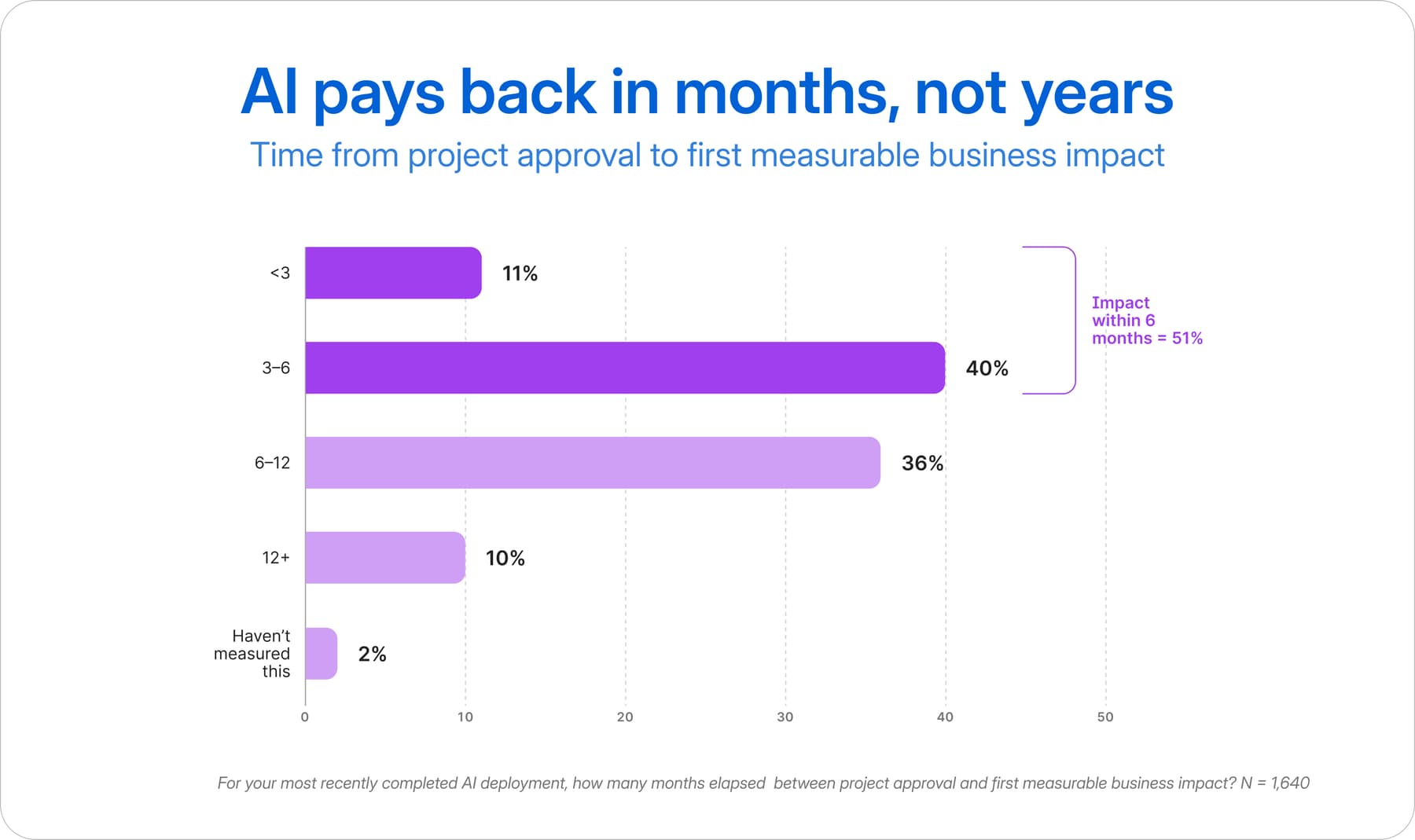
A year ago, just 8% of respondents called their organization advanced or leading-edge. Today, 64% do, and value has followed: 80% report moderate or significant ROI, and 51% have seen business impact within six months of project approval — a turnaround hard to imagine for any IT initiative two years ago.
80% report moderate or significant ROI from AI implementations
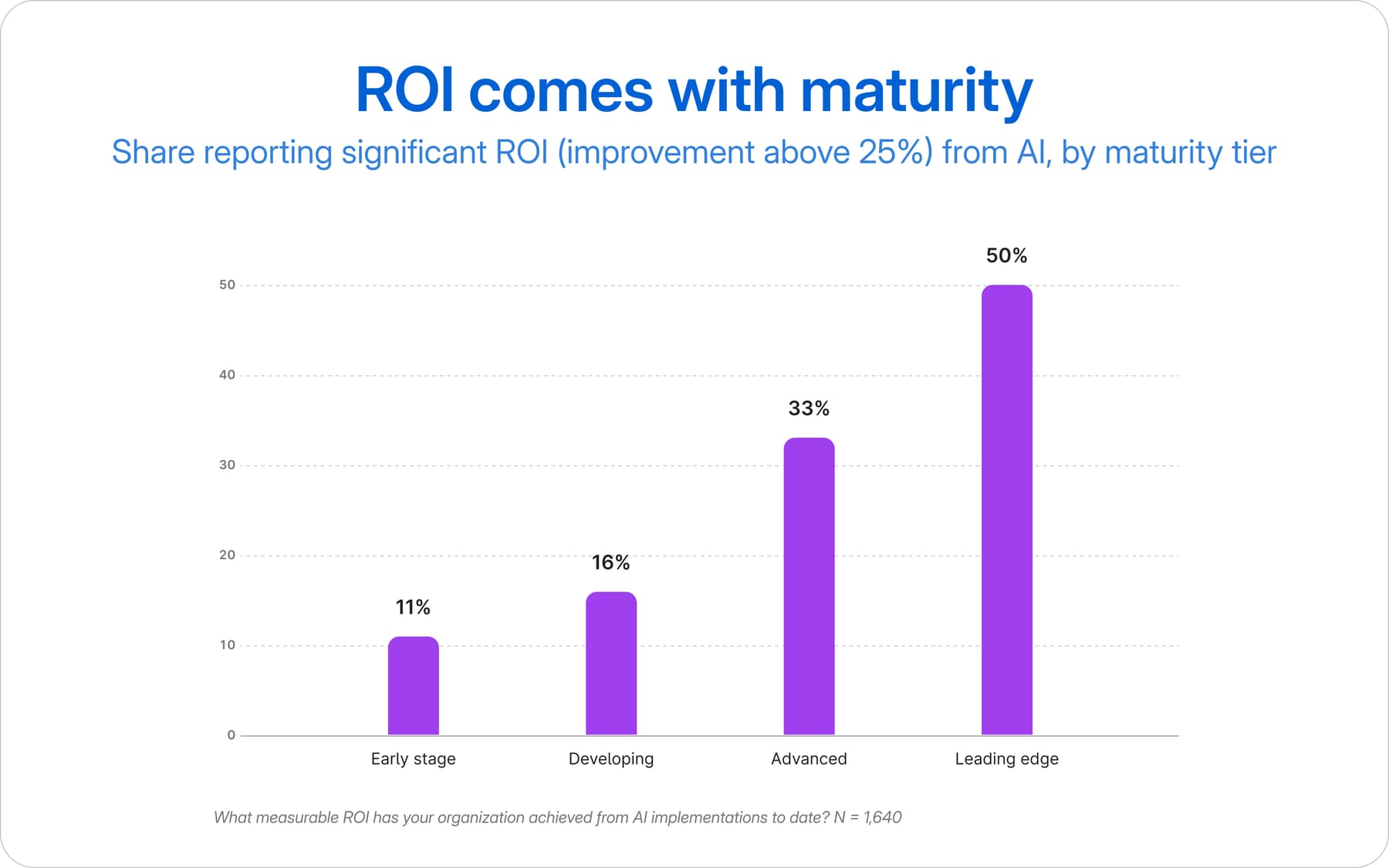
30% report significant ROI, defined as ˮmeasurable improvement above 25%ˮ on the metric they track.
That figure hides the year’s central finding: the gap in significant ROI between early-stage and leading-edge companies. Just 11% of early-stage organizations report significant ROI, against 50% of leading-edge ones. That is one of the widest gaps in the survey.
At the leading edge, AI agents focus on new work, not cheaper work
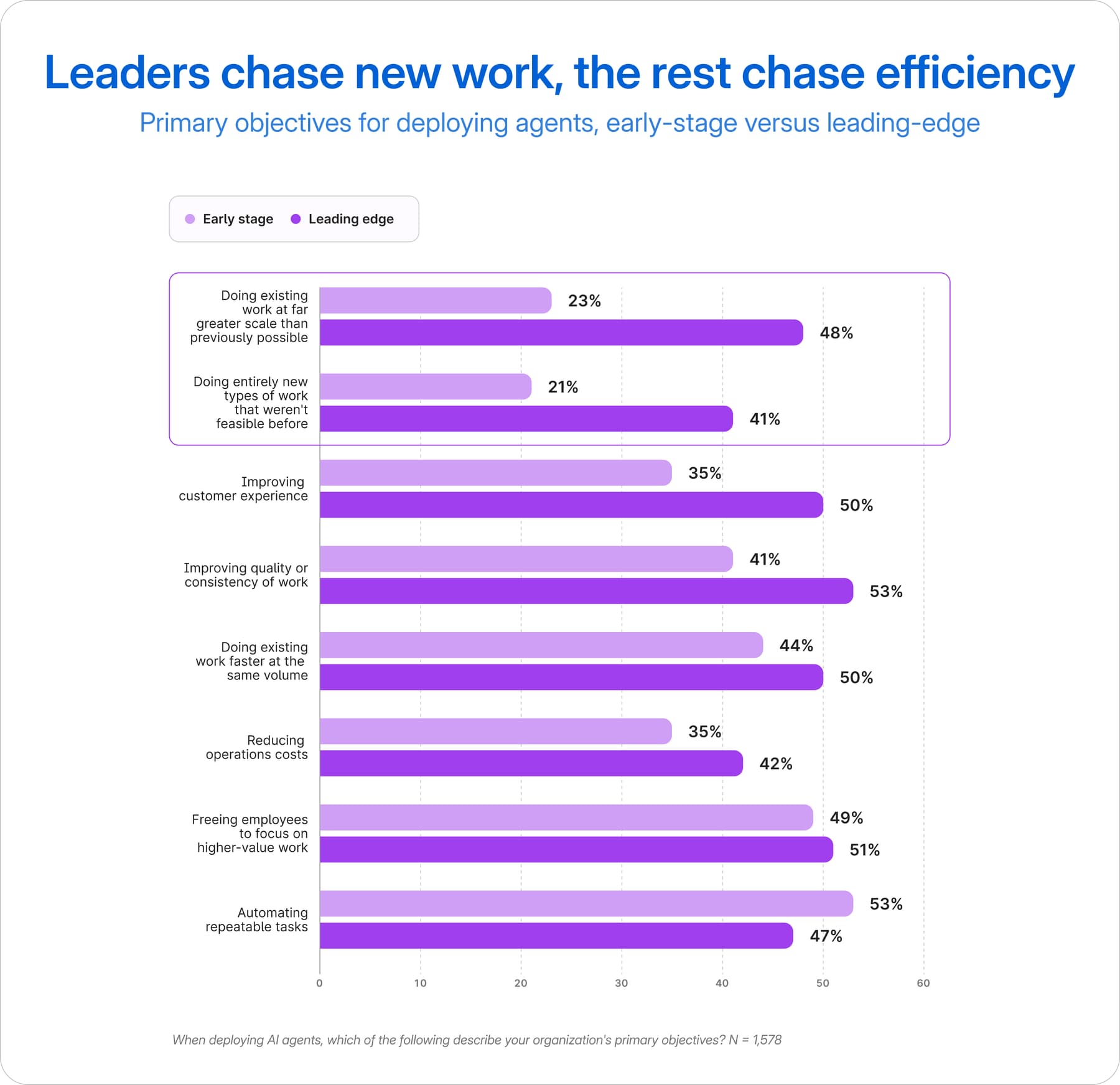
The most-cited objectives for deploying agents are still conventional efficiency wins: improving the quality and consistency of work (55%), automating repeatable tasks (53%), and improving customer experience (48%).
What sets the leading edge apart is the push into new work. 48% of leading-edge companies name “doing existing work at far greater scale than was previously possible” as a primary objective, and 41% – against just 21% of early-stage companies – name ˮdoing entirely new types of work that weren′t feasible beforeˮ as a goal.
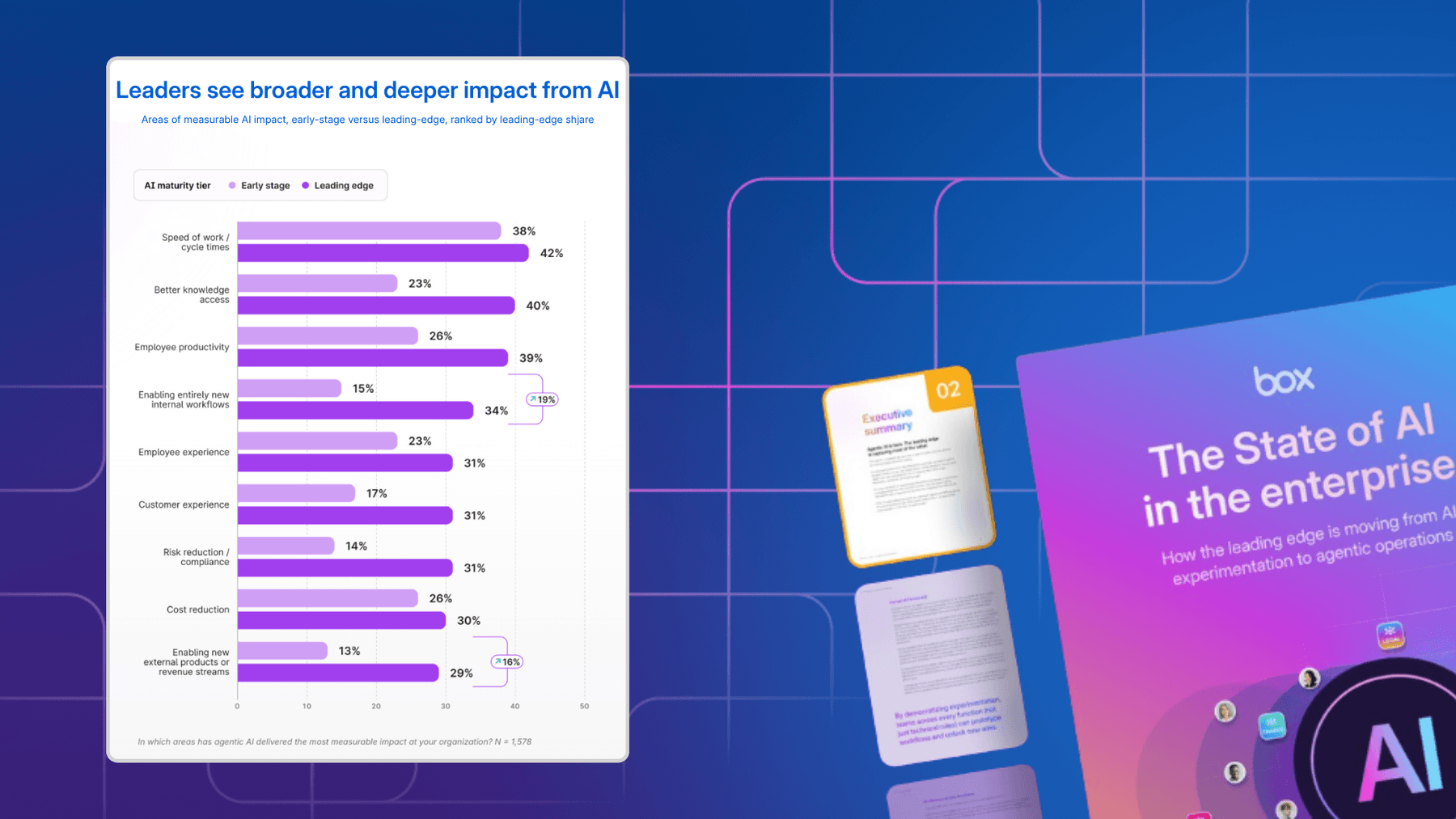
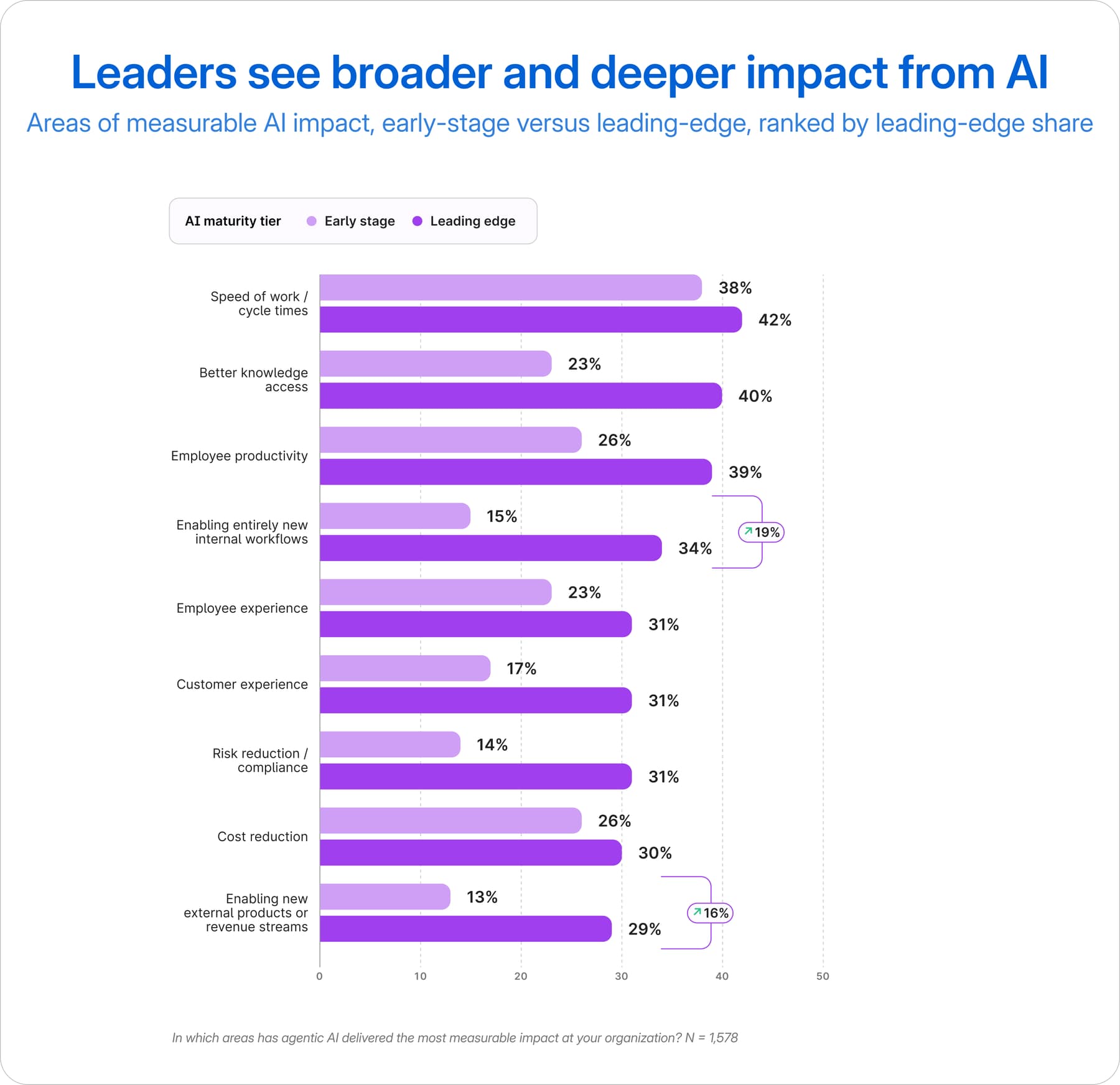
Leading-edge companies also see measurable impact across a broader range of areas. Employee productivity (43%) and speed of work (42%) are the most-cited impacts overall, but the leaders see meaningful impact more widely: over a third see it in new internal workflows (against 26% on average), and nearly a third see it in entirely new products or revenue streams (against 22% across all respondents).
Agents become a digital workforce
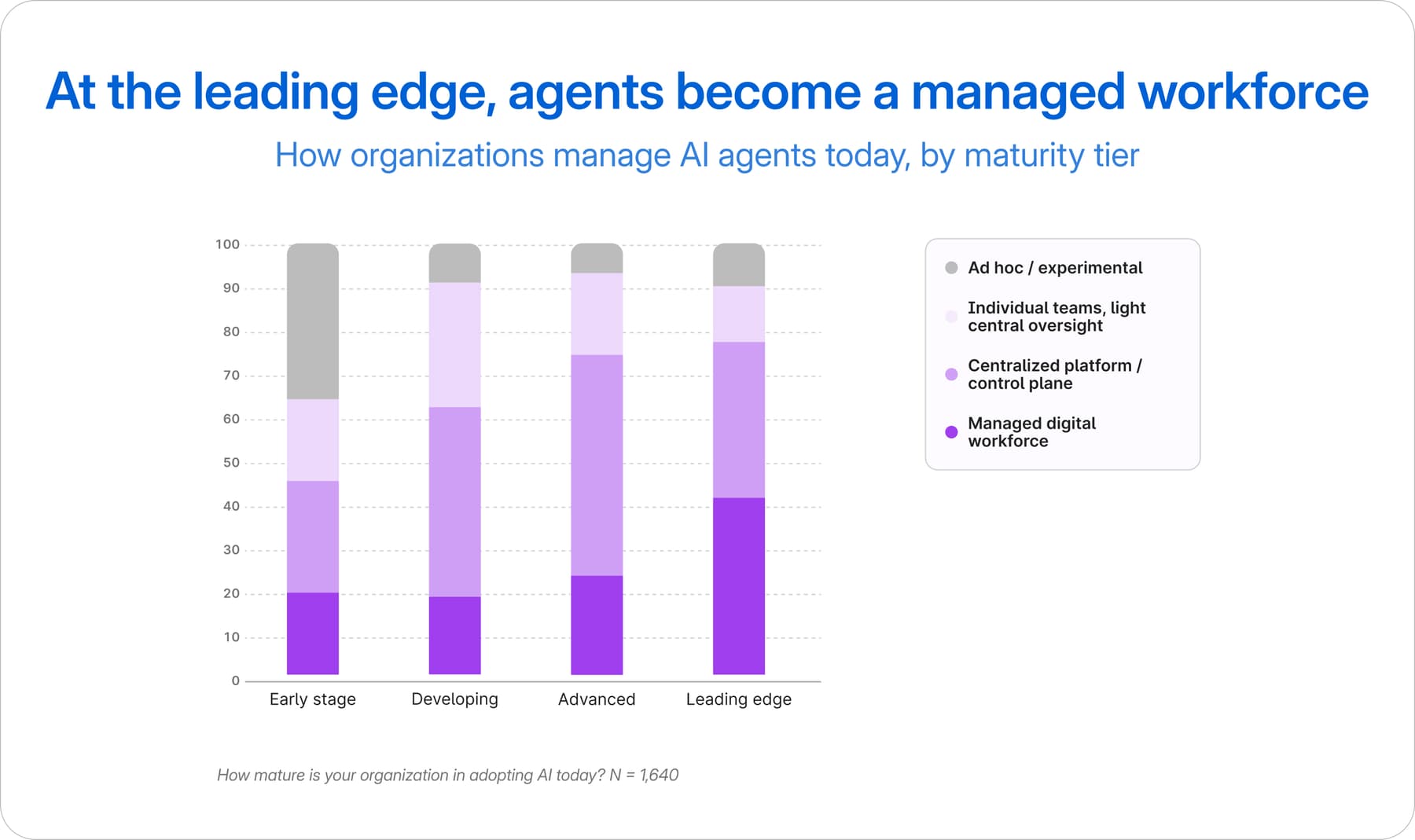
As they spread across the enterprise, the operating model for agents is coming into focus. Asked how they manage agents today, 36% of early-stage respondents describe their approach as ad hoc or experimental. Developing and advanced teams most often manage agents through a centralized platform or control plane. And the leading edge has moved toward a “managed digital workforce” — agents formally onboarded, with defined roles and permissions, and managed as if they were employees.
A clear AI leadership function is also forming. 95% of organizations have a dedicated AI leadership role, with responsibilities that span governance, P&L accountability for AI ROI, and communication and cultural change.
Only about 18% credit their most successful AI work to a central AI or data-science team.
Token economics
The question of who owns the AI bill has settled around a hybrid model. 45% of organizations take this hybrid approach, where IT owns the core infrastructure and underlying token or compute budget, while business units own application-level spend. 34% centralize the full token and compute budget in IT; 19% put AI budgets entirely outside IT, in individual teams. The hybrid share rises from 28% at early stage to 50% at the leading edge: leaders converge on the model that gives IT the platform, and the business the use cases.
It′s not just a technology activation step. It′s rethinking the process from the beginning. There′s real change management that has to happen, and there′s real fluency the business needs in order to adopt the tool and make a real impact.
When asked what organizational elements their company has in place for AI, 40% of respondents said they had AI policies and usage guidelines in place. 35% said that they have a dedicated team to deploy and manage agents, and 34% have defined standards for how agents access company content. When asked how they are incentivizing AI use in their company, 38% said they tie AI usage to performance reviews and compensation, and 39% track token or compute consumption per team.
Only 7% apply no incentives at all.
Yet for all this formal structure, only about 18% credit their most successful AI work to a central AI or data-science team. Most successful initiatives have come either through a mix of central and business-unit collaboration (27%) or through the IT function (also 27%).
Frequently Asked Questions
What is the AI maturity gap in enterprises?
The maturity gap refers to the widening difference in AI outcomes between early-stage and leading-edge organizations. While 80% of organizations report moderate or significant ROI, value concentrates heavily at the top of the maturity curve.
How widespread is AI adoption in enterprises today?
99% of organizations now use AI in some form, 83% run AI agents, and 19% already operate agents autonomously at scale. Adoption has expanded dramatically across every function in just twelve months.
How does ROI differ between early-stage and leading-edge companies?
50% of leading-edge organizations report significant ROI, defined as measurable improvement above 25%, compared to just 11% of early-stage companies. That gap is one of the widest findings in Box's 2026 State of AI in the Enterprise report.
How quickly do organizations see business impact from AI?
51% of organizations see measurable business impact within six months of project approval. That speed of return is a significant shift from what was typical for enterprise IT initiatives just two years ago.
What sets leading-edge companies apart in how they use AI agents?
Leading-edge companies push beyond efficiency gains into entirely new types of work. 41% name doing work that was not previously feasible as a primary objective, compared to just 21% of early-stage companies.
How do leading-edge organizations manage AI agents?
The leading edge has moved toward a managed digital workforce model, where agents are formally onboarded with defined roles and permissions and managed similarly to employees. Earlier-stage organizations are more likely to describe their approach as ad hoc or experimental.
Who owns AI budgets in most enterprises?
45% of organizations use a hybrid model where IT owns core infrastructure and compute budgets while business units own application-level spend. This hybrid approach becomes more common as organizations mature, rising from 28% at early stage to 50% at the leading edge.
Which teams drive the most successful AI initiatives?
Only 18% of organizations credit their most successful AI work to a central AI or data-science team. Most successful initiatives come through IT or a mix of central and business-unit collaboration.
Do most organizations have formal AI leadership in place?
95% of organizations have a dedicated AI leadership role covering governance, ROI accountability, and cultural change. This signals that AI has moved well beyond an experimental function into a core operational discipline.
This is chapter 2 of Box's State of AI in the Enterprise report 2026. Read more:
1: Executive Summary | 2: The Maturity Gap | 3: Context | 4: Control | 5: Change | 6: Capability | 7: Conclusion
-----