This is chapter 3 of Box's State of AI in the Enterprise report 2026. Read more:
1: Executive Summary | 2: The Maturity Gap | 3: Context | 4: Control | 5: Change | 6: Capability | 7: Conclusion
-----
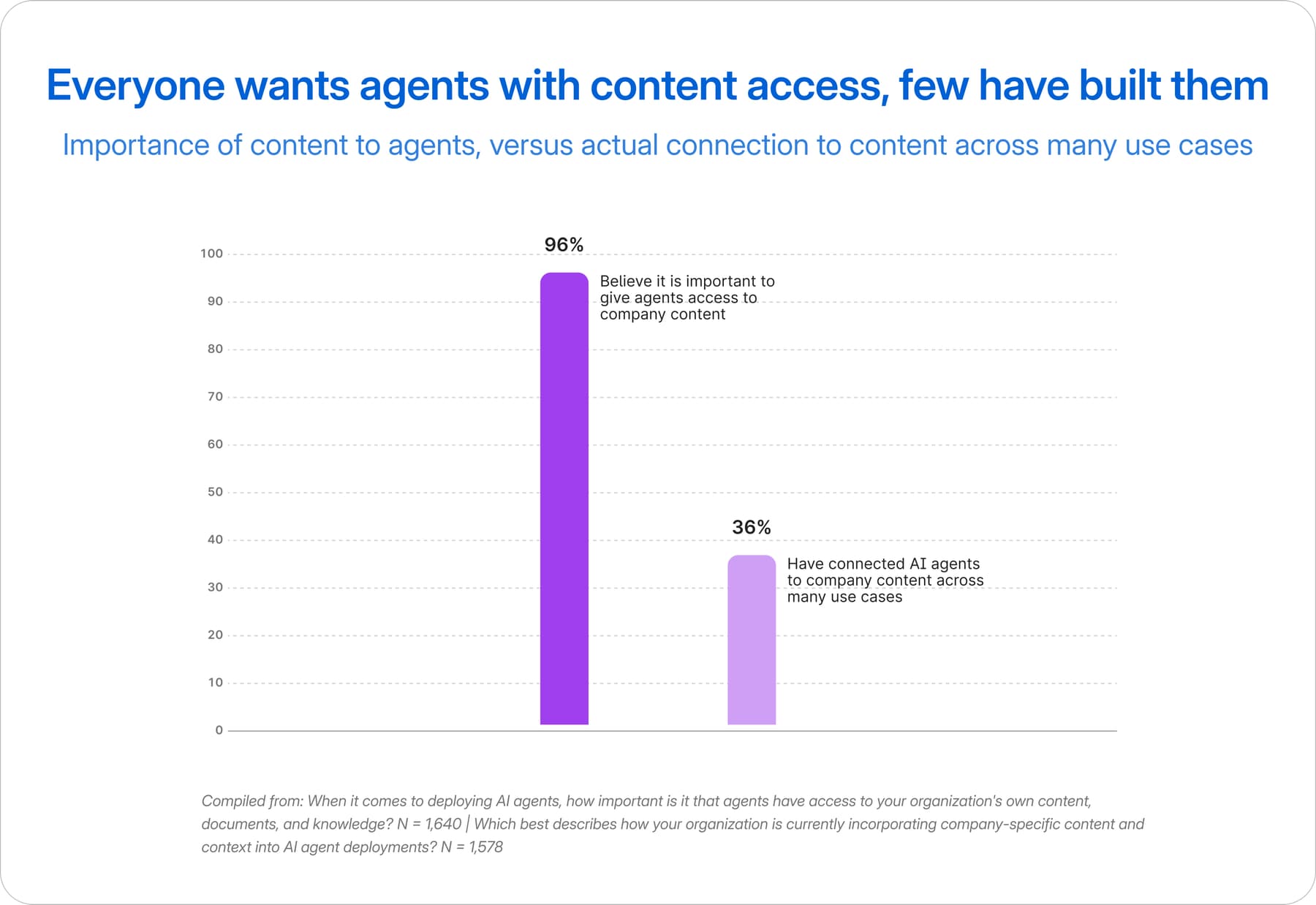
TL;DR: Agents are only as good as the content they can reach. 96% of organizations know it; 36% have wired it up. The 2026 bottleneck isn't model capability. Instead, it's making enterprise knowledge accessible, usable, and trustworthy for the agents that depend on it.
Agents are only as good as the content they can reference and the institutional knowledge that tells them how to use it. 96% of organizations say it's important or very important that agents can access company-specific content and knowledge. Yet only 36% of those using or experimenting with agents have successfully connected them to trusted internal content across many use cases.
In 2026, the defining adoption challenge is closing that gap: the operational work of making enterprise knowledge accessible, usable, and trustworthy for AI systems.
If the first phase of enterprise AI was defined by access to models, the next is defined by access to context.
The gap is sharpest at the maturity extremes: 42% of leading-edge organizations have connected agents to trusted internal content across many use cases, versus just 17% at the early stage.
The most mature organizations treat unstructured data as a competitive advantage
Leading-edge companies, who tend to see the greatest ROI, are also the ones that prize business context most. 76% of leading-edge respondents say it′s ˮvery importantˮ that agents access company content, against 34% at the early stage.
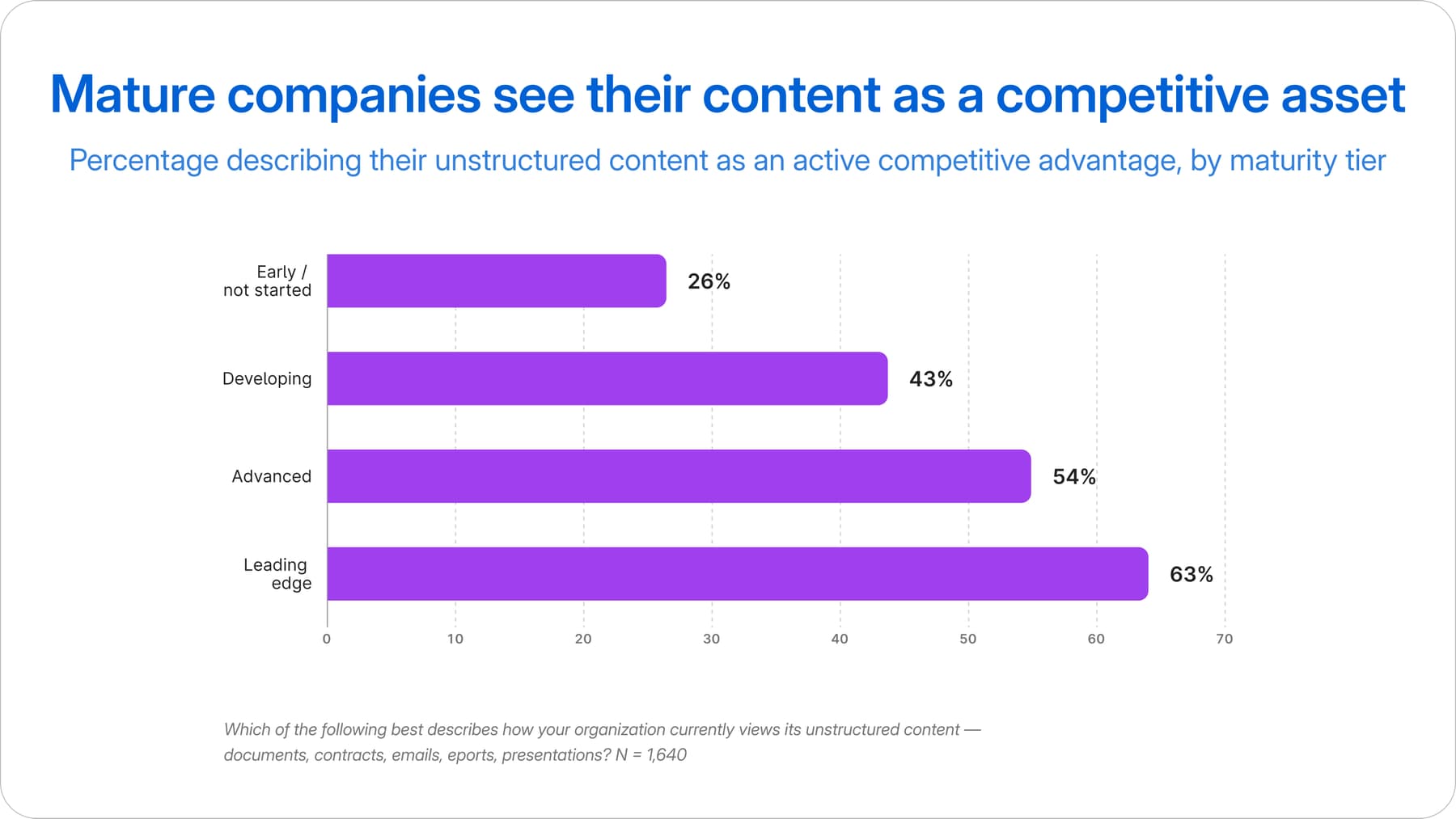
63% of leading-edge organizations now describe their unstructured data — documents, contracts, reports — as an active competitive advantage they′re already putting to work with AI, compared with 26% at the early stage.
The same progression shapes how organizations think about extracting structured data from unstructured files — the contracts, forms, invoices, and onboarding documents that hold enterprise-specific information in shapes systems can′t natively parse.
When you think of AI, you think it can just work — but it doesn′t. There has to be a foundation. Garbage in, garbage out has never been more real: if AI is reading your information, it has to be quality information.
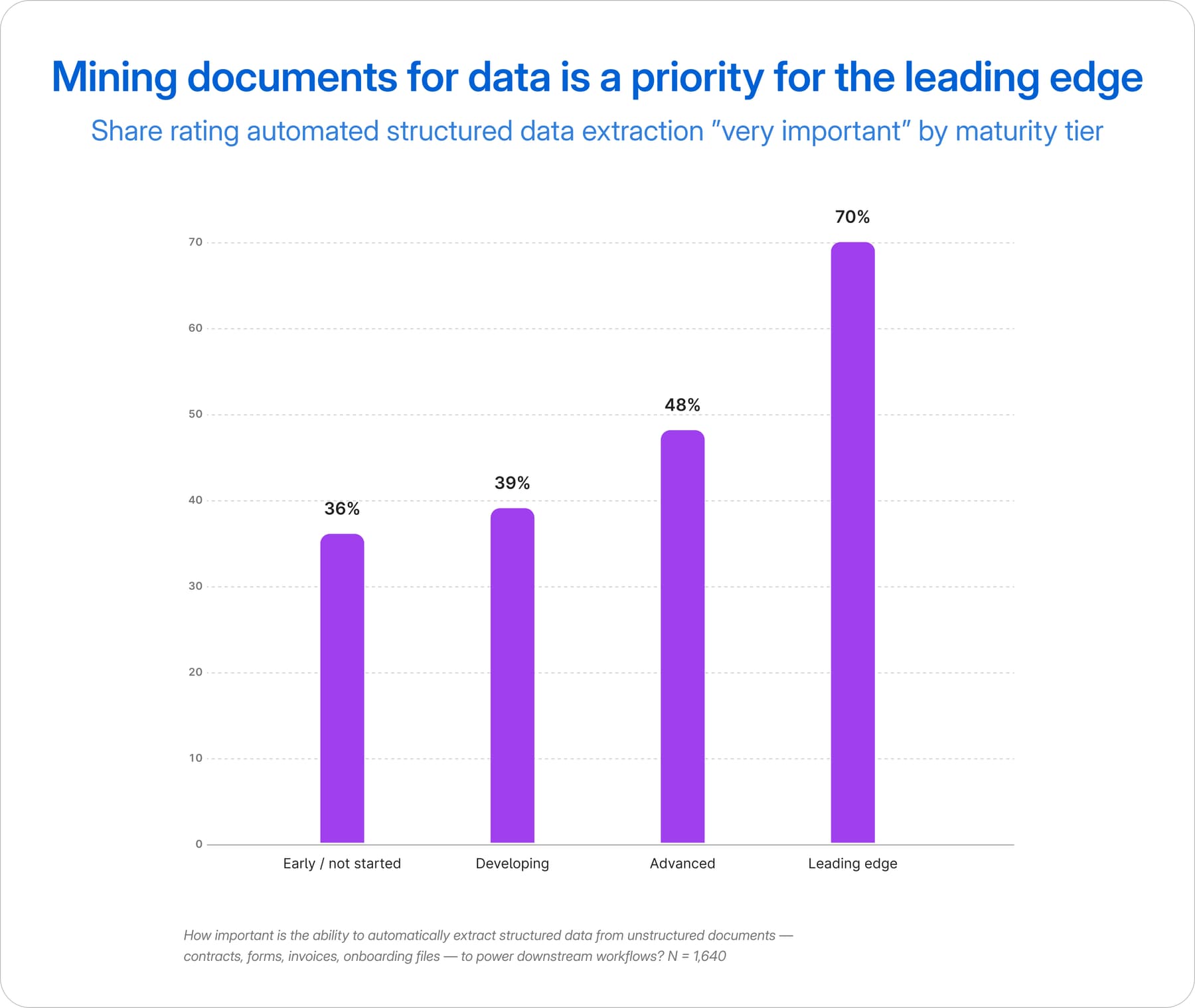
Across the survey, 49% call automated structured-data extraction ˮvery importantˮ to powering downstream workflows. Among leading-edge companies, that rises to 70%; at the early stage, it falls to 36%.
Content is moving from filing cabinet to intelligence layer
For agents, enterprise content is no longer simply a repository to search. It is instead becoming a working environment.
Agents need places to read, write, store intermediate outputs, preserve context, and collaborate with people and other agents — all under the same permissions, governance, and audit controls that protect the business today. Companies that close the context gap aren′t just making content searchable; they′re turning it into work surfaces for agents.
More than two-thirds of respondents say legacy or on-premises systems remain a moderate or major barrier to effective agent deployment
The biggest barriers are operational, not technological
Asked to name the largest barriers to giving agents access to organizational content, IT leaders point first to security and privacy concerns (38%) and regulatory or compliance worries (29%). Those are the obvious answers, and the most visible. They′re also upstream of the real difficulty.
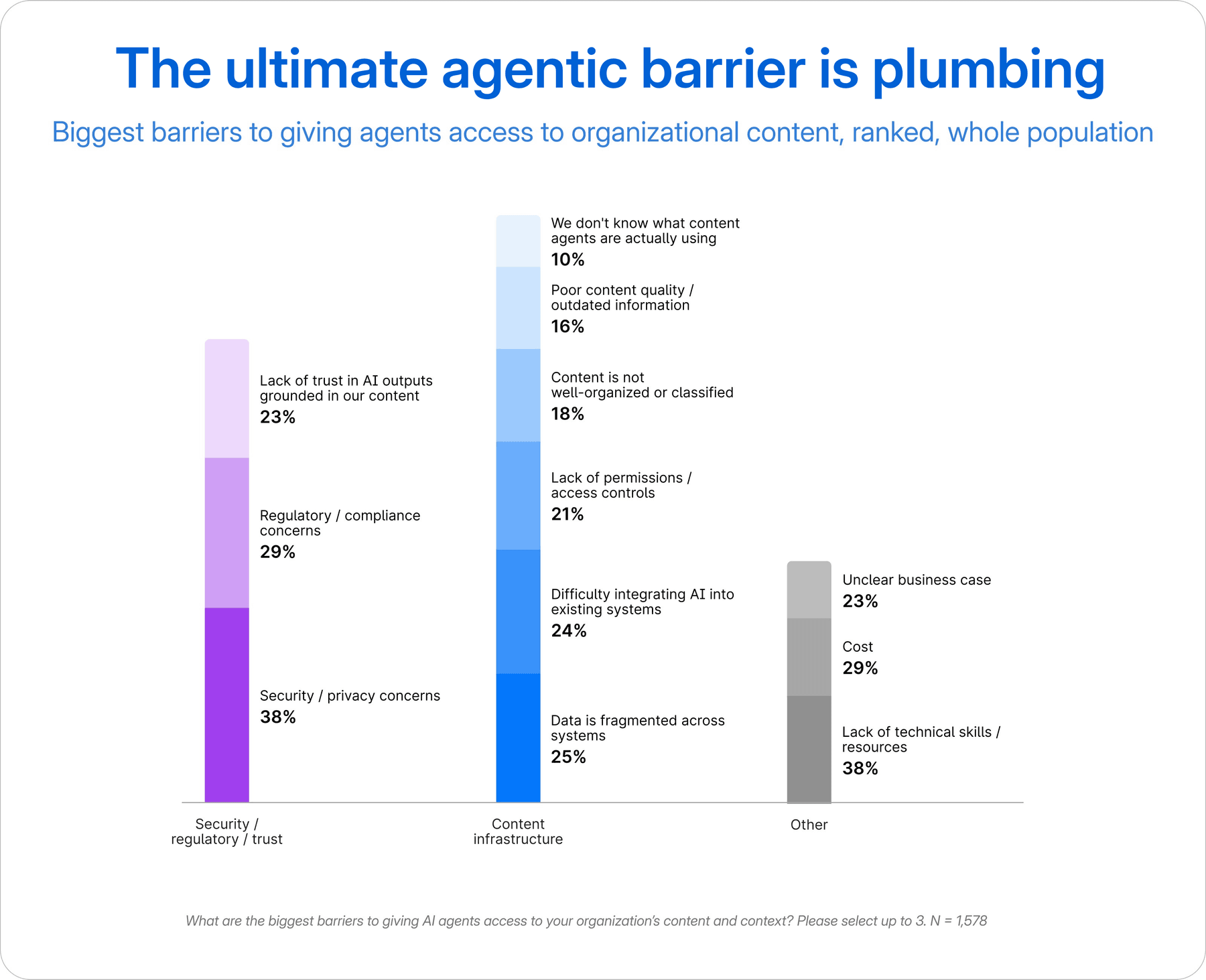
Beneath the security and compliance layer sits a cluster of operational barriers to connecting agents to content (the blue bar in the graph above): data fragmented across systems (25%), difficulty integrating AI into existing systems (24%), missing permissions or access controls (21%), content that isn′t well organized or classified (18%), and poor or outdated content quality (16%).
Taken together, the content-infrastructure layer accounts for more cited barriers than the security layer above it. The harder work is in the plumbing.
Legacy systems compound the problem. More than two-thirds of respondents say legacy or on-premises systems remain a moderate or major barrier to effective agent deployment, a constraint that worsens every other blocker.
Model capability is no longer enough. Competitive advantage increasingly depends on how well organizations can organize and operationalize their institutional knowledge and content. And once agents can access that content, the company has to govern what they do with it, which is the subject of the next section.
Frequently Asked Questions
Why is enterprise content considered the AI bottleneck in 2026?
Agents are only as good as the content they can access. While 96% of organizations say it's important that agents access company-specific content, only 36% have successfully connected agents to trusted internal content across many use cases.
What is the "context gap" in enterprise AI?
The context gap is the difference between knowing agents need company-specific knowledge and actually making that knowledge accessible, usable, and trustworthy for AI systems at scale.
What are the biggest barriers to giving AI agents access to enterprise content?
Security and privacy concerns top the list at 38%, followed by regulatory and compliance worries at 29%. Operational barriers like fragmented data, missing permissions, and poor content quality also play a significant role.
How do leading-edge organizations approach unstructured data differently?
63% of leading-edge organizations treat unstructured data, such as documents, contracts, and reports, as an active competitive advantage they're already putting to work with AI, compared with just 26% at the early stage.
Why does content quality matter so much for AI agents?
AI agents depend on accurate, well-organized information to produce reliable outputs. As Deloitte's Mike Carlino notes, garbage in, garbage out has never been more real: if AI is reading your information, it has to be quality information.
How do legacy systems affect AI agent deployment?
More than two-thirds of respondents say legacy or on-premises systems remain a moderate or major barrier to effective agent deployment, compounding every other operational blocker.
How are leading-edge companies using automated structured-data extraction?
70% of leading-edge organizations call automated structured-data extraction very important to powering downstream workflows, compared with just 36% at the early stage.
How is enterprise content changing in the age of AI agents?
Content is evolving from a static repository into a working environment where agents read, write, store outputs, and collaborate, all under the same permissions, governance, and audit controls that protect the business today.
This is chapter 3 of Box's State of AI in the Enterprise report 2026. Read more:
1: Executive Summary | 2: The Maturity Gap | 3: Context | 4: Control | 5: Change | 6: Capability | 7: Conclusion
-----