This is chapter 4 of Box's State of AI in the Enterprise report 2026. Read more:
1: Executive Summary | 2: The Maturity Gap | 3: Context | 4: Control | 5: Change | 6: Capability | 7: Conclusion
-----
TL;DR: Governance is not the brake on distributed AI. Done right, it is what makes scaling it survivable. Almost everyone believes better governance would help them move faster over time. Far fewer have built governance models fit for agents.
Agents are now live across functions, business units, and frontline teams. The conventional read is that stronger governance in that distributed environment will slow adoption and impact.
The data suggests a more nuanced reality: governance built only for human workflows can slow deployment, but governance built for agents gives organizations the visibility and control they need to scale.
Leading-edge organizations see more incidents — and that′s not the bad news it looks like
The need for stronger governance is unquestioned: 49% of organizations have already had an AI-related data exposure incident, where an AI tool surfaced content a user shouldn′t have been able to access. 16% describe their incident as significant.
49% of organizations have already had an AI-related data exposure incident
For CISOs and other accountable executives, the question is no longer whether widespread AI adoption creates new risks — it does — but whether the organization can detect them in time to act.
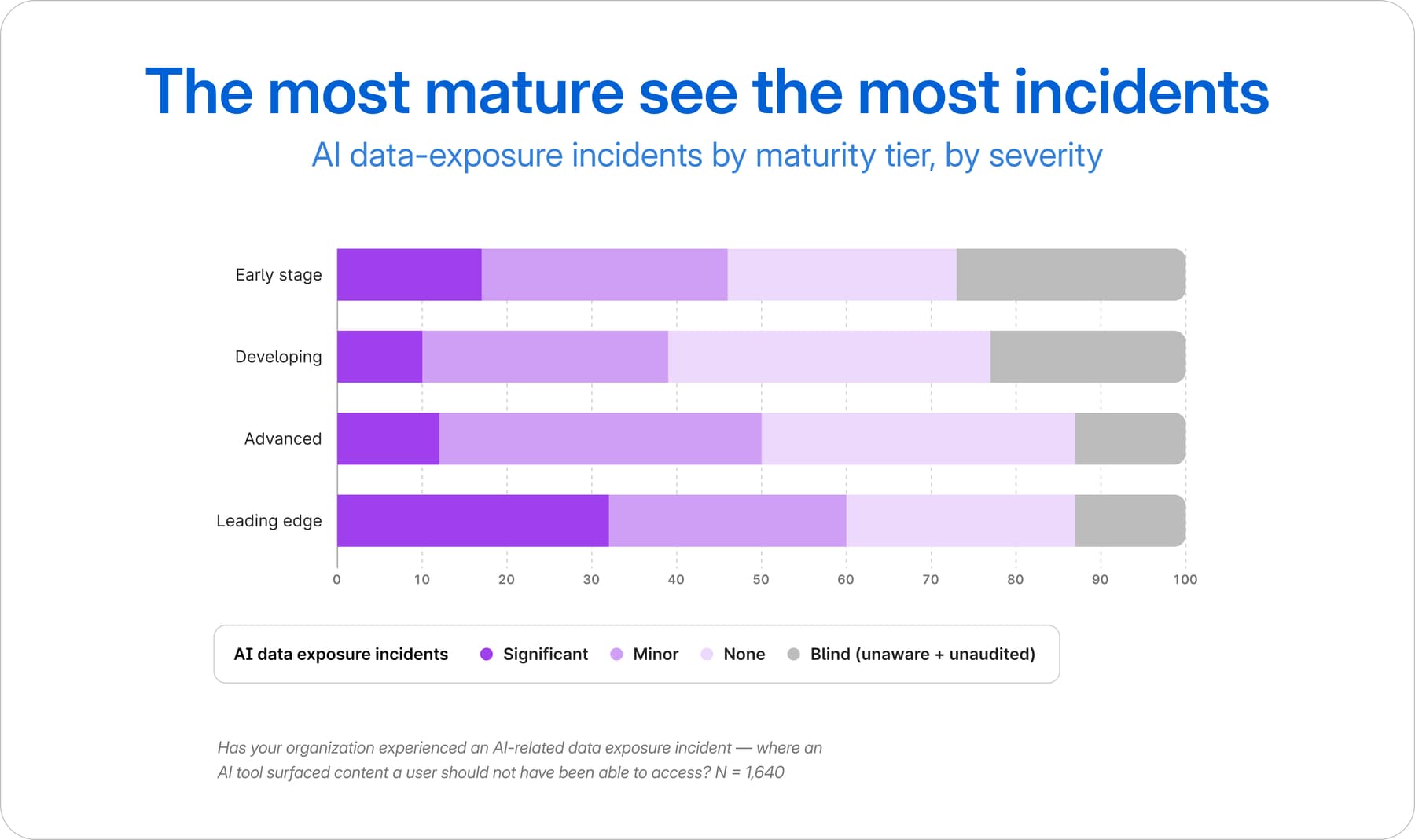
One might assume that the further along the maturity curve a company is, the fewer security incidents it sees. The opposite holds. 60% of leading-edge organizations report an AI-related exposure incident, against 46% of early-stage ones. Among leaders, 32% report a significant incident; among early-stage organizations, 17% do.
Just 34% have formal standards governing how agents access company data.
Two things are happening at once, and both push leading-edge incident counts up.
The first is exposure: leading-edge organizations run more agents, wired to more systems and more content, so there′s simply more surface area on which an incident can occur.
The second is visibility: the leading edge is far better at seeing the incidents it has. 28% of early-stage respondents say they′re unaware of any incident, or have simply never audited for one.
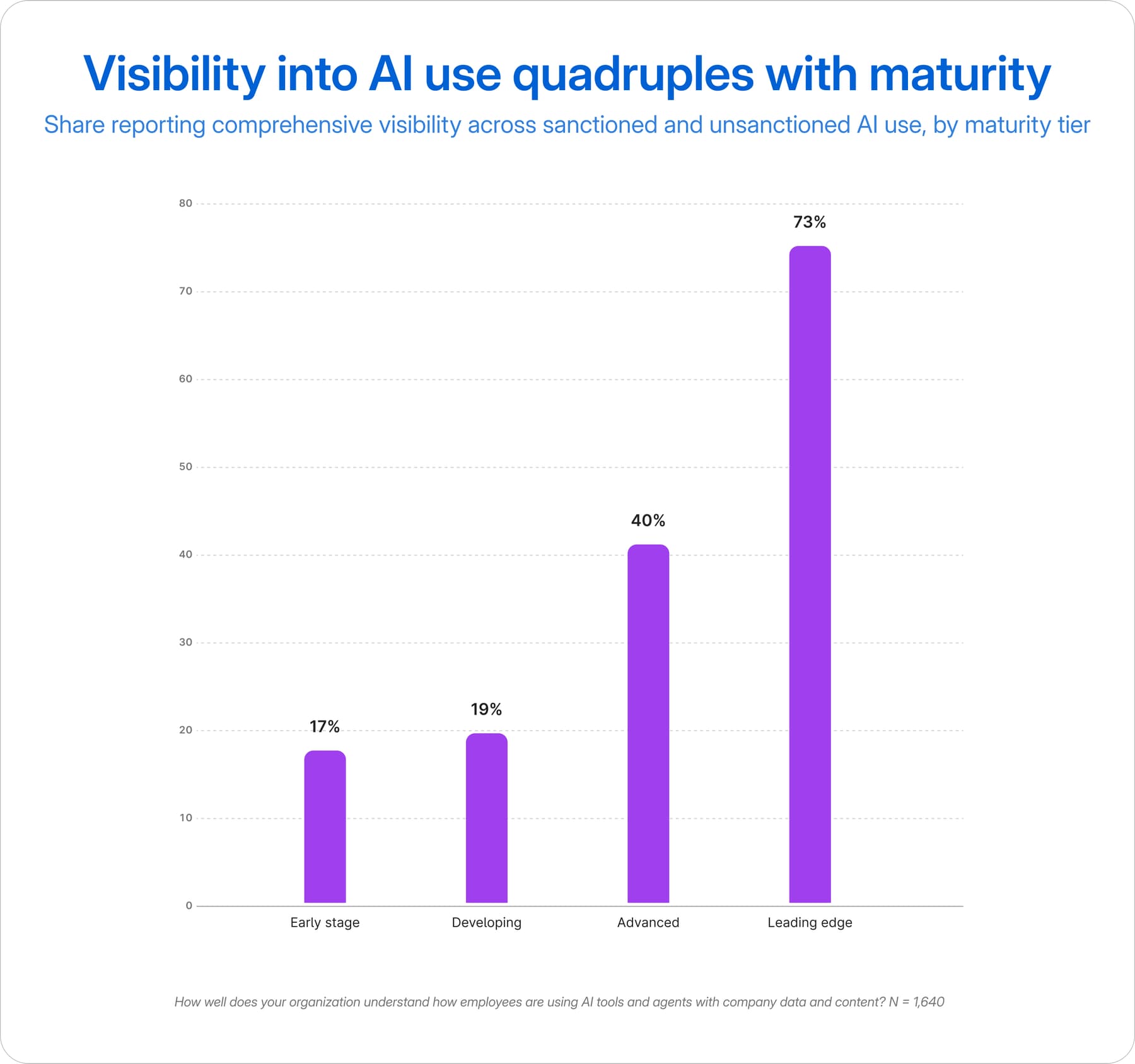
Asked how well they understand how employees use AI tools with company content, just 17% of the early stage claim ˮcomprehensive visibility across sanctioned and unsanctioned usage.ˮ At the leading edge, that figure is 73%.
The early-stage organization′s lower incident count isn′t a clean measure of incidents avoided. Part of it is incidents that were never detected. Maturity doesn′t make incidents disappear; it makes them legible — and a known incident is one you can manage.
This pattern isn′t new to enterprise AI. It′s a near-textbook recapitulation of what Weick and Sutcliffe′s ˮhigh-reliability organizationˮ framework describes for aviation, nuclear power, and surgical safety: the safest fleets carry the densest incident logs. High-reliability operators report more incidents and near-misses than less reliable ones. The 2026 data suggests enterprise AI is following the same arc.
Governance must be built for agents, not retrofitted from humans
76% of respondents say their current governance requirements are slowing their ability to deploy agentic AI. But 93% agree that better governance would help them move faster over time. That is not a contradiction. It is the difference between governance retrofitted from human workflows and governance designed for agents: permissions, visibility, auditability, and trusted-source controls built into the way agents work.
Agent governance and data management is a key unlock for how you can actually accelerate. Corporate policies exist for a reason — but giving access to an agent unlocks a lot, so you evaluate it case by case.
Organizations have acted. In 2025, 24% reported established or advanced AI governance frameworks. This year, 73% do. Whatever else has happened to enterprise AI in the past twelve months, governance has stopped being a deferred problem.
But frameworks have outpaced real world instrumentation. Only 39% of organizations report comprehensive visibility across sanctioned and unsanctioned AI use. Just 34% have formal standards governing how agents access company data. 27% still call their governance ad hoc or developing.
This is another example that in 2026, the challenge of enterprise AI is not model capability.
It′s organizational capability. The companies furthest along are combining governance, infrastructure modernization, permissions management, and enterprise knowledge access into a single operating model.
Frequently Asked Questions
What percentage of organizations have experienced an AI-related data exposure incident?
According to Box's State of AI in the Enterprise report 2026, 49% of organizations have already had an AI-related data exposure incident, where an AI tool surfaced content a user should not have been able to access. Of those, 16% describe their incident as significant.
Why do leading-edge organizations report more AI security incidents than early-stage ones?
Leading-edge organizations have far better visibility into their environments, with 73% reporting comprehensive awareness of AI usage compared to just 17% of early-stage organizations.
Does stronger AI governance slow down deployment?
Governance retrofitted from human workflows can slow deployment, but governance designed specifically for agents accelerates it over time. In fact, 93% of respondents agree that better governance would help them move faster over time.
How has enterprise AI governance adoption changed since 2025?
In 2025, only 24% of organizations reported established or advanced AI governance frameworks. By 2026, that figure rose to 73%, signaling that governance has shifted from a deferred problem to an active priority.
What gaps still exist in enterprise AI governance today?
Despite rapid framework adoption, real-world instrumentation lags behind. Only 39% of organizations have comprehensive visibility across sanctioned and unsanctioned AI use, just 34% have formal standards governing how agents access company data, and 27% still describe their governance as ad hoc or developing.
What is the difference between governance built for humans and governance built for agents?
Governance retrofitted from human workflows lacks the permissions, visibility, auditability, and trusted-source controls that agents require. Governance designed for agents embeds those controls directly into how agents operate, giving your organization the oversight needed to scale safely.
What does the data say is the biggest challenge for enterprise AI in 2026?
The primary challenge is not model capability but organizational capability. The companies furthest along are combining governance, infrastructure modernization, permissions management, and enterprise knowledge access into a single, unified operating model.
This is chapter 4 of Box's State of AI in the Enterprise report 2026. Read more:
1: Executive Summary | 2: The Maturity Gap | 3: Context | 4: Control | 5: Change | 6: Capability | 7: Conclusion
-----