The misconception
If you've ever connected ChatGPT, Claude, or a custom MCP client to your Box account, you've probably thought: "As long as I block downloads, I'm safe. The agent can't take the file out."
The reality is harder. AI agents don't need to download a file to exfiltrate it. If an agent can preview a document, it can read it, comprehend it, and reproduce what's inside. From a data loss prevention perspective, an LLM reading content is functionally the same as downloading it. The moment your existing Integration Restriction stops at the download boundary, you have a gap.
Why this matters now
Enterprise workflows are moving from thousands of human users to a world where every user brings a handful of AI agents along with them. IDC projects that by 2028, roughly 70% of AI-driven enterprises will operate multi-tool, multi-agent architectures. That is a scale shift that human-era governance assumptions were not built for.
The structural problem is this: the controls that kept content safe from human misuse were designed around a click, a download, and an audit log. Agents don't click. They call APIs, they read text representations, and they answer questions on behalf of a user in seconds. Governing what an agent can read is now as important as governing what it can download, and it has to be enforced at the same layer, not bolted on later.
Architecture walkthrough
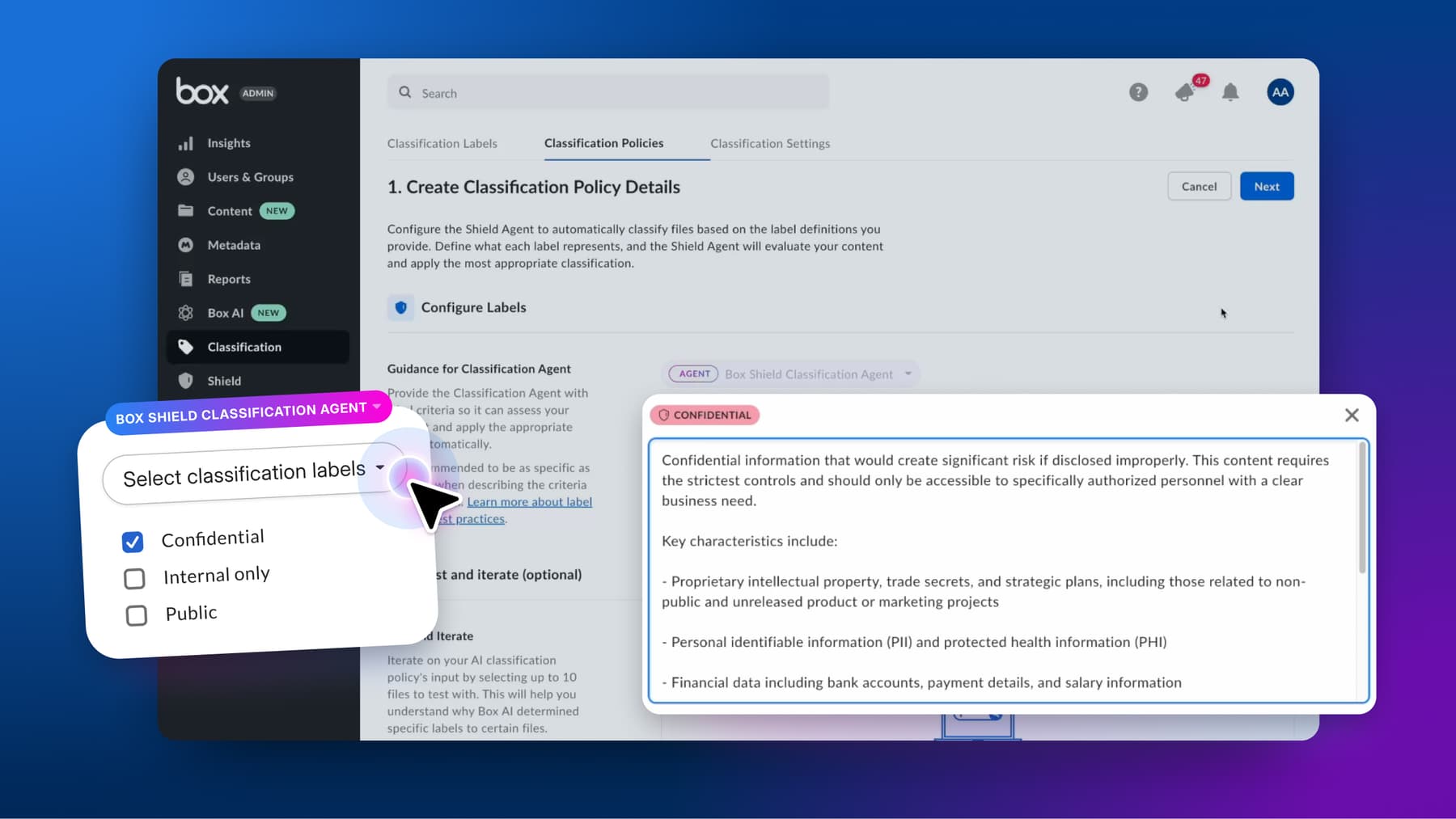
Classification-Based Access Policy extends the Integration Restriction security control in Box Shield with a new Read action, evaluated at request time against the classification on every file. Here is what happens end-to-end, stage by stage, with the security checkpoint named at each step.
A. Box user initiates access through a connected integration
A Box user initiated an action through a connected third-party integration. The integration sends the file requests to Box and identifies itself with an external serviceId. Box evaluates the integration’s serviceId to determine whether the requested action is allowed, blocked, or monitored.
B. Box Platform: SIS holds the rules
Shield's rule store (SIS) is the source of truth for every access policy an admin has configured. When an admin creates a Classification-Based Access Policy, the Download and Read toggles, the scope (block-all-except or allow-only), and the integration lists are persisted here. SIS also carries the enforcement mode for each action independently: enforce or monitor.
C. Box Platform: the enforcement engine decides
Every file access request from the connected integration lands in the enforcement engine. It pulls the file's current classification, looks up the restriction policy that applies to that classification in SIS, and evaluates the caller's serviceId against the Download and Read scopes independently. The policy evaluates the connected integration’s serviceId rather than the Box user alone. When a user accesses content directly, there is no restricted integration serviceId to block. When the user acts through a connected integration, the integration can be stopped by the Read restriction. Download and Read are two separately toggle actions on the same control, so an admin can block all integrations from previewing Confidential content while allowing a specific list to download, or any other combination.
D. Observability: every decision is logged
Every allow, block, and would-have-blocked (monitor mode) decision is emitted to the Event Stream API with the application ID, application name, action type (download or read), enforcement mode, file ID, user, and timestamp. Admins get full visibility into restriction activity across both action categories, without needing to instrument anything themselves.
E. Governed output: what the caller actually sees
When Read restriction fires, the integration receives a response with the classified content removed. It does not get a partial answer. It does not get the text representation.The caller can see the file exists (metadata is still returned today), but cannot ingest the content.
Architecture diagram

An enterprise scenario
Imagine a mid-market financial services firm. The compliance team classifies every deal document as Confidential the moment it lands in the M&A folder. A deal analyst uses ChatGPT as a connected integration to access their Box account and summarize public research faster.
Without Classification-Based Access Policy, the analyst opens the ChatGPT plug-in and asks it to summarize a document from the M&A folder. ChatGPT calls the preview endpoint, receives the text representation, and returns a clean two-paragraph summary of the target's non-public financials. The file was never downloaded. The content is now in the model's context.
With Classification-Based Access Policy enforced, the same request lands in the enforcement engine, is matched against the Confidential access policy, and is blocked at the read layer. ChatGPT replies that it cannot access the file. It proposes two workarounds: open in Box preview, or fetch the raw file. Both hit the same enforcement engine and both fail. The analyst still has their agent for public research. The M&A content stays inside the compliance boundary.
Questions your enterprise should ask
- Can you tell, right now, which third-party integrations have ever previewed a Confidential file in your Box tenant?
- If a user connects a new AI agent tomorrow, is your default posture "allow" or "deny" for reading classified content?
- Do your integration policies distinguish between Download and Read as separate actions, or do you treat them as one?
- Can you audit every read decision (blocked, allowed, or monitored) with the integration identity attached?
For most organizations, the honest answer to at least two of these is "not yet." Classification-Based Access Policy answers each of them directly. Read is a first-class action. Read restriction defaults to off, so no existing policy changes silently. Every decision is logged with the integration identity. And the same classifications you already trust drive the enforcement.
What you can build once this is governed
Because Read is now governed at the classification layer, you can safely:
- Roll out the Box MCP server to more teams, with confidence that Confidential and Internal content stays inside your rules.
- Approve new AI agents as they emerge without rewriting policy per app. Add the integration to the right Shield list, and the classification-based rules apply automatically.
- Adopt in monitor mode first. Run Read restriction in monitor for a classification to see who would have been blocked, then flip to enforce when you are ready.
- Extend the same identity-plus-classification pattern into your Event Stream consumers, so your SIEM sees agent activity the same way it sees user activity.
Bottom line
Classification-Based Access Policy is not a wrapper around the existing download control. It is a rebuild of the Integration Restriction enforcement path that treats Read as a first-class, independently governed action, tied to the classifications your business already trusts. One control, two independent toggles, every decision logged, and no path around it via preview, search, or text representation. That is what governing AI agents at enterprise scale looks like.