With roots tracing back to the advent of semiconductors in the ’60s, Broadcom is one of the original tech innovators. Today, the company is still on the cutting edge of technology as a dominant supplier of hardware integral to global AI infrastructure.
Broadcom is also at the forefront of technological innovation when it comes to getting work done. Inside the company, they take a proactive and intentional approach to integrating AI across lines of business to speed up workflows and enable new ways of working altogether.
In this episode of the Box AI-First Podcast, Stanley Toh, Head of Enterprise End-User Services and Experiences at Broadcom, joins Box Chief Customer Officer Jon Herstein. They discuss how Broadcom — a huge company with roughly 40,000 employees and 10,000 outsourced partners and contractors — is transforming work with AI. They also talk about the challenges that come with AI adoption in the enterprise ecosystem, including managing governance and choosing the right use cases.
Key takeaways:
- Broadcom prioritizes business-enhancing AI over “feel-good AI,” implementing strict governance to protect sensitive information
- Successful AI implementation requires close collaboration between IT and business units, with transparent communication to overcome user resistance
- Broadcom demonstrates intentional AI adoption in customer support, legal processing, R&D, and HR, all built around clear business outcomes
Avoiding AI for the sake of AI
“If you break it down,” says Toh, “there are two kinds of AI. There’s AI that can help the business grow, make your processes more efficient, improve the way your engineers code, and enhance everything from help desk to cybersecurity to IT operations. Then there’s the bucket of ‘feel-good AI.’”
That second bucket, in Toh’s estimation, is worth avoiding. Falling in this category: the glut of easy-to-find-and-turn-on AI tools that do highly specific things, but don’t make much impact on the business. He cites, as one example, a meeting recording and transcribing tool that Broadcom employees got excited about — but which only does one thing. More alarmingly, it presents a security risk in a company where every meeting could easily involve sensitive enterprise information (IP, sales deal details, go-to-market strategies). Toh’s team enforces a hard rule against using this particular AI transcription tool.
To be worth the time and financial investment, an AI tool must provide tangible business value — not just act as a flashy, superficial addition. Herstein chimes in: “We’re seeing this very consistently in the Box customer base. All of these AI tools and platforms are being thrown at you as a customer, and sorting out the ‘feel-good’ AI technologies from the ones that add business value is a real challenge.”
The business justification for a new AI tool
For Broadcom (and most companies), the goal is for AI to move from an abstract buzzword to a concrete tool that solves business problems right now.
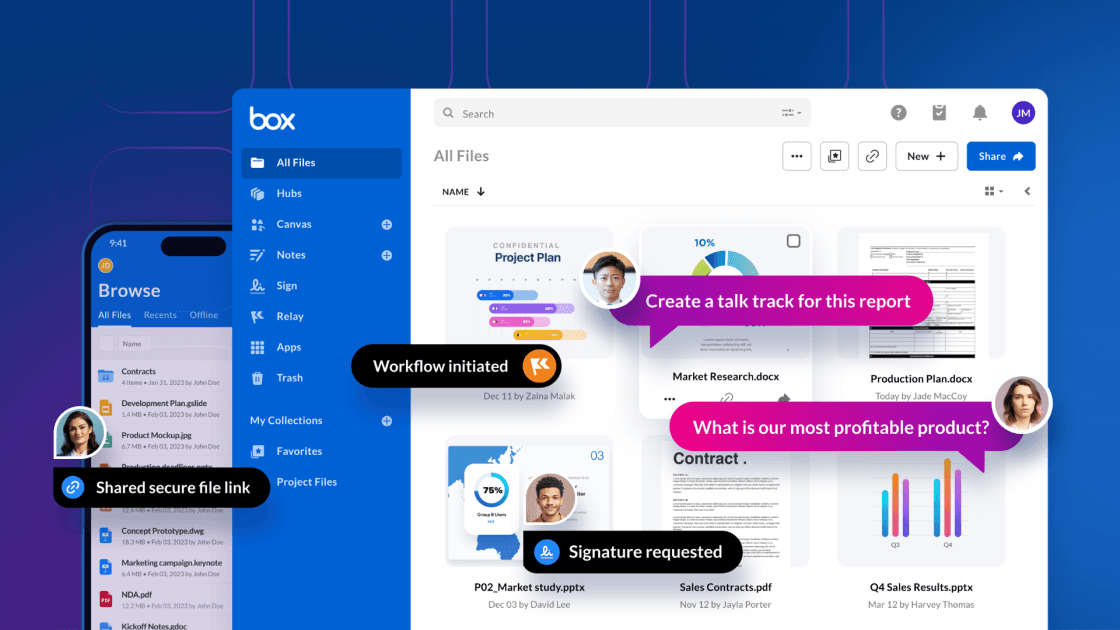
Broadcom has a whopping 2.3B files on the Box platform. As Toh sees it, “There’s a lot of content, and there’s a lot of value in that content. Box AI helps people find things better. They can do comparison, search, and get insight out of it. This justified turning on Box AI.”
When evaluating exactly how to use Box AI, Toh’s team looked at areas of potential ROI including time savings, employee efficiency, improved business processes, and faster time to market for product development. To make practical decisions, IT collaborated closely with business units like HR, finance, and logistics.
“If you collaborate more closely with the business unit,” Toh says, ”understand their needs, what they’re trying to solve — you can then bring AI technology to the table to help them solve those problems and streamline their workflows."
Here are four ways Broadcom is using AI today to make a tangible difference to the business.
1. Customer support
Broadcom deployed chatbots internally years ago, and those tools boast an impressive 85% effectiveness rate for internal operations, which is statistically quite high. External chatbots have also been transformational, allowing seamless customer support and enhancing case resolution speeds. Toh says: "Help desks are low-hanging fruit for AI adoption. If any company hasn’t implemented AI yet, that’s a key starting point."
2. Legal document processing
Box AI enables Broadcom to process lengthy contracts and legal documents with speed and precision. Within the legal department, Broadcom uses AI for contract comparison, instantly identifying clause changes and key elements, reducing human error and workload.
3. R&D code assistance
AI’s ability to assist developers in coding and reducing cycle times accelerates go-to-market outcomes — a competitive edge in a tech-driven industry.
4. HR
Broadcom is currently retooling its employee lifecycle by integrating AI, from pre-hire onboarding processes to career progression insights. Toh says, “One of the areas I’m very excited about is reimagining the entire employee journey, using all the latest modules and components from Box Enterprise Advanced Plus to see how we can make that journey more seamless.”
The future of AI for Broadcom
“Traditional IT was seen as a call center,” Toh says. “Now, with AI, we’re collaborating more closely with the business unit, understanding their needs, and bringing to the table IT technology that will help them solve problems and streamline workflows, from HR to logistics.”
He shares Broadcom's perspective on emerging trends, particularly around agentic AI. For instance, the company is pioneering self-service capabilities that will deliver faster, smarter customer support. Toh says, "With agentic AI, it’s not just about a chatbot giving you links anymore. Now, it’s a conversation. Self-service has evolved into self-healing."
Underlying every decision Toh’s team makes: AI adoption must be intentional and built around clear business outcomes. When executed mindfully, AI has the power to enhance efficiency, create new opportunities, and boost workforce satisfaction. Toh puts it this way: "We need to embrace technology’s advancement, but never sacrifice the integrity of the company. AI solutions must deliver sustainable business value. As leaders, it’s our job to ensure that balance."
Catch the full episode
Ready to dive deeper into this discussion? Don’t miss this episode: Driving efficiency at Broadcom with AI.Subscribe now to stay informed and get inspired about the AI-first era.