RWS Global, a leading live entertainment and sports production company, takes an explicit stance on creativity and AI. In an industry built on imagination and storytelling, the company has drawn a line: AI cannot originate story, tone, emotion, or intent.
But there is a place for AI at RWS, and it’s a critical one: Unlocking the time and space for humans to be more creative.
RWS Global manages entertainment across 45 cruise ships, 135 theme parks, and global sporting events including the Paris Olympics — making it one of the world's leading live entertainment production companies. Chief Operating Officer Jake McCoy oversees the operational complexity of creating destination experiences worldwide. In a recent conversation with Box's Chief Customer Officer Jon Herstein, McCoy revealed how his organization built an AI-powered foundation that enhances human creativity without replacing it.
During its AI transformation, the lessons RWS Global learned include:
- Start with outcomes, not tools — "earn the right to automate"
- Build on a foundation of AI-extracted metadata
- Embed guardrails into technology, not policy manuals
- Reserve human creativity for what only humans can do
Earn the right to automate
McCoy's AI philosophy can be condensed down to just a few words: "Earn the right to automate." In other words, he says, "Don't use AI for the sake of AI. Don’t just apply this new tool to everything. Like anything in business, you have to start with the outcome. What are you trying to achieve? Work backwards from that.”
This ethos isn't remotely about resistance to technology. It's about understanding that AI implementation without proper foundation is just "AI theater” —which is why RWS Global focused its AI efforts on operational efficiency and workflow automation rather than creative applications. The reasoning was strategic: By reducing time spent on administrative tasks (searching for files, managing versions, tracking approvals) teams would naturally gain more time for the type of work only humans can do, which requires creativity and critical thinking.
The contract process streamlined with metadata
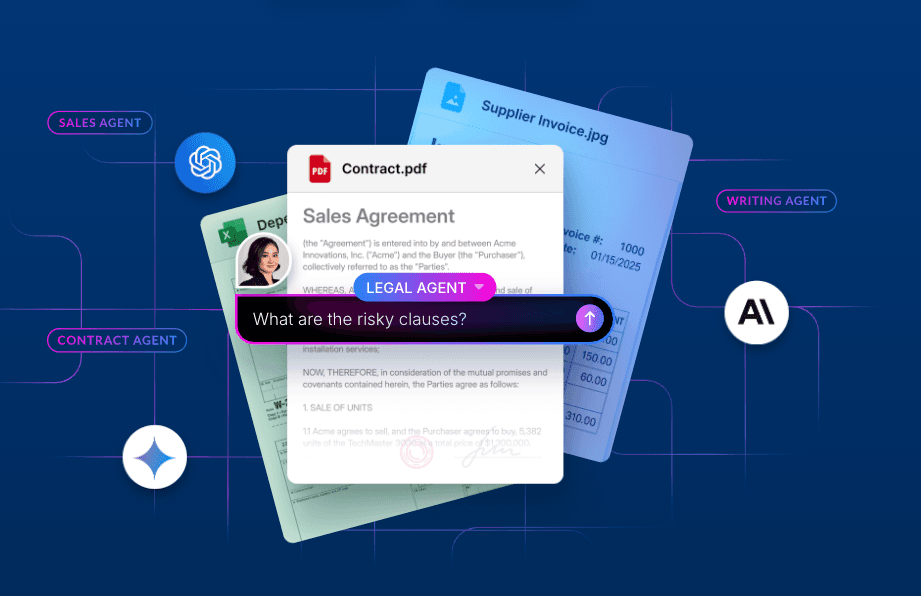
Here’s an example. “Before Box,” McCoy explains, “we had hiring managers submitting contract requests, and the legal department would manually work up a contract, send it out over DocuSign, track its progress, and then file it in Dropbox or wherever. Depending on the region, the workflow was slightly different.”
With 8,000 performers contracted annually, this effort represented thousands of hours of administrative burden. Now, with Intelligent Content Management from Box, the workflow has been systematized:
- When a hiring manager submits a contract request, Box DocGen automatically works up an agreement for legal review
- The legal department can easily approve it and send it out via Box Sign
- The final signed contract is automatically filed in the correct place on Box
In other words, the entire workflow, from request to signature to filing, is now automated, freeing legal teams to focus on strategic work rather than document shuffling.
Guardrails that allow for experimentation and mistakes
By using AI to handle operational complexity, RWS Global has enhanced their creative capacity, and this is by design.
McCoy says, “My most controversial take is AI is not the threat to creativity; leadership laziness is. AI is not going to dilute originality on its own, but what really erodes it is when people are using AI as a shortcut to avoid making hard creative decisions. They're not clarifying intent. They're not investing in their craft. If you're leaving AI to fill a vacuum of taste or vision or accountability, you’re not innovating. You're abdicating.”
If you're leaving AI to fill a vacuum of taste or vision or accountability, you’re not innovating. You're abdicating.
This philosophy extends to how RWS has structured AI governance, too. Rather than creating restrictive policies that generate fear, they've built guardrails into workflows. These guardrails are embedded directly into the technology architecture to separate access from authority, ensuring that while all employees can use AI for low-risk tasks like summarizing reports, only specific roles are permitted to use it for high-risk operations like generation or approval.
Rather than micromanaging individual user prompts, this approach standardizes the core principles of what AI should never do at RWS, such as originating story tone or making safety calls. By automating these controls within Box, the organization removes the burden of constant analysis from the employee, allowing them to focus on creative execution within a pre-configured “safe sandbox.” Employees don't need to constantly reference a policy manual to determine what's appropriate, The systems guide them naturally toward proper usage.


A foundation of metadata
The technical foundation for AI success involves something no one talked about a few years ago: AI-extracted metadata. "I don't think anybody ever thought metadata was going to be something we were talking about on a podcast," McCoy laughs. "If you had asked me that three years ago, I would've been like, what?"
When you're managing decades of production content across multiple continents and venues, the ability to find the right asset at the right moment becomes mission-critical. McCoy describes how metadata has transformed from basic file properties to rich contextual information: A song file isn't just a file; it's a rock and roll song from a specific cruise ship show, used as part of a 45-minute medley.
AI-powered metadata extraction now tags every unstructured content file with rich contextual information, giving RWS unprecedented visibility into (and organization around) its existing assets. On this foundation, McCoy believes that if teams are still manually searching for information in five years, it will be “a leadership failure.”
The human element in AI deployment
RWS Global AI implementation strategy offers valuable lessons in other enterprise organizations dealing with such change management. Rather than top-down mandates, RWS identified "AI champions" across different departments who helped shape policies before launch. This collaborative approach meant that when AI tools rolled out, they addressed real problems that teams actually faced.
The organization around AI initiatives also allows the teams to share what works and doesn’t work as they experiment. McCoy explains, “As each team works individually, we’re finding we’ve got three different product divisions working on AI projects. Land might be working on one thing, but Sea is completely unaware of that conversation. We realized we needed to have conversations.”
From management to intelligence
For RWS Global, AI success isn't measured in dashboards or efficiency metrics alone. "Value is fewer late-stage surprises. It is safer shows, it is faster onboarding, it is consistent delivery," McCoy explains.
The ultimate test comes from an unexpected source: guest silence. He says, “In our industry, if a guest or a fan never notices technology, then we've done our job.” It's a fitting philosophy for AI implementation: The best AI disappears into the workflow, amplifying human capability so seamlessly that the output feels entirely, authentically human.
By earning the right to automate, building on solid foundations, and maintaining clear principles about human creativity, RWS has created a model where AI amplifies human capability rather than replacing it.
Ready to earn the right to automate in your organization? Listen to the full conversation on the AI-First Podcast: Earning the right to automate with Box and RWS Global. Or dive deeper into RWS Global's transformation in the complete Box Customer Story.