This article was originally published on Box's X account on June 8, 2026. View it here.
We’re increasingly seeing founders building personal AI knowledge bases: folders filled with notes, research, customer calls, strategy docs, and operating principles that agents like Claude Code or Codex can organize, summarize, and turn into action. This really took off after Karpathy’s viral post on knowledge bases.
The setup works remarkably well for individuals;a personal knowledge base gives an agent durable memory and turns scattered information into a compounding asset.
But the moment AI becomes a team workflow, the personal vault starts to break.A startup needs a shared source of truth that multiple people and multiple agents can use safely. Teams need to know:
- Who can access specific information?
- Who can update it?
- Which version is current?
- How do we review agent-generated changes?
- Can outputs be traced back to source material?
While context is still important, the operationalization of trust and governance in these workflows becomes crucial.
From personal memory to a shared company brain
We’ve started noticing some instances of a shared company brain, within customers and internal Box teams. We believe this is the next evolution of AI knowledge management: a governed repository of company context, product knowledge, customer information, operating rules, and generated outputs. Unlike traditional documentation, this knowledge is operational. Agents can read it, update it, apply it to workflows, and generate outputs from it.
A "shared company brain", is the next evolution of AI knowledge management: a governed repository of company context, product knowledge, customer information, operating rules, and generated outputs.
For example:
- A founder updates a product decision.
- An engineer asks an agent to update the PRD and operating instructions.
- A customer success lead asks an agent to generate onboarding materials using the latest approved company context.
- The outputs are saved back into the shared workspace for future use.
The company brain becomes the system that humans and agents use to operate the business.
Why governance matters
The moment this becomes a team workflow, the personal vault starts to break. A local folder works when one person owns the context. It doesn’t work when the founder, engineer, customer success lead, product lead, and sales teammate all need the same source of truth. It doesn’t work when some people should edit product principles while others should only generate outputs from them. It doesn’t work when a customer-facing answer needs to cite sources, go through human review, and leave an audit trail. It doesn’t work when every teammate has copied yesterday’s version of the company brain into their own agent workspace.
The company brain becomes the system that humans and agents use to operate the business.
Different teammates will use different tools: Claude Code, Codex, Claude via MCP, and whatever comes next. The company brain shouldn’t have to change as the agent changes; it should keep compounding.
In this model, Box serves as the governed content layer.Box provides a shared source of truth with:
- Permissions and access controls
- Version history
- Collaboration
- Review and approval workflows
- Auditability
- Support for both local and cloud-based agent workflows
Developers can access content through Box Drive as if it were a local repository. Business users can access the same content through Box MCP using cloud-based agents. Both are working from the same underlying source of truth.
Here’s the resulting model:
Agents become the reasoning layer. Box becomes the governed memory layer.
A concrete example: the startup company brain
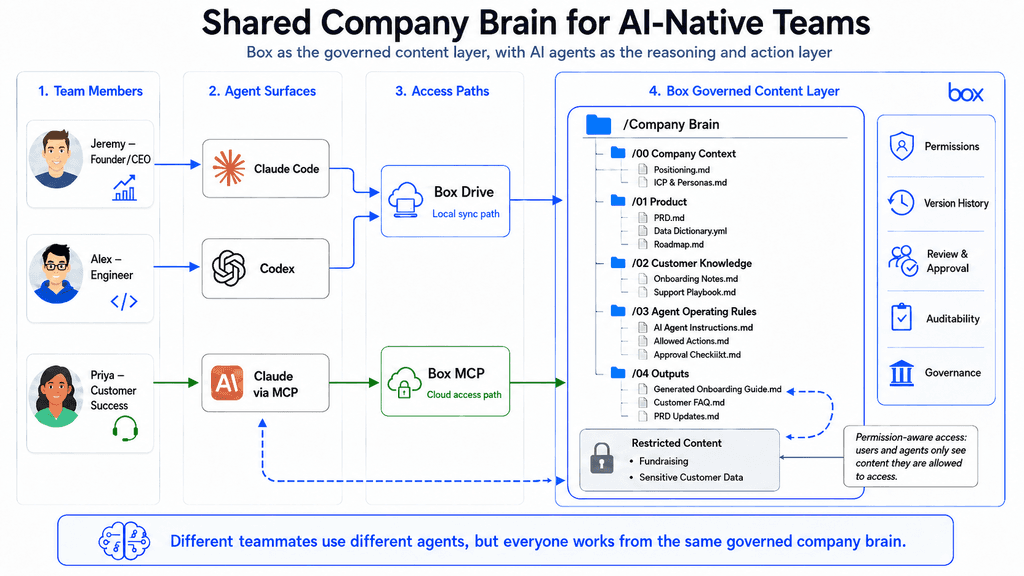
Imagine a small AI-native startup building a triage assistant for CPG brands. The team creates a shared /Company Brain folder in Box. Inside it are folders for company context, product knowledge, customer knowledge, agent operating rules, and generated outputs.
The founder updates a product principle: for retailer deductions under $500, the agent may auto-triage, but it must require human approval before dispute submission.
The engineer opens Claude Code against the Box Drive version of the folder. The agent reads the company brain and updates the PRD, the AI agent instructions, and the human approval checklist. Those changes sync back into Box.
Later, the customer success lead opens Claude connected to Box through MCP and asks for a one-page onboarding guide for a new CPG customer. The guide reflects the latest product decision, uses the current positioning, follows the approval rules, and saves the generated output back to the /Outputs folder.
Agents become the reasoning layer. Box becomes the governed memory layer.
This is the company brain in action. The founder isn’t emailing around a new rule to multiple teammates.
Why this matters
As AI becomes part of everyday work, startups need a place where both humans and agents can safely access, update, and operationalize company knowledge. A shared company brain helps a team operate from the same context - company positioning, personas, product principles etc.
To recap some of the requirements:
- Company brains optimize for team alignment.
- A company brain supports many contributors.
- A company brain requires permissions, governance, and review.
- A company brain should remain a permission-aware source of truth.
The first wave of AI knowledge bases made individuals more productive. The next wave will help entire teams operate from the same trusted context. That shared company brain may become one of the most important operating advantages for AI-native companies.
For larger enterprises, the company brain has another major component: an agent-accessible knowledge vault where curated, structured, permissioned files become the operating memory for AI work. We will explore this in a subsequent post.