Box CEO Aaron Levie has been vocal about the magnitude of the transformation underway in business today:
"With AI, there's not going to be any going back to the way things used to be and how we work. It's just not possible because the efficiency gain between the company that uses AI versus the one that doesn't is just too insurmountable to try and make up for if you're not using these technologies."
There's not going to be any going back to the way things used to be
And yet, most companies are stuck in what McKinsey calls “a proliferation of disconnected micro-initiatives and a dispersion of AI investments, with limited coordination at the enterprise level.” They’ve deployed dozens of tools but aren’t seeing business transformation.
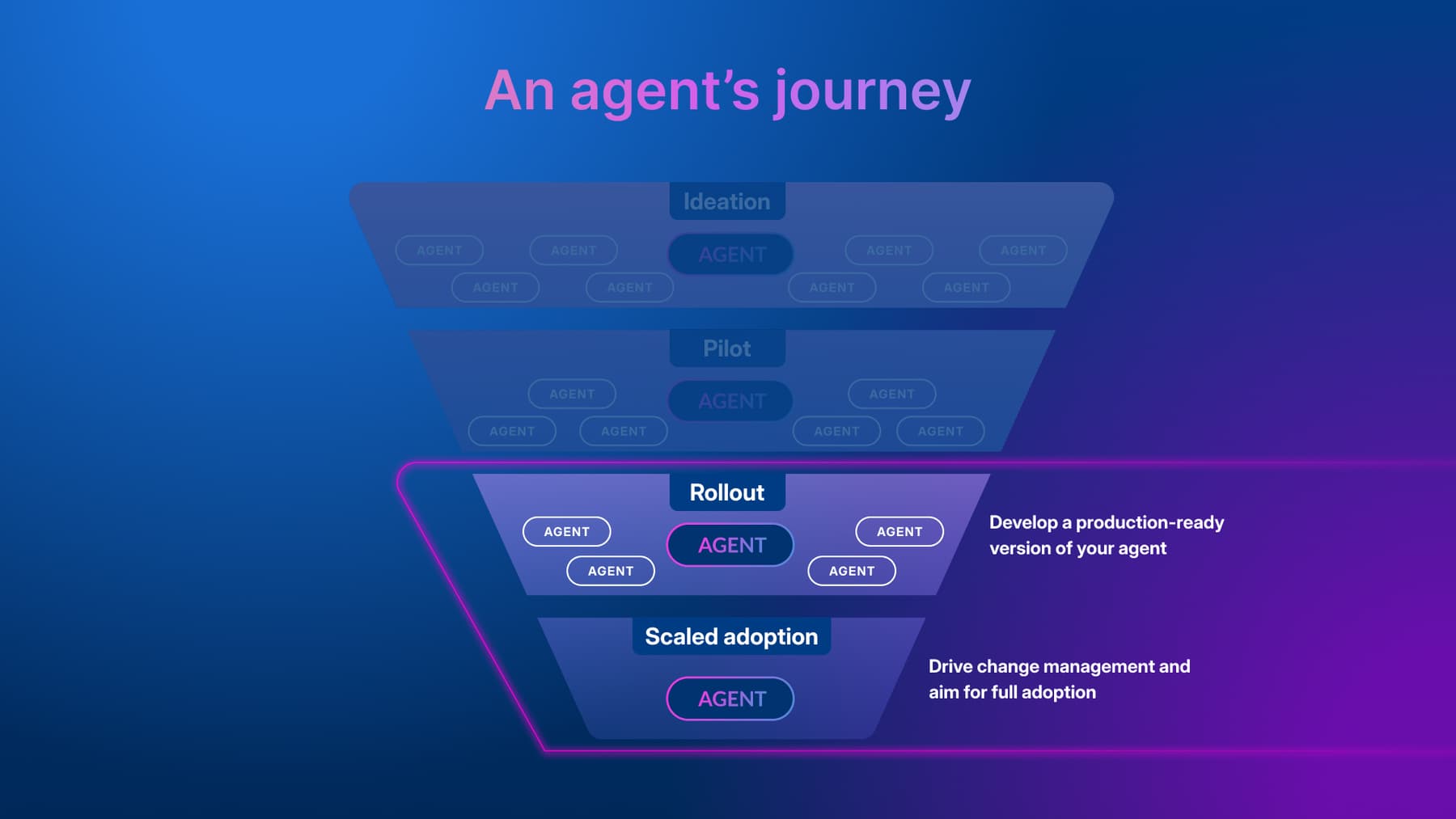
Box took a different approach. We ideated over 100 AI agents across every function, then systematically figured out which are the few "big bets" that will deliver measurable impact and are focused on rolling those out at scale. The result? We’ve transformed how 2,800 employees work across sales, support, engineering, and customer success.
This guide shares our complete methodology—the frameworks for AI principles, governance structures, and value realization that enabled us to move from experimentation to strategic execution.
Ready to identify your AI transformation priorities?
Why AI Principles Come First
Before deploying a single agent, you need clear AI principles. They serve two critical functions:
External credibility. Customers and partners need clarity on how you approach AI security, governance, and transparency—especially when AI touches sensitive enterprise content.
Internal confidence. Your employees are asking: Will AI replace my job? Do I need to become a technical AI expert? What happens to my team? Without explicit answers, fear spreads faster than adoption.
As Olivia Nottebohm, Box’s Chief Operating Officer and one of the key leaders in the company’s AI-first transformation, explains: “This is the most significant technology most people will have experienced in 15 to 20 years. We needed to think about it from a change management perspective, because ultimately AI is an extension of human activity—a capability expander that gives freedom to do things you otherwise couldn’t do.”
We needed to think about [AI] from a change management perspective, because ultimately AI is an extension of human activity
Levie points out that "AI agents both free up people to do more of what they couldn't do before, which will lead to all new work being done. But it also accelerates work in ways that essentially redefines the output expectations."
This dual reality—expansion and redefinition—explains why Box's first principle focuses on AI as a "capability expander" rather than an efficiency tool. The message matters: people need to understand their jobs are changing, not disappearing.
Box's AI Principles
Our principles focus on empowerment rather than "use it or else" messaging:
- AI as a capability expander: AI shouldn't just speed up old tasks—it should open doors to things you couldn't do before
- Human-AI partnership: AI handles routine tasks, freeing employees to focus on innovation and relationships
- AI-native design: Software interfaces must adapt to thousands of intelligent agents running simultaneously
- Strong anchors in data privacy, security, trust, and governance: Systems must enforce strict access controls, even with autonomous agents (core principle: "AI agents can't keep a secret")
- Data as a strategic asset: Successful AI strategy starts with secure data management—accurate capture, thoughtful organization, careful permission enforcement, and continuous updates
How to Build Your Own AI Principles
Follow these four steps:
1. Start with leadership alignment. Before crafting any external messaging, leadership must agree on fundamental positions about AI’s role in the company. This prevents mixed messages that confuse employees and customers.
2. Consider your dual audience. Employees need reassurance about future roles. Customers need confidence in your security approach. Both audiences must see themselves reflected in your principles.
3. Frame transformation positively while addressing concerns. Our principles call for AI use so we can reinvest savings back into the organization. Box teams know this means more time for strategic goals.
4. Make principles authentic to your culture. Another company’s principles won’t resonate with your specific context. Adapt concepts but craft language that reflects your organizational values.
Functionally Owned, with Central Strategy & Support

At Box, we’ve built a governance model where functional leaders own AI transformation for their teams, operating within a centrally-defined strategy and guardrails, and supported by specialized technical teams who can convert ideas into agentic workflows.
Our model has three interconnected parts — executive sponsorship; functional ownership; and the central ‘design and build’ team.
Executive Sponsorship: Central Strategy and Guardrails
Box's AI executive sponsorship is led by Olivia Nottebohm, the company’s COO, Ravi Malick, the CIO, and Jessica Swank, Chief People Officer, to represent business, IT and people aspects — all of which are critical.
“This is really about strategic cohesion and making sure that we’re being efficient and thoughtful about how we deploy AI across the business,” Malick says.
The executive sponsors, supported by an AI Transformation Director, set the strategic direction for Box’s AI-first transformation, making the foundational decisions that enable rapid execution without chaos.
What they do:
- Set strategy, direction, and guardrails for what Box does with AI
- Track progress centrally and drive accountability in execution
- Make final decisions and trade-offs on anything escalated (prioritization of big bets, areas requiring substantial investment)
Key Decisions Executive Sponsors Have Made
Box-first principle for content workflows. “One of our Box AI principles is we should be using our product where we can,” explains Robert Ferguson, Box’s Head of Corporate Strategy & Chief of Staff to the CEO. “This does three things: First, it proves we believe in what we sell. Second, it creates real-world examples we can share with customers. Third, it provides our product teams with immediate feedback from customer zero.”
This isn’t dogmatic. Box readily adopts third party AI tools where they excel (Cursor for coding, specialized platforms for support automation). But for content-centric workflows, Box uses Box.
‘Big Bets’ focus for 2026. “The recognition that we need to pick some big bets enables us to focus our resources and executive sponsorship in areas we think AI will have the greatest impact,” Ferguson notes. “We’re not saying stop ideation. But we are asking our functional leaders to prioritize which ideas will have the highest impact and to deprioritize those that may only solve a small problem for a handful of people.”
This shifted resources from distributed experimentation to concentrated impact. Instead of 100 agents getting 1% better, Box is now investing in making a more focused set of 15 - 25 agents production-ready with training, integration, and change management support.
We are asking our functional leaders to prioritize which ideas will have the highest impact and to deprioritize those that may only solve a small problem for a handful of people.
More on how Box ideated over 100 agents to a consolidated list of key ‘big bets’ in the next article in this series.
Saying ‘no’. To ensure the best possible change management, the executive sponsors work with the functional leaders to explicitly decide what not to pursue. Systematically teaching people how to leverage select key agents has way more impact than building and instituting hundreds. This mindset provides air cover for functional leaders to decline requests outside their big bets without seeming unresponsive.
Ready to identify your AI transformation priorities?
Functional Ownership: Leaders and AI Managers
"We want to empower functional leaders to think holistically about outcomes needed from their team”, Nottebohm explains. “So they're thinking "OK, I want my lead generation team to be successful and help deliver the business. My SDRs can create pipeline now, but they could create even more pipeline if I can teach them how to effectively manage and prompt agents.""
My SDRs can create pipeline now, but they could create even more pipeline if I can teach them how to effectively manage and prompt agents.
Functional leaders are therefore responsible for mapping out what AI support they envision that will help them reimagine their function and achieve more.
Then AI Managers in their team are assigned to manage AI agents that have been piloted and deployed, drive adoption and sharing feedback to optimize agents with the AI Agent Build/Central Solutioning team.
What Functional Leaders do:
- Propose "big bets" for their function based on business priorities
- Define "team outcomes" for what they need their teams to do by leveraging agents
- Set ambitious business goals that leverage AI capabilities
What AI Managers do
- Own adoption and change management within their teams
- Provide feedback loops to improve the agents, creating new and different agents over time
Ferguson emphasizes "We want the functional leader to be in the driving seat, because ultimately they're leading a team. It just so happens that part of their team will be agents. They understand the business goals, they know what good work looks like, and they can make the tradeoffs."
We want the functional leader to be in the driving seat, because ultimately they're leading a team.
This creates new strategic questions to be addressed:
- Capacity planning: If an agent handles first-response customer support with 50% deflection, how does that change the need for future headcount?
- Organizational design and role requirements: How do we evolve roles to manage agents — e.g., validate output, troubleshoot, and map out for our Employee Success team what data pipelines to connect — or to focus on new, higher-value activities that were not previously possible (e.g., covering more customers, conducting new analysis)
- Design new processes altogether: Work can be done fundamentally differently with AI agents. What’s the optimal way to design workflows around the capabilities of AI?
- Budget allocation: How do you balance investment between training people, licensing agents, and building integration infrastructure?
- Performance management: When a process involves both human and AI contributions, how do you evaluate individual performance?


Design & Build Team: Building at Scale
Not every AI agent requires centralized development. AI Managers and their teams at Box can build many agents directly using Box’s AI Studio. A copywriter agent that drafts social posts, for example, can be built and maintained entirely within a marketing team.
But certain agentic systems require a different approach. This is where Box's Design & Build Team steps in.
When to Build Centrally vs. Within Functions
AI Managers build directly when the agent serves a single function's workflow and doesn't require integration with multiple enterprise systems. These are typically straightforward use cases that can be fully realized within AI Studio's capabilities.
The Design & Build Team steps in when multiple functions need to leverage the same underlying capability, when complex enterprise system integrations are required (like Salesforce, GCP, or data warehouses), or when the workflow involves multiple teams or cross-functional processes.
As Robert Ferguson explains: "The line isn't about complexity for its own sake—it's about economies of scale and technical requirements. If six different teams need account research capabilities, we shouldn't have six teams each building their own version. And if an agent needs to pull data from Salesforce, our data warehouse, and Box while writing back to multiple systems, that requires technical expertise that most functional teams don't have and shouldn't need to develop."
If six different teams need account research capabilities, we shouldn't have six teams each building their own version.
What the Design & Build Team Does
This cross-functional team—combining expertise from Enterprise Solutions, IT, and functional leaders like Nora Soza—handles the "how" for complex agentic systems:
- Determine which capabilities should be centrally built versus functionally owned, ensuring agents are designed for reuse across functions
- Build production-grade agents with enterprise system integrations that can scale across the organization
- Advise AI Managers on what's possible and practical, providing frameworks for when to build in AI Studio versus request central development and creating templates and patterns that functional teams can adapt
This structure solves the critical scaling challenge Ferguson identified: "Functional teams are essential in driving what agents get built and ensuring they solve real problems. But the work to scale from pilots to enterprise-wide deployments sometimes needs a team focused solely on that - whether it is to bring the technical expertise required for complex integrations or to serve as the central project manager for agents that are truly cross-functional in use."
The result: AI Managers maintain ownership of the "what" and "why" while the Design & Build Team handles technical complexity, enabling the organization to move faster without duplicating effort.
Avoiding New Bureaucracy: Adapting Existing Processes
Box's governance model intentionally avoids creating new approval bodies or bureaucratic layers. Instead, existing processes adapt to include AI as a regular part of the tech stack.
Legal, GRC, and Cybersecurity teams update Box's AI acceptable use policy and guidelines for existing internal approval processes for third party tools to cover AI-specific risks.
Procurement follows the same approval avenues for significant third party AI tool spend as for existing software, with recognition that Box is also in a period of experimentation with some tools.
The key principle: Empower functional leaders to drive transformation within clear guardrails, supported by specialized expertise—without creating new layers of approval or bureaucracy.
Finding Your Big Bets: The 2x2 Framework
With principles established and governance in place, how can functional leaders and AI Managers decide which ‘big bets’ to focus on?

Box uses a prioritization framework that plots opportunities on two dimensions:
- Repeatability: How often does this task or workflow occur?
- Critical Thinking Required: How complex is the judgment or decision-making?
The sweet spot—high on both dimensions—identifies your highest-ROI opportunities. These are complex decisions that happen frequently enough to matter.
A lead gen agent that performs sophisticated data analysis but executes dozens of times per day delivers far more value than a rarely used tool, no matter how impressive.
This framework forces explicit prioritization. If you could only deliver 2-3 initiatives next quarter, which occupy the upper-right quadrant of your matrix?
Ready to identify your AI transformation priorities?
Three Value Areas for AI Impact
Box focuses value realization across three areas, each with distinct ROI characteristics:
Area 1: Productivity (Agents help people work faster)
Productivity improvements accelerate existing work without changing process structure. Agents function as assistants while humans maintain decision authority and final review.
Example: Box’s sales RFP assistant reduced response time from two days to four hours—a 90% time reduction. Professional services teams generate statements of work 35% faster.
The evaluation framework: What high-volume, repeatable tasks consume disproportionate time relative to value created? Every organization has productivity drains where capable professionals spend hours on work that doesn’t require their expertise.

Area 2: Automation (Agents oversee entire processes)
Value comes from ratio changes—agents handling dramatically more volume with the same team size.
Example: Box’s customer support deflection agent handles 50% of inbound questions without human intervention. This doesn’t just save time; it fundamentally changes the support equation. The same team can handle dramatically more work.
The key question: What complete workflows can run autonomously with human oversight rather than involvement?
Area 3: Net-New Capabilities (Unlocking the previously impossible)
This tier enables capabilities that didn’t exist at any headcount or budget level. Value emerges from new revenue streams, market access, or strategic advantages.
Example: Box’s lead generation agent analyzes customer usage patterns, freemium conversion signals, and engagement data to generate targeted outreach recommendations—work that previously required SQL expertise, data warehouse access, and hours of analysis per account. Now any SDR accesses equivalent insights conversationally in seconds.
This represents capability redistribution, not productivity improvement. When any sales rep can perform advanced data analysis, what happens to specialized analyst roles?
The evaluation framework: What becomes possible that was impossible before, not merely harder or more expensive? Focus on constraints beyond time—expertise, language, geographic presence, analysis complexity.

Next Steps: Your AI-First Transformation
Box’s transformation from fragmented experimentation to strategic execution required:
- Clear AI principles that address both external stakeholders and internal anxiety
- AI Transformation Council governance, setting the strategic direction for Box’s AI-first transformation, and making the foundational decisions that enable rapid execution without chaos.
- Functional leaders and AI Managers responsible for defining where agents should be deployed across the business
- Central Solutioning team responsible for building and maintaining agentic systems at production scale
- Prioritization discipline using the 2x2 framework to identify big bets
- Three-tier value framework distinguishing productivity, automation, and net-new capabilities
The journey has revealed that AI-first transformation requires more than technology deployment. It demands systematic frameworks that prevent fragmentation while enabling velocity.
*This is the first article in our six-part series on Box’s AI-first transformation. Upcoming articles will cover ideation methods, piloting best practices, scaling transitions, adoption culture, and success metrics—each with practical templates and frameworks you can implement immediately.
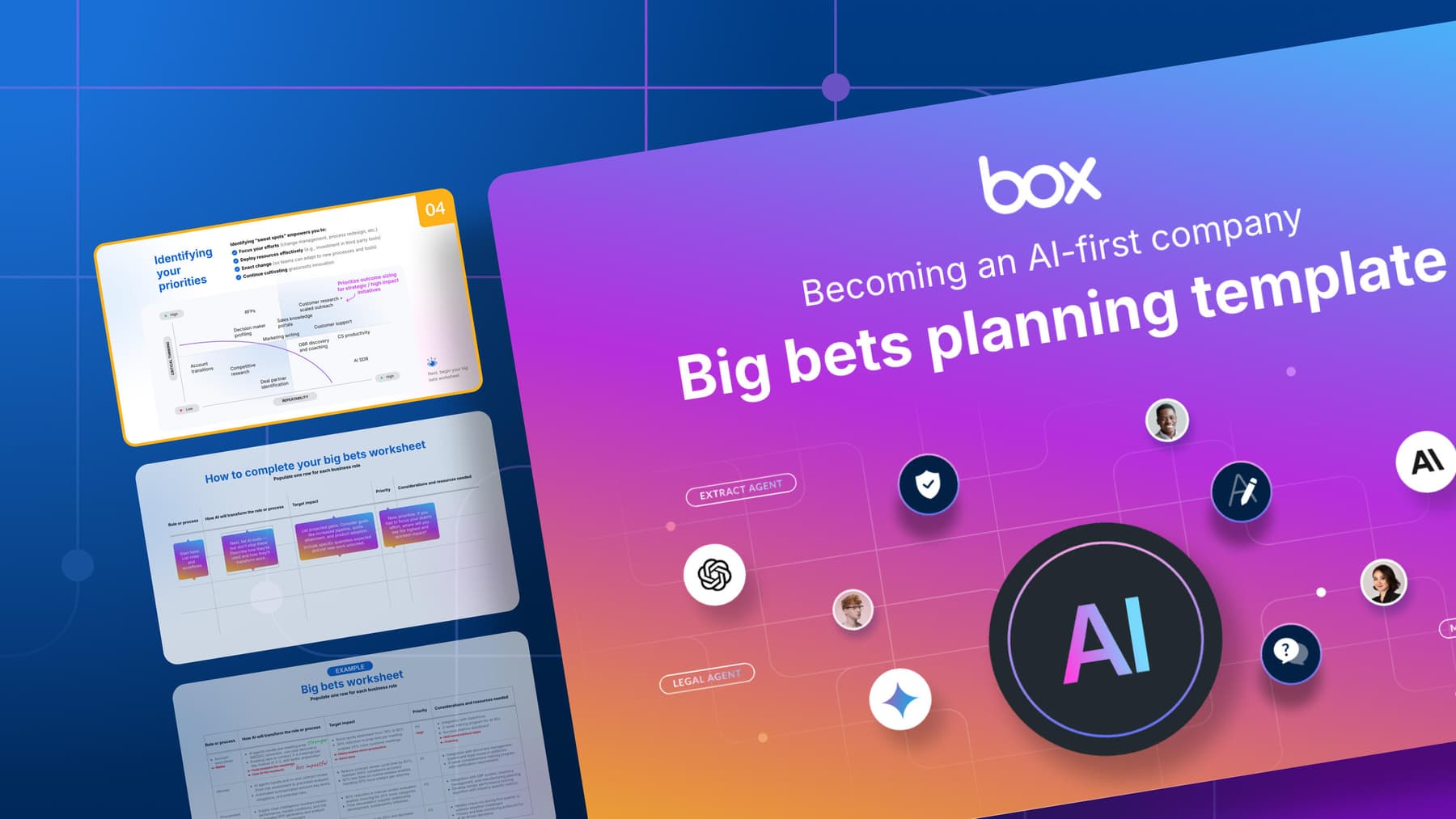
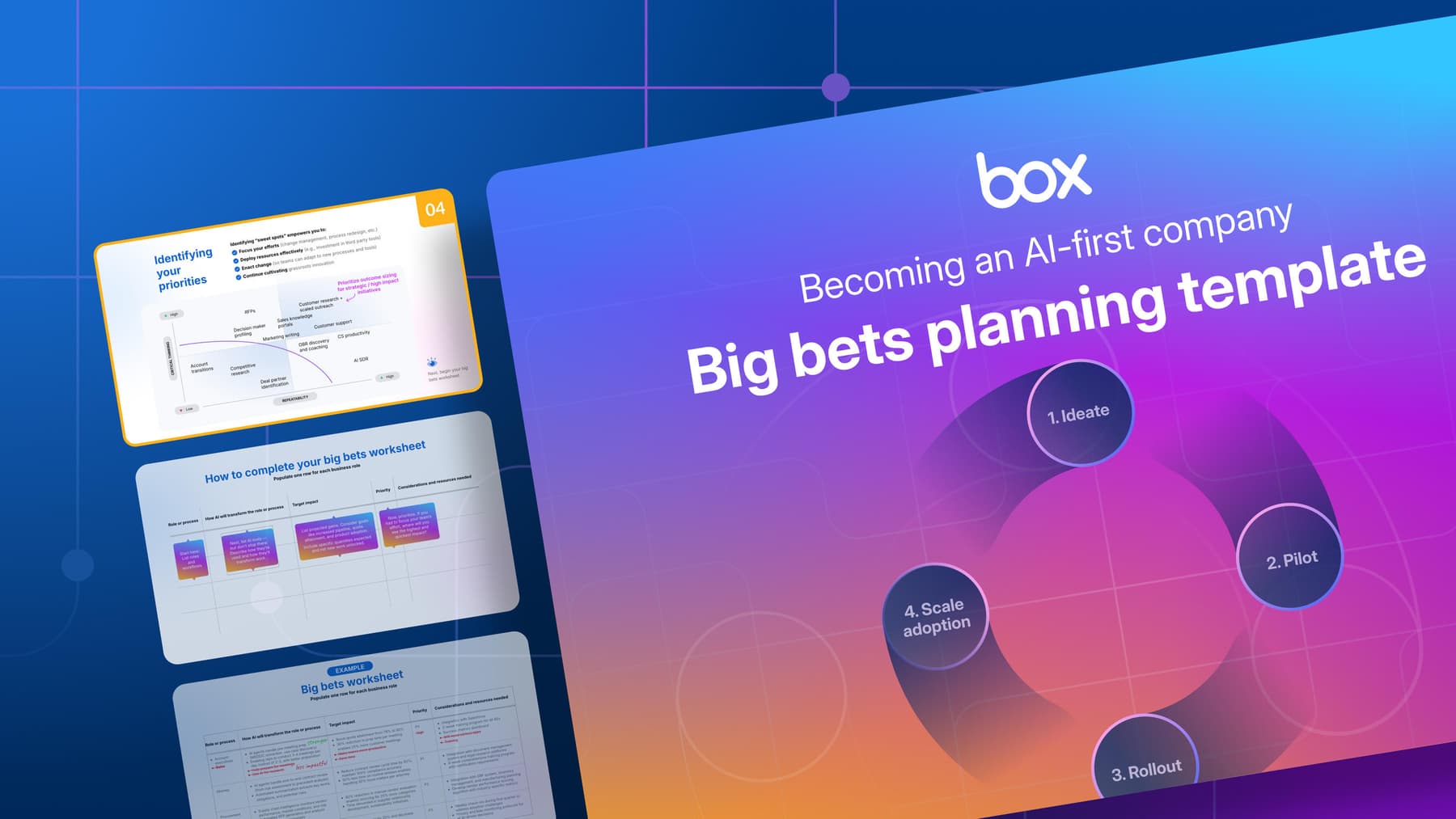
Download your 2x2 AI framework chart and resources pack here, and be signed up to learn when our next article in this series is released.