Life sciences organizations are under constant pressure to accelerate innovation, collaborate across complex ecosystems, and bring new therapies and products to market efficiently. At the same time, they must manage increasing volumes of regulated and unstructured content while maintaining adherence to strict regulatory standards like 21 CFR Part 11, HIPAA, and GxP.
Content is often distributed across legacy repositories, on-premises systems, shared drives, email, paper-based processes, and disconnected point solutions. This fragmentation makes it harder for employees and external partners to find the right information, complete critical workflows, maintain inspection readiness, and apply AI responsibly.
Rather than replacing every system of record, Intelligent Content Management provides a secure content and collaboration layer that works alongside existing clinical, research, manufacturing, regulatory, and commercial systems. It helps teams manage and act on content such as protocols, investigator and site files, quality records, batch documentation, contracts, audit materials, research documents, and commercial content.
A secure, governed content repository with built-in automation capability enables your team to apply AI to workflows without jeopardizing your content or your trials.
Key insights:
- Unify regulated and non-regulated content across research, clinical, quality, manufacturing, regulatory, and commercial teams.
- Strengthen collaboration and compliance with governed access, automated workflows, approvals, e-signatures, retention, and audit trails.
- Make unstructured content AI-ready with permission-aware search, extraction, summarization, and purpose-built AI agents.

Securely unify all your content to accelerate compliant collaboration
One of the most significant barriers to clinical operational excellence has always been content management. Siloed content repositories running on legacy systems, on-prem servers, manual email-based handoffs, paper-based processes, and a disjointed patchwork of point solutions slow down study startup, site monitoring, and investigator onboarding
Intelligent Content Management brings this content together in a centralized, secured, AI-ready content that accelerates trial execution and R&D by enabling seamless, compliant collaboration across research teams and external partners: sponsors, CROs, principal investigators, study coordinators, regulatory bodies, and more.
Teams can apply consistent metadata, permissions, retention policies, and audit trails while continuing to work with the systems and applications already in place.
This creates a trusted foundation for employees and external partners to access the information they need, complete workflows more efficiently, and maintain control over sensitive and regulated content.
Enable secure collaboration with external partners
Life sciences organizations collaborate with a wide range of external stakeholders, including CROs, CDMOs, clinical research sites, investigators, suppliers, manufacturing partners, and regulatory bodies. These relationships often involve sensitive, regulated, and time-critical content.
Intelligent Content Management enables organizations to create secure, governed workspaces for external collaboration. Granular permissions, controlled sharing, version history, automated workflows, and audit trails help teams exchange documents while maintaining visibility and control.
These capabilities can support clinical site exchange, CRO onboarding, remote site monitoring, manufacturing collaboration, supplier management, technology transfer, and post-merger integration.
Transform your e-signature and approval workflows with 21 CFR Part 11 Box Sign
Box is designed to manage the entire lifecycle of clinical documentation, including protocol sign-offs, site feasibility agreements, and patient consent forms (eConsent). With Box Sign natively supporting FDA 21 CFR Part 11–compliant electronic signatures and signature logs, clinical leads can eliminate manual paper handling, speed up site activation cycle times, and ensure a tamper-proof audit trail for every signed record.

Support regulated workflows across the organization
Regulated work often depends on the movement, review, approval, and retention of content across multiple teams and organizations. Intelligent Content Management helps automate these document-intensive processes while supporting governance and compliance requirements.
Common life sciences use cases include:
- Clinical study startup and site collaboration
- Investigator site file and trial master file management
- Remote site monitoring
- Quality management and virtual inspections
- GxP records archiving
- GMP manufacturing and batch documentation
- CDMO and supplier collaboration
- Regulatory and promotional content review
- Research and development collaboration
- Post-merger integration
Maintain continuous inspection and audit readiness
Inspection readiness is an ongoing operational requirement for life sciences organizations. Teams need to locate the right records quickly, demonstrate appropriate access and approvals, and show that content has been managed according to required policies.
Intelligent Content Management supports inspection readiness through centralized content, structured metadata, retention policies, version history, access controls, audit trails, and automated workflows. Quality and regulatory teams can organize audit materials, prepare controlled workspaces, and collaborate with internal and external stakeholders without losing governance.
This approach can help reduce manual preparation and make audit and inspection activities more repeatable and manageable.
Apply AI to governed life sciences content
Life sciences organizations have large volumes of valuable information stored in unstructured formats, including protocols, site documents, quality records, batch documentation, audit materials, contracts, research content, and commercial assets.
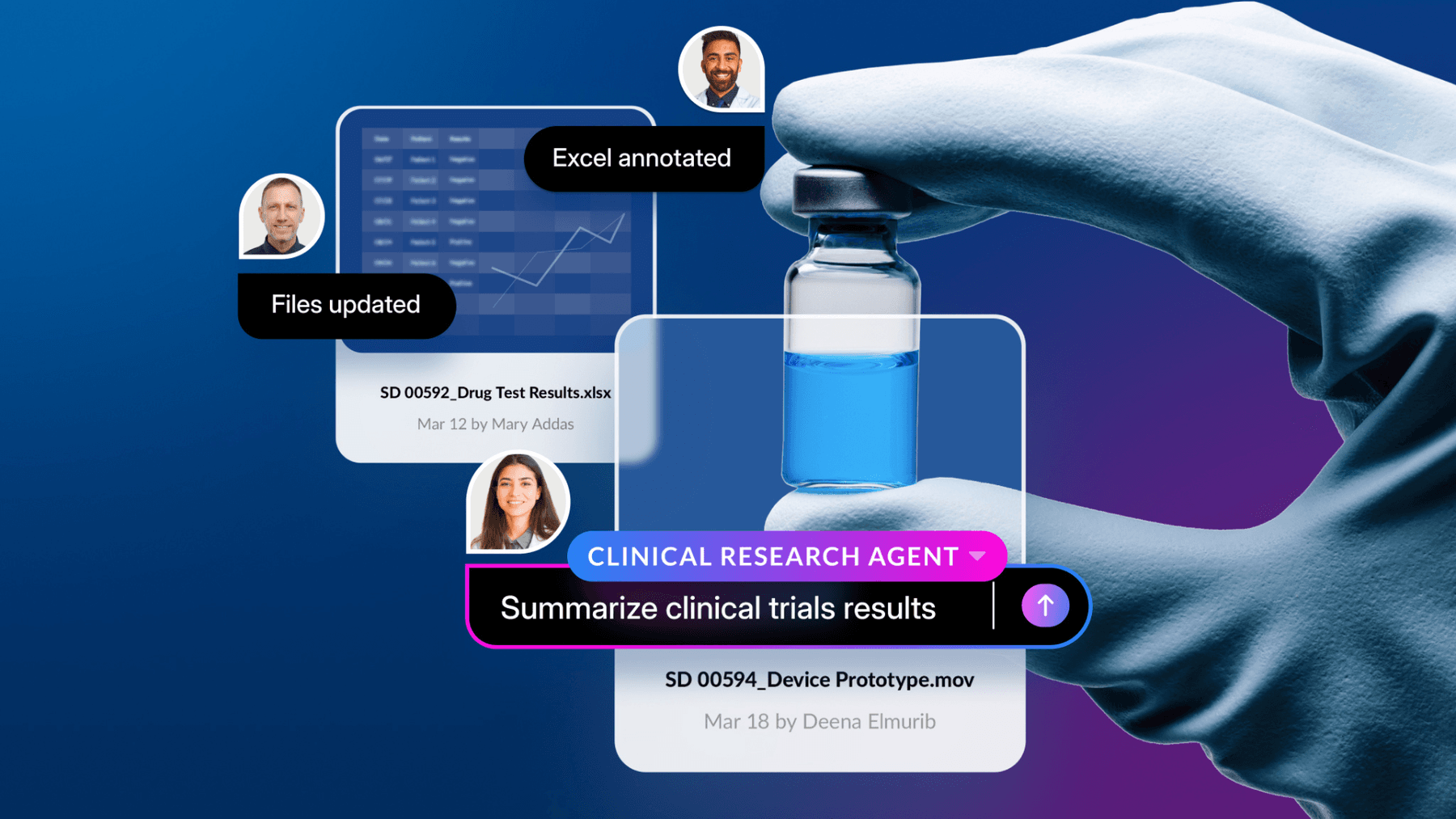
Box AI helps teams work with this content while respecting existing permissions and governance controls. Teams can extract key information, summarize documents, ask questions across approved content, identify relevant records, and automate next steps.
Purpose-built AI agents can support functional workflows such as research, quality, clinical operations, manufacturing, and regulatory review. Human oversight remains central to decision-making, particularly for regulated processes.
AI use cases
- Extract information from unstructured documents. Extract key information from protocols, investigator documents, quality records, batch records, contracts, and other content to reduce manual review and improve findability.
- Automate document intensive work: Use structured information and AI-generated insights to trigger follow-ups, route approvals, support review processes, and improve visibility across teams and external partners.
- Make unstructured content AI-ready: Ask questions across governed content, summarize large document sets, and surface relevant information while maintaining appropriate governance, permissions, review processes, and auditability.
Intelligent Content Management for life sciences innovation
Intelligent Content Management gives life sciences organizations a secure, governed foundation for collaboration, automation, and AI. By connecting content and workflows across research, clinical, quality, manufacturing, regulatory, and commercial teams, organizations can reduce friction and make critical information easier to manage and use.
Box works alongside existing systems and helps organizations support a wide range of use cases, from clinical site exchange and study startup to quality inspections, GxP archiving, GMP manufacturing, commercial content review, and post-merger integration.
With content at the center, life sciences teams can collaborate more securely, strengthen compliance, and move innovation forward with greater speed and confidence.
Ready to accelerate your clinical study startup and optimize CRO collaboration? Learn more about Box for life sciences.