Government agencies face an unprecedented challenge.
Citizens expect modern, efficient services powered by AI, yet the sensitive nature of government data demands uncompromising security. The tension between innovation and protection has left many agencies to watch private sector transformation from the sidelines.
The solution isn’t choosing between AI and security. It’s building a foundation that enables both. Recent conversations with federal, state, and local leaders at the Box Public Sector Virtual Summit reveal five critical strategies that allow agencies to leverage AI’s transformative power while maintaining the compliance and trust that citizens deserve.

1. Build a secure foundation first — AI depends on it
Government leaders know that digital transformation requires more than adding AI tools to existing systems. At the Box Public Sector Virtual Summit, Box CEO Aaron Levie described the need for a secure foundation that unifies content (documents, files, spreadsheets, images, videos) into a single platform, so teams can:
- Add structure to unstructured data
- Apply appropriate governance and permissions
- Ensure workflows remain auditable and compliant
- Select high-assurance models when needed
This approach allows agencies to leverage AI capabilities without compromising security or regulatory requirements.
Get more insights on powering the public sector with AI in Box CEO Aaron Levie’s Summit keynote.
Moreover, deploying AI-powered search across all your content (with role-based access controls) helps teams find important information faster, Conrad said.
Watch the “Demystifying AI session” to see how easy it is to build an AI agent with Box
2. Deploy workflow agents that prioritize security and human oversight
With proper controls, AI agents can dramatically reduce manual work — but government operations still demand human oversight at critical decision points.
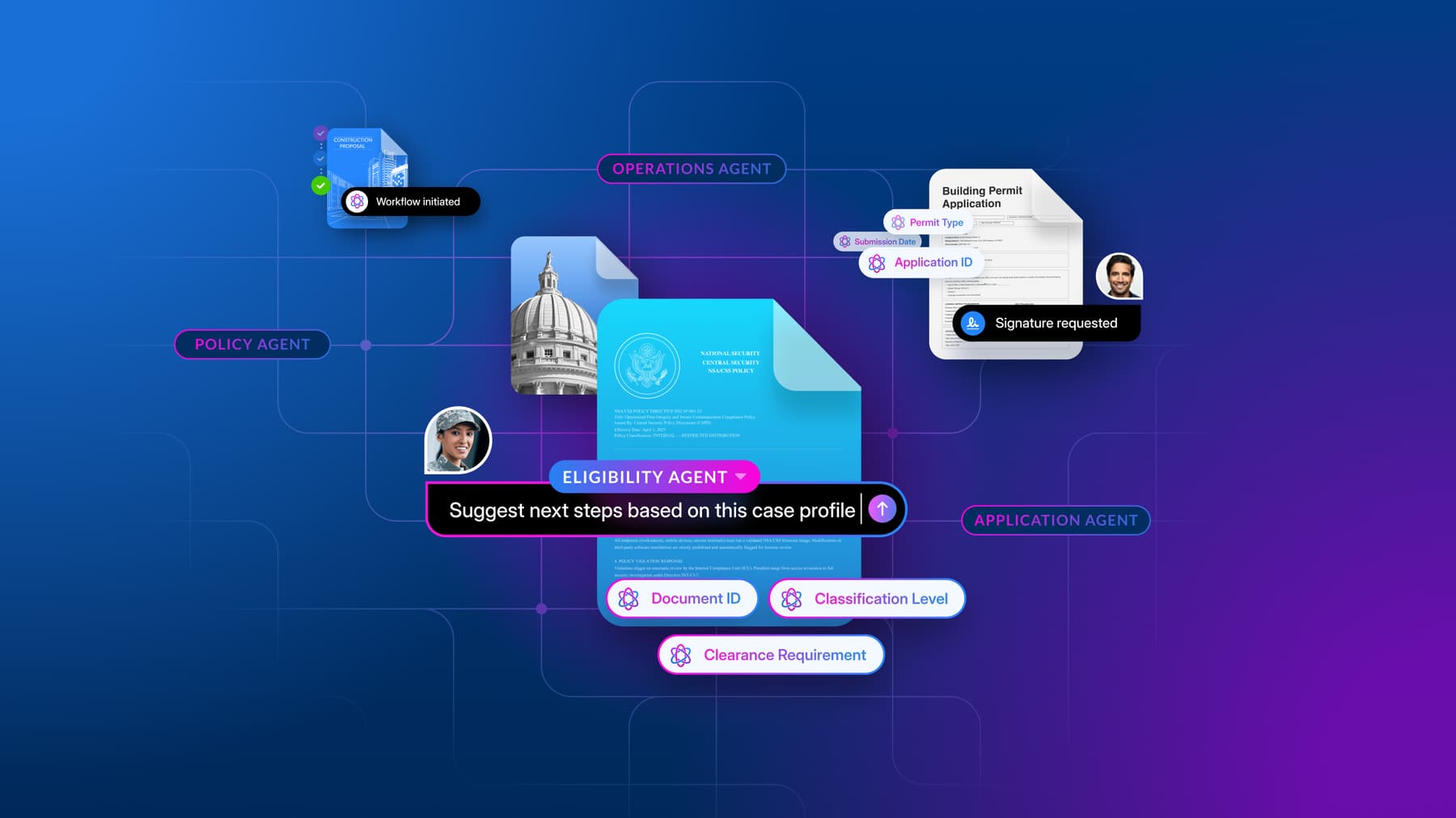
At the Public Sector Summit, Brett Conrad, VP of Public Sector Sales, shared three types of Box agents that help the public sector drive successful implementations while preserving accountability:
- Extract agents: Convert unstructured intake (PDFs, images, audio, video) into structured metadata with confidence scores and human review
- Compose agents: Draft policy documents from approved knowledge bases with proper source citations
- Research agents: Summarize file collections, answer questions across case libraries, and search millions of records
These capabilities allow non-developers to configure appropriate workflows with permissions that ensure repeatable, auditable outcomes — essential for government accountability.
Moreover, deploying AI-powered search across all your content (with role-based access controls) helps teams find important information faster, Conrad said.
Watch the “Demystifying AI session” to see how easy it is to build an AI agent with Box
3. Know that you don’t have to sacrifice compliance for speed
The need to trade speed or efficiency for compliance no longer exists.
Government agencies often struggle with the tension between speed/introducing modernized workflows and compliance. But modern platforms improve efficiency by orchestrating entire processes — from intake to archival — and can stay within compliance boundaries while dramatically reducing processing times. Speakers at the Summit shared use cases that demonstrated how:
- Drag-and-drop workflow tools combine AI and human tasks with branching logic and notifications
- Multi-week processes can be completed in minutes while preserving audit trails
- Document generation integrates with e-signature and immutable archiving for records retention
This approach helps agencies meet citizen/business owner/resident expectations for faster service without sacrificing the governance requirements that protect public trust.
See a federal and state/local government use case
4. Customize AI solutions to suit your agency’s needs
Rather than generic AI implementations, agencies need solutions that speak to some of the unique challenges they face:
- Federal investigations: Secure evidence repositories with automated metadata extraction and full chain of custody logs
- Permits and citizen services: Smart forms reduce incomplete submissions; extraction agents convert intake into structured data
- Contract analysis: AI tools extract key clauses, payment schedules, and risks; dashboards help avoid missed renewals
- HR, benefits claims, and FOIA processing: Classification and AI-assisted review reduce manual work and error rates
These examples demonstrate how AI can be applied to improve specific government processes rather than as a one-size-fits-all solution.
See use cases in action in the Federal and State and local contextualized sessions
5. Choose solutions that make protection and trust integral, not optional
Security cannot be an afterthought in government technology implementations.
The Summit highlighted how protection, compliance, and trust must be built into every aspect of content management and AI deployment. These capabilities ensure that agencies can innovate while maintaining the high standards of security and compliance that citizens expect from their government:
- AI-driven classification and enforcement of access controls
- Ransomware and insider threat detection
- Metadata tools that power retention, searchability, and FOIA readiness
- Transparent AI outputs with citations and source links
- Permission boundaries that prevent context leakage
Customer perspectives
Government leaders shared firsthand experiences in implementing modern content management solutions. These real-world perspectives provide insights into both challenges and successes:
- City of San Jose CIO Khaled Tawfik and Muhammad Bajwa, VP of Consulting Services Teknita (winner of the Box Public Sector Partner of the Year award) noted that modernizing legacy records systems enables frictionless public access to centuries of searchable records
- The GovAI Coalition (co-founded by Khaled Tawfik) has worked on shared policies and best practices (now adopted by 200+ agencies) which demonstrate the power of cross-agency collaboration
- Former federal CIO Jason Gray shared perspectives on operational pain points across large, distributed missions and how unified platforms can reduce administrative overhead
These stories highlight the practical benefits of modernizing content management in government settings.
Your pragmatic roadmap to implementation
Implementing new technology in government requires careful planning. A methodical approach helps agencies balance innovation with risk management, ensuring new technologies enhance (rather than disrupt) critical government services — a sentiment shared by many Box experts across all sessions featured at the Summit.
By balancing compliance and agility, agencies can reduce manual work and improve citizen outcomes while maintaining security and transparency, ultimately delivering better service to the public.
Here’s what a practical roadmap to improve your content + AI strategy might look like:
- Start with a focused pilot to demonstrate cycle time improvements and measurable ROI
- Use prebuilt solutions first, then customize for your specific needs (see how with Box AI Studio)
- Ensure security is built in to your content platformwith flexible options and multiple AI models for different types of data
- Embed governance from day one with retention, legal holds, and access policies
- Integrate with existing systems (ServiceNow, Salesforce, Workday, etc.) to avoid data fragmentation
Intelligent Content Management from Box can help. Watch the Summit to learn more and see examples in action.