For state and local government agencies, the promise of AI feels both urgent and uncertain — according to a recent MIT study, only a third of internal AI pilots ever reach production. Agencies that build on a secure, unified content foundation can harness AI to deliver real results without sacrificing compliance or public trust.
At the recent Box State and Local Government Summit, agency leaders, technology partners, and Box experts came together to address this challenge head on. Here are five key strategies that emerged to help state and local agencies move from experimentation to measurable outcomes.
1. Unify your content to unlock AI's potential
AI is only as powerful as the data it can access. Yet most agencies struggle with content scattered across legacy systems, network file shares, and siloed platforms, making it nearly impossible to leverage for AI. Organizations need to consolidate their fragmented systems to prevent AI and AI agents from accessing outdated or incorrect content.
The solution is a unified content platform that brings structure to unstructured data, applies consistent governance and permissions, and ensures workflows remain auditable. This is the necessary foundation to make AI efforts trustworthy.
2. Start with Real Problems, Not Technology Experiments
One of the Summit's most candid discussions came from the partner panel featuring leaders from AWS, Salesforce, and Carahsoft. The consensus? Pilots fail because they start as experiments rather than operational transformation efforts.
"The pilots that succeed tend to follow a different journey," explained Shashi Rao from AWS. "They start with a real operational problem, not just a technology test."
Nadia Hansen from Salesforce emphasized the importance of defining outcomes upfront: "What is the outcome we're trying to solve for? If we implement AI, it's going to reduce processing time, increase efficiency, and allow constituents to get services quickly."
Dilshad Albert from Cloud SynApps shared, "We have AI pilots where out of the gate the expectation is 100% accuracy. But it's a pilot," Albert cautioned. He encouraged agencies to use AI to identify data inconsistencies rather than shelving projects when imperfections emerge. "Don't shelf the project because of those discrepancies. Use that to address that and fix that issue."
The panel identified high-impact starting points that work well in government: automating paper forms, pre-filling applications, streamlining document intake, and enabling AI-powered search across case files.
3. Automate workflows designed to keep humans in the loop
Government operations demand accountability. AI can dramatically reduce manual work, but government workers know critical decisions still require human oversight.
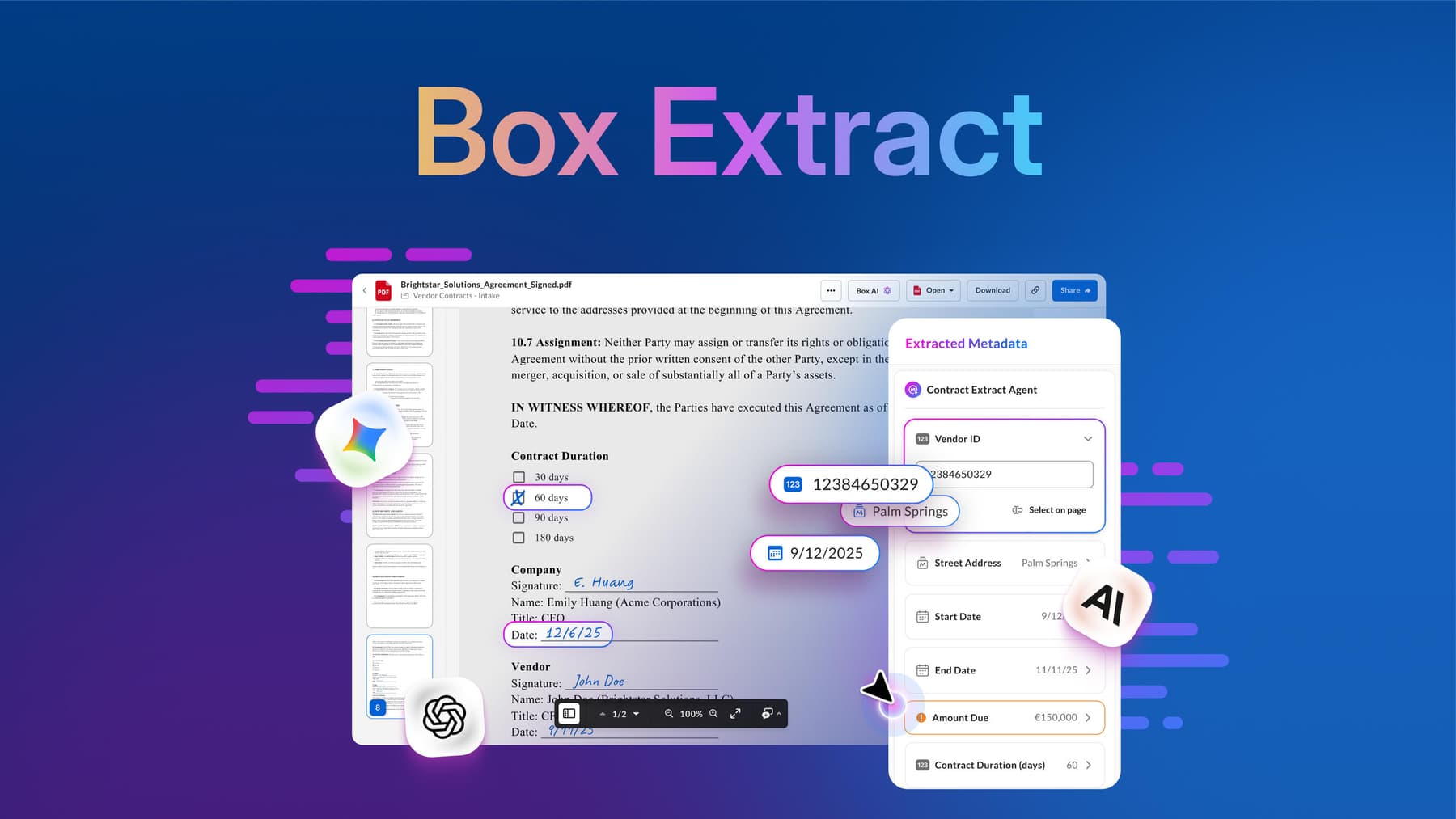
The Summit's claims management demo showcased how agencies can transform claims management from intake to final determination. When a SNAP benefits applicant submits a benefits application, Box automatically creates standardized folder structures, extracts key data from uploaded documents, and routes signature requests — all while preserving complete audit trails.
For eligibility caseworkers, Box AI acts as a force multiplier. Rather than manually cross-referencing applicant documents against dozens of pages of policy guidelines, caseworkers can ask questions directly and receive answers grounded in both case files and official policy (complete with citations).
"Box AI isn't making the decision," the demo emphasized. "The caseworker is. What AI is doing is helping them quickly generate clear, consistent documentation that references the evidence and policy guidelines."
4. Build security and governance in, don’t bolt it on
For agencies handling sensitive constituent data, security cannot be an afterthought. The Summit highlighted how protection, compliance, and trust must be embedded into every aspect of content management and AI deployment.
Will Monahan, CISO at the Georgia Department of Community Health, shared how his agency is rolling out Box AI while maintaining rigorous security standards. "We have a policy for artificial intelligence. We're providing training to our team members... Human in the loop, just the basics."
Georgia DCH is leveraging Box Shield Pro to automatically classify sensitive documents at scale. "In the military, more often than not, a human [has to say if something is] top secret material," Monahan explained. "Box Shield Pro can do it at scale. And when we do that, our protections get better too."
The key insight: When you have your unstructured content in a secure solution with proper data classification driving fine-grained access controls, you can enable AI with confidence.
5. Think big, start focused, standardize for scale
The City and County of Denver offered a masterclass in Intelligent Content Management. Tara Segura, Denver's Data Protection Officer, described how her team approached Box implementation with both ambition and discipline: "One of the biggest foundational decisions you can make is to be thoughtful at implementation," Sagara advised. "Don't be afraid to think big. By being able to take that step back and look at the use of a tool across the government environment, you can create something scalable."
Denver's approach involved understanding business needs across multiple agencies before implementation, then standardizing where possible while accommodating unique requirements. The result: reduced risk, improved efficiency, and a platform that enables, rather than restricts, innovation.
On AI adoption, Segura emphasized the importance of having approved tools ready for staff: "The day after the Super Bowl, our team got inundated with requests for AI tools. Having solutions like Box AI available really prepares us to meet end user needs in the moment."
By balancing compliance and agility, agencies can reduce manual work and improve constituent outcomes while maintaining the security and transparency that public trust demands.
Stream the Summit to see demos, hear customer stories, and get the practical guidance you need to transform how your agency serves the public.